
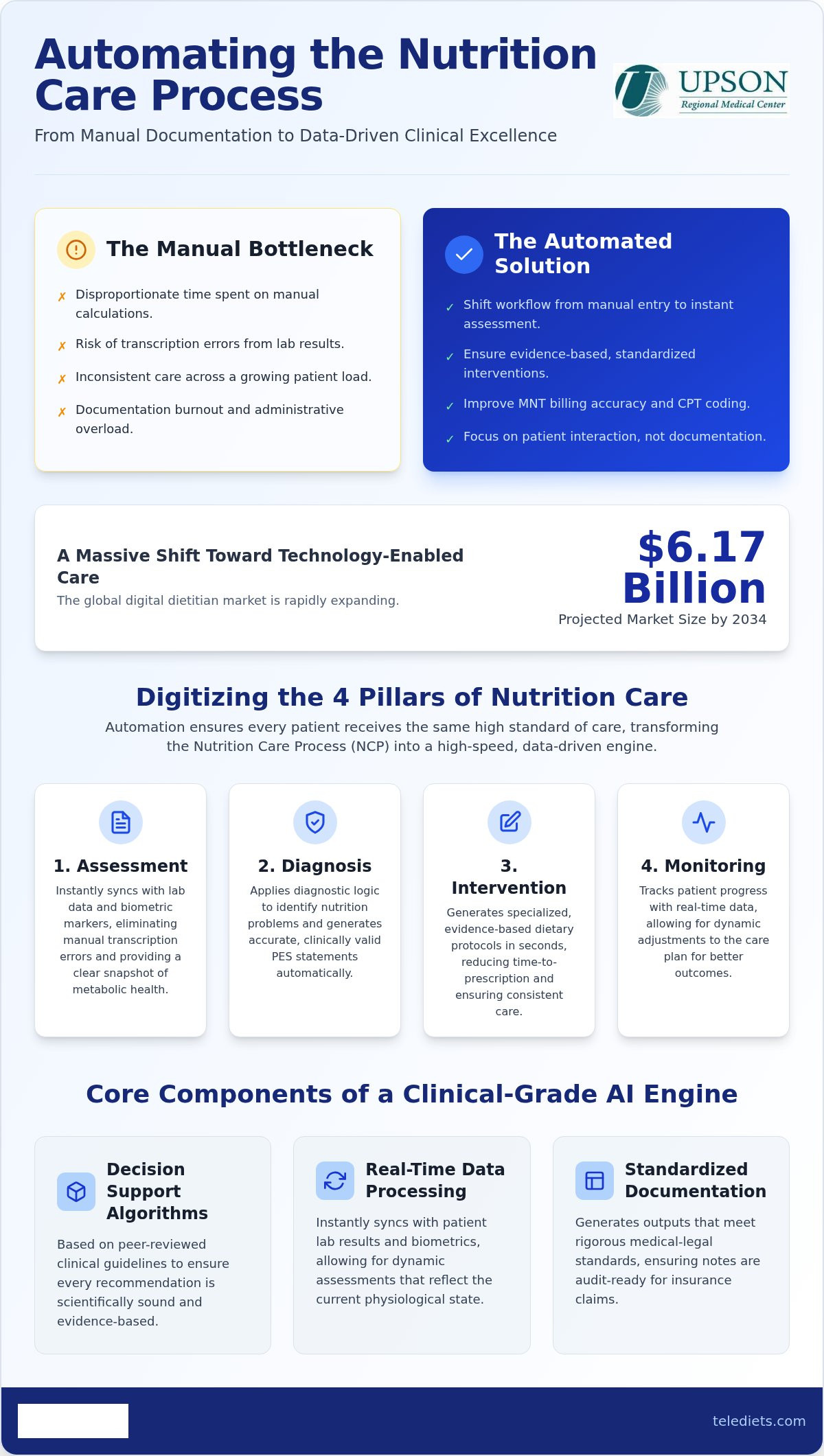
Clinical excellence shouldn’t be held hostage by the clock. While your expertise lies in complex Medical Nutrition Therapy, you likely spend a disproportionate amount of your day manually calculating macronutrients or struggling to translate lab results into actionable protocols. The global digital dietitian market is projected to reach $6.17 billion by 2034, signaling a massive shift toward technology-enabled care. Transitioning to an automated nutrition care process is no longer just a luxury for high-volume clinics. It’s a necessary evolution for any practitioner who wants to provide evidence-based interventions without the burnout of manual documentation.
You know that consistent, standardized care is the backbone of patient success, but maintaining that level of precision across a growing patient load is exhausting. We understand that you need tools that empower your clinical judgment rather than replace it. In this guide, you’ll learn how to digitize and scale the four-step Nutrition Care Process to improve patient outcomes and clinical efficiency. We’ll walk through the specific steps to reduce your time-to-prescription for MNT, ensure all interventions are billable, and create a seamless workflow that keeps your practice at the forefront of modern medicine.
Key Takeaways
- Learn how implementing an automated nutrition care process shifts your workflow from manual data entry to instant, lab-integrated assessments.
- Discover how to digitize the four clinical pillars to scale your practice while maintaining the highest standards of evidence-based care.
- Understand the administrative and financial benefits of automation, including enhanced accuracy for MNT billing and CPT coding.
- Identify the essential features of a clinical nutrition platform, from peer-reviewed protocol validity to seamless telemedicine and EHR integration.
- Explore how AI-driven engines can generate specialized dietary protocols in seconds, allowing you to focus more on patient interaction and less on documentation.
What is an Automated Nutrition Care Process (NCP)?
The standard Nutrition Care Process is a systematic method that clinicians use to provide high-quality care. It typically involves four distinct steps: assessment, diagnosis, intervention, and monitoring. While this framework is the gold standard within the field of Clinical Nutrition; the manual execution of these steps often creates a bottleneck in modern practices. An automated nutrition care process represents the integration of Artificial Intelligence (AI) and Software-as-a-Service (SaaS) into this clinical framework. It transforms the process from a time-consuming administrative task into a high-speed, data-driven engine.
This shift moves your practice away from manual data entry and toward lab-integrated automated assessments. Instead of spending twenty minutes cross-referencing blood glucose levels with dietary requirements, the system does it in seconds. Automation is essential for managing high-volume chronic disease patient loads, where the sheer amount of data can overwhelm even the most experienced providers. By using clinical-grade software, you ensure that every intervention remains evidence-based and standardized; regardless of how many patients you see in a day.
The Evolution of the Nutrition Care Process
Nutrition documentation has come a long way from paper-based charting. We’ve seen a steady progression toward Electronic Health Record (EHR) integration, but automation is the final step in that journey. There’s currently a global shortage of specialized nutrition providers, and manual workflows only exacerbate the problem. Automation allows your existing team to do more without sacrificing the quality of care. It’s vital to distinguish between generic diet apps and clinical-grade NCP automation. While consumer apps focus on calorie counting, an automated nutrition care process focuses on medical necessity, clinical markers, and billable outcomes.
Key Components of a Digital NCP Engine
A sophisticated digital engine is built on several critical pillars that ensure clinical safety and operational efficiency:
- Decision Support Algorithms: These are based on peer-reviewed clinical nutrition guidelines; ensuring that the recommendations provided are scientifically sound.
- Real-Time Data Processing: The software syncs with patient lab results and biometric markers instantly. This allows for a dynamic assessment that reflects the patient’s current physiological state.
- Standardized Documentation: The system generates outputs that meet rigorous medical-legal standards. This ensures that your notes are ready for audits and insurance claims without requiring hours of manual editing.
By centralizing these components, you create a workflow that is both scalable and highly accurate. You’re no longer just guessing or relying on memory; you’re using a precision tool designed for the modern clinical environment.
Digitizing the 4 Pillars of Nutrition Care
Implementing an automated nutrition care process moves your practice from theoretical frameworks to high-speed clinical execution. While the Academy of Nutrition and Dietetics defines the Nutrition Care Process as a systematic method for professional practice, the manual application of these steps often leads to inconsistencies. Digitizing these pillars ensures that every patient receives the same high standard of care; regardless of clinic volume or complexity of the diagnosis. This systematic approach allows you to focus on the patient relationship while the software handles the heavy lifting of data synthesis and protocol generation.
Automating Assessment and Diagnosis
Precision is paramount. By integrating lab data directly into your workflow, you eliminate the risk of manual transcription errors that often plague traditional charting methods. An automated engine syncs biometric markers and patient history instantly, providing a clear snapshot of the patient’s metabolic health. The software then applies diagnostic logic to identify specific nutrition-related problems, such as metabolic syndrome, renal complications, or obesity markers. This leads to the creation of a standardized Problem-Etiology-Signs/Symptoms (PES) statement. Clinicians looking to bridge the gap between data and diagnosis often turn to specialized AI platforms to ensure their PES statements are both accurate and clinically valid.
Executing the Intervention and Monitoring
Once a diagnosis is established, the system moves into the intervention phase. Instead of spending hours building a plan from scratch, the engine generates Advanced Medical Series Meal Plans tailored to the specific clinical findings. These aren’t generic suggestions; they’re precise protocols designed to address the etiology identified in the previous step. For patients on specific medication regimens, such as GLP-1 receptor agonists, the system can deploy specialized GLP-1 Meal Plan Protocols to manage side effects and support lean muscle mass. This level of specificity is difficult to achieve manually at scale.
The final pillar, monitoring and evaluation, is where long-term outcomes are secured. Utilizing a Telemedicine Plugin allows for remote tracking and immediate patient access to their updated protocols. You can distribute meal plans securely and set automated follow-up prompts to track adherence and biometric changes in real time. This continuous feedback loop ensures that the intervention remains effective. If a patient’s lab results shift, the automated nutrition care process allows you to pivot the intervention in seconds rather than waiting for the next quarterly review. This proactive stance is what separates modern, technology-forward practices from traditional models.
Clinical and Financial Benefits of NCP Automation
Efficiency in a modern clinical setting is measured by the ability to deliver high-quality care without compromising the practice’s financial health. Traditional nutrition counseling often suffers from high administrative overhead; specifically the hours required to manually calculate macronutrients and draft meal plans. By implementing an automated nutrition care process, you reclaim this time. This allows your team to focus on patient-facing interactions while the software handles the complex data synthesis. Precision pays. When you automate the diagnostic and prescriptive steps, you eliminate the administrative friction that prevents most clinics from scaling their nutrition services. This scalability is particularly vital for physicians who wish to provide comprehensive Medical Nutrition Therapy (MNT) without the immediate need to hire additional full-time administrative staff.
Maximizing Reimbursement with Integrated Coding
One of the most significant hurdles in clinical nutrition is the complexity of insurance reimbursement. Automated platforms streamline the documentation required for CPT codes 97802 (initial assessment) and 97803 (re-assessment). These systems ensure that every note is structured to meet payer requirements; significantly reducing the likelihood of claim denials. Standardized, clinical-grade reporting provides the “medical necessity” evidence that auditors look for. For instance, insurance billing tools ensure CPT compliance by automatically mapping clinical findings to the appropriate billing codes. With Medicare Part B covering MNT at no cost for patients with diabetes or non-dialysis chronic kidney disease as of July 2026, having a foolproof billing workflow is essential for capturing this revenue stream.
Improving Patient Outcomes Through Precision
Financial success is ultimately tied to patient success. Lab-based nutrition interventions have a documented impact on critical chronic disease markers, including A1c levels and BMI. When protocols are generated directly from biometric data, the “protocol drift” that often occurs with generic advice is eliminated. Every patient receives evidence-based guidance tailored to their specific metabolic profile. This precision fosters a deeper sense of trust between the patient and provider. Digital protocols are also inherently more accessible; patients can view their plans on their devices, which improves long-term compliance. By utilizing high-touch digital monitoring, you can identify adherence issues early and intervene before they lead to poor clinical outcomes. This proactive approach ensures that your practice remains a leader in evidence-based care while maintaining a healthy bottom line.
Selecting an Automated MNT Platform for Your Practice
Choosing the right technology is the most critical decision you’ll make when transitioning to an automated nutrition care process. Not all software is created equal, and the tools you select must align with the clinical rigor of your practice. You should prioritize clinical validity above all else. This means ensuring the platform utilizes peer-reviewed protocols rather than generic templates. A clinical-grade platform needs to handle complex cases, such as patients with multi-morbidities, by applying logic that mirrors your own professional judgment. When the software acts as a “Trusted Expert Guide,” it empowers your team to deliver high-quality Medical Nutrition Therapy without the risk of human error in manual calculations.
EHR and Telemedicine Integration Requirements
Your nutrition software shouldn’t exist in a silo. It needs to sync with your current EHR or telemedicine stack to be truly effective. HIPAA-compliant data exchange is the absolute foundation of any secure modern practice. While many standalone apps exist, they often create data fragmentation and administrative headaches. This is why a dedicated telemedicine plugin is superior to standalone apps. It keeps the patient within your clinical ecosystem and ensures a seamless data flow from lab results to the final nutrition prescription. This level of integration reduces the friction that often leads to abandoned protocols and missed billing opportunities.
Clinical Versatility and Specialized Protocols
Assess the depth of the protocol library before committing to a platform. A robust system should offer a range from Standard Series Meal Plans to an Advanced Medical Series designed for chronic disease management. With the rapid rise of GLP-1 receptor agonists in clinical weight loss, having specific GLP-1 Meal Plan Protocols is now essential. These protocols help you manage common side effects and ensure muscle preservation during rapid weight loss. You must also validate the AI engine logic. It should be sophisticated enough to adjust recommendations based on real-time biometric changes and laboratory markers, ensuring that the intervention remains safe and effective over time.
User experience is the final piece of the puzzle. If the interface is too complex, your team will struggle to adopt it. If it’s too difficult for patients to navigate, their adherence will drop. The goal is a professional, reassuring experience for everyone involved. To see how these tools work in a live clinical environment, you can explore our automated nutrition solutions today. By selecting a platform that balances clinical precision with ease of use, you position your practice for long-term growth and superior patient outcomes.
TeleDIETS: The AI Engine for Clinical Nutrition
TeleDIETS serves as the definitive turn-key solution for clinics ready to modernize their workflow. It’s more than just a tool; it’s a high-fidelity engine that executes the entire automated nutrition care process without the administrative lag of traditional methods. By generating evidence-based protocols instantly from lab data and clinical diagnoses, you ensure that your practice remains at the peak of clinical precision. This automation doesn’t replace your expertise; it amplifies it by handling the complex calculations and documentation requirements that often slow down patient throughput.
Empowering Physicians with Specialized Protocols
Patients today expect a sophisticated, technology-forward approach to their health. This is especially true for those utilizing emerging treatments that require high-touch dietary support. Our GLP-1 meal plan protocols are specifically designed to support patients on weight-loss medications by prioritizing protein intake for muscle preservation and managing common gastrointestinal side effects. Beyond weight management, the Advanced Medical Series allows you to scale chronic disease interventions for renal, cardiac, and metabolic conditions. By offering these specialized protocols, you position your clinic as a leader in medical nutrition, capable of delivering elite care to a high volume of patients without increasing your team’s workload.
Seamless Implementation and Support
Transitioning to a digital framework shouldn’t be a disruptive event for your staff. The TeleDIETS AI engine is designed for seamless deployment as either a SaaS application or a licensed API, depending on your practice’s specific technical requirements. We act as your “Trusted Expert Guide,” ensuring your care team is fully trained to integrate these automated NCP tools into their daily workflows. This isn’t a one-off transaction; it’s a long-term partnership focused on your success and your patients’ outcomes. You’re never left to navigate the complexities of digital nutrition care alone, as we provide the stability and reliability you need to grow.
The financial viability of your nutrition program is finally secured through integrated billing and CPT coding tools. By automating the documentation for codes like 97802 and 97803, TeleDIETS maximizes your practice revenue and reduces the risk of claim denials. You’ve already seen how automation improves clinical accuracy; now you can see how it transforms your bottom line. It’s time to move beyond manual charting and embrace the future of clinical nutrition with a partner who understands the demands of modern medicine.
Scaling Precision in Modern Clinical Nutrition
Transitioning to an automated nutrition care process represents more than just a technological upgrade; it’s a commitment to clinical excellence at scale. You’ve seen how digitizing the four pillars of care eliminates administrative bottlenecks and ensures every patient receives evidence-based guidance tailored to their specific lab results. By integrating billing tools and specialized protocols, your practice can finally bridge the gap between high-volume care and personalized medicine. This shift allows you to focus on the patient relationship while the technology handles the complex data synthesis and documentation required for modern compliance.
Ready to see how these tools integrate into your workflow? TeleDIETS offers evidence-based protocols developed over 30 years and is trusted by leading physicians and telemedicine platforms worldwide. Our platform provides the integrated billing tools you need for seamless MNT reimbursement and the specialized protocols required for modern therapies like GLP-1 support. Schedule a demo of the TeleDIETS AI Nutrition Engine to empower your team and elevate your patient outcomes today. You have the expertise; we provide the engine to help it reach more people efficiently. Your practice is ready for the next level of clinical efficiency.
Frequently Asked Questions
What is the primary benefit of automating the Nutrition Care Process?
The primary benefit is a significant reduction in administrative time and the elimination of manual transcription errors. An automated nutrition care process allows providers to generate evidence-based dietary protocols in seconds rather than hours. This efficiency enables practices to scale their services and manage high-volume patient loads without the need to hire additional administrative staff.
Does automated nutrition software replace the need for a Registered Dietitian?
No, the software doesn’t replace the clinician; it serves as a high-fidelity decision-support tool. It empowers Registered Dietitians and physicians by handling the data-heavy aspects of assessment and diagnosis. This allows the care team to focus on patient counseling and complex clinical judgment rather than spending their time on manual macronutrient calculations.
Can automated meal plans be billed to insurance?
Yes, automated meal plans are billable when delivered as part of Medical Nutrition Therapy (MNT). By utilizing integrated billing tools, practices can ensure that every intervention is documented to meet rigorous medical necessity standards. This makes it easier to capture revenue for services that were previously too time-consuming to document and bill properly.
How does lab data integration work in an automated NCP?
Lab data integration works through a secure, direct sync between the clinical software and your EHR or laboratory provider. Biometric markers and blood chemistry results flow into the AI engine automatically. The system then applies clinical logic to these markers to identify specific nutritional needs and trigger the appropriate Advanced Medical Series protocol.
Is automated nutrition therapy software HIPAA compliant?
Yes, any clinical-grade platform must be fully HIPAA compliant and prepared to sign a Business Associate Agreement (BAA). With the 2026 HIPAA Security Rule updates introducing stricter cybersecurity requirements, using a modern SaaS platform ensures your practice remains compliant with the latest federal standards while protecting sensitive patient health information.
What CPT codes are used for automated medical nutrition therapy?
The primary CPT codes used are 97802 for the initial assessment and 97803 for follow-up re-assessments. These codes cover face-to-face or telemedicine visits where a standardized automated nutrition care process is used to guide the intervention. Integrated coding tools help map clinical findings to these codes to streamline the entire reimbursement process.
Can I use automated protocols for patients on GLP-1 medications?
Yes, specialized GLP-1 Meal Plan Protocols are specifically designed to support patients on these medications. These automated protocols focus on critical needs like high protein intake for muscle preservation and fiber for gastrointestinal support. The system automatically adjusts these plans based on the patient’s real-time biometric feedback and lab results.
How long does it take to generate a meal plan with an automated system?
Generating a customized, evidence-based meal plan takes only a few seconds once the patient data is entered or synced. Traditional manual methods often take 30 to 60 minutes per patient. This rapid turnaround allows you to provide a finished dietary prescription to the patient before they even leave their appointment; significantly improving patient satisfaction.
Leave a Reply