
With the 2026 Medicare conversion factor rising to $33.568 for qualifying APM participants, the financial stakes for accurate nutrition billing have never been higher. You likely feel the mounting pressure of high claim denial rates and the increasing complexity of annual CMS updates. It’s frustrating to deliver life-changing clinical care only to have your reimbursement stalled by manual coding errors or difficulty documenting time-based units. You deserve a workflow that rewards your expertise rather than penalizing administrative oversight.
This guide empowers you to master the billing codes for medical nutrition therapy 2026, ensuring your practice remains compliant while maximizing every dollar of earned revenue. We’ll provide a clear roadmap through the current CPT and HCPCS landscape, including the latest telehealth regulations that extend through 2027. You’ll learn how to navigate the $31.85 originating site fee and implement site-neutral payment adjustments without disrupting your patient care. We’ll also preview how moving from manual entry to automated, protocol-driven documentation can secure your practice’s financial future in a value-based care environment.
Key Takeaways
- Differentiate between primary CPT codes and HCPCS G-codes to ensure you’re billing the most accurate level of care for every patient encounter.
- Review Medicare’s annual hour limits and documentation standards to maintain compliance and avoid costly audit triggers.
- Implement the latest modifiers and place of service codes for billing codes for medical nutrition therapy 2026 to capture full reimbursement for remote visits.
- Explore how integrating clinical software and Advanced Medical Series Meal Plans can automate your documentation and support medical necessity for complex cases.
Essential CPT and HCPCS Codes for MNT in 2026
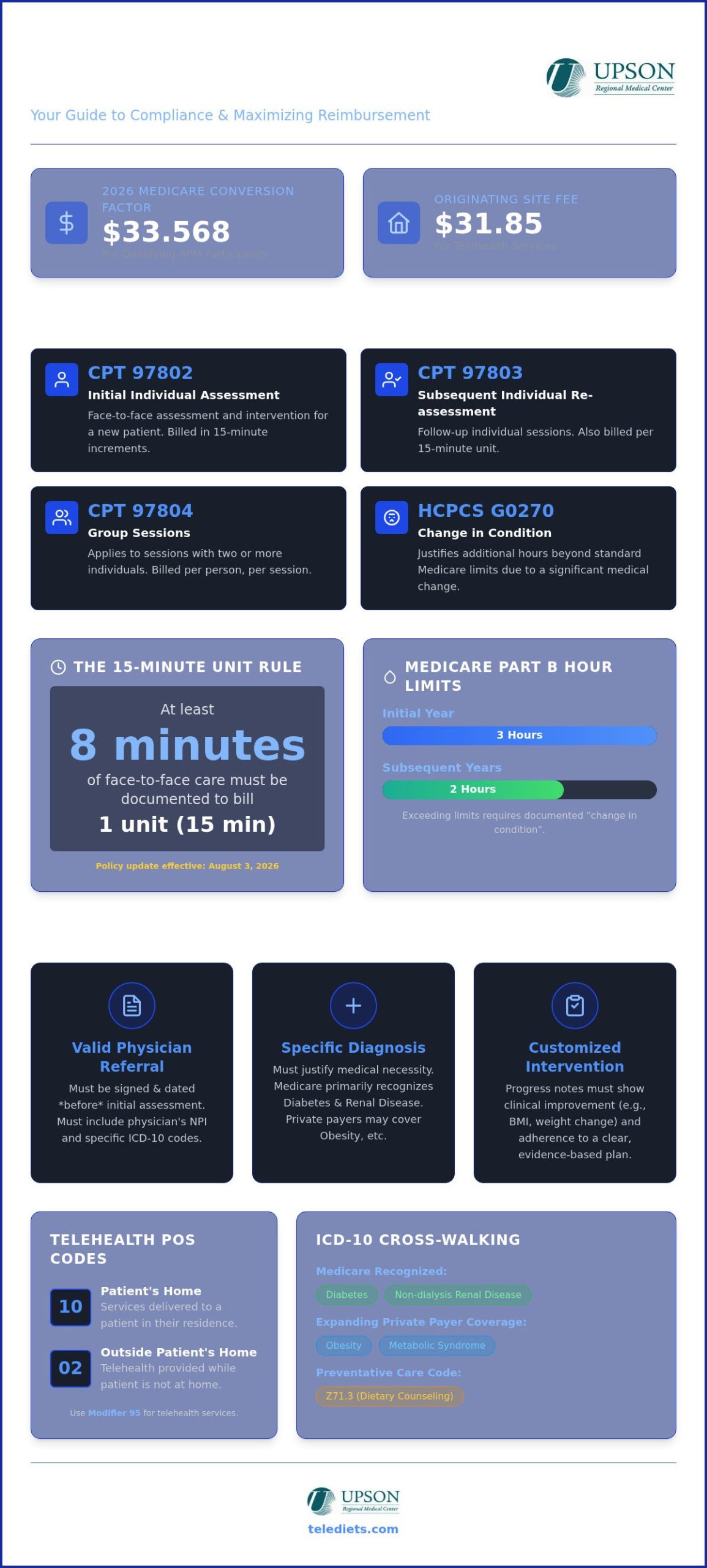
Accurate reimbursement starts with a precise understanding of the 15-minute unit rule. For 2026 compliance, you must round your session time to the nearest 15-minute increment, ensuring that at least eight minutes are spent in face-to-face care to bill a single unit. This meticulous tracking is vital for the billing codes for medical nutrition therapy 2026, especially as CMS tightens its audit focus on time-based documentation. Claims submitted after the August 3, 2026 policy update must reflect these specific unit calculations or face immediate denial.
Defining the 2026 MNT Code Set
The core of your billing strategy relies on three primary CPT codes. Code 97802 defines a face-to-face assessment and intervention for an individual, billed in 15-minute increments. Code 97803 handles subsequent individual re-assessments and interventions, also billed per 15 minutes. For group settings, 97804 applies to sessions with two or more individuals. When a patient’s medical condition changes significantly mid-year, such as a shift from chronic kidney disease to a post-transplant status, you should utilize HCPCS code G0270 to justify additional individual reassessment hours beyond the standard Medicare limits. Mastering these billing codes for medical nutrition therapy 2026 ensures your practice is compensated for the increased complexity of care.
ICD-10 Cross-Walking for MNT
Successful claims require a direct link between the CPT code and a qualifying diagnosis. Medicare primarily recognizes diabetes and non-dialysis renal disease as valid triggers, while many private payers have expanded coverage to include obesity and metabolic syndrome for 2026. For preventative care, using code Z71.3 for dietary counseling and surveillance helps categorize sessions that don’t yet meet chronic disease thresholds. To support these claims, many providers integrate Advanced Medical Series Meal Plans into their workflow to provide evidence-based interventions. Understanding this Clinical Nutrition Overview is essential for aligning your billing with the scientific standards expected by modern payers.
Documentation Standards and Frequency Limitations
Compliance in 2026 requires more than a simple summary of patient interaction. To successfully bill for the billing codes for medical nutrition therapy 2026, your records must clearly justify medical necessity through a three-pronged approach: a valid referral, a specific diagnosis, and a customized intervention plan. Medicare Part B maintains strict frequency limits, typically allowing three hours of individual counseling in the initial year and two hours in subsequent years. If you exceed these hours, you must document a “change in condition” or a physician-ordered reassessment to justify the use of secondary HCPCS codes.
The Physician Referral Requirement
A signed and dated referral is the bedrock of your claim. It must be obtained before the initial 97802 assessment occurs. To avoid denials, ensure the referring physician includes their NPI number and specific ICD-10 codes that match the patient’s condition. Standardizing this intake process prevents administrative bottlenecks and ensures your services are recognized as part of a coordinated care plan. It’s vital that the referral specifically mentions medical nutrition therapy rather than general “dietary advice” to meet CMS scrutiny.
Clinical Progress Notes for 2026
Your progress notes should tell a clear story of clinical improvement. Essential components include the patient’s response to therapy, anthropometric changes like BMI or weight fluctuations, and specific measures of dietary adherence. Using evidence-based Advanced Medical Series Meal Plans allows you to point to established protocols that justify intensive sessions. This structure makes it easier to demonstrate the “time spent” without falling into the trap of over-rounding or under-reporting. For accurate unit calculation, remember that at least 8 minutes of a 15-minute unit must be performed to bill. To streamline this process, many providers use specialized billing tools that automate the generation of these audit-ready notes.
Billing for Telehealth and Remote Nutrition Services
Virtual care has moved from a temporary flexibility to a permanent fixture in clinical nutrition. For 2026, you must differentiate between Place of Service (POS) 02, used when telehealth is provided outside the patient’s home, and POS 10, which identifies services delivered to a patient in their residence. Using the correct code is essential for accurate reimbursement rates under the billing codes for medical nutrition therapy 2026. While Modifier 95 remains the standard for real-time audio-visual sessions, you should verify if specific commercial payers still require Modifier GT to process claims without delays.
State-by-state parity laws continue to evolve, affecting how much you are reimbursed compared to in-person visits. To remain compliant in 2026, every MNT session must utilize synchronous, real-time communication that includes both audio and video components. This interactive requirement ensures the “face-to-face” nature of the CPT codes is maintained in a digital environment. It’s also worth checking local regulations, as some states have updated their reimbursement minimums for remote providers as of August 2026.
Remote Patient Monitoring (RPM) and MNT
Integrating RPM can enhance patient outcomes, but you must navigate the 2026 CCI edits to avoid prohibited code bundling. Billing for physiological monitoring alongside nutrition therapy requires distinct documentation that separates the time spent on each service. Utilizing a telemedicine nutrition plugin helps you capture this session data automatically, ensuring your time-based units are defensible during an audit. This integration allows you to focus on clinical care while the software handles the administrative complexity of tracking patient engagement.
Compliance in Virtual Consultations
Security remains a top priority for virtual care. Your platform must meet 2026 HIPAA standards for encryption and data privacy to protect sensitive patient information. Additionally, you must capture digital signatures on MNT consent forms before the session begins to satisfy payer requirements. To simplify your remote workflow and ensure every claim is built on compliant data, consider upgrading to integrated telemedicine billing solutions today.
Streamlining MNT Reimbursement with Clinical Software
Manual billing for the billing codes for medical nutrition therapy 2026 often remains the primary bottleneck for growing clinical practices. TeleDIETS addresses this challenge by automating the generation of billing-ready clinical documentation, effectively removing the administrative friction that leads to claim denials. By integrating Advanced Medical Series Meal Plans, you ensure every intervention meets the rigorous medical necessity standards required by CMS and private payers. This systemic approach empowers you to scale your MNT services significantly without the need to increase your billing staff headcount.
Automating the Nutrition Prescription
Modern clinical software transforms complex patient data into actionable care plans with minimal manual effort. You can generate professional protocols based on lab results and specific clinical diagnoses in seconds. The platform ensures every meal plan is billing-compliant by automatically linking the intervention to the appropriate ICD-10 codes. This precision eliminates the guesswork often associated with manual cross-walking and protects your practice during potential audits. It’s a shift from reactive documentation to a proactive, protocol-driven workflow.
The GLP-1 Billing Opportunity
The rise of intensive obesity management presents a significant revenue opportunity for modern clinics. Using GLP-1 meal plan protocols allows your practice to support high-demand programs with evidence-based nutrition support. These specialized protocols provide the clinical justification necessary to bill for intensive behavioral therapy alongside standard MNT. By leveraging these tools, you position your practice as a leader in the GLP-1 era while maintaining full compliance with the latest billing codes for medical nutrition therapy 2026. This integration ensures your focus remains on patient outcomes while the technology secures your clinical reimbursement.
Securing Your Clinical Revenue in 2026
Mastering the updated billing codes for medical nutrition therapy 2026 is more than a compliance requirement; it’s a strategic move to safeguard your practice’s financial health. You now have the roadmap to navigate complex CMS policy shifts, from site-neutral payment adjustments to the nuances of telehealth place-of-service modifiers. By shifting from manual entry to protocol-driven documentation, you reduce the administrative burden that often leads to burnout and denied claims.
Your clinical expertise deserves a professional workflow that matches its value. TeleDIETS provides the sophisticated tools you need to thrive, featuring a physician-designed AI nutrition engine and evidence-based GLP-1 protocols. Our platform’s integrated CPT coding tools ensure that your documentation is audit-ready from the start, allowing you to spend more time with patients and less time on paperwork. Access 2026-Ready MNT Billing Tools and Clinical Protocols today to empower your practice and maximize your revenue. You’ve got the expertise; we’re here to provide the support you need to succeed.
Frequently Asked Questions
What is the difference between CPT 97802 and 97803 in 2026?
CPT 97802 represents the initial individual assessment and intervention, while 97803 is used for subsequent re-assessments. You’ll use 97802 only once per patient per referral period to establish the baseline nutrition plan. In contrast, 97803 covers follow-up sessions where you monitor progress or adjust the intervention. Both codes are billed in 15-minute units, requiring a minimum of eight minutes of face-to-face time to qualify for a single unit.
How many units of MNT can be billed per day under Medicare?
Medicare doesn’t set a rigid daily unit cap, but you’re bound by the annual hour limitations of three hours in the first year and two hours thereafter. Most providers bill four units of 97802 for a one-hour initial session. If you need to exceed these daily or annual limits due to a significant change in the patient’s medical condition, you must document the necessity and use HCPCS G-codes.
Can physicians bill for MNT services or only Registered Dietitians?
Medicare specifically recognizes Registered Dietitians and certain nutrition professionals as the primary providers for these services. While physicians can provide nutritional counseling, they typically bill using Evaluation and Management (E/M) codes rather than specific billing codes for medical nutrition therapy 2026. If a physician employs an RD, the services are usually billed under the RD’s own NPI to ensure compliance with Medicare Part B’s independent provider requirements.
What modifiers are required for telehealth MNT billing in 2026?
You must use Modifier 95 to identify MNT services provided via real-time, interactive audio and video telecommunications. This modifier confirms that the session met the synchronous communication standards required for virtual care. Additionally, you’ll need to pair this with the correct Place of Service code, such as POS 10 for patients receiving care in their own homes, to ensure your reimbursement rates are calculated accurately by the payer.
Is obesity a covered diagnosis for MNT billing in 2026?
Medicare Part B continues to restrict MNT coverage to patients with diabetes, non-dialysis renal disease, or those within three years of a kidney transplant. However, many private insurance carriers have expanded their policies to include obesity as a covered diagnosis for the billing codes for medical nutrition therapy 2026. You should always verify the specific ICD-10 requirements with each commercial payer before initiating a weight management program to ensure session coverage.
Leave a Reply