
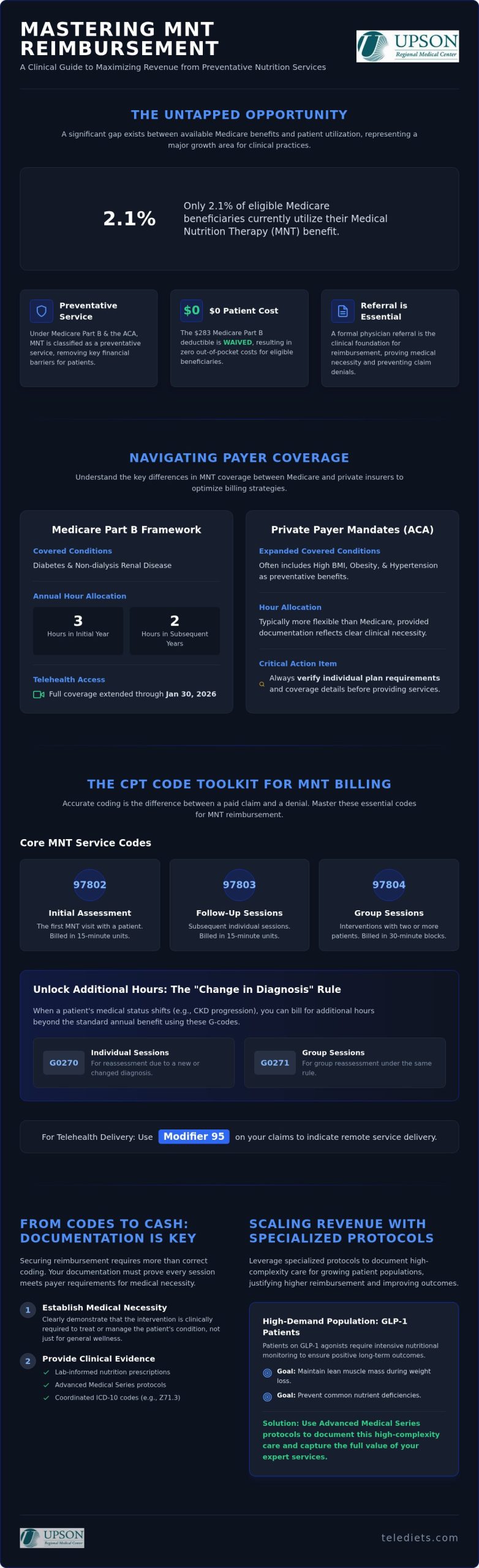
Did you know that only 2.1% of eligible Medicare beneficiaries currently utilize their Medical Nutrition Therapy benefit? You likely recognize that nutrition is the clinical cornerstone of managing chronic conditions like diabetes and CKD, yet the administrative burden of securing reimbursement for preventative nutrition services often feels like a barrier rather than a bridge. Between shifting CPT code valuations and the complexities of documenting medical necessity, it’s easy for providers to feel overwhelmed by manual paperwork and evolving payer requirements.
This guide will empower you to master the complexities of MNT billing, from identifying high-reimbursement codes to leveraging modern software that streamlines clinical documentation. We’ll explore the latest 2026 Medicare updates, including the $283 Part B deductible waiver and telehealth extensions through January 30, 2026. You’ll also learn how to integrate specialized protocols for GLP-1 patients into your workflow, ensuring your clinic captures the full value of the expert care you provide while improving long-term patient outcomes.
Key Takeaways
- Identify the core CPT codes for initial and reassessment sessions, including the “Change in Diagnosis” rule to unlock additional billing hours.
- Master the specific documentation standards required to secure reimbursement for preventative nutrition services while ensuring compliance with payer medical necessity thresholds.
- Discover how lab-informed nutrition prescriptions and Advanced Medical Series protocols provide the clinical evidence needed to support high-reimbursement claims.
- Learn how to scale your practice revenue by integrating automated workflow tools and specialized meal plan protocols for high-demand populations, such as GLP-1 patients.
The Landscape of Reimbursement for Preventative Nutrition Services
Medical Nutrition Therapy (MNT) has evolved from a niche support service into a primary clinical intervention. Under Medicare Part B and the Affordable Care Act (ACA), MNT is classified as a preventative service. This designation is vital for your practice because it often removes the financial barrier for patients. For eligible Medicare beneficiaries, the Part B deductible of $283 is waived for these services, resulting in a $0 out-of-pocket cost for the patient.
Clinics are increasingly adopting this model to improve the return on investment for chronic disease management. By addressing nutrition early, you can mitigate the progression of costly conditions. While Medicare currently limits coverage to diabetes and non-dialysis renal disease, the Role of Dietitians in Nutrition Services is expanding rapidly into metabolic syndrome and obesity management through private payer mandates.
Establishing a successful claim begins with a physician referral. This document serves as the clinical foundation for reimbursement for preventative nutrition services, proving that the intervention is medically necessary rather than merely elective wellness. Without this formal referral, most payers will automatically deny the claim, regardless of the patient’s clinical needs.
Medicare vs. Private Payer Mandates
Medicare Part B provides a structured framework for MNT coverage. Beneficiaries are typically entitled to three hours of one-on-one counseling in their initial year and two hours in subsequent years. These hours are crucial for stabilizing patients with complex dietary needs. Telehealth extensions through January 30, 2026, further ensure that these services remain accessible regardless of patient location.
Private insurers operate under different mandates shaped by the ACA. Many plans now cover nutritional counseling for patients with a high BMI or hypertension as a preventative benefit. You should verify individual plan requirements, as many commercial payers offer more flexible hour allocations than Medicare, provided the documentation reflects a clear clinical necessity for obesity management or cardiovascular risk reduction.
Essential CPT Codes for Medical Nutrition Therapy (MNT)
Accurate coding is the difference between a paid claim and a frustrating denial. Your primary toolkit for reimbursement for preventative nutrition services consists of three time-based CPT codes. Code 97802 is for the initial assessment, billed in 15-minute units. Subsequent individual sessions use 97803, while 97804 covers group interventions in 30-minute blocks. Precision in tracking these units ensures that your clinical time is fully accounted for during the billing cycle.
Medicare’s annual hour limits don’t have to stall patient progress. The “Change in Diagnosis” rule allows you to provide extra care when a patient’s medical status shifts. By using G0270 for individual sessions or G0271 for groups, you can bill for additional hours beyond the standard benefit for reimbursement for preventative nutrition services. This is a powerful tool for patients whose conditions, like chronic kidney disease, require sudden dietary adjustments. For a deeper look at these policy shifts, review the Academy’s latest on MNT Advocacy and Reimbursement.
Telehealth delivery has become a standard part of the modern clinical workflow. Medicare has extended coverage for these remote services through January 30, 2026, provided you use the 95 modifier. You must also ensure your ICD-10 codes, such as Z71.3 for dietary counseling, align with the patient’s primary medical diagnosis. This coordination proves the medical necessity of the visit and significantly reduces the risk of administrative pushback.
Coding for Specialized Patient Populations
Managing patients on GLP-1 receptor agonists requires intensive nutritional monitoring to maintain lean muscle mass and prevent nutrient deficiencies. You can use Advanced Medical Series protocols to document the high-complexity care these patients need. This ensures your claims reflect the specialized nature of the intervention. To streamline this process, you can access integrated billing tools designed for clinical efficiency.
Documentation and Compliance Strategies for Clinics
Securing consistent reimbursement for preventative nutrition services requires more than just selecting the right code. You must demonstrate that every session meets the “Medical Necessity” threshold. Payers look for specific evidence in clinical notes that the intervention directly addresses the patient’s diagnosed condition. If documentation is vague, you risk costly clawbacks. Integrating lab results through Advanced Medical Series protocols allows you to build nutrition prescriptions based on objective data, creating a robust clinical narrative that justifies the complexity of your care.
Consistency is your best defense against administrative pushback. Standardizing the Nutrition Care Process (NCP) ensures every patient interaction follows the ADIME format: Assessment, Diagnosis, Intervention, and Monitoring/Evaluation. This structured approach isn’t just a clinical best practice; it’s the specific language insurance auditors use to evaluate claims. By maintaining physician referrals and detailed progress logs within a centralized platform, you create an audit-proof trail that protects your clinic’s revenue and professional reputation while improving reimbursement for preventative nutrition services across your patient population.
Streamlining the Referral Workflow
A fragmented referral process often leads to missed billing opportunities and patient attrition. Establishing a clear internal pathway between Primary Care Physicians (PCPs) and Registered Dietitians (RDs) ensures that every eligible patient receives the necessary referral at the point of care. You can significantly reduce administrative overhead by automating these handoffs and the resulting paperwork. Utilizing Medical Nutrition Therapy SaaS allows you to generate billing-compliant documentation in seconds, bridging the gap between clinical diagnosis and successful reimbursement. Ready to optimize your clinical workflow? Get started with our automated billing tools.
Scaling Nutrition Revenue with Automated Workflow Software
The administrative burden of manual meal planning often creates a “profitability gap” that prevents clinics from realizing the full potential of reimbursement for preventative nutrition services. When your clinical staff spends hours drafting individual dietary guides, the cost of delivery can quickly exceed the reimbursement rate. By utilizing AI engines to generate evidence-based plans in seconds, you can shift your focus back to patient care while ensuring your services remain financially viable.
Implementing specialized GLP-1 Meal Plan Protocols allows you to capture the surging demand for obesity management services. These patients require precise nutritional support to mitigate side effects and preserve lean mass, making them ideal candidates for intensive MNT. Integrating these protocols into your workflow doesn’t just improve patient outcomes; it provides the high-complexity documentation that payers require for successful claims. This targeted approach addresses the specific reimbursement nuances that many generic platforms overlook.
To truly scale, you must look beyond physical office walls. Leveraging a Telemedicine Plugin enables you to expand your service area across state lines where licensing allows, without the overhead of additional square footage. Integrating TeleDIETS billing tools directly into your existing EHR or EMR workflow streamlines your revenue cycle management, ensuring that coding for 97802 or 97803 happens at the point of care rather than as a time-consuming afterthought.
The Future of MNT: AI and Lab Integration
The next frontier of clinical nutrition is the seamless integration of lab data with automated prescriptions. When your software analyzes biomarkers to suggest specific dietary interventions, you provide a level of precision that increases both patient trust and payer satisfaction. This technology-led approach allows your practice to scale from 10 to 100+ MNT patients per month using specialized meal plan protocols, turning nutrition from a peripheral service into a primary revenue driver.
Optimizing Your Clinical Revenue Lifecycle
Transitioning to a nutrition-centric model doesn’t just improve patient health; it establishes a sustainable growth path for your clinic. By mastering the core CPT codes and the “Change in Diagnosis” rule, you’ve already taken the first step toward maximizing reimbursement for preventative nutrition services. Effective documentation remains your strongest asset against audits, especially when supported by lab-informed evidence and standardized care processes. The integration of technology ensures these clinical standards are met without sacrificing your team’s efficiency.
It’s time to bridge the gap between diagnosis and payment using physician-designed tools that simplify complex workflows. Start scaling your MNT revenue with TeleDIETS clinical billing tools, which feature integrated insurance billing, CPT coding tools, and evidence-based GLP-1 and Advanced Medical Series protocols. These specialized resources empower you to deliver clinical-grade care while maintaining a healthy bottom line. Your practice is now equipped to lead the shift toward preventative, value-based medicine with confidence and precision.
Frequently Asked Questions
Does Medicare cover preventative nutrition for weight loss?
Medicare Part B doesn’t currently provide reimbursement for preventative nutrition services solely for weight loss. Coverage is strictly limited to patients with diabetes, non-dialysis chronic kidney disease, or those who have received a kidney transplant within the last 36 months. However, private payers often have broader mandates under the ACA that may include weight management for patients with a high BMI or hypertension.
Can a physician bill for MNT services, or must it be a Registered Dietitian?
Medical Nutrition Therapy codes, specifically 97802 through 97804, are designated for Registered Dietitians or qualified nutrition professionals. While a physician must provide the initial referral to establish medical necessity, they don’t bill these specific codes themselves. Seamless collaboration between the referring MD and the RD is essential to ensure the claim is accepted and the practice captures the appropriate revenue.
What are the most common reasons for MNT reimbursement denials?
The most frequent denials stem from missing physician referrals or using a non-covered ICD-10 diagnosis code. Many clinics also face challenges when they exceed the annual hour limits without utilizing the G0270 “Change in Diagnosis” code. Ensuring your documentation clearly reflects the Nutrition Care Process is the best way to secure reimbursement for preventative nutrition services and avoid administrative clawbacks.
How do I bill for nutrition services provided via telehealth in 2026?
Through January 30, 2026, you can bill for remote MNT by appending the 95 modifier to standard CPT codes like 97802 or 97803. This modifier indicates the service was delivered via real-time audio and video technology. You should also verify the correct Place of Service code with individual payers; some require POS 11 for the provider’s office while others have transitioned to POS 02 or 10.
Are there specific CPT codes for GLP-1 patient nutrition support?
There are no unique CPT codes exclusively for GLP-1 therapy support. Instead, you should use standard MNT codes while ensuring the ICD-10 codes accurately reflect the patient’s underlying condition, such as obesity or metabolic syndrome. Using specialized protocols helps you document the increased complexity of managing these patients, which is critical for justifying medical necessity and supporting higher-complexity nutrition prescriptions during an audit.
Leave a Reply