
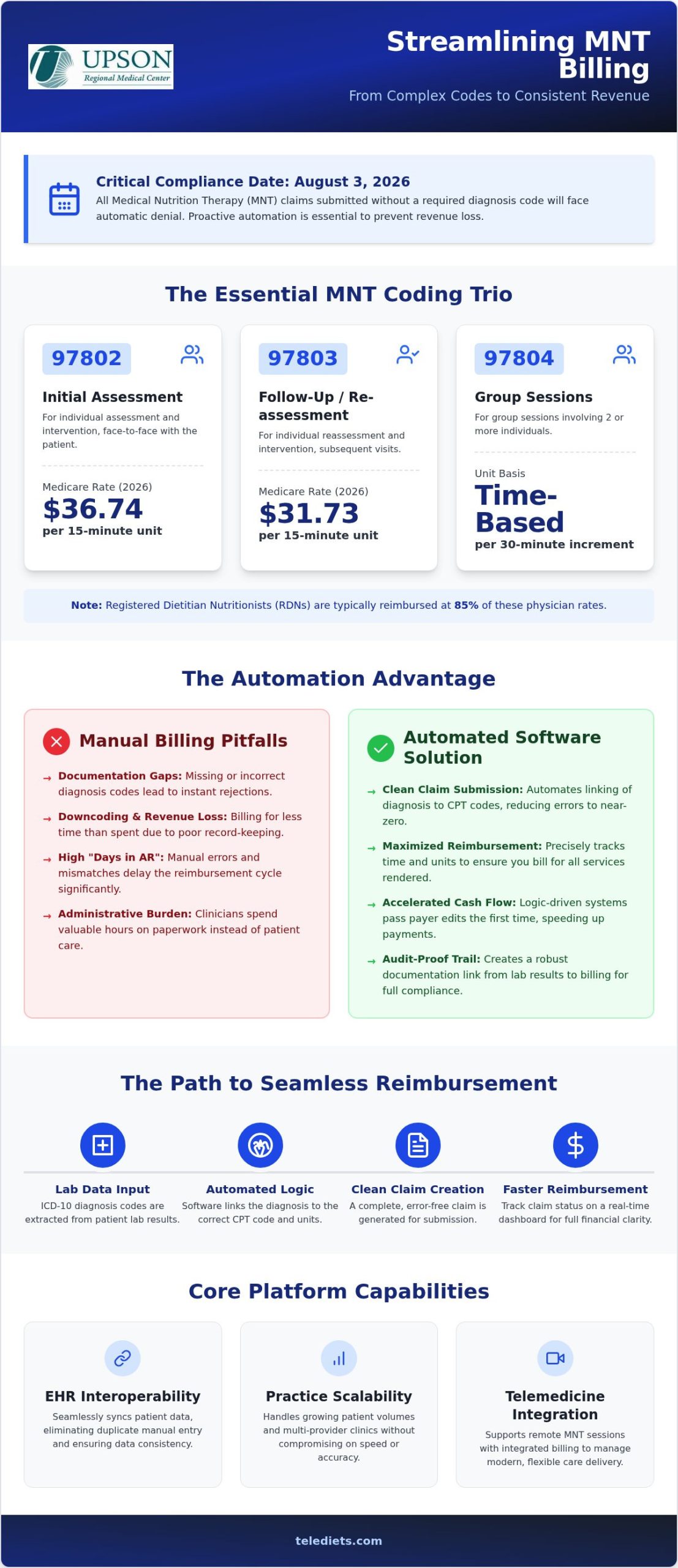
Did you know that as of August 3, 2026, every Medical Nutrition Therapy claim submitted without a required diagnosis code will be automatically denied? You likely entered this field to provide life-changing nutritional care, not to spend your evenings deciphering the nuances between CPT 97802 and Medicare’s specific HCPCS codes. Integrating automated MNT billing software allows you to reclaim those hours while ensuring your practice captures every dollar of the $36.74 per-unit reimbursement you’ve earned. It’s time to stop letting administrative complexity limit your clinical impact.
In this clinical guide, you’ll learn how to transform logistical hurdles into a streamlined, high-margin revenue driver. We’ll examine the latest 2026 reimbursement rates, clarify CPT code usage, and provide a roadmap for a seamless workflow from diagnosis to claim submission. By the end of this article, you’ll have the tools to align clinical data with billing logic, creating a more sustainable and efficient practice that prioritizes both patient outcomes and financial health.
Key Takeaways
- Master the critical distinctions between MNT CPT codes to protect your practice’s revenue and ensure long-term clinical sustainability.
- Leverage automated MNT billing software to eliminate manual entry errors, ensuring clean claim submissions that accelerate your reimbursement cycle.
- Evaluate medical nutrition platforms based on their ability to integrate with existing EHRs and support complex, evidence-based clinical workflows.
- Streamline your operations by adopting lab-based prescription tools that automatically link clinical interventions to the correct billing codes.
Navigating CPT Codes for Nutrition Counseling and MNT
In the modern healthcare environment, Medical Nutrition Therapy (MNT) billing is no longer just a back-office task; it’s a vital component of Clinical Nutrition that dictates your practice’s growth. Accurate coding ensures that your expertise is valued and reimbursed correctly. Yet, many providers find that manual entry creates a significant administrative bottleneck. This complexity often prevents clinicians from scaling their services, as the time spent on paperwork competes with patient care.
The Essential MNT Coding Trio: 97802, 97803, and 97804
Mastery of these three codes is the foundation of a profitable nutrition service. Each is billed in specific time increments that must be documented with clinical precision.
- 97802: This code covers the initial individual assessment and intervention. For 2026, the national Medicare rate is approximately $36.74 per 15-minute unit.
- 97803: Used for follow-up visits and reassessments. Medicare reimburses this at roughly $31.73 per 15-minute unit.
- 97804: This applies to group sessions involving two or more individuals, billed in 30-minute increments.
Registered Dietitian Nutritionists typically receive 85% of these physician rates. Implementing automated MNT billing software helps you track these units precisely, reducing the risk of human error during busy clinic days.
Common Billing Pitfalls in Nutrition Therapy
Financial leakage often stems from simple documentation gaps. As of August 3, 2026, CMS requires a specific diagnosis on every MNT claim; without it, the claim is automatically rejected. Many practices also struggle with “downcoding,” where they bill for less time than spent because they lack clear records. High-quality automated MNT billing software bridges the gap between your lab-based prescriptions and the final insurance claim, ensuring that every diagnosis is linked to the correct CPT code from the start.
How Automated MNT Billing Software Eliminates Manual Errors
Manual coding is often the primary source of financial leakage in clinical nutrition. When you rely on handwritten notes or separate spreadsheets, the risk of a mismatch between the diagnosis and the CPT code increases. Using automated MNT billing software streamlines this transition, moving your clinical data directly into a clean claim format. This precision is vital for reducing “Days in AR” (Accounts Receivable), as it ensures your submissions pass payer edits the first time.
Security is just as critical as accuracy. These platforms manage HIPAA-compliant transmissions by using encrypted channels and secure Business Associate Agreements (BAAs). Logic-driven systems then step in to match your clinical protocols against specific payer rules. This prevents common errors like billing for a 97803 follow-up before the required reassessment window opens, ensuring you don’t lose revenue to preventable denials.
Bridging the Gap Between Lab Results and CPT Codes
Sophisticated systems automatically extract ICD-10 diagnosis codes from patient lab data to populate insurance forms with clinical precision. This documentation provides an objective trail of medical necessity. It links the patient’s biochemical markers directly to the intervention, creating a robust defense against potential audits. By automating this link, you ensure that every claim is grounded in verifiable clinical data, satisfying even the strictest payer requirements.
Real-Time Revenue Cycle Management for Clinics
A centralized dashboard gives you a transparent view of your practice’s financial health. You can track the status of 97802 and 97803 claims, identifying payment delays before they impact your cash flow. If you’re looking to scale your impact, you might explore integrated clinical solutions that merge billing with the visit itself. The system also automates follow-up reminders, ensuring you maximize the covered 2-hour annual allowance for MNT reassessments without manual tracking.
Selecting the Best Medical Nutrition Therapy Platform
Choosing a platform is a strategic decision that impacts both clinical outcomes and financial health. A high-quality system doesn’t just process claims; it acts as an extension of your clinical team. You need automated MNT billing software that offers full interoperability with your existing EHR. This ensures that patient data flows seamlessly without manual duplication. Scalability is equally important. Whether you’re a solo practitioner or managing a multi-provider clinic, your software must handle increasing patient volumes and diverse telemedicine needs without compromising on speed or accuracy.
Telemedicine Integration and Remote MNT Billing
Remote care is a permanent fixture in modern practice. In 2026, billing for virtual MNT requires specific modifiers, such as Modifier 95, to indicate the service was provided via synchronous audio and video. Utilizing a specialized telemedicine nutrition plugin simplifies this process by automatically appending the necessary codes to your remote consultations. This integration ensures you remain compliant with evolving virtual care regulations while maintaining a steady revenue stream from anywhere in the country.
Protocol Variety: GLP-1 and Advanced Medical Series
Your billing logic should be as sophisticated as your clinical protocols. Modern platforms should automatically match complex diagnoses to evidence-based meal plans, such as GLP-1 support or the Advanced Medical Series. This automation ensures that the prescribed intervention is perfectly aligned with the billed diagnosis. When your system links these protocols directly to automated MNT billing software, you reduce the likelihood of payer scrutiny and claim denials. Ready to elevate your practice? Start your integration today to bridge the gap between clinical excellence and administrative efficiency.
Implementing TeleDIETS for Seamless Clinical Workflows
Transitioning from fragmented manual systems to an integrated SaaS solution is the final step in modernizing your clinical practice. TeleDIETS serves as this bridge, embedding sophisticated CPT coding tools directly into the dietary prescription process. By automating the cycle from assessment to claim, you significantly reduce the administrative weight that often leads to provider burnout. This efficiency allows you to scale your services, moving beyond the limitations of manual spreadsheets and toward a high-volume, evidence-based model that prioritizes both patient care and practice health.
From Lab to Reimbursement in Seconds
The user journey begins with clinical data. Once lab results are uploaded, the TeleDIETS AI engine suggests a protocol, such as the Advanced Medical Series, and immediately prepares the associated billing codes. This eliminates the need for manual cross-referencing between clinical notes and coding manuals. To start this transition, you can access the TeleDIETS SaaS platform and begin automating your workflow today. This seamless path ensures that your focus remains on the patient, while the automated MNT billing software handles the technical complexities of reimbursement.
The Future of Automated Clinical Nutrition
Looking ahead, the role of technology in clinical nutrition will only deepen. Predictive billing features in 2026 software are designed to anticipate payer-specific changes, such as the stricter diagnosis requirements effective August 3, 2026, before they result in denials. TeleDIETS acts as a long-term partner in chronic disease management, ensuring that your practice stays ahead of regulatory shifts while maintaining financial stability. It’s more than a tool; it’s a stable foundation for a modern, technology-forward clinical environment that values precision and efficiency.
Scaling Your Clinical Nutrition Impact
The shift toward clinical automation isn’t just about operational efficiency; it’s about protecting the long-term sustainability of your practice. By mastering core CPT codes and moving away from manual data entry, you ensure that every minute of patient care is accurately captured and reimbursed. Transitioning to automated MNT billing software transforms a complex, error-prone administrative cycle into a seamless extension of your clinical workflow. This evolution allows you to focus on your primary mission: delivering evidence-based nutrition therapy that improves patient outcomes.
With integrated CPT coding tools, evidence-based GLP-1 protocols, and a telemedicine-ready plugin architecture, TeleDIETS provides the stability you need to thrive in a modern clinical environment. Start your TeleDIETS SaaS subscription and automate your MNT billing today to reclaim your time and maximize your reimbursement potential. You’ve already built the clinical expertise. Now, it’s time to secure the professional freedom and financial growth you deserve.
Frequently Asked Questions
What is the most commonly used CPT code for nutrition counseling?
CPT codes 97802 and 97803 are the most frequently utilized codes for individual nutrition counseling. Code 97802 covers the initial assessment and intervention, while 97803 is used for subsequent reassessments. Both are billed in 15-minute units. These codes allow registered dietitians to provide specialized care for chronic conditions like diabetes while ensuring their time is accurately reflected in the reimbursement process.
Can I bill for MNT and a standard office visit on the same day?
You can bill for both MNT and a standard Evaluation and Management (E/M) office visit on the same day if the services are distinct. This typically requires appending Modifier 25 to the E/M code to indicate it was a significant, separately identifiable service. It’s essential that your documentation clearly separates the clinical time spent on the office visit from the time dedicated specifically to Medical Nutrition Therapy.
Does automated MNT billing software work for telemedicine services?
Yes, automated MNT billing software is fully compatible with telemedicine services and remote patient monitoring. When billing for virtual consultations, the software automatically appends Modifier 95 to the standard CPT codes like 97802 or 97803. This ensures your claims meet 2026 telehealth requirements. This integration allows you to maintain a seamless workflow whether you’re seeing patients in a physical clinic or through a secure virtual platform.
How does software ensure CPT codes match the clinical diagnosis?
Clinical software ensures accuracy by using logic-based validation to link ICD-10 diagnosis codes directly to the appropriate CPT codes. When you prescribe a protocol based on lab results, the system verifies that the diagnosis meets the payer’s medical necessity criteria for MNT. This automated cross-referencing reduces the risk of claim denials caused by code mismatches, ensuring your documentation supports the specific intervention billed to insurance.
What are the benefits of using an AI-powered MNT billing engine?
An AI-powered engine streamlines the entire revenue cycle by identifying potential errors before claim submission. By utilizing automated MNT billing software, you can reduce “Days in AR” and ensure a higher percentage of clean claims. The technology anticipates payer-specific rule changes and automates follow-up reminders for reassessment windows. This empowers your clinical team to focus on patient care rather than navigating the complexities of manual insurance paperwork.
Leave a Reply