
Did you know that utilizing automated coding tools can reduce claim denials by as much as 34%? With 68% of providers now using AI for administrative functions, learning how to bill insurance for dietitian services through manual processes often leads to costly errors and lost revenue. You’ve likely felt the exhaustion of matching complex nutrition plans to specific medical diagnoses, only to have a claim rejected due to a minor coding misalignment. It’s frustrating when your clinical expertise is overshadowed by the technicalities of reimbursement.
Mastering these complexities doesn’t have to be an overwhelming task. This guide provides a clear, step-by-step path to managing MNT reimbursement with precision. We’ll cover the 2026 CMS rates for CPT codes like 97802 and 97803, the latest ICD-10-CM updates for dietary counseling, and how to integrate these workflows into your clinical EHR. By the end of this article, you’ll have the tools to achieve higher claim acceptance rates and a more efficient, technology-forward practice that supports long-term growth.
Key Takeaways
- Identify the primary CPT codes for initial and follow-up MNT to ensure your unit-based billing reflects the full scope of your clinical time.
- Master the essential link between ICD-10 diagnosis codes and medical necessity to understand exactly how to bill insurance for dietitian services without risking denials.
- Adopt a structured 5-step workflow, from benefit verification to ADIME documentation, to create a seamless path for claim submission and acceptance.
- Leverage modern automation and CPT coding tools to generate evidence-based protocols that integrate directly into your clinical EHR for improved efficiency.
Essential CPT Codes for Medical Nutrition Therapy (MNT)
Success in clinical reimbursement begins with a precise understanding of the CPT code set. When you’re determining how to bill insurance for dietitian services, you’ll primarily rely on three codes: 97802 for the initial assessment, 97803 for individual follow-up sessions, and 97804 for group interventions. These codes operate on a 15-minute unit-based system. For 2026, the CMS national reimbursement rate is $36.74 per unit for 97802 and $31.73 per unit for 97803.
Accuracy in time-based documentation is vital for preventing audits. In 2026, payers require clear “start and stop” times to justify the units billed. For instance, a 45-minute follow-up session equals three units of 97803. If a patient experiences a significant change in medical condition, such as a new diagnosis of diabetes or renal failure, you may need to use G-codes like G0270 or G0271 for reassessment. This detailed approach ensures that your work aligns with the standards found in a Clinical Nutrition Overview, which highlights the role of MNT in managing chronic disease.
Coding for Telemedicine and Remote MNT
Telehealth is now a permanent fixture in modern practice. To ensure your remote sessions are reimbursable, you must use the correct Place of Service (POS) codes: 02 for telehealth provided in a location other than the patient’s home, or 10 for services provided while the patient is at their residence. You should also append Modifier 95 to your CPT codes to signify a synchronous audio-visual interaction.
Efficiency is key when managing these variables. Implementing professional Insurance Billing & CPT Coding Tools helps you automate these selections. This ensures that your documentation remains HIPAA-compliant while providing a clear path for how to bill insurance for dietitian services across various care settings without the risk of manual entry errors. It’s about creating a stable, reliable billing cycle that supports both your practice and your patients’ long-term outcomes.
Aligning ICD-10 Codes with Medical Necessity
Establishing medical necessity is the foundational step in securing reimbursement. While CPT codes describe the specific service you’ve provided, the ICD-10 code provides the clinical justification. Without this alignment, payers will likely deny the claim as non-essential. Common reimbursable codes include the E11 series for Type 2 Diabetes, the N18 series for Chronic Kidney Disease, and the E66 series for Obesity. To strengthen your documentation, always include recent lab results in your clinical notes. High A1c levels or abnormal lipid panels provide the objective evidence required to justify intensive nutritional intervention. Referencing established MNT CPT Codes policies can help you determine which specific diagnoses meet various payer thresholds for medical necessity.
Coding for GLP-1 and Metabolic Syndrome Protocols
The rise of GLP-1 receptor agonists has shifted the diagnostic landscape for many providers. When you’re managing patients on these medications for weight management, it’s vital to document metabolic syndrome or specific co-morbidities like hypertension or dyslipidemia. These additional factors often trigger higher reimbursement tiers or allow for more frequent visits under many commercial insurance plans. Documenting these links is a critical part of how to bill insurance for dietitian services effectively, as it demonstrates the complexity of the care being delivered.
By using the TeleDIETS Advanced Medical Series, you can automatically align clinical protocols with these specific ICD-10 codes. This system ensures that every meal plan generated is backed by the patient’s lab data and diagnosis, making your documentation robust. If you’re looking to scale your practice revenue while maintaining clinical precision, consider implementing advanced billing and coding tools to streamline this alignment process. This approach transforms a complex administrative task into a seamless clinical workflow that prioritizes patient outcomes and ensures your practice is compensated for its expertise.
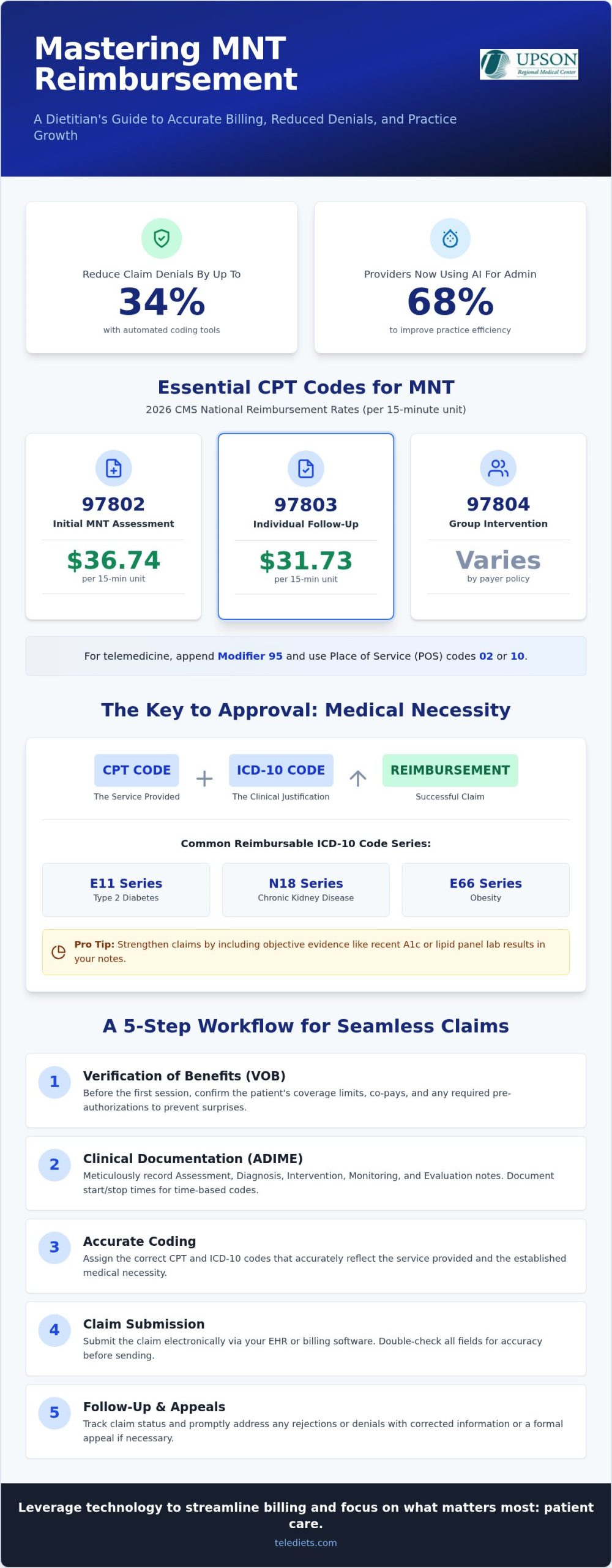
A 5-Step Workflow for Seamless Claim Submission
Establishing a repeatable system is essential for high-volume clinics. Follow this methodical workflow to ensure your claims are processed accurately and efficiently:
- Verification of Benefits (VOB): Confirm specific coverage limits and patient responsibility before the initial session.
- Clinical Documentation: Record your ADIME notes meticulously. For general surveillance, the ICD-10 Code for Dietary Counseling (Z71.3) remains a valid 2026 standard.
- Superbill Generation: Consolidate your NPI, patient demographics, and CPT units into a single document.
- Clearinghouse Submission: Use a clearinghouse to “scrub” the claim for errors before final submission.
- Denial Management: If a claim is rejected for “lack of necessity,” don’t panic; appeal immediately with the physician referral and lab data.
This structured approach is the most reliable way to master how to bill insurance for dietitian services while maintaining a high claim acceptance rate.
Maximizing Efficiency with Intake Integration
Digital intake tools significantly reduce front-desk friction by collecting insurance data before the patient even enters the clinic. TeleDIETS plugins serve as a critical bridge between physician diagnosis and dietitian billing. By syncing these systems, you ensure that the medical necessity established by the doctor flows directly into your billing workflow. You can implement these integrated billing tools to automate the generation of CPT-ready protocols. This integration ensures that how to bill insurance for dietitian services is no longer a manual burden, but a streamlined component of your clinical excellence.
Leveraging Automation to Scale Nutrition Revenue
Modern clinical practices are rapidly moving away from the cumbersome manual entry systems that once defined the industry. By adopting automated clinical nutrition prescriptions, you can eliminate the guesswork often associated with how to bill insurance for dietitian services. AI engines now have the capability to analyze complex patient lab data and generate CPT-ready protocols in seconds. This technology-forward approach ensures that every intervention is both clinically valid and pre-validated for reimbursement before the claim is even generated.
Reducing human error is perhaps the most immediate benefit of automation. Since a significant portion of claim denials can be traced back to simple coding mismatches or missing modifiers, using integrated coding tools provides a layer of security that manual logs cannot match. You can scale your Medical Nutrition Therapy (MNT) offerings without the need to hire additional administrative staff. SaaS integration allows your existing team to handle higher patient volumes while maintaining the clinical precision required for 2026 compliance standards.
The TeleDIETS Advantage for Clinical Practices
TeleDIETS Insurance Billing & CPT Coding Tools are specifically designed to bridge the gap between complex clinical data and long-term financial sustainability. The platform empowers physicians to prescribe evidence-based MNT that arrives in the provider’s hands already optimized for the billing cycle. This seamless flow from diagnosis to documentation maximizes your revenue potential while ensuring high-quality patient outcomes.
Ready to scale your clinical nutrition services? Start your TeleDIETS integration today. By automating the most technical aspects of how to bill insurance for dietitian services, you’re free to focus on what matters most: providing expert care to your patients. This partnership-oriented approach ensures your practice remains an innovator in the evolving healthcare landscape.
Advancing Your Practice Through Billing Precision
We’ve explored the 2026 CMS reimbursement landscape, from unit-based CPT codes to the critical alignment of ICD-10 diagnoses. Establishing medical necessity through lab results and structured ADIME notes is no longer just a compliance requirement; it’s a strategic advantage for clinical growth. By integrating these workflows, you move beyond the manual complexities of how to bill insurance for dietitian services and into a modern model of data-driven efficiency.
TeleDIETS provides the essential bridge with integrated CPT coding tools, lab-based protocol generation, and evidence-based GLP-1 support. These innovations empower you to scale your MNT services while maintaining the clinical precision your patients deserve. You have the expertise to transform patient lives. Now, you have the technology to ensure your practice remains sustainable, authoritative, and well-supported. It’s time to reclaim your time and focus on your patients.
Automate Your MNT Billing Workflow with TeleDIETS
Frequently Asked Questions
What is the difference between CPT codes 97802 and 97803?
CPT code 97802 is used exclusively for the initial individual medical nutrition therapy assessment and intervention. In contrast, 97803 is the code for subsequent follow-up sessions or re-assessments. Both codes are unit-based, meaning you bill in 15-minute increments. Accurate differentiation is a core part of how to bill insurance for dietitian services to ensure your practice receives the correct reimbursement rates for initial versus ongoing care.
Can a physician bill for dietitian services under their own NPI?
Physicians can bill for these services “incident to” their professional work, provided the dietitian is an employee or contractor and the physician is physically present in the office suite. However, many private payers and Medicare allow registered dietitians to enroll as independent providers. Billing under the dietitian’s own NPI often simplifies the process and provides clearer documentation for medical nutrition therapy sessions within a multi-disciplinary clinical environment.
How many units of MNT can be billed per patient per year?
For Medicare beneficiaries, coverage is typically limited to three hours of MNT in the first referral year and two hours in subsequent years. This equates to 12 units for the initial year and 8 units thereafter. If a patient’s medical condition changes significantly, you may bill additional hours using G-codes, provided a physician issues a new referral. Always verify specific unit limits with private commercial payers during the benefit verification step.
Is a referral always required for insurance to pay for dietitian services?
A physician referral is almost always required to establish the medical necessity needed for insurance reimbursement. For Medicare Part B, a referral specifically citing a diagnosis of diabetes or renal disease is mandatory. While some commercial plans might offer limited preventative benefits without a formal referral, maintaining a signed physician order is the most reliable way to learn how to bill insurance for dietitian services without facing frequent claim denials.
What modifiers are needed for telehealth dietitian billing in 2026?
In 2026, you must append Modifier 95 to your MNT codes to indicate that the service was provided via synchronous, interactive audio and video telecommunications. Additionally, you should use the correct Place of Service (POS) code, such as 10 for a patient in their home. These specific technical requirements ensure that remote sessions are recognized as equivalent to face-to-face clinical encounters by both CMS and major commercial insurance carriers.
Leave a Reply