
What if the primary barrier to your patients’ metabolic success isn’t their willpower, but the clinical gap between your lab results and their dinner plate? You likely recognize that nutrition is the cornerstone of chronic disease management, yet the reality of manual meal planning often feels like an administrative weight your team can’t sustain. Implementing a turnkey nutrition program for medical office success allows you to bridge this gap, providing the granular support patients on GLP-1 protocols require without increasing your staff’s daily workload.
In the following sections, you’ll discover how to integrate clinical-grade, revenue-generating nutrition therapy into your practice with total confidence. We will explore how automated prescriptions based on labs can deliver consistent metabolic outcomes while creating new, reliable revenue streams via CPT code billing. By the end of this guide, you’ll understand how to leverage modern technology to empower your patients and your bottom line without the traditional overhead associated with medical nutrition therapy.
Key Takeaways
- Understand the core architecture of a turnkey nutrition program for medical office success, which combines clinical-grade meal plans with automated administrative support.
- Learn how AI-driven engines translate complex lab results into personalized nutritional protocols for chronic disease management in under 60 seconds.
- Identify the specific CPT codes and automated billing tools necessary to transform medical nutrition therapy into a reliable, high-margin revenue stream.
- Master the four-step launch process for clinical nutrition software to ensure seamless integration into your existing provider workflow and staff orientation.
What Defines a True Turnkey Nutrition Program for Medical Offices?
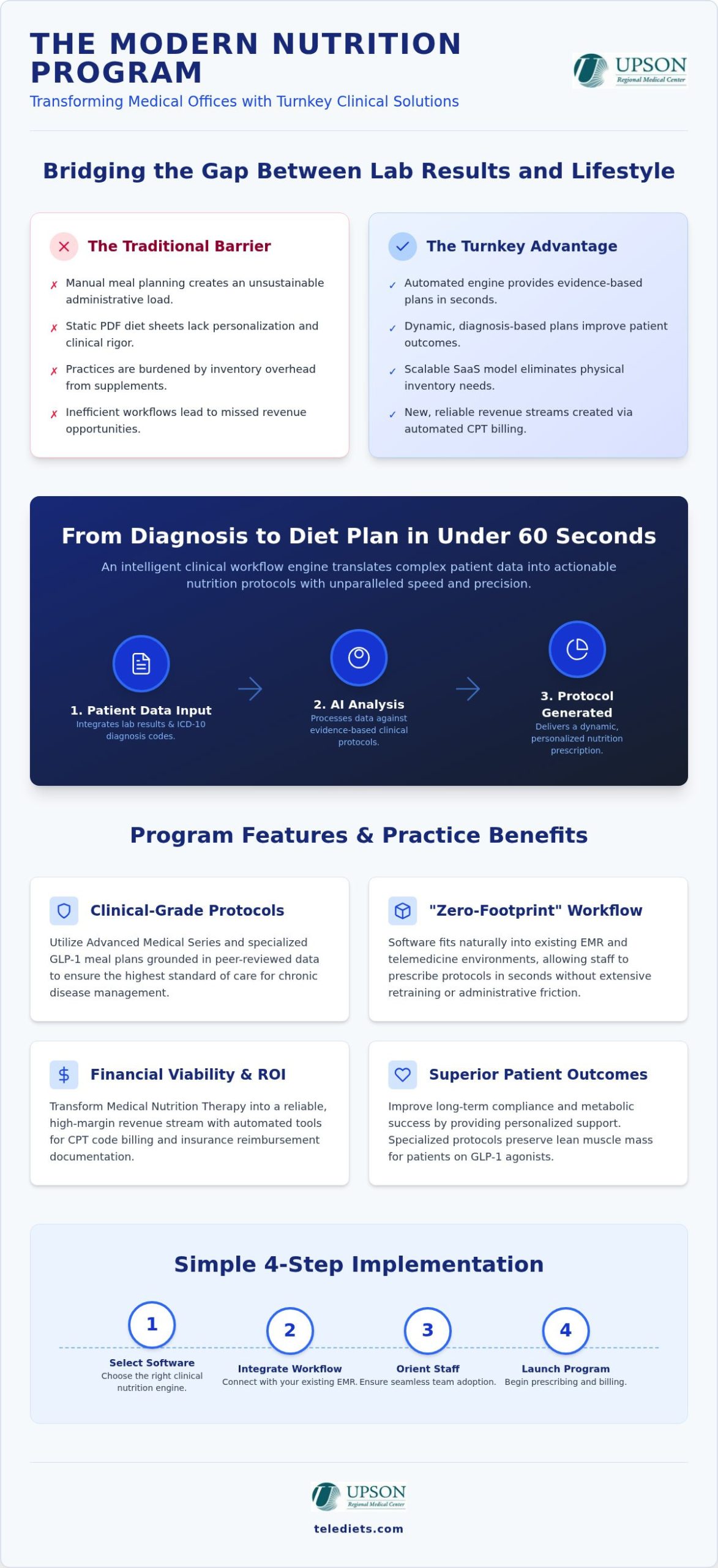
A turnkey nutrition program for medical office success is more than a digital library of recipes. It’s a pre-configured, clinical workflow engine that integrates evidence-based protocols, patient delivery systems, and billing tools without requiring custom software development. This infrastructure handles the heavy lifting of meal planning and patient tracking, allowing you to scale your practice efficiently. This model marks a significant departure from the manual diet sheets of the past. Instead of handing a patient a static PDF, you provide a dynamic, diagnosis-based nutritional prescription that evolves with their health data.
Modern practices are increasingly moving away from the logistical burden of physical product sales, such as stocking supplements or meal replacements. The shift toward SaaS-based Medical Nutrition Therapy (MNT) allows providers to focus on clinical outcomes rather than inventory management. By adopting this digital-first approach, your office can offer high-value services that are both scalable and scientifically rigorous, avoiding the overhead of storage and shipping.
The Role of Evidence-Based Protocols
Understanding what is clinical nutrition requires a move away from generic wellness advice. A sophisticated turnkey system utilizes Advanced Medical Series meal plans and specialized GLP-1 protocols. These interventions are grounded in peer-reviewed data and current clinical standards. They ensure that patients managing complex conditions like metabolic syndrome or undergoing medical weight loss receive protocols designed specifically for their physiological needs, rather than a one-size-fits-all suggestion that doesn’t account for clinical nuances.
Workflow Integration: The ‘Zero-Footprint’ Goal
The most effective systems aim for a zero-footprint integration. This means the software fits naturally into your existing EMR and telemedicine environments without disrupting your established routine. By prioritizing intuitive interfaces, you can launch these services without extensive staff retraining. Implementing a turnkey nutrition program for medical office workflows ensures that your team can prescribe protocols in seconds, keeping the focus on patient interaction rather than administrative friction. Efficiency is paramount.
Clinical Excellence Through AI and Lab-Integrated Personalization
Modern medicine demands precision. A turnkey nutrition program for medical office success leverages AI to bridge the gap between diagnostic data and patient action. By integrating lab results directly into the clinical workflow, you can generate personalized nutritional protocols for chronic conditions in under 60 seconds. This capability allows your practice to transition seamlessly from Standard Series to Advanced Medical Series plans without increasing clinical hours or administrative overhead. Efficiency doesn’t come at the cost of accuracy; it’s the result of sophisticated automation.
This data-driven approach is vital for addressing the “GLP-1 gap.” Patients utilizing GLP-1 receptor agonists often face significant risks of muscle wasting. Specialized GLP-1 meal plan protocols provide the targeted protein and micronutrient density required to preserve lean muscle mass during rapid weight loss. By providing this level of support, you ensure that weight loss is both healthy and sustainable for your metabolic health patients.
Automating the Nutrition Prescription
The software translates ICD-10 diagnosis codes into actionable daily meal plans for the patient. This automation reduces human error and ensures every recommendation aligns with evidence-based templates. When protocols are standardized through a clinical nutrition engine, your team maintains clinical excellence across a high volume of patients without manual calculations or guesswork.
Supporting Specialized Patient Populations
Specialized populations, such as those requiring renal, diabetes, or cardiovascular support, benefit from diagnosis-based meal planning. This level of personalization improves long-term compliance because patients see the direct link between their labs and their daily food choices. To ensure these services meet the criteria for insurance reimbursement for nutrition, your documentation must be precise and medically necessary. You can begin implementing these Advanced Medical Series protocols to elevate your standard of care and patient outcomes immediately.
Financial Viability: Insurance Reimbursement and Practice ROI
Integrating a turnkey nutrition program for medical office operations transforms nutritional counseling from an administrative burden into a sustainable revenue center. Many practices hesitate to offer Medical Nutrition Therapy (MNT) because they fear insurance complexity. However, when you use a system that bridges the gap between clinical action and billing, the financial path becomes clear. The return on investment (ROI) is driven by the contrast between a fixed SaaS subscription and the recurring revenue generated from high-volume, billable units. This positioning ensures nutrition is a core service that increases patient retention and long-term lifetime value.
Mastering MNT Billing Codes
Clinical reimbursement relies on precise documentation. You’ll primarily utilize CPT codes 97802 for the initial assessment and 97803 for subsequent re-assessments and follow-up sessions. Manual documentation for these encounters is often where claims fail. Turnkey software automates the generation of the necessary clinical notes and diagnosis-linked data required to satisfy payer requirements. By reducing claim denials through standardized documentation, your staff spends less time on administrative appeals. You can access integrated billing tools to streamline this process immediately.
The Telemedicine Advantage
You can scale your services without adding a single square foot to your physical clinic. Leveraging a telemedicine plugin allows you to conduct MNT sessions remotely, increasing billable encounters while keeping your exam rooms open for high-acuity visits. This model is particularly effective for maintaining consistent follow-ups with GLP-1 or metabolic patients who require frequent touchpoints. You can expand your reach to a national patient base, ensuring that your turnkey nutrition program for medical office success remains scalable. This approach ensures your practice stays competitive and financially resilient in 2026.
To start capturing these revenue streams, you can explore our insurance billing and CPT coding tools today.
Selecting and Launching Your Clinical Nutrition Software
Selecting the right software is the final step in bridging the gap between clinical intent and active practice. When evaluating a turnkey nutrition program for medical office use, prioritize clinical depth and integration capabilities over generic wellness features. You need a platform that handles the complexities of metabolic health while remaining intuitive enough for your front-line staff. Success depends on a structured launch that minimizes disruption to your existing patient flow.
The transition typically follows a four-step progression. First, configuration ensures the software reflects your specific clinical protocols. Second, staff orientation empowers your team to use the tools confidently. Third, patient enrollment begins, moving from pilot groups to full adoption. Finally, you must establish the billing cycle setup to ensure CPT codes are captured accurately. Identifying a “Nutrition Champion”, such as a dedicated medical assistant or nurse practitioner who oversees these steps, is often the difference between a stalled project and a thriving revenue center.
Implementation Checklist for Providers
Before moving to active clinical implementation, ensure your practice is prepared for the shift. Use this checklist to guide your progress:
- Verify insurance contracts: Confirm MNT coverage and reimbursement rates in your specific region.
- Select your platform: Choose a system that offers both Standard Series and Advanced Medical Series protocols to cover all patient needs.
- Go hybrid: Integrate the telemedicine nutrition plugin to support patients who prefer remote consultations and remote patient monitoring.
Scaling the Program
Once the initial workflow is stable, use patient success stories and data-driven outcomes to grow the program internally. Demonstrating consistent metabolic improvements helps secure buy-in from other providers in the practice. If you’re ready to transform your patient care and establish a turnkey nutrition program for medical office success, you can start your clinical subscription today to access our full protocol library and begin your implementation.
Scaling Precision Nutrition in 2026 and Beyond
The shift toward data-driven, automated nutrition is a clinical necessity for modern practices. By integrating a turnkey nutrition program for medical office success, you bridge the gap between diagnostic labs and patient outcomes without adding to your team’s administrative load. You’ve seen how AI-driven protocol generation and the Advanced Medical Series provide specialized support for metabolic health and GLP-1 patients in seconds. Mastering CPT codes 97802 and 97803 ensures your practice captures the revenue it deserves for these high-value interventions.
Implementing these tools allows you to focus on what matters most: your patients. The right digital infrastructure turns nutrition from a side-thought into a core pillar of your medical office. You’re now equipped to lead your practice into a more efficient, profitable, and patient-centered future. Empower your practice with TeleDIETS clinical nutrition software and start your implementation today. Your journey toward clinical excellence and enhanced practice ROI begins with a single, sophisticated step.
Frequently Asked Questions
What is a turnkey nutrition program for a medical office?
A turnkey nutrition program for medical office success is a pre-configured clinical system that integrates evidence-based meal plans, automated delivery software, and administrative support tools. Unlike manual diet sheets, it provides a dynamic infrastructure that handles everything from protocol generation to billing. This allows your practice to launch a clinical-grade medical nutrition therapy program immediately, without the need for custom software development or extensive internal research.
How do I bill insurance for medical nutrition therapy (MNT)?
You can bill insurance for medical nutrition therapy by utilizing specific CPT codes, primarily 97802 for initial assessments and 97803 for follow-up sessions. Success in reimbursement depends on precise clinical documentation that links nutritional interventions to a patient’s diagnosis. Our integrated billing and CPT coding tools automate this process, generating the necessary reports to satisfy payer requirements and reducing the risk of claim denials for your office.
Can my medical assistants manage the nutrition software, or do I need a dietitian?
Your medical assistants or nurse practitioners can effectively manage the nutrition software because the AI engine handles the complex protocol generation. While a dietitian provides specialized oversight, the platform’s intuitive interface and automated lab-to-protocol translation allow your existing staff to oversee patient enrollment and tracking. This approach ensures you can scale specialized care without the immediate need to hire additional clinical staff, making the program highly efficient.
Does the software integrate with my existing Electronic Medical Record (EMR) system?
The software functions alongside your existing Electronic Medical Record (EMR) system and telemedicine environment. The platform prioritizes seamless workflow integration, allowing you to prescribe Advanced Medical Series protocols directly within your current provider routine. By utilizing the telemedicine plugin, you can also support hybrid care models, ensuring that patient data and nutritional progress are easily accessible without disrupting your established clinical documentation habits or requiring extensive staff retraining.
Are the meal plans appropriate for patients on GLP-1 medications?
Specialized GLP-1 meal plan protocols are specifically designed to meet the unique needs of patients on receptor agonists. These plans focus on high protein density and micronutrient support to help preserve lean muscle mass during rapid weight loss. By providing these targeted interventions through a turnkey nutrition program for medical office workflows, you address the specific metabolic challenges these patients face. This ensures their weight loss journey is both safe and sustainable.
Leave a Reply