
What if the most powerful clinical lever for hitting your quality targets isn’t a new pharmaceutical, but the food your patients consume between appointments? For most physicians, the transition to a value-based care nutrition strategy feels like a logistical nightmare of manual counseling and untrackable dietary logs. You know that nutrition is the foundation of chronic disease management. However, high overhead and declining fee-for-service reimbursements often make it nearly impossible to scale effectively.
This guide changes that narrative by showing you how to integrate automated medical nutrition therapy directly into your workflow. You’ll learn how to leverage AI-driven protocols to improve MIPS and HEDIS scores, reduce hospital readmissions, and unlock new revenue streams through optimized MNT billing. We’ll explore the shift from labor-intensive manual plans to sophisticated, lab-based meal protocols that drive measurable patient outcomes without adding to your staff’s burden. It’s time to turn nutrition into a high-performing clinical asset.
Key Takeaways
- Understand how medical nutrition therapy serves as a critical clinical lever for managing chronic conditions within a value-based framework.
- Implement a scalable value-based care nutrition strategy that aligns evidence-based protocols with MIPS and HEDIS quality measures.
- Streamline your practice workflow by using AI to generate lab-specific meal plans instantly, removing the need for manual counseling.
- Capture new revenue streams using CPT codes 97802 and 97803 while lowering costs by reducing avoidable hospital readmissions.
The Intersection of Medical Nutrition Therapy and Value-Based Care
Medical Nutrition Therapy (MNT) is no longer a peripheral wellness service; it’s the cornerstone of effective chronic disease management. As the industry moves toward Value-based health care, the focus shifts from the volume of patient visits to the quality of patient outcomes. This transition requires moving beyond a simple “dietary advice” checkbox and adopting a rigorous, data-driven approach. This strategy directly supports the “Triple Aim” by improving the patient experience, enhancing population health, and significantly reducing the cost of care.
A value-based care nutrition strategy functions as a targeted clinical intervention designed to manage chronic disease and lower overall medical expenditures through evidence-based dietary protocols.
Why Traditional Nutrition Counseling Fails VBC Models
Traditional counseling methods often fail in modern clinical environments because they create a significant “time-sink” for providers. Manual meal planning is unsustainable for high-volume clinics, and inconsistent advice across a provider network creates clinical risk. Without a unified system, it’s difficult to track dietary compliance or correlate food intake with lab results. In a value-based model, these inefficiencies drain resources and prevent scaling for high-risk populations like those with diabetes or hypertension.
Nutrition as a Driver for Quality Incentives
Standardized nutrition protocols serve as a powerful driver for quality incentives. By linking dietary interventions to HEDIS and MIPS performance categories, you can document measurable improvements in metabolic health. Effective management reduces the need for acute care and minimizes readmission penalties. When you automate this process, you ensure every patient receives scientifically valid guidance. This consistency stabilizes outcomes across your entire panel and maximizes your value-based reimbursements.
Mapping Nutrition Protocols to VBC Quality Measures
Effective population health management starts with identifying high-risk cohorts who benefit most from intensive dietary intervention. Patients struggling with diabetes, hypertension, and obesity represent the greatest opportunity for clinical improvement and cost savings. By shifting from “general diets” to lab-based biometric prescriptions, you move beyond generic advice into the realm of precision medicine. Clinical data demonstrates that lab-based nutrition interventions correlate directly with significant reductions in A1c levels for diabetic populations. This precision is essential for a successful value-based care nutrition strategy.
Standardizing this care across a practice requires evidence-based tools like the Advanced Medical Series Meal Plans. These protocols ensure every patient receives the same high-caliber guidance regardless of which provider they see. This consistency is vital for maintaining the integrity of your clinical data and meeting stringent quality benchmarks.
Managing GLP-1 Patients in a VBC Framework
Nutrition support is critical for patients on GLP-1 receptor agonists to ensure drug efficacy and preserve lean muscle mass. Without structured dietary guidance, rapid weight loss can lead to sarcopenia, which compromises long-term health outcomes. Utilizing specialized GLP-1 Meal Plan Protocols helps patients navigate side effects while meeting essential protein and micronutrient targets. You can explore these specialized protocols to better support your obesity management programs.
Outcome Tracking and Data Integration
Bridging the gap between the kitchen and the clinic requires a sophisticated SaaS approach. Automated software captures the specific data points needed for VBC reporting, such as dietary adherence and biometric changes. This integration allows you to demonstrate the efficacy of your interventions to payers, securing the maximum possible reimbursements for your practice’s performance. By documenting these outcomes, you transform nutrition from a lifestyle suggestion into a verifiable clinical outcome.
Implementing an Automated Clinical Nutrition Workflow
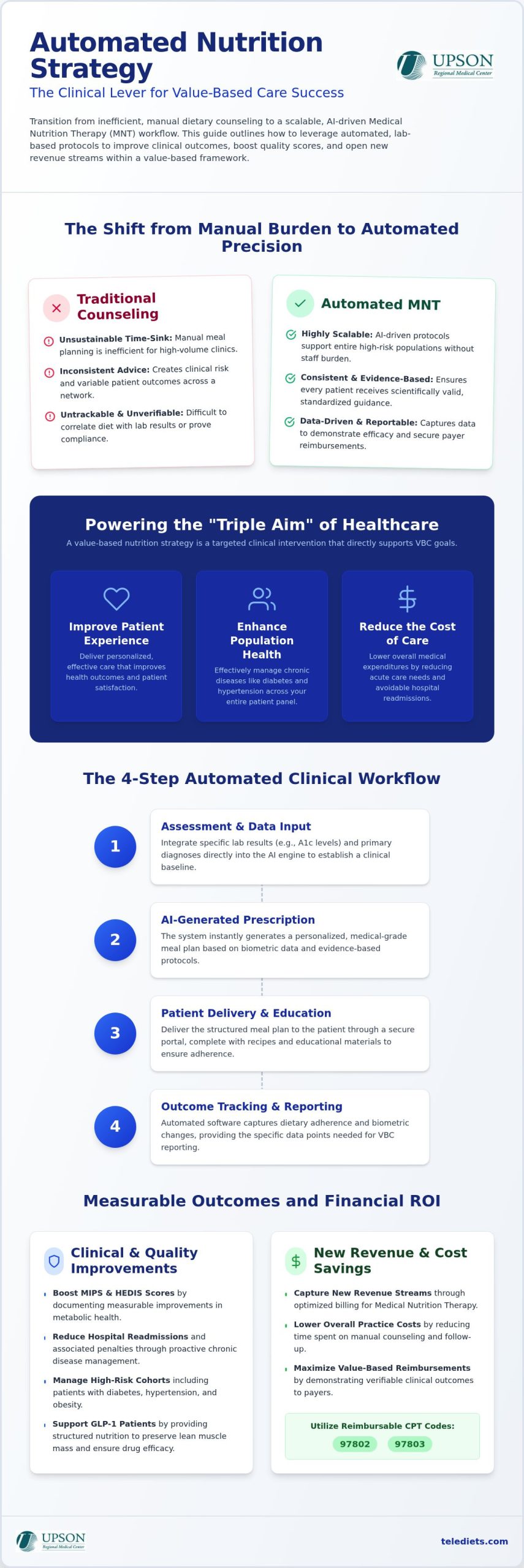
Transitioning from theoretical models to clinical reality requires a structured, repeatable workflow. A successful value-based care nutrition strategy hinges on four distinct steps that move a patient from initial assessment to long-term compliance without draining clinic resources. This systematic approach ensures that nutrition therapy becomes a standard part of every patient encounter rather than an afterthought.
- Assessment: You start by integrating specific lab results and primary diagnoses directly into the AI engine.
- Prescription: The system then generates a personalized, medical-grade meal plan in seconds rather than hours.
- Delivery: You distribute these protocols through a telemedicine plugin, allowing for seamless remote care.
- Monitoring: Finally, you track dietary adherence and adjust the strategy based on follow-up biometric data.
Leveraging AI for Scalable Nutrition Care
Hiring additional staff to handle manual meal planning is often cost-prohibitive for growing practices. An AI-powered nutrition therapy engine solves this by replacing labor-intensive documentation with automated, clinical-grade outputs. This technology ensures that every provider in your practice delivers consistent, evidence-based care while maintaining the highest levels of accuracy for quality reporting, ultimately ensuring your value-based care nutrition strategy remains both accurate and profitable. It allows you to scale your MNT services to thousands of patients without increasing your overhead.
EHR and Telemedicine Integration
Streamlining the provider experience is essential for successful implementation. Dedicated nutrition plugins allow you to prescribe meal plans within your existing digital environment, reducing friction for both the clinician and the patient. Patients benefit from immediate, digital access to their protocols via their own devices, which significantly increases the likelihood of adherence. This digital bridge between the clinic and the home is vital for hitting your value-based targets. To begin automating your clinical workflow, you can get started with our AI-powered MNT tools today.
Financial ROI: Billing, Reimbursement, and Sustainability
A robust value-based care nutrition strategy isn’t just a clinical necessity; it’s a powerful financial engine. By utilizing CPT codes 97802 for initial assessments and 97803 for follow-up visits, practices can generate consistent, direct revenue from medical nutrition therapy. Beyond these billable events, there’s a significant “hidden ROI” found in the reduction of 30-day hospital readmissions. Preventing metabolic crises through precise, automated nutrition protocols reduces the heavy financial penalties often associated with high-risk patient populations. Automated billing tools further enhance this profitability by reducing the administrative burden for MNT, ensuring that your team spends more time on care and less on complex paperwork.
Insurance Billing and CPT Coding Accuracy
Claims for nutrition services are frequently denied due to improper documentation or simple coding errors. Using integrated CPT coding tools ensures that every claim meets the specific requirements of private and public payers. This clinical accuracy is essential for maintaining a sustainable revenue cycle. By automating the capture of required clinical data, you provide the evidence-based documentation necessary for successful reimbursement without manual intervention. This transition from manual to automated coding protects your practice from revenue leakage while supporting better patient outcomes.
Scaling Your Practice with TeleDIETS
The TeleDIETS platform is designed to align clinical excellence with long-term practice profitability. Its AI-powered engine allows you to implement a high-volume value-based care nutrition strategy without the massive overhead of hiring additional specialized staff. Integrating this technology into your operational framework ensures that your practice remains competitive and financially sound as industry standards evolve toward outcome-based payments. You’ll be able to manage more complex cases with higher precision and lower costs. Start optimizing your VBC nutrition strategy with TeleDIETS to secure your practice’s future and improve patient lives.
Future-Proofing Your Practice with Precision Nutrition
The shift from volume to value represents a significant opportunity to reclaim the clinical impact of nutrition without sacrificing practice efficiency. By moving beyond generic advice and adopting lab-based biometric prescriptions, you provide patients with a higher standard of care that directly influences quality scores. Implementing a comprehensive value-based care nutrition strategy allows you to address chronic disease at its root while securing the financial health of your organization through optimized billing and reduced penalties.
Automation is the key to this transition. With the evidence-based Advanced Medical Series and AI-powered meal plan generation, you can provide personalized therapy at scale. Integrated insurance billing tools ensure your efforts are properly reimbursed, turning a traditionally labor-intensive service into a streamlined clinical asset. You’ve already seen how to bridge the gap between the clinic and the kitchen effectively. You can scale your clinical nutrition with TeleDIETS software today. Your practice is ready for the future of medicine.
Frequently Asked Questions
What is the difference between general dietary advice and Medical Nutrition Therapy (MNT) in VBC?
MNT is a formal clinical intervention based on a specific diagnosis and lab work, whereas general advice is non-specific wellness guidance. In a value-based care nutrition strategy, MNT is billable and trackable, allowing providers to link dietary protocols to specific biometric improvements. This data-driven approach is essential for meeting the metabolic targets required by value-based contracts. Unlike generic tips, MNT is a targeted tool for managing chronic disease at a population level.
Which CPT codes are used for medical nutrition therapy reimbursement?
Physicians and clinics primarily utilize CPT codes 97802 and 97803 for MNT services. Code 97802 covers the initial assessment and intervention, while 97803 is used for follow-up visits and reassessments. Using integrated insurance billing and CPT coding tools helps ensure these claims are documented correctly, reducing the risk of denials and maximizing the revenue generated from your nutrition services. This automation simplifies the process of capturing necessary clinical documentation for every encounter.
How does nutrition software improve MIPS or HEDIS scores?
Nutrition software automates the delivery of evidence-based protocols that directly impact metabolic health markers like A1c and blood pressure. By consistently applying the Advanced Medical Series across your patient panel, you stabilize clinical outcomes. This consistency allows you to report improved performance in quality categories, raising your MIPS or HEDIS scores and securing higher incentive payments. It removes the variability of manual counseling, ensuring that every patient receives high-quality, clinical-grade dietary guidance.
Can I bill for nutrition therapy provided via telemedicine?
Yes, you can bill for MNT services delivered remotely by using a dedicated telemedicine plugin. Most payers recognize MNT as a valid telehealth service when it meets the same clinical standards as an in-person visit. This capability allows you to scale your value-based care nutrition strategy by reaching patients in their homes, which improves long-term dietary compliance and reduces the likelihood of avoidable hospital readmissions. Remote monitoring ensures that patients stay engaged with their protocols between visits.
What are the specific nutritional needs for patients on GLP-1 medications?
Patients on GLP-1 receptor agonists require high protein intake and specific micronutrient support to preserve lean muscle mass during rapid weight loss. Without structured GLP-1 Meal Plan Protocols, these patients are at risk for sarcopenia and nutrient deficiencies. Providing targeted nutrition therapy ensures the weight lost is primarily fat tissue, which optimizes the long-term metabolic benefits of the medication while minimizing gastrointestinal side effects. This clinical support is vital for maintaining patient health throughout the treatment.
Leave a Reply