
What if your practice management tool functioned as a clinical partner rather than just a digital calendar? For many providers, the current generation of dietitian practice management software feels more like a lifestyle app than a medical necessity. You’re likely spending hours manually adjusting meal plans or struggling to align nutrition protocols with complex patient lab results. It’s frustrating when your digital tools can’t keep pace with your clinical expertise, especially when navigating the intricacies of MNT insurance billing and CPT codes. This administrative burden doesn’t just drain your energy; it limits your ability to provide high-level care.
We understand that your time is best spent with patients, not wrestling with manual data entry. You deserve a system that functions as a clinical decision support tool. This article outlines the transition to a clinical-grade framework for 2026. You’ll learn how to automate nutrition prescriptions based on real-time data and streamline your billing to maximize reimbursement. We’ll preview the shift toward integrated lab results, the implementation of specialized GLP-1 receptor agonist protocols, and the tools needed to scale medical nutrition therapy for chronic disease management.
Key Takeaways
- Learn how to transition your workflow from basic scheduling to a clinical-grade system that prioritizes automated Medical Nutrition Therapy.
- Discover how advanced dietitian practice management software integrates lab data and diagnoses to generate precise nutrition prescriptions in seconds.
- Identify integrated billing and CPT coding tools that streamline insurance claims and improve reimbursement for chronic disease management.
- Understand the selection criteria for clinical platforms that support specialized protocols, including the Advanced Medical Series and GLP-1 receptor agonist nutrition plans.
Beyond Scheduling: The Evolution of Dietitian Practice Management Software
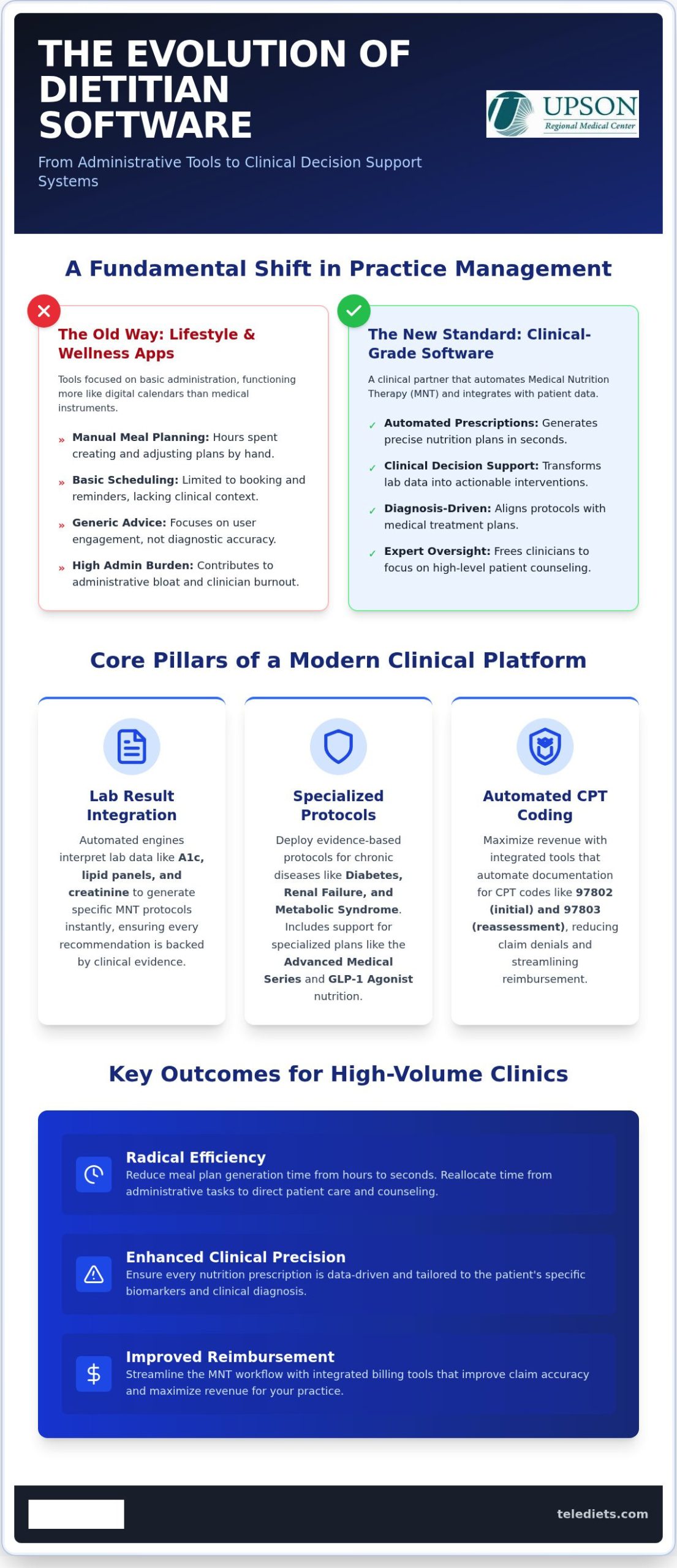
Modern healthcare requires much more than a digital calendar and a basic intake form. While traditional Medical practice management software focuses on administrative tasks like scheduling and billing, the evolution of dietitian practice management software in 2026 centers on clinical decision support. This shift moves the practitioner from manual data entry to a role of expert oversight. In high-acuity environments, your software must function as a therapeutic tool for Medical Nutrition Therapy (MNT) rather than a simple business portal. It’s about transforming raw patient data into actionable, evidence-based interventions that drive measurable health outcomes.
The Difference Between Wellness Coaching and Clinical MNT
Standard wellness apps often fail in a medical setting because they prioritize user engagement over diagnostic accuracy. Clinical-grade platforms require deep integration with lab results, such as lipid panels and A1c levels, to ensure intervention safety. While a lifestyle app might track steps or calories, a medical-grade tool automates complex protocols for Diabetes, Metabolic Syndrome, or Renal care based on specific biomarkers. These professional standards are necessary to meet the rigorous requirements of chronic disease management. It’s the difference between suggesting a “healthy diet” and prescribing a targeted nutritional protocol that aligns with a physician’s treatment plan.
Why Automation is Essential for Modern Healthcare Providers
Administrative bloat is a primary driver of clinician burnout. Manually generating meal plans can take hours, which is unsustainable in high-volume clinics where patient needs are complex. Modern AI engines change this dynamic by generating personalized nutrition prescriptions in seconds. This speed allows you to match the pace of referring physicians while maintaining clinical precision. You don’t have to choose between speed and quality. By automating the generation of the Advanced Medical Series protocols, you can focus on patient counseling and outcomes instead of getting lost in spreadsheets and manual calculations.
Core Pillars of Clinical Nutrition Software: Labs, Protocols, and Billing
A clinical practice requires tools that treat nutrition as medicine. Effective dietitian practice management software moves beyond “what the patient wants” to focus on “what the patient’s labs require.” This involves a shift from generic meal planning to diagnosis-driven protocols for conditions like Diabetes or Renal failure. By integrating these features, you ensure that every recommendation is backed by scientific validity. It’s about moving from administrative support to true clinical decision support that enhances patient outcomes.
Integrating Lab Results and Clinical Diagnoses
Tailoring macronutrient profiles to clinical markers like creatinine or hemoglobin A1c is no longer a manual task. Automated engines interpret patient lab data to generate specific MNT protocols in seconds. This level of precision is essential for managing high-acuity patients who require strict dietary adherence. Following Telehealth best practices ensures that remote care remains as rigorous as in-person consultations. You can quickly deploy the Advanced Medical Series Meal Plans to address specific metabolic needs without spending hours on calculations.
Maximizing Revenue with Integrated CPT Coding Tools
Sustainability in private practice relies on accurate reimbursement. You must utilize specific CPT codes such as 97802 for initial assessments and 97803 for reassessments to capture the full value of your services. Modern software automates the documentation necessary to support these claims, significantly reducing the risk of denials. You don’t have to worry about the complexities of billing codes when your system handles the heavy lifting. For those ready to scale, you can sign up for clinical billing tools that integrate directly into your workflow. This interoperability ensures nutrition data flows into the broader patient EHR, positioning you as an essential part of the medical team. If you’re looking for a clinical-first solution, explore how integrated practice management tools can transform your revenue cycle.
Evaluating Software for High-Volume Clinics: A Selection Framework
Selecting dietitian practice management software for a high-volume clinic requires a rigorous evaluation of its clinical depth. You shouldn’t settle for a system that only manages calendars; you need a framework that supports advanced care. Scrutinize the underlying AI engine closely. A generic large language model often lacks the guardrails needed for medical nutrition therapy. Instead, prioritize specialized clinical engines that generate prescriptions based on validated medical series. These engines ensure that your interventions remain evidence-based even as you scale your patient load across multiple providers.
Specialized Protocols: The Case for GLP-1 Support
Patients utilizing GLP-1 receptor agonists face unique nutritional challenges, including rapid satiety and potential muscle loss. Generic meal plans don’t account for these medication-induced changes or the specific timing requirements for nutrient intake. You need specialized GLP-1 Meal Plan Protocols that prioritize protein density and micronutrient absorption. Without this clinical specificity, providers risk sub-optimal patient outcomes and poor medication tolerance. A clinical-grade platform provides the precise framework necessary to support these high-acuity patients effectively while maintaining safety standards.
Telemedicine and Remote MNT Delivery
Modern practices require seamless, HIPAA-compliant telemedicine plugins that live directly within your provider portal. These tools shouldn’t be an afterthought or a separate login. They must facilitate remote patient monitoring and real-time intervention without adding administrative friction to your workflow. When evaluating software, consider how it handles multi-provider environments. A unified system ensures that your Advanced Medical Series protocols are applied consistently across your entire clinical team. This consistency is vital for maintaining a high standard of care as your practice grows and evolves.
To ensure your clinic meets these high standards, you can get started with clinical-grade protocols today. This transition empowers your team to deliver precise care at any volume while significantly reducing the manual burden on your staff.
Streamlining the MNT Workflow with TeleDIETS AI and Clinical Protocols
The TeleDIETS AI engine represents a fundamental shift in how providers utilize dietitian practice management software. Rather than acting as a passive storage system, it functions as a high-velocity licensing engine designed for clinical precision. By synthesizing lab data and diagnoses, the platform generates evidence-based MNT protocols in seconds. This allows physician-led clinics to adopt a “nutrition-as-a-service” model, where dietary intervention is as integrated and measurable as pharmaceutical therapy. The Standard and Advanced Medical Series provide the foundation for this care, ensuring that diverse patient populations receive targeted, medically validated support.
Scaling Clinical Excellence with Specialized Meal Plan Protocols
In the modern weight management environment, the ability to support patients on GLP-1 receptor agonists is a critical differentiator. TeleDIETS provides specialized GLP-1 Meal Plan Protocols that address the specific physiological needs of these patients, such as maintaining lean muscle mass and managing satiety. These pre-validated series save clinicians hours of manual labor, allowing them to scale their practice without compromising on the quality of care. It’s about leveraging technology to provide expert-level guidance at a pace that matches the speed of modern medicine.
Implementation: Integrating Nutrition SaaS into Your Practice
Onboarding your team and syncing clinical workflows with TeleDIETS is a structured, methodical process. It begins with integrating the Telemedicine Plugin into your existing provider portal, ensuring that remote MNT delivery is seamless and secure. From there, you can license the appropriate medical series to match your clinic’s specialty. This streamlined approach allows you to bridge the gap between initial diagnosis and effective dietary prescription. You can join the clinical nutrition revolution with TeleDIETS to start transforming your patient outcomes through advanced automation and evidence-based protocols.
The Future of Precision Nutrition Therapy
The landscape of medical nutrition therapy is shifting from manual administrative tasks to automated clinical decision support. As you look toward the requirements of 2026, the right dietitian practice management software should serve as a force multiplier for your clinical expertise. By integrating lab data with the evidence-based Advanced Medical Series, you ensure every patient receives a prescription tailored to their specific metabolic needs. You’ve seen how specialized GLP-1 support protocols and integrated CPT 97802/97803 billing tools can transform a high-volume clinic into a streamlined, profitable center of excellence.
This transition empowers you to focus on what matters most: the clinical outcomes of your patients. You don’t have to navigate the complexities of modern healthcare alone. With the right tools, you can scale your impact and provide elite-level care without increasing your administrative burden. Scale your clinical practice with TeleDIETS MNT software and lead the way in evidence-based nutrition. Your practice is ready for the next level of clinical precision.
Frequently Asked Questions
What is the difference between dietitian EHR and practice management software?
EHRs primarily focus on storing longitudinal patient health records, while practice management software handles the operational and administrative aspects of a clinic. Clinical-grade platforms often combine these functions to provide a unified workflow. While the EHR maintains the patient’s medical history, the management system uses that data to drive scheduling, billing, and the generation of specific Medical Nutrition Therapy protocols. This ensures your clinical decisions and business operations remain perfectly aligned.
Can dietitian software help with CPT coding and insurance billing for MNT?
Clinical-grade software provides integrated tools to automate CPT coding and streamline insurance billing for Medical Nutrition Therapy. The system facilitates the use of specific codes like 97802 and 97803 by generating the necessary clinical documentation automatically. This reduces the risk of claim denials and administrative errors. By using these specialized billing tools, your clinic can improve its reimbursement accuracy and ensure the financial sustainability of chronic disease management services.
How does AI-powered nutrition software integrate with patient lab results?
AI-driven platforms integrate with lab results by using a specialized clinical engine to analyze patient biomarkers like A1c or lipid panels. The system synthesizes this data to generate a personalized nutrition prescription in seconds. This allows you to deploy the Advanced Medical Series protocols that are specifically tailored to the patient’s current health status. It replaces manual calculations with data-driven precision, ensuring that every dietary plan is grounded in recent diagnostic findings.
Are there specific nutrition protocols for patients on GLP-1 medications?
There are specialized GLP-1 Meal Plan Protocols designed specifically for patients on GLP-1 receptor agonists. These protocols address unique clinical needs such as maintaining lean muscle mass and managing medication-induced satiety changes. Standard dietitian practice management software that lacks these medical series cannot provide the necessary protein density or micronutrient focus. Using evidence-based protocols ensures that your patients receive the therapeutic support required to achieve successful outcomes while on these medications.
Is dietitian practice management software HIPAA compliant for telemedicine?
High-quality dietitian practice management software is designed to be HIPAA compliant, providing secure environments for telemedicine and patient data storage. This compliance is usually delivered through a specialized telemedicine plugin that integrates directly into your clinical workflow. These tools enable you to conduct remote consultations and monitor patient progress while protecting sensitive health information. It ensures your practice meets all federal privacy standards while delivering medical-grade nutrition therapy across a national patient base.
Leave a Reply