
What if the time you spend documenting 15-minute MNT increments could be halved while simultaneously slashing your insurance claim denial rate? Many practitioners feel the weight of the 2026 Medicare Physician Fee Schedule changes, especially with the strict diagnosis requirements for renal and diabetes claims taking effect this August. It’s frustrating to provide life-changing care only to have a reimbursement denied because a CPT code didn’t perfectly align with a specific dietary protocol. You can reclaim your clinical focus by using specialized medical nutrition therapy billing software designed to bridge the gap between complex ICD-10 codes and evidence-based meal planning.
We understand that your priority is patient outcomes, not administrative hurdles. This guide explores how to integrate clinical-grade dietary protocols directly into your workflow to justify medical necessity, automate unit tracking, and secure the higher reimbursement rates your expertise deserves. By the end of this article, you’ll have a clear roadmap for selecting a platform that transforms your billing from a chore into a clinical asset.
Key Takeaways
- Master the nuances of CPT codes 97802, 97803, and 97804 to ensure every 15-minute increment of care is accurately captured for reimbursement.
- Discover how specialized medical nutrition therapy billing software automates the transition from clinical consultation to claim submission, reducing administrative fatigue and denial rates.
- Learn to leverage lab data to generate evidence-based dietary protocols that provide the scientific justification needed for complex medical necessity reviews.
- Explore the integration of advanced tools, such as the Telemedicine Plugin, to maintain professional billing standards while delivering remote nutrition therapy.
Navigating the Complexities of Medical Nutrition Therapy Reimbursement
Effective medical nutrition therapy billing software isn’t just an accounting tool; it’s a specialized clinical engine designed to manage CPT codes 97802, 97803, and 97804. While general EHR systems handle broad practice needs, they often lack the granularity to track the 15-minute increments essential for MNT. This gap leads to revenue leakage and audit risks. Understanding how these tools fit into the broader medical billing process ensures your practice captures every billable minute while maintaining clinical integrity.
The shift toward value-based care has placed nutrition at the center of chronic disease management. However, this transition introduces significant friction points. Aligning specific ICD-10 codes with dietary protocols is increasingly difficult; especially with 2026 regulations requiring strict diagnosis documentation for diabetes and renal disease. Specialized software solves this by automatically linking patient data to the necessary medical necessity justifications.
Essential CPT Codes for Nutrition Services
Precision starts with the correct application of codes. 97802 covers the initial individual assessment and intervention, while 97803 is utilized for subsequent re-assessments and follow-up care. CPT code 97804 for group medical nutrition therapy must be billed in 30-minute increments to remain compliant with federal audit standards.
High-performance medical nutrition therapy billing software tracks cumulative time across these units, preventing the common mistakes of over-billing or under-billing that trigger insurance denials. By automating this tracking, you ensure that your documentation reflects the actual duration of the clinical encounter. This level of accuracy is vital for securing reimbursement in an environment where payers scrutinize the relationship between time spent and patient outcomes.
Core Features of High-Performance MNT Billing Software
High-performance medical nutrition therapy billing software transforms administrative burden into a streamlined clinical workflow. It doesn’t just track time; it validates the medical necessity of every intervention. By integrating real-time eligibility verification, practitioners can confirm Medicare coverage for MNT before the session starts, significantly reducing front-end claim rejections. All clinical-grade nutrition prescriptions and patient records are stored in HIPAA-compliant cloud environments, ensuring your documentation remains secure and easily accessible for future reviews.
Automated ICD-10 Mapping and Clinical Documentation
Modern platforms bridge the gap between diagnosis and treatment. They automatically map ICD-10 codes, such as Type 2 Diabetes or Metabolic Syndrome, to specialized Advanced Medical Series Meal Plans. This automation generates audit-ready documentation during the consultation. You won’t have to worry about manual entry errors because the software justifies the clinical rationale behind each protocol. This ensures your claims stand up to payer scrutiny while providing patients with evidence-based care.
Telemedicine Integration for Remote Care
Delivering care remotely requires tools that capture billing data without interrupting the patient experience. A dedicated Telemedicine Plugin captures the duration of virtual visits and automatically applies the correct place-of-service (POS) codes. This ensures that remote sessions are billed accurately according to 2026 standards for virtual supervision. By linking the meal plan generator directly to the billing module, you eliminate the need for administrative double-entry. If you’re looking to enhance your virtual practice, you can integrate clinical billing tools directly into your existing workflow for maximum efficiency.
Using robust medical nutrition therapy billing software allows you to prioritize patient outcomes over paperwork. When your systems are synchronized, you create a stable foundation for a scalable, insurance-based nutrition practice.
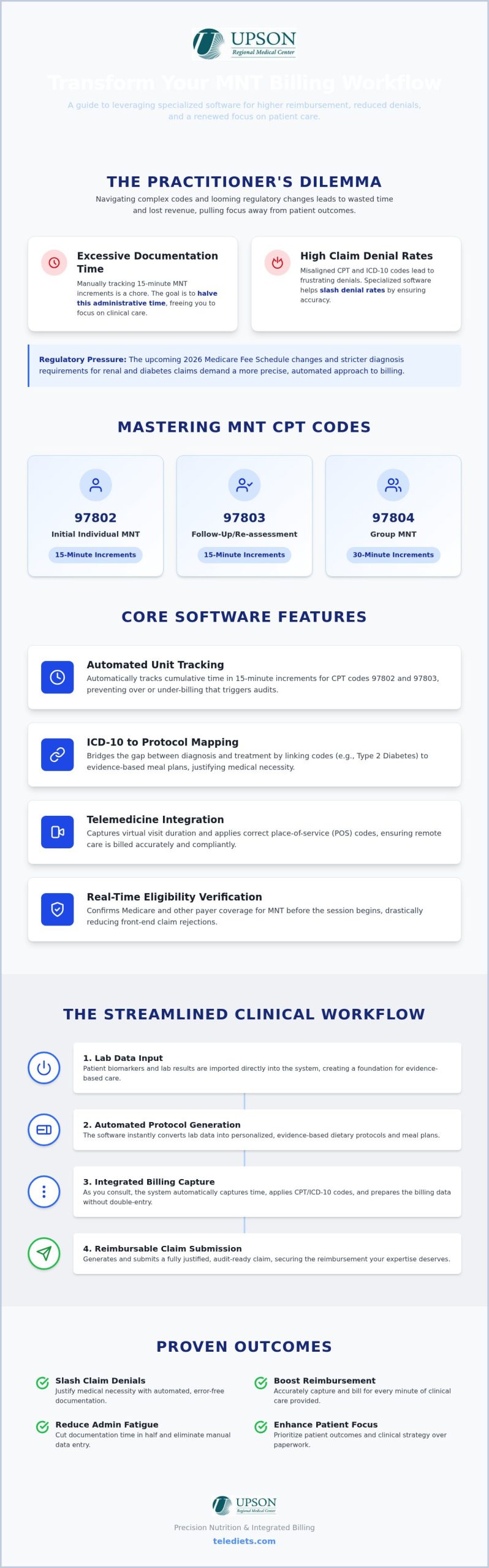
Streamlining the Path from Lab Results to Reimbursable Claims
Converting lab data into a personalized dietary protocol in seconds is the ultimate workflow advantage for a modern clinic. Traditional systems force you to manually cross-reference biomarkers with nutrition plans, but advanced medical nutrition therapy billing software automates this transition. By linking your meal plan generator directly to the billing module, you eliminate the administrative double-entry that often leads to transcription errors. This integration ensures every prescription is backed by the latest clinical data, which is essential as professional organizations advocate for the Medical Nutrition Therapy Act to expand patient access to these vital services.
Integrating Lab-Based Nutrition Prescriptions
You can use specific lab results, such as HbA1c levels or lipid profiles, to immediately trigger the appropriate Standard Series or Advanced Medical Series plans. The software acts as a ‘Clinical-to-Claim’ bridge by validating that the selected meal plan directly addresses the patient’s documented diagnosis, creating a transparent audit trail. This scientific alignment is crucial for meeting the 2026 requirement that claims for codes like 97802 must include specific diagnoses for diabetes or renal disease to avoid automatic denial.
Beyond the initial claim, tracking patient outcomes provides the objective data needed for long-term MNT authorization. When you can demonstrate measurable improvements in patient health, insurance providers are more likely to approve extended care. Modern interfaces are designed with clinical staff in mind, significantly reducing training time through intuitive, logical layouts that mirror a standard consultation. You don’t need to be a coding expert to submit clean claims; the system handles the technical complexity. If you’re ready to modernize your practice, get started with TeleDIETS today to see how integrated tools can transform your clinical efficiency.
The TeleDIETS Solution: Precision Nutrition and Integrated Billing
TeleDIETS functions as a comprehensive AI engine for clinics that demand scientific precision alongside administrative efficiency. It moves beyond basic documentation by providing a suite of Insurance Billing & CPT Coding Tools that automate the financial side of patient care. This integration ensures that your medical nutrition therapy billing software works in tandem with your clinical protocols, reducing the risk of human error during code entry. It’s a stable partnership that prioritizes your success.
The platform is uniquely positioned to support high-growth clinical areas, such as obesity management through specialized GLP-1 Meal Plan Protocols. These evidence-based plans provide the necessary documentation to justify medical necessity for patients on weight-loss medications. Providers can view the TeleDIETS member checkout to explore the various integration levels available for their specific practice size. Precision care requires precision tools.
Scaling with GLP-1 and Advanced Medical Series
Specialized protocols do more than improve patient health; they enhance billing consistency. When patients follow structured Advanced Medical Series plans, their progress is easier to document for long-term authorization. For high-volume primary care environments, the Standard Series plans offer a turnkey solution that allows staff to provide quality care without spending hours on meal planning. This efficiency allows you to see more patients without increasing your administrative load.
Implementing the Telemedicine Plugin
Integrating the Telemedicine Plugin into your current telehealth platform is a straightforward process that yields immediate results. By automating the capture of session duration and applying the correct place-of-service codes, you maximize remote MNT revenue. This allows you to focus on the consultation while the software handles the technical requirements of current Medicare guidelines. Methodical implementation ensures your medical nutrition therapy billing software remains a tool for growth rather than a source of frustration.
Future-Proof Your Nutrition Practice with Integrated Billing
Navigating the 2026 regulatory landscape requires more than just clinical expertise; it demands a technological foundation that aligns your care with payer requirements. We’ve explored how specialized medical nutrition therapy billing software bridges the gap between patient consultations and successful reimbursement. By automating CPT coding for 97802 and 97803, you’ll ensure every 15-minute increment of your time is accurately captured. Integrating evidence-based meal plan protocols directly into your workflow provides the scientific justification needed to satisfy strict medical necessity audits.
As you look toward scaling your practice, remember that efficiency is your greatest asset. Tools like the Telemedicine Plugin allow you to maintain this precision across virtual care environments, capturing revenue without adding to your administrative burden. You have the clinical skills to change lives; let modern technology handle the complexities of the claim cycle. It’s time to empower your practice with a solution that values your expertise as much as you do. Scale your practice with TeleDIETS MNT Billing Tools and secure your professional future today.
Frequently Asked Questions
What are the most common CPT codes used by medical nutrition therapy billing software?
The primary codes utilized by medical nutrition therapy billing software include 97802 for initial assessments and 97803 for individual reassessments. Both codes are billed in 15-minute units. For group sessions, 97804 is the standard code, billed in 30-minute increments. Specialized software ensures that these units are tracked accurately during the consultation, preventing common errors like under-billing or exceeding the daily maximum units allowed by specific insurance payers.
Can physicians bill for MNT services provided by their staff using this software?
Physicians can bill for MNT services provided by staff, such as Registered Dietitians, provided they meet Medicare’s direct supervision requirements. The 2026 Physician Fee Schedule allows for virtual direct supervision in many clinical scenarios. Using integrated billing tools helps practices document the supervising physician’s involvement and ensures that the claims meet the necessary criteria for incident to billing, which is essential for maximizing revenue within a multi-disciplinary medical practice.
How does MNT software ensure compliance with Medicare’s 15-minute billing increments?
Dedicated medical nutrition therapy billing software uses automated time-tracking features to monitor the exact duration of each patient encounter. The system automatically calculates the total number of 15-minute units based on the session’s start and end times. This automation eliminates the need for manual calculations, which often lead to audit red flags. It ensures that your documentation precisely matches the units billed, providing a stable foundation for compliance during payer reviews.
Is a specialized telemedicine plugin necessary for billing remote nutrition consultations?
While you can bill for remote MNT using general tools, a specialized Telemedicine Plugin is highly recommended for accuracy. It automatically applies the correct place-of-service codes and modifiers required for telehealth reimbursement. This specific tool integrates the session timer directly with the billing module, ensuring that remote consultations are captured as billable units without administrative double-entry. It provides the clinical precision needed to maintain high reimbursement rates for virtual chronic disease management.
Does medical nutrition therapy software support billing for GLP-1 support protocols?
Yes, the software supports billing for GLP-1 Meal Plan Protocols by linking these specialized interventions to the appropriate CPT codes and diagnostic data. It generates the clinical documentation required to justify medical necessity for patients on weight-loss medications. By using Advanced Medical Series protocols, practitioners can provide evidence-based care that is fully documented for insurance review, ensuring that the intensive nutritional support required for GLP-1 patients is recognized and reimbursed.
Leave a Reply