
Could your practice be losing thousands in untapped revenue simply because manual meal planning takes too long to bill effectively? In 2026, the ROI of medical nutrition therapy services is no longer just a clinical goal; it’s a measurable engine for practice growth. You likely already recognize that nutrition is the cornerstone of managing chronic conditions like diabetes or renal disease. Yet, when faced with low reimbursement rates for manual counseling and the complexity of CPT coding, it’s easy to view MNT as an administrative burden rather than a financial asset.
We believe you shouldn’t have to choose between quality care and a healthy bottom line. This guide provides a clear framework for calculating MNT profitability by removing the time variable from your clinical workflow. We’ll examine evidence-based protocols that generate clinical-grade meal plans in seconds, allowing you to leverage the 2026 Medicare reimbursement rate of $31.73 for CPT 97803 without the traditional burnout. You’ll learn how to integrate specialized GLP-1 protocols and advanced medical series to improve patient retention and transform your nutrition services into a streamlined, high-yield department.
Key Takeaways
- Master the specific CPT billing codes and Medicare requirements necessary to maximize the ROI of medical nutrition therapy services in your practice.
- Discover how AI-driven automation can reduce your “time-to-prescribe” from sixty minutes to sixty seconds while maintaining clinical precision.
- Learn how specialized nutritional protocols for GLP-1 receptor agonists can prevent muscle loss and nutrient deficiencies to improve long-term patient outcomes.
- Identify the strategic advantages of MNT in value-based care models, including its proven ability to reduce hospitalizations and physician service costs.
Quantifying the ROI of Medical Nutrition Therapy in Modern Practice
Understanding What is Medical Nutrition Therapy (MNT) is a vital step toward unlocking its economic potential. In 2026, the ROI of medical nutrition therapy services is defined by a triad of clinical outcomes, direct insurance reimbursement, and long-term patient retention. While traditional “manual MNT” often suffered from high overhead due to time-intensive meal planning, the transition to automated protocols has shifted the service into a high-margin revenue driver.
Research published via PubMed highlights that for chronic populations, the savings generated by reduced hospitalizations can significantly exceed the initial implementation costs of MNT programs. Within 2026 value-based care models, these results translate directly into quality incentive payments that reward providers for proactive management. By stabilizing patient health through nutrition, practices secure their standing in performance-based networks and maximize their Medicare reimbursement potential while simultaneously reducing the clinical burden on the entire care team.
Clinical vs. Financial ROI: A Dual Perspective
Superior health outcomes often act as a precursor to financial stability. Measurable improvements in HbA1c and BMI drive patient satisfaction, which directly correlates with higher retention rates. When you provide clinical-grade nutrition protocols, you often reduce the need for aggressive medication titration. This stabilization makes patient management more predictable and less resource-intensive over time, allowing your staff to focus on higher-level care instead of constant crisis management for uncontrolled conditions.
The Cost of Inaction: Missing the MNT Opportunity
Practices that ignore integrated nutrition services face a significant revenue leak as patients turn to unverified consumer apps for advice. These apps don’t offer the clinical validity of a physician-led program, yet they capture patient engagement that belongs in your clinic. MNT ROI is the net profit generated per physician-minute after software automation. By capturing this demand in-house, you turn a common patient request into a sustainable business asset that supports both the patient’s health and the practice’s longevity.
Direct Revenue Drivers: CPT Coding and Insurance Reimbursement
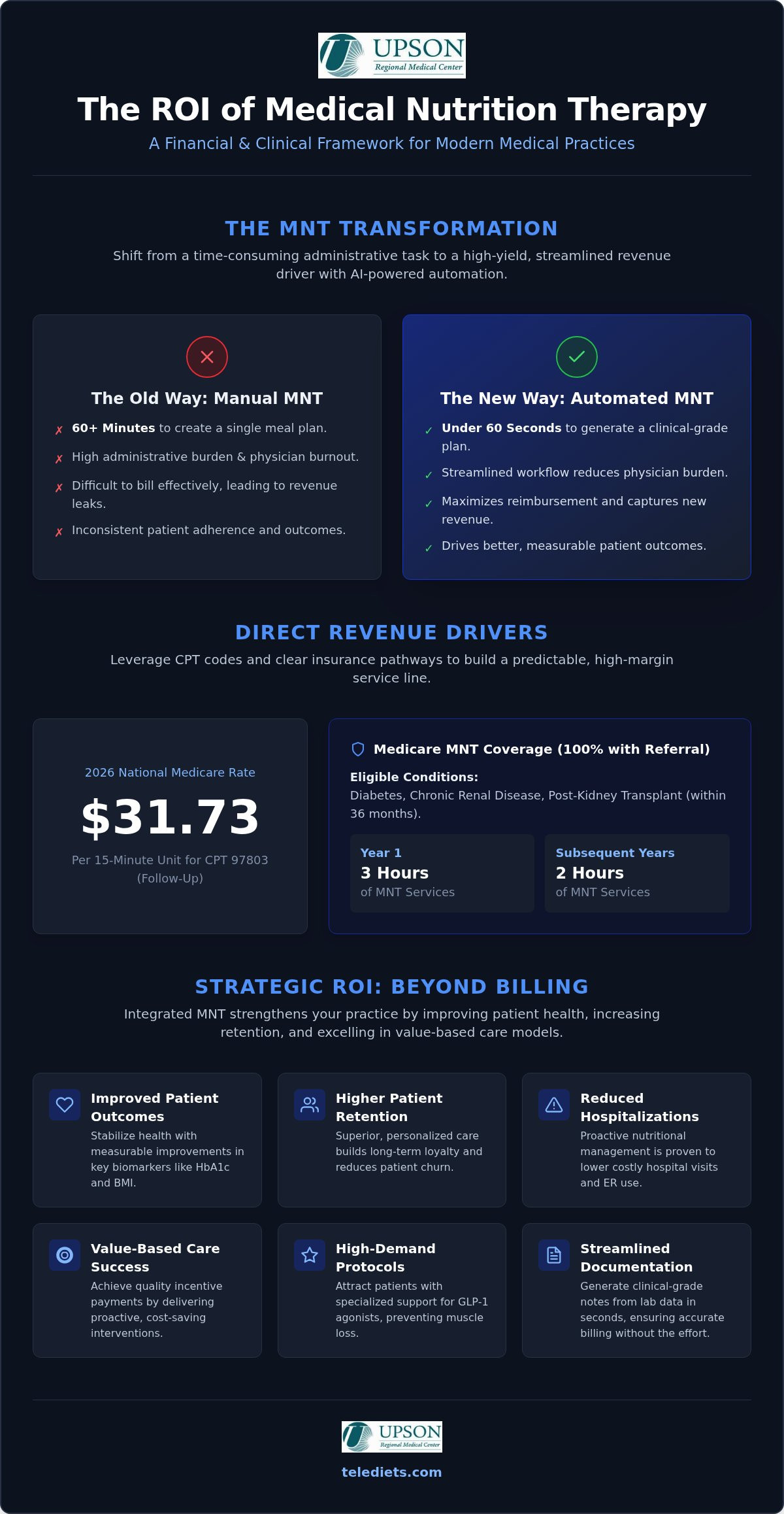
Medicare Part B provides a structured foundation for reimbursement. For patients with diabetes, chronic renal disease, or those who are 36 months post-kidney transplant, Medicare covers 100% of MNT with a referral. This includes three hours in the first year and two hours in subsequent years. By scheduling regular follow-ups, you don’t just improve patient health; you build a predictable calendar of billable events that supports the ROI of medical nutrition therapy services. Systematic reviews on the cost-effectiveness of MNT demonstrate that these interventions reduce long-term medical spending, making them attractive to payers.
The core billing units are CPT 97802 for the initial assessment and CPT 97803 for follow-up sessions. In 2026, the national Medicare rate for CPT 97803 is $31.73 per 15-minute unit. Using integrated insurance billing and CPT coding tools ensures that these units are captured accurately. This reduces administrative friction and prevents the revenue leakage common in manual systems.
Maximizing CPT 97802 and 97803
Documentation is the bridge between care and payment. To ensure full reimbursement, physicians must record assessment details, nutrition goals, and time spent during the session. TeleDIETS tools streamline this by generating clinical-grade documentation from lab data in seconds. This precision helps you optimize your billing workflow while maintaining high standards of care without increasing physician burnout.
Private Payer Trends for Nutrition Services
Commercial insurers are increasingly following Medicare’s lead by expanding coverage for metabolic syndrome and preventative nutrition. They recognize that proactive MNT is a cost-saving measure compared to treating advanced complications. Many private plans now allow for more flexible visit limits than Medicare, offering a broader window to prove the ROI of medical nutrition therapy services across a diverse patient base.
Operational ROI: Reducing Physician Burden with AI Automation
The traditional barrier to MNT was the sheer volume of manual work required. Physicians often spent up to 60 minutes per patient on meal planning, which made the service financially unviable. AI automation fundamentally changes the ROI of medical nutrition therapy services by reducing this “time-to-prescribe” to just 60 seconds. By leveraging lab-based nutrition prescription software, you can generate clinical-grade plans based on real-time data. You don’t need to hire a full-time in-house dietitian for every primary care location to offer high-quality care.
Scaling MNT Without Increasing Headcount
SaaS platforms allow a single provider to manage 5x more MNT patients compared to manual methods. Integrating these tools into your existing EHR and telemedicine workflows ensures that nutrition therapy becomes a seamless part of the consultation. Telemedicine plugins and automated patient delivery systems further reduce administrative overhead. You’re no longer responsible for the logistics of plan distribution; the software handles the fulfillment, leaving your team free to focus on patient outcomes.
Advanced Medical Series: High-Complexity, Low-Effort
Managing complex metabolic syndrome or renal cases often demands extensive manual research to ensure safety and efficacy. The Advanced Medical Series Meal Plans provide evidence-based protocols that remove this burden entirely. Automated clinical-grade protocols ensure 100% adherence to the latest MNT standards, which protects your practice from the risks of outdated advice. This high-complexity, low-effort approach allows you to treat specialized populations profitably. You can access these automated MNT tools to start scaling your clinical revenue today.
Strategic ROI: High-Demand Protocols and Patient Retention
It’s no longer just about billing; the strategic ROI of medical nutrition therapy services extends far beyond individual units. It creates a “sticky” practice environment where patients view your clinic as a comprehensive wellness partner. In 2026, the most significant growth area is the GLP-1 opportunity. Patients using GLP-1 receptor agonists require specific nutritional interventions to prevent lean muscle mass loss and manage common gastrointestinal side effects. By providing these specialized protocols, you ensure higher drug efficacy and better long-term outcomes, which naturally increases patient loyalty. Using the TeleDIETS AI engine, you can offer the Advanced Medical Series as a premium service tier for patients with complex needs. This approach empowers your staff to deliver high-level care with minimal manual effort.
The GLP-1 Nutrition Synergy
Quantifying the ROI of a specialized GLP-1 support program involves measuring both increased retention and reduced medication dropouts. Our GLP-1 Meal Plan Protocols focus on high-protein intake to protect metabolic health. These evidence-based strategies improve the patient experience by mitigating nausea and fatigue. This proactive model positions your practice as a leader in modern obesity management and loyalty.
Telemedicine Integration: Expanding Your Reach
Remote delivery via telemedicine plugins allows you to scale MNT services without geographic constraints. You can attract a national patient base by offering digital-first clinical nutrition that fits busy schedules. This remote model maximizes the ROI of medical nutrition therapy services by lowering overhead costs. Ready to scale? Start your TeleDIETS subscription today to transform your practice into a high-yield clinical engine.
Future-Proofing Your Clinical Revenue with Automated MNT
Medical nutrition therapy is no longer an administrative hurdle or a low-margin service. By leveraging modern automation, you can transform complex dietary management into a streamlined revenue stream that enhances both patient outcomes and practice stability. You’ve seen how integrating CPT coding support and generating lab-based plans in seconds removes the time barrier that previously limited the ROI of medical nutrition therapy services. Whether you’re managing high-demand populations with specialized GLP-1 protocols or scaling chronic disease care through the Advanced Medical Series, the tools for profitable growth are now within reach.
Shifting to a technology-forward approach ensures your practice remains competitive in a value-based care environment. You can empower your team to deliver clinical-grade nutrition without increasing headcount or physician burnout. The future of integrated care is efficient, evidence-based, and financially sustainable. We’re here to help you navigate this transition with confidence.
Automate your MNT workflow and maximize ROI—Subscribe to TeleDIETS now
Frequently Asked Questions
How much can a clinic typically bill for MNT services per patient?
Medicare reimburses CPT 97803 at a national rate of $31.73 per 15-minute unit in 2026. For an initial three-hour assessment under CPT 97802, a clinic can bill up to 12 units. Subsequent two-hour follow-up sessions allow for 8 units annually. Total revenue per patient depends on the specific units documented and the negotiated rates with private payers, which often vary from standard Medicare schedules.
Is MNT covered by insurance for conditions other than diabetes and kidney disease?
Medicare Part B strictly covers MNT for diabetes, non-dialysis kidney disease, and post-transplant care. However, many private insurance providers have expanded coverage to include metabolic syndrome and obesity management. These payers recognize that proactive nutrition reduces long-term medical spending. It’s essential to verify individual plan benefits, as the ROI of medical nutrition therapy services is often highest when treating metabolic conditions before they escalate.
Do I need a Registered Dietitian on staff to bill for MNT services?
Medicare requires that MNT services be provided by a Registered Dietitian or a nutrition professional meeting specific regulatory requirements. While the physician provides the referral, the dietitian typically performs the assessment and intervention. Under the Medicare Physician Fee Schedule, RDNs are reimbursed at 85% of the physician’s rate. Utilizing automated tools allows an RD to manage a higher patient volume, maximizing the efficiency of your staff.
How does automated MNT software improve practice ROI compared to manual methods?
Automated software eliminates the time variable that often makes manual counseling unprofitable. By reducing the time-to-prescribe from sixty minutes to sixty seconds, software allows your practice to scale services without increasing headcount. This efficiency directly improves the ROI of medical nutrition therapy services by lowering the cost per encounter while ensuring all clinical protocols and CPT documentation requirements are met with precision.
Can MNT services be delivered and billed via telemedicine?
MNT services can be delivered and billed via telemedicine using specific modifiers to indicate remote care. Medicare and many private payers continue to support telehealth for nutrition counseling to improve patient access. By using an integrated telemedicine plugin, your clinic can offer digital-first nutrition support. This model reduces in-office overhead and allows you to maintain a recurring revenue stream through remote follow-up sessions and digital meal plan delivery.
Leave a Reply