
What if the primary obstacle to your clinic’s growth isn’t a lack of patients, but a fragmented approach to MNT revenue cycle management? You’re likely all too familiar with the frustration of seeing complex CPT codes like 97802 and 97803 met with low reimbursement rates or administrative denials. It’s exhausting to balance high-level clinical protocols with the manual burden of billing, especially when the 2026 regulatory landscape demands even stricter diagnostic documentation. You deserve a system that honors your expertise while securing your financial future.
This guide provides the clinical and operational blueprint you need to transform your billing from a hurdle into a streamlined engine for profitability. We’ll explore how to integrate lab-based diagnostics with automated coding tools to ensure your practice captures the full value of the MNT services you provide. By aligning your clinical workflow with modern financial operations, you can finally achieve the seamless integration required to thrive in a value-based care environment.
Key Takeaways
- Understand why MNT revenue cycle management demands a specialized approach distinct from standard primary care billing to ensure every referral is captured accurately.
- Master the nuances of CPT codes 97802 and 97803 to prevent claim denials and optimize your clinic’s financial performance.
- Learn to bridge the gap between clinical documentation and financial outcomes. Implementing a structured five-stage billing lifecycle makes this process seamless.
- Discover how integrated digital tools automate the generation of lab-based protocols. This reduces administrative time while improving patient care.
Understanding Revenue Cycle Management for Medical Nutrition Therapy
MNT RCM is the synchronization of clinical nutrition delivery with financial reimbursement. While Understanding Revenue Cycle Management provides a baseline for any medical practice, nutrition services require a specialized focus. Effective MNT revenue cycle management ensures that your expertise in managing chronic conditions translates into sustainable clinic revenue. Unlike general primary care billing, nutrition therapy relies on 15-minute time-based units, strict referral verification, and specific annual session limits. This precision directly impacts patient access to clinical-grade dietary protocols. When your financial operations are seamless, you can focus on patient outcomes rather than administrative friction.
The Financial Importance of MNT in Modern Practice
Nutrition therapy is a cornerstone of value-based care. Approximately 60% of U.S. adults live with at least one chronic disease, and these conditions drive nearly 90% of the $4.87 trillion in annual healthcare spending. By optimizing your billing, you contribute to lower long-term costs and improved patient health. Additionally, robust nutrition documentation helps providers boost their MIPS and MACRA scores. This demonstrates the high-value nature of clinical nutrition in any modern, physician-led environment, making it a strategic asset for practice growth.
Common Hurdles in Nutrition Billing
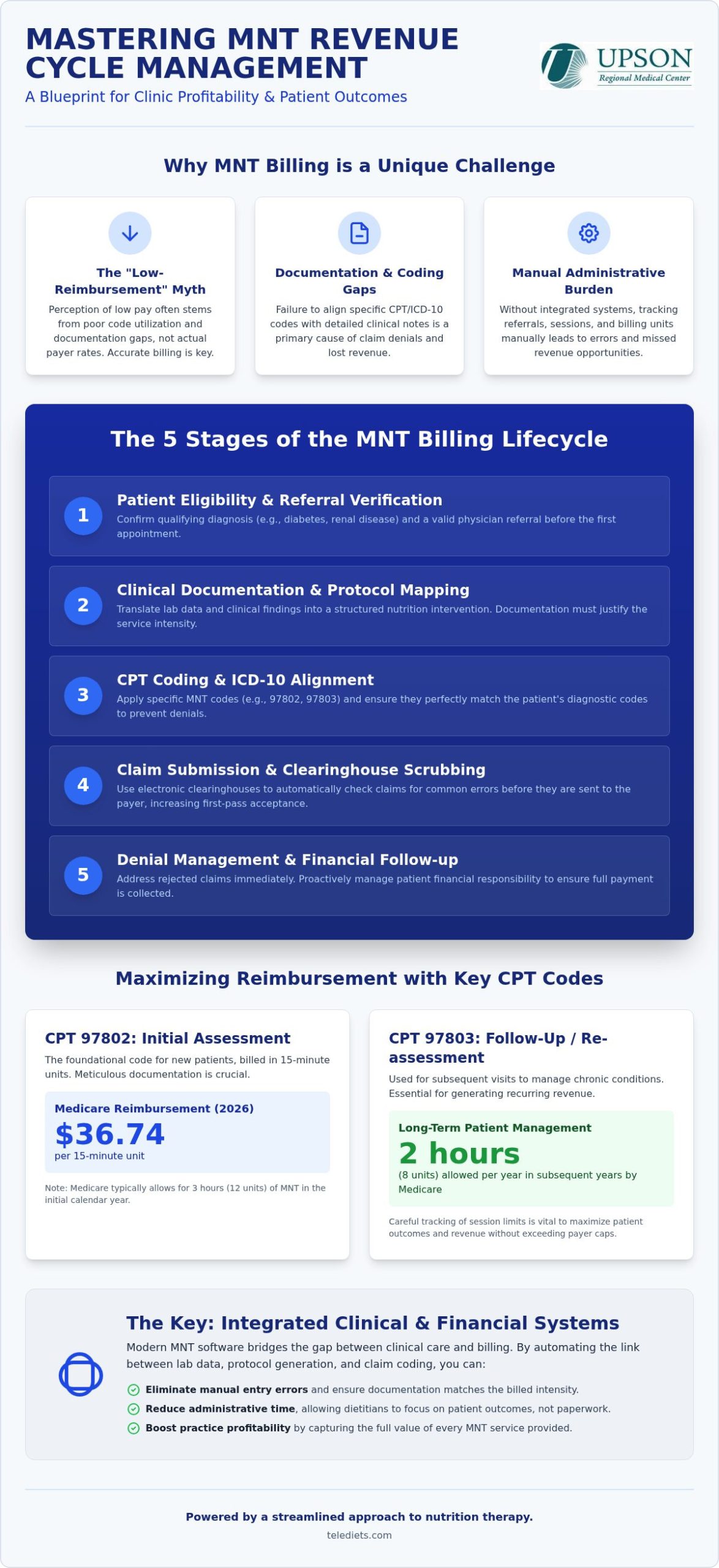
Many practitioners struggle with the “low-reimbursement” myth. This perception often stems from poor code utilization or documentation gaps rather than actual payer rates. For example, in 2026, the Medicare reimbursement rate for CPT 97802 is $36.74 per unit. Capturing these units accurately requires tight coordination between the dietitian and the physician’s billing office. Without integrated systems, the administrative burden of manual tracking often leads to missed revenue. Overcoming these hurdles is the first step toward a more profitable and scalable nutrition program that rewards clinical excellence.
The 5 Stages of the MNT Billing Lifecycle
Effective MNT revenue cycle management follows a methodical progression from the initial referral to the final payment. Precision at each stage prevents the administrative delays that often plague nutrition clinics. Mastery of this cycle ensures that clinical expertise is rewarded with financial stability while maintaining compliance with 2026 standards.
- Step 1: Patient Eligibility and MNT Referral Verification. Confirm that the patient has a qualifying diagnosis, such as diabetes or non-dialysis renal disease, and a valid physician referral.
- Step 2: Clinical Documentation and Diagnosis-to-Protocol Mapping. Translate lab data and clinical findings into a structured nutrition intervention.
- Step 3: CPT Coding and ICD-10 Alignment. Apply specific codes like 97802 for initial assessments and 97803 for re-assessments while ensuring they match the patient’s diagnostic codes.
- Step 4: Claim Submission and Clearinghouse Integration. Use electronic clearinghouses to scrub claims for errors before they reach the payer.
- Step 5: Denial Management and Patient Financial Responsibility. Address rejected claims immediately. Per regulations effective August 3, 2026, claims will be denied if submitted without a required diagnosis.
Following industry best practices helps mitigate these common administrative pitfalls and ensures your practice remains audit-ready.
Syncing Clinical Data with Financial Claims
Modern RCM requires that lab results and clinical diagnoses automatically inform the coding process to eliminate manual entry errors. This alignment ensures that the intensity of the service is reflected in the final claim. Automated meal plan protocols ensure documentation matches the billed intensity, creating a verifiable link between the patient’s health status and the services rendered. Utilizing integrated clinical software can automate this bridge, significantly reducing your administrative burden.
Optimizing Follow-up Revenue
Capturing recurring revenue depends on the effective use of CPT 97803. While the initial assessment is vital, the long-term management of chronic disease happens in follow-up sessions. Medicare typically allows for three hours of MNT in the initial year and two hours in subsequent years. Managing these session limits carefully ensures you maximize patient outcomes without exceeding payer caps.
Maximizing Reimbursement: CPT Codes and Documentation Standards
Navigating the technicalities of coding is essential for successful MNT revenue cycle management. For 2026, CPT 97802 remains the standard for initial individual assessments, reimbursed at $36.74 per 15-minute unit. In contrast, CPT 97803 covers re-assessments at $31.73 per unit. When a patient experiences a significant change in medical condition or diagnosis, you should transition to HCPCS codes G0270 or G0271. These codes allow for additional hours beyond the standard Medicare limits of three hours in the first year and two hours thereafter, provided the medical necessity is clearly documented.
Documentation must explicitly demonstrate this necessity to survive payer audits. Providing evidence-based meal plans serves as concrete proof of service delivery and clinical intent. Since August 3, 2026, CMS has enforced a stricter policy where claims lacking a specific diagnosis are automatically denied. Your clinical notes shouldn’t just record the visit; they must justify the intensity of the intervention through direct lab-to-protocol mapping. This level of detail protects your revenue and validates the clinical value you provide.
The GLP-1 Factor in RCM
GLP-1 receptor agonist protocols represent a high-growth area for modern clinics. Patients on these medications require intensive MNT to manage appetite, prevent muscle loss, and ensure sustainable results. Positioning specialized nutrition as a necessary companion to pharmacological treatment allows you to bill for higher complexity. This approach ensures that the clinical oversight matches the patient’s metabolic needs while securing appropriate reimbursement for the increased provider time required.
Telemedicine and Remote MNT Billing
Remote care is now a standard expectation for nutrition services. For 2026, use Place of Service (POS) 10 if the patient is in their residence and POS 02 for other locations, typically appending modifier 95 for real-time audio-visual sessions. To streamline this, integrating a Telemedicine Nutrition Plugin ensures your digital consultations meet both clinical and billing standards. You can optimize your coding workflow today by adopting tools designed for clinical precision and financial accuracy.
Streamlining RCM with Integrated MNT Software Solutions
Modern MNT revenue cycle management relies on more than just basic record-keeping. While generic EHR systems often force dietitians into manual workarounds, a dedicated SaaS platform provides the clinical intelligence necessary to automate the billing bridge. AI-powered engines significantly reduce “days in AR” by validating claims against real-time clinical data before they’re even submitted. This proactive approach ensures that every 15-minute unit billed is backed by precise, audit-ready documentation. TeleDIETS integrates CPT coding tools directly into the provider workflow, ensuring that every clinical decision is immediately linked to its corresponding financial action.
Generating lab-based nutrition prescriptions in seconds allows you to spend more time with patients and less on data entry. This efficiency doesn’t just save time; it increases accuracy. When your software understands the relationship between a metabolic marker and a specific protocol, the financial risk of a claim denial decreases. Dedicated SaaS solutions for MNT outperform generic billing software because they’re built to handle the unique session limits and referral requirements inherent to nutrition therapy.
Automating the Clinical Nutrition Prescription
Eliminating the manual gap between a diagnosis and a personalized meal plan is essential for practice scalability. TeleDIETS supports Advanced Medical Series protocols to justify high-complexity billing, ensuring your documentation reflects the true depth of care provided. This alignment is vital when managing patients with chronic conditions who require sophisticated, evidence-based interventions that go beyond general wellness advice.
Future-Proofing Your Practice for 2026
As we move through 2026, payers are increasingly deploying AI-driven audit tools to scrutinize MNT claims for medical necessity. Preparing for this shift means adopting systems that prioritize clinical validity and coding precision. You can protect your clinic’s financial health by using tools built specifically for the complexities of medical nutrition. Scale your MNT revenue with TeleDIETS clinical tools to stay ahead of regulatory changes and maximize your practice’s potential.
Securing Your Practice’s Financial Future
Mastering your financial operations is the final step in delivering truly comprehensive care. We’ve explored how precise CPT coding and a structured documentation lifecycle prevent the denials that often stall practice growth. In the 2026 landscape, success requires more than clinical skill; it demands a sophisticated approach to MNT revenue cycle management. By integrating lab-based diagnostics directly with automated billing tools, you ensure that every intervention is both medically necessary and fully reimbursed.
You don’t have to navigate these administrative complexities alone. TeleDIETS provides an AI-driven lab-to-protocol engine and integrated insurance tools trusted by high-volume clinics nationwide. This system empowers your team to focus on patient outcomes while the software handles the technical bridge to financial stability. Optimize your MNT workflow and revenue today with TeleDIETS. You’ve built a practice centered on health; now it’s time to ensure that practice has the financial foundation it deserves to thrive.
Frequently Asked Questions
What are the most common CPT codes for Medical Nutrition Therapy?
The primary codes include 97802 for the initial 15-minute assessment and 97803 for individual re-assessments. Group therapy sessions are billed under 97804. If a patient’s medical condition or treatment regimen changes significantly, you may utilize HCPCS codes G0270 and G0271 to provide additional covered hours. Using these specific codes accurately is essential for maintaining a high claim acceptance rate in any professional clinical environment.
Does Medicare cover MNT for all chronic diseases?
Medicare Part B currently covers MNT only for patients with diabetes, non-dialysis renal disease, or those within three years of a kidney transplant. While the Medical Nutrition Therapy Act could expand this coverage to a dozen more indications by the end of 2026, you must currently ensure a physician referral is documented. This referral establishes the medical necessity required for reimbursement for these specific, federally approved chronic conditions.
How does MNT revenue cycle management differ from standard medical billing?
MNT revenue cycle management differs from standard billing by focusing on 15-minute time-based units rather than single encounter codes. Most nutrition services also have strict annual session limits, such as the three-hour cap for initial Medicare assessments. Unlike general primary care, nutrition billing requires a specialized workflow to track these units and verify that every session aligns with both the physician’s referral and the patient’s diagnostic limits.
Can physicians bill for MNT services provided by a registered dietitian?
Physicians can integrate these services into their practice, but the rules depend largely on the payer’s credentialing requirements. Medicare requires the Registered Dietitian to be the rendering provider with their own NPI for direct reimbursement. Some private insurers allow different billing structures, making it vital to verify each contract. Navigating these nuances is a central component of MNT revenue cycle management to ensure your clinic captures revenue while remaining fully compliant.
How can software reduce MNT claim denials?
Clinical software reduces denials by automating the link between patient lab data and the final claim. Platforms like TeleDIETS use integrated CPT coding tools to ensure every session matches the billed intensity and diagnostic requirements. This automation is particularly important following the August 3, 2026, CMS update, which denies claims submitted without a required diagnosis. Using specialized tools helps your practice maintain accuracy without increasing the administrative burden on your staff.
Leave a Reply