
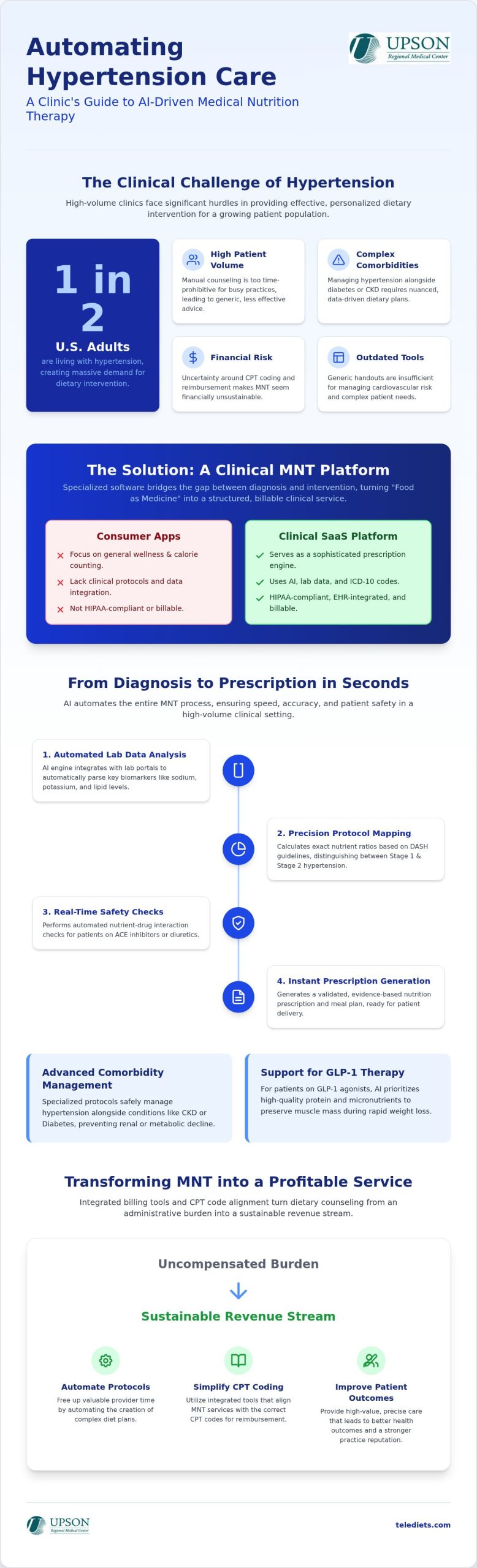
Did you know that 1 in every 2 U.S. adults is currently living with hypertension? For high-volume clinics, this statistic represents a massive demand for dietary intervention that often exceeds the limits of manual counseling. You likely find it difficult to balance the complexity of managing comorbid conditions, such as diabetes or obesity, with the need for efficient patient throughput. It’s common to feel that providing personalized medical nutrition therapy is a financial risk, especially when CPT coding and insurance reimbursement feel like moving targets.
This guide demonstrates how hypertension diet planning software for clinics can automate evidence-based management and unlock new revenue streams. You’ll learn how to generate lab-driven nutrition prescriptions in seconds and utilize specific billing tools to maximize your practice’s ROI. We’ll provide a clear roadmap for integrating advanced medical nutrition therapy into your existing workflow, allowing you to improve patient outcomes while building a more sustainable, technology-forward clinical environment.
Key Takeaways
- Learn how hypertension diet planning software for clinics converts complex lab results into automated, evidence-based nutrition prescriptions in seconds.
- Explore the use of Advanced Medical Series protocols to safely manage hypertensive patients who also present with comorbid conditions like CKD or diabetes.
- Identify the primary CPT codes and integrated billing tools necessary to establish a profitable and sustainable Medical Nutrition Therapy service line.
- Master the essential implementation criteria, from HIPAA compliance to EHR integration, required to scale clinical nutrition effectively within your practice.
What is Hypertension Diet Planning Software for Clinics?
Hypertension diet planning software for clinics is a specialized Medical Nutrition Therapy (MNT) tool designed to bridge the gap between clinical diagnosis and actionable patient intervention. Unlike consumer-grade calorie counters or recipe apps that focus on general wellness, these clinical SaaS platforms serve as sophisticated prescription engines. They empower providers to move beyond generic advice and deliver precise, evidence-based nutrition that functions as a core component of a patient’s treatment plan.
Modern platforms use AI to analyze systolic and diastolic trends alongside critical lab data, such as sodium and potassium levels. This technology translates complex metabolic markers into specific dietary protocols in seconds. By formalizing “Food as Medicine” into a structured, billable clinical service, clinics can provide high-value care that is both medically effective and financially sustainable.
The Evolution of Medical Nutrition Therapy (MNT)
Manual dietary counseling is often too time-prohibitive for high-volume practices, making it difficult to address the nuanced needs of patients with chronic hypertension. Relying on outdated handouts isn’t sufficient for managing cardiovascular risk. Today’s MNT leverages digital automation to implement the DASH (Dietary Approaches to Stop Hypertension) diet and other therapeutic protocols with clinical precision. This evolution ensures that every patient receives a personalized strategy tailored to their specific hypertensive stage and comorbidities.
Key Features of Clinical-Grade Hypertension Platforms
A robust hypertension diet planning software for clinics must offer features that support a professional medical environment. These include:
- Automated Plan Generation: The software creates customized meal plans based on specific ICD-10 codes and metabolic markers.
- HIPAA-Compliant Security: Patient dietary records and health data are protected by enterprise-grade encryption to ensure full regulatory compliance.
- EHR Integration: Seamless data flow between the nutrition platform and your existing electronic health records.
How AI Automates Hypertension Protocols and Provider Workflows
Modern clinical workflows require a balance of speed and absolute accuracy. AI-driven hypertension diet planning software for clinics eliminates the need for manual data entry by integrating directly with lab portals. The engine automatically parses sodium, potassium, and lipid levels to identify specific metabolic needs. This automation extends to safety, performing real-time nutrient-drug interaction checks for patients on ACE inhibitors or diuretics. It’s now possible to move from a confirmed diagnosis to a validated clinical prescription in mere seconds, ensuring your treatment plan is both immediate and evidence-based.
Precision Nutrition: Mapping Labs to DASH Protocols
AI engines calculate exact macronutrient and micronutrient ratios by distinguishing between Stage 1 and Stage 2 hypertension requirements. These systems utilize DASH diet guidelines to create highly targeted interventions that reflect a patient’s current biomarkers. By automating the generation of the “Advanced Medical Series,” you reduce administrative friction while ensuring patients with complex comorbidities receive safe protocols. This is particularly vital for managing hypertension alongside CKD or Diabetes, where dietary nuances are critical to preventing further renal or metabolic decline.
Supporting Patients on GLP-1 Medications
As more hypertensive patients begin GLP-1 receptor agonist therapy for weight loss, maintaining nutrient density becomes a clinical priority. AI-powered tools manage this intersection by prioritizing high-quality protein intake and micronutrient sufficiency to preserve muscle mass. This level of oversight ensures that rapid weight loss supports cardiovascular health without causing nutritional deficiencies. If you’re ready to modernize your practice, you can explore how our AI-powered MNT engine scales your clinical services.
Maximizing ROI: Insurance Billing and CPT Coding for MNT
Transitioning from clinical protocols to financial sustainability is a vital step for any modern practice. Integrating medical nutrition therapy (MNT) into a cardiology or primary care practice isn’t just a clinical necessity; it’s a strategic financial move. By using hypertension diet planning software for clinics, providers can transform dietary counseling from an uncompensated administrative burden into a robust revenue stream. Integrated billing tools simplify the reimbursement process by automatically aligning prescriptions with the appropriate documentation required for insurance claims.
Essential CPT Codes for Nutrition Services
CPT 97802 serves as the standard code for the initial medical nutrition assessment and intervention, typically billed in 15-minute increments. For subsequent visits, clinics utilize 97803 for re-assessments and ongoing interventions. In cases where a patient’s condition changes significantly, G0270 allows for additional MNT services. According to 2026 Medicare reimbursement rates, the national unadjusted rate for 97802 is $36.74 per unit, while 97803 is reimbursed at $31.73 per unit. These figures demonstrate how consistently billing for MNT can quickly offset the cost of the software while improving patient biomarkers.
Leveraging Telemedicine for Remote Hypertension Care
Telemedicine plugins allow for seamless remote MNT delivery within a standard telehealth visit, capturing billable time without increasing your physical office footprint. This capability is essential for scaling clinical nutrition services in high-volume practices where exam room availability is limited. By utilizing these digital tools, your clinic can maintain high engagement levels and monitor patient progress remotely, ensuring long-term blood pressure control. You can get started with our integrated billing and telemedicine tools today to maximize your practice’s ROI.
Implementing a Clinical Nutrition Strategy in Your Practice
Successful implementation of hypertension diet planning software for clinics begins with a clear evaluation of security and compatibility. Your practice needs a solution that prioritizes HIPAA compliance, offers a wide variety of evidence-based protocols, and integrates smoothly with your current EHR. It’s not just about the technology; it’s about finding a “Trusted Expert Guide” who provides the clinical support and training your team needs to feel empowered and capable.
Choosing between a SaaS subscription or licensing a dedicated AI engine depends on your practice’s scale. While smaller clinics benefit from the agility of a subscription, larger healthcare systems often license the engine to power internal patient portals. TeleDIETS provides the flexibility and scientific validity required for either path, positioning your clinic at the forefront of modern hypertension management.
Scaling Your Nutrition Service Line
To scale effectively, you must introduce MNT software into your existing workflow without disrupting patient volume. Start by identifying key staff members who will manage the automated tools for patient education and follow-up. Training should focus on how to generate the Advanced Medical Series plans quickly. This allows your team to spend more time on high-level care and less on the administrative friction of manual plan creation.
Getting Started with Automated Prescriptions
You can begin prescribing clinical-grade nutrition today by accessing the TeleDIETS platform. This transition to automated MNT offers a profound long-term impact on patient adherence. When patients receive professional, lab-driven nutrition plans that align with their specific diagnosis, they’re more likely to achieve their blood pressure goals. This success creates a positive feedback loop that drives clinic growth and establishes your practice as a leader in comprehensive cardiovascular care.
Modernizing Your Clinical Nutrition Strategy
Transitioning to a digital nutrition model is no longer a luxury for high-volume practices; it’s a clinical necessity. Automating lab-driven prescriptions and nutrient-drug interaction checks reduces administrative friction while enhancing patient safety. By aligning these automated workflows with standardized billing practices, your clinic can finally capture the full value of medical nutrition therapy without increasing your staff’s workload.
Implementing hypertension diet planning software for clinics ensures that every patient receives evidence-based care that scales alongside your practice. Whether you’re managing complex comorbidities or supporting patients on GLP-1 protocols, the right technology provides the precision required for modern cardiovascular care. It’s time to empower your practice with TeleDIETS hypertension diet planning software. With integrated CPT coding tools, Advanced Medical Series protocols, and seamless telemedicine integration, you’re well-equipped to drive better outcomes. We’re here to support your journey toward a more efficient and profitable clinical environment.
Frequently Asked Questions
What CPT codes are used for hypertension diet planning software?
The primary CPT codes for hypertension medical nutrition therapy are 97802 for the initial assessment and 97803 for subsequent re-assessments. These codes are typically billed in 15-minute increments. When a patient experiences a significant change in their clinical condition, providers may utilize G0270. Utilizing hypertension diet planning software for clinics ensures these codes are supported by the precise documentation required for successful insurance reimbursement.
Can physicians bill for medical nutrition therapy provided via software?
Yes, physicians can bill for medical nutrition therapy when they use clinical-grade software to deliver evidence-based protocols. While general health apps aren’t billable, professional SaaS platforms provide the automated documentation and time-tracking necessary to satisfy payer requirements. This allows practices to turn dietary counseling into a sustainable revenue stream. Integrating these tools into your workflow ensures that nutrition services are recognized as a legitimate part of the patient’s medical treatment plan.
How does lab-based meal planning software improve hypertension outcomes?
Lab-based software improves outcomes by aligning dietary prescriptions with a patient’s specific biomarkers, such as sodium and potassium levels. By automating the generation of the Advanced Medical Series protocols, clinicians can provide highly targeted interventions that reflect the patient’s current metabolic state. This precision leads to improved blood pressure control and better long-term adherence. Patients feel more confident when their nutrition plan is directly linked to their clinical lab results.
Is hypertension diet planning software HIPAA compliant?
Professional hypertension diet planning software for clinics is built with enterprise-grade encryption to ensure full HIPAA compliance. These platforms protect sensitive patient data, including metabolic markers and dietary records, through secure data transmission and storage protocols. Unlike consumer apps, clinical SaaS solutions are designed to meet the rigorous regulatory standards required for use in a medical environment. This ensures your practice remains compliant while delivering modern, technology-forward care to your patients.
What is the difference between MNT software and a consumer diet app?
The primary difference lies in clinical validity and professional utility. Consumer apps focus on general calorie counting or weight loss tips for individuals. In contrast, MNT software is a professional tool that integrates with lab portals to generate medical-grade nutrition prescriptions. It supports complex chronic disease management through protocols like the Advanced Medical Series. Additionally, MNT platforms include integrated billing and coding tools that allow clinics to maximize ROI through insurance reimbursement.
Leave a Reply