
Patient engagement works best when it extends beyond the telehealth visit. Patient engagement tools for nutrition therapy include secure portals, messaging, appointment scheduling, food-log and lab-result uploads, and nutrition-goal tracking. Together, these features help patients participate in care between appointments and give providers a clearer view of progress.
Focus on tools patients can use consistently, not simply the number of features a platform offers. This article explains how engagement tools support virtual nutrition care and what to consider when planning for patient participation. Accessible design, staff and patient education, and relevant measures can help make technology a practical part of nutrition care.
Key Takeaways
- Identify the telehealth features that can help patients participate in nutrition care between visits, from secure communication to goal tracking.
- Connect engagement activities with meaningful care outcomes by considering how patient participation and nutrition progress are monitored.
- Build an engagement plan around patients’ needs, staff workflows, and clear measures of participation rather than choosing tools by feature count alone.
- Assess nutrition platforms by how well they support your practice’s clinical and administrative workflows, including insurance billing and CPT coding.
Nutrition professionals delivering telehealth care
Telehealth lets nutrition professionals deliver clinical care remotely and gather information between visits. Effective engagement connects each digital interaction to a patient’s nutrition needs.
Patient-Centered Nutrition Care
Patient-centered nutrition care uses medical history, lab values, and lifestyle to shape an individual care plan. This approach helps providers tailor clinical decisions rather than rely on generic guidance. In critical care, early enteral nutrition can reduce overall infection rates, organ failure, and hospital length of stay. Patient participation and feedback also help providers monitor needs and adjust care as circumstances change.
Virtual-care screening can review dietary intake, daily routines, medical history, food allergies, and dietary restrictions. These details help providers identify relevant questions before a visit and focus the discussion on the patient’s circumstances. A screening might reveal a food allergy or a routine that affects meal timing. Providers can use that information to shape the assessment and care plan.
Care-gap screening identifies recommended services a patient may have missed, such as mammograms, colonoscopies, or annual wellness visits. During a nutrition encounter, providers can record relevant gaps and coordinate follow-up within the care team. This connects nutrition support to broader preventive care rather than treating food goals in isolation.
Telehealth platforms used for nutrition care should comply with federal HIPAA privacy and security standards. Secure tools protect sensitive health information and support confidential communication between patients and providers.
In the United States, insurance coverage and reimbursement depend on the patient’s plan and the service billed. Coverage requirements can affect referrals to medical nutrition therapy in primary care clinics.
Risks of Digital Engagement Tools
Digital engagement tools can create access, usability, and privacy barriers. Patients need consistent high-speed internet and a suitable device to join virtual visits; without them, screening and follow-up may be difficult. Interfaces should be usable across ages and levels of technological proficiency. Providers should also protect sensitive information and use secure messaging, since weak privacy practices can undermine confidentiality and trust.
Healthcare delivery and patient outcomes
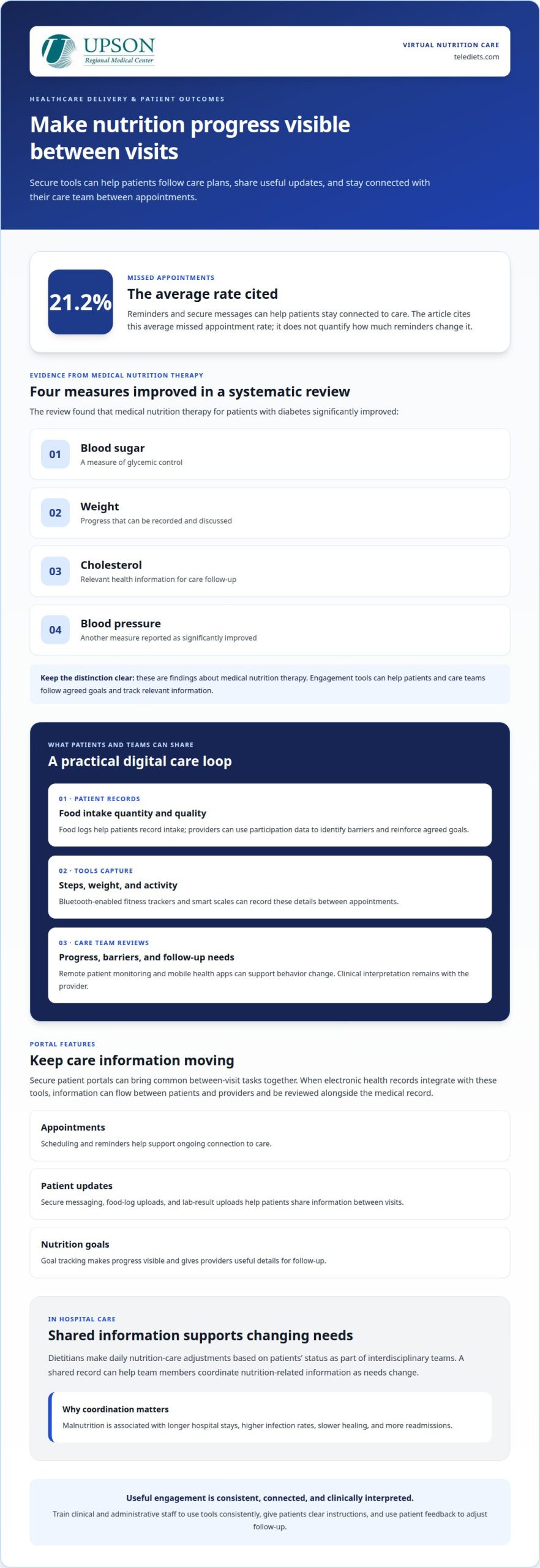
Dietitians use secure portals, food logs, and follow-up messages to turn care plans into manageable actions between visits. Patients can record food intake quantity and quality, while providers use participation data to identify barriers and reinforce agreed goals.
A systematic review found that medical nutrition therapy for patients with diabetes significantly improved blood sugar levels, weight, cholesterol, and blood pressure. Engagement tools can help patients and care teams follow agreed goals and track information relevant to these outcomes. They support follow-through by making progress visible and giving providers useful details for follow-up.
In hospitals, dietitians make daily nutrition-care adjustments based on patients’ status as part of interdisciplinary teams. A shared record can help team members coordinate nutrition-related information as needs change. This matters because malnutrition is associated with longer hospital stays, higher infection rates, slower healing, and more readmissions.
Platform features shape how information moves through care. Secure patient portals can support appointment scheduling, food-log or lab-result uploads, messaging, and nutrition-goal tracking. When electronic health records integrate with these tools, information can flow between patients and providers. This continuity helps clinicians review relevant updates alongside the patient’s medical record.
Between appointments, Bluetooth-enabled fitness trackers and smart scales can record steps, weight, and activity. Certified Diabetes Care and Education Specialists also use remote patient monitoring and mobile health apps to promote behavior change. These tools give care teams additional information to discuss with patients, while clinical interpretation remains with the provider.
Follow-up also matters for attendance: the average missed appointment rate cited is 21.2%. Reminders and secure messages can help patients stay connected to care. Providers should train clinical and administrative staff to use engagement tools consistently, so patient groups receive clear instructions and updates. Dietitians can then use patient feedback to adjust follow-up and support participation.
Patient engagement planning resources and toolkits
A practical engagement plan links each tool to a patient need and a measurable care objective. Education, communication preferences, and selected measures help teams make the plan specific.
Popular Nutrition Engagement Platforms
Nutrition engagement platforms generally combine communication, education, and progress-tracking functions. No single feature set suits every clinic; the right fit depends on care goals and patient preferences. A practice focused on between-visit participation, for example, may prioritize reminders and goal tracking, while another may emphasize educational materials. A toolkit can help teams define priorities before selecting measures.
Features and Ease of Use
Tools differ in how they deliver communication and how easily patients can use them. Email, SMS, automated phone calls, apps, and secure patient-specific microsites offer different ways to share information. Comparing tools means matching each channel’s functions to patient preferences and the clinic’s workflow. A simple interface matters because patients have different ages and levels of technological proficiency.
Start with a clear engagement objective, such as helping patients understand nutrition goals or participate in follow-up. Then choose communication and education methods that support it. Patient education about a tool’s purpose and functions can build awareness and confidence using the technology. For example, a clinic can explain how a selected channel supports an agreed nutrition goal, then invite feedback about its usefulness.
Measurement should reflect the objective, not just the tool’s activity. The Patient Engagement Metrics Selector lets users filter metrics by six categories, including stakeholder type and life cycle stage. This helps teams organize measures around who is engaging and when. A clinic can use that structure to select relevant measures, review participation, and refine its engagement plan.
Personalized planning considers which patients may need different communication approaches. If a patient prefers SMS over email, that preference can guide outreach. Teams can use feedback to adjust educational materials or channels, then monitor whether the changes support participation. This cycle keeps planning connected to patient experience instead of relying on assumptions about which platform feature will encourage engagement.
Which nutrition therapy patient engagement platforms are most popular?
Nutrition practices use several types of platforms: secure patient portals, mobile apps, messaging channels, and patient-specific microsites. Each supports a different part of engagement, so compare them by care task rather than popularity. A portal can organize patient interactions, while SMS can deliver a concise reminder. The best fit depends on patient preferences and clinical workflow.
Secure portals are useful when patients need a central place to manage care activities. Nutrition providers can use them for appointment scheduling, food-log or lab-result uploads, messaging, and nutrition-goal tracking. A patient might upload a food log before a follow-up, giving the provider material to discuss. This format suits clinics that want several patient-facing functions in one channel.
Mobile apps can support ongoing engagement through goal tracking and educational content. Some nutrition apps use points, badges, challenges, or rewards to encourage dietary and lifestyle goals. These features may suit patients who respond to visible milestones. Providers should connect each feature to a defined care objective rather than adding rewards without a clear role in the patient’s plan.
Communication channels differ in reach and interaction. Email can carry detailed education, while SMS and automated phone calls can deliver shorter prompts. Secure patient-specific microsites offer another way to share tailored information. A clinic might use email for nutrition education and a reminder channel for a scheduled follow-up. The choice should reflect patient preferences and staff workflow.
Compare options by function, usability, and how information supports care. Check whether patients can complete the intended task, such as submitting a food log or finding a nutrition goal. Consider whether staff can use the platform consistently and whether it fits the practice’s existing processes. Educating patients about the tool’s purpose can encourage adoption. A good fit makes the next nutrition-care action clear for both patient and provider.
TeleDIETS: Insurance Billing & CPT Coding Tools
TeleDIETS supports nutrition practices with clinical meal plans and billing and coding resources. Its Insurance Billing & CPT Coding Tools help address administrative workflow needs related to medical nutrition therapy.
For care planning, TeleDIETS offers Standard Series Meal Plans, Advanced Medical Series Meal Plans, and GLP-1 Meal Plan Protocols. These options support practices serving patients with varied nutrition needs, including chronic disease management. The platform enables healthcare professionals to prescribe evidence-based nutritional plans tailored to lab results and clinical diagnoses.
If your practice is assessing nutrition workflows alongside patient engagement, consider whether these tools fit your clinical and administrative needs. Contact TeleDIETS to discuss its offerings.
Turn your engagement plan into a practical next step
Choose one care process to strengthen first, then make its purpose clear to patients and staff. Your team might focus on helping patients stay connected with their nutrition plan between visits. Use patient feedback to shape the approach, and review whether the selected patient engagement tools for nutrition therapy fit the clinical workflow. A focused first step gives your team a clear basis for refining its approach over time.
TeleDIETS offers Standard Series Meal Plans, Advanced Medical Series Meal Plans, and GLP-1 Meal Plan Protocols to support nutrition care planning. These offerings may be relevant as you consider how clinical nutrition resources fit alongside your practice’s engagement approach.
To discuss how TeleDIETS may fit your practice’s nutrition care needs, contact TeleDIETS about nutrition care. Thoughtful planning can help your team move forward with clarity and purpose.
Frequently Asked Questions
What are Patient Engagement Tools?
Patient engagement tools are digital functions that help patients participate in care outside direct clinician interaction. They can include patient portals, secure messaging, educational content, reminders, and goal-monitoring functions. A portal might let a patient review an assigned nutrition objective before a follow-up. These tools complement professional care; they don’t independently assess a patient’s clinical needs or replace provider judgment.
What are patient engagement tools for nutrition therapy?
Patient engagement tools for nutrition therapy are digital features that support participation in nutrition assessment, care planning, and follow-up. A patient might receive nutrition education tailored to a care plan, record relevant information, or send a question through a secure channel. For a practice, the useful choice connects a defined nutrition-care task with a clear patient action and provider follow-up.
Which tools support meal planning, food tracking, and nutrition education?
Meal planning tools can present clinician-selected plans, while food-tracking features let patients record intake for later discussion. Nutrition education functions can share material on food labels, portion sizes, ingredient lists, or substitutions. AI-enabled nutrition tools can generate personalized diet recommendations based on health data, preferences, goals, and dietary restrictions. Providers should align each function with the clinical plan and review its relevance during care.
Do nutrition engagement platforms integrate with EHRs and telehealth systems?
Some platforms support connections with electronic health records or telehealth workflows, though integration varies. Before adopting one, map what information staff need during a virtual appointment and where they need to access it. Then assess whether the platform makes that information available within the intended workflow. Don’t assume every product connects to every clinical system or transfers information in the same way.
How can a dietitian choose and implement a patient engagement tool?
Start with a specific clinical objective, such as helping patients prepare for nutrition follow-ups. Assign who reviews incoming patient information and how it enters the care workflow. Train staff with a sample case, then gather feedback on usability and fit. Define how patients can continue participating if they can’t use the selected digital channel. Expand the approach only after the initial workflow is clear.
What privacy and HIPAA requirements apply to nutrition therapy apps?
Nutrition telehealth apps should comply with federal HIPAA privacy and security standards. They should use robust security and secure, encrypted messaging to protect sensitive health information and support confidentiality.
Leave a Reply