
If your clinic’s nutrition protocols aren’t automatically syncing with patient lab results, are you practicing medical nutrition therapy or just handing out recipes? You’ve likely felt the frustration of spending hours on manual meal planning only to see patient adherence stall. It’s exhausting to manage complex CPT coding for MNT while trying to maintain clinical precision. Finding the right medical nutrition therapy software for clinics is no longer just about convenience; it’s about closing the gap between diagnostic data and daily dietary habits.
This 2026 buyer’s guide will help you select a clinical-grade platform that transforms these manual hurdles into a streamlined, revenue-generating engine. You’ll discover how to integrate lab-based protocols, automate insurance-reimbursable billing, and scale your provider workflows without sacrificing the quality of care. We’ll examine the top-performing tools that ensure evidence-based prescriptions and drive better outcomes for your patients with metabolic and chronic conditions. By the end of this guide, you’ll have a clear framework for choosing a partner that supports your clinical expertise and your business growth.
Key Takeaways
- Move beyond basic calorie counting by implementing diagnostic-grade engines that translate patient lab work into precise dietary prescriptions.
- Discover how specialized protocols in the Advanced Medical Series can standardize care for complex renal, cardiac, and metabolic conditions.
- Increase clinic profitability by automating insurance billing documentation and seamlessly integrating CPT codes 97802 and 97803.
- Identify the essential criteria for selecting medical nutrition therapy software for clinics that prioritizes clinical validity and long-term provider support.
What Defines High-Performance Medical Nutrition Therapy Software?
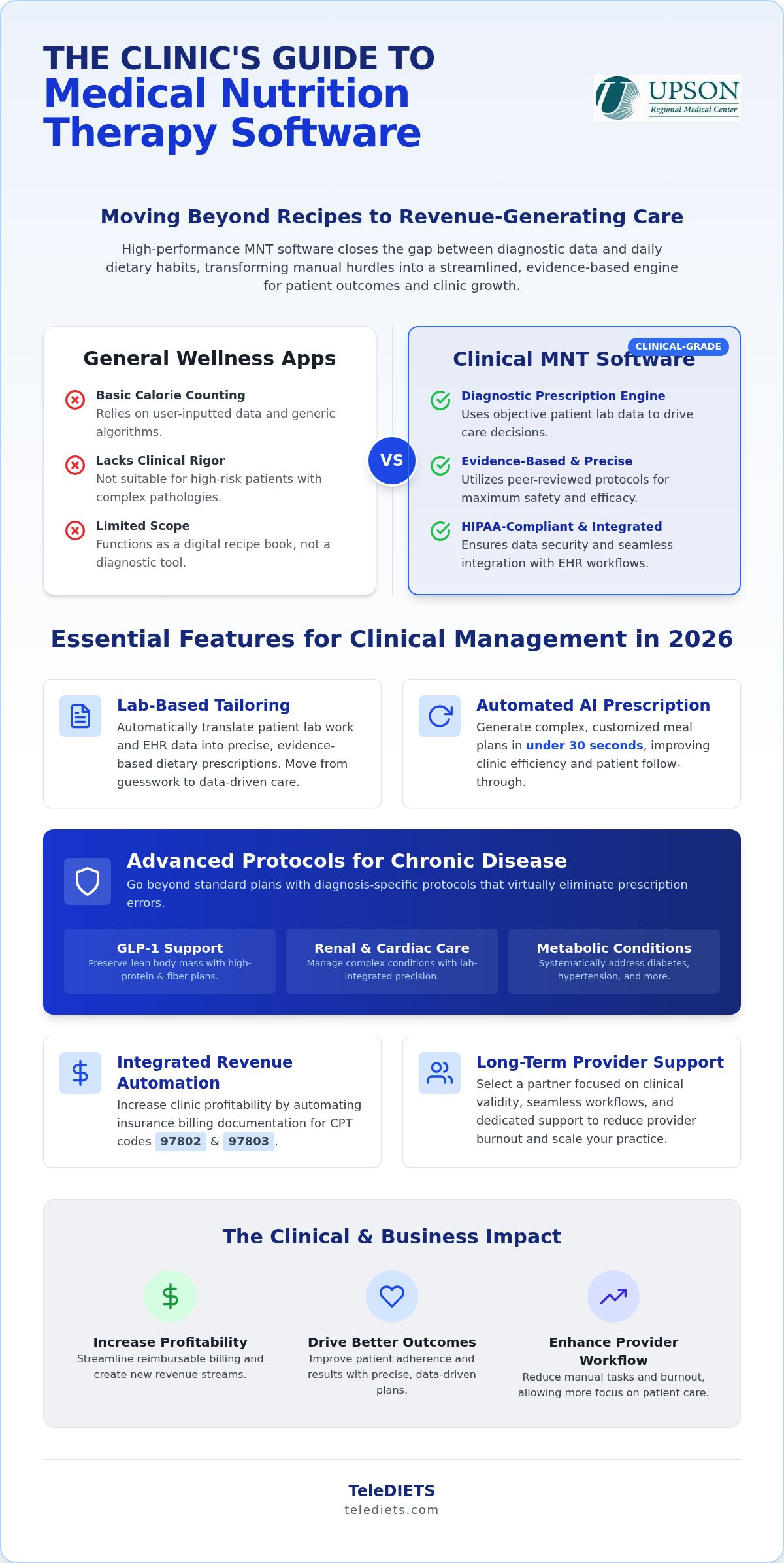
High-performance software isn’t just a digital recipe book; it’s a diagnostic prescription engine. While consumer apps focus on basic calorie tracking, medical nutrition therapy software for clinics uses objective lab data to drive patient care. Understanding What is Clinical Nutrition? is essential here. MNT is a specialized medical service that requires tools capable of managing chronic conditions like diabetes, hypertension, and metabolic syndrome with scientific precision.
Clinical-grade platforms must support HIPAA-compliant data handling and secure provider-patient communication. This protection is vital. It shields your practice from liability and ensures that sensitive health information remains confidential. When you move beyond simple tracking, you empower your staff to deliver high-quality, evidence-based care that actually moves the needle on patient outcomes.
Clinical Accuracy vs. General Wellness Apps
Consumer-grade apps often lack the rigor needed for high-risk patients. They rely on user-inputted data and generic algorithms that don’t account for complex pathologies. High-performance software utilizes peer-reviewed, evidence-based dietary protocols. These protocols ensure that every prescription is backed by clinical research. It provides a level of safety and efficacy that wellness apps simply can’t match. You aren’t just giving advice; you’re providing a clinical intervention.
Integration with Clinical Workflows and EHRs
The most effective medical nutrition therapy software for clinics bridges the gap between a patient’s diagnosis and their daily dietary actions. By automating nutrition prescriptions based on EHR data, you can significantly reduce physician burnout. Instead of manually calculating macronutrients or searching for renal-friendly meal plans, the system generates a tailored protocol in seconds. This integration ensures that nutrition becomes a seamless part of the treatment plan rather than an afterthought.
Essential Features for Clinical Nutrition Management in 2026
Modern clinical nutrition is moving away from static PDF templates toward dynamic, data-driven interventions. High-performance medical nutrition therapy software for clinics must now act as a clinical decision support tool. The core of this evolution is lab-based tailoring. Instead of asking patients to guess their needs, clinicians can now generate meal plans directly from blood work results. This shift ensures that every macronutrient and micronutrient target is aligned with the patient’s current physiological state.
Speed is equally critical in a busy clinic environment. Automated AI engines now allow providers to generate complex, evidence-based prescriptions in under 30 seconds. This efficiency doesn’t just save time; it ensures that the nutrition plan is delivered while the patient is still in the exam room, significantly improving the likelihood of follow-through. Recent studies on Technology-Enabled Medical Nutrition Therapy show that these digital tools are vital for bridging the gap between clinical advice and patient action.
The Rise of GLP-1 Meal Plan Protocols
With the widespread use of GLP-1 receptor agonists, clinics need specific software to manage the unique nutritional challenges these medications present. It’s not just about weight loss; it’s about muscle preservation and avoiding nutrient deficiencies. Advanced software interfaces now include dedicated GLP-1 protocols that prioritize high-quality protein and fiber. These tools help you monitor and maintain lean body mass while your patients achieve their metabolic goals.
Advanced Medical Series for Chronic Disease
Managing chronic conditions requires more than “standard” healthy eating plans. The Advanced Medical Series provides diagnosis-specific protocols for renal, cardiac, and metabolic care. By using lab-integrated software, you can virtually eliminate prescription errors in chronic care because the system cross-references lab values against established clinical guidelines. This level of precision is exactly what distinguishes a clinical-grade platform from a basic meal planner. If you’re ready to upgrade your practice’s capabilities, consider exploring the specialized medical protocols available today.
Maximizing Clinic Revenue with Integrated Billing and Telehealth
Clinical excellence and financial sustainability aren’t mutually exclusive. High-performance medical nutrition therapy software for clinics should empower your practice to capture revenue that often goes unclaimed. Many primary care clinics overlook the financial potential of reimbursable nutrition services because the billing process feels too complex. By integrating insurance billing and CPT coding tools directly into the provider workflow, you turn nutrition from an administrative burden into a profitable service line.
Automating the documentation process is the most effective way to ensure high claim acceptance rates. When your software automatically populates the necessary clinical data for insurance providers, it minimizes the time your staff spends on manual entries and corrections. This streamlined approach allows you to focus on patient care while the system handles the back-end complexities of medical reimbursement.
Understanding CPT Codes for Medical Nutrition Therapy
Effective billing starts with the correct application of specific CPT codes. Code 97802 covers the initial assessment and intervention, while 97803 is used for follow-up re-assessments and interventions. Modern software captures the specific data points required for these codes, ensuring your documentation is audit-proof. This precision reduces the risk of claim denials and ensures your clinic is fairly compensated for the specialized care provided to patients with chronic conditions.
Scaling with Telemedicine and Remote Monitoring
Your practice’s growth shouldn’t be limited by the number of exam rooms available. Utilizing a telemedicine plugin allows you to deliver MNT remotely, expanding your reach to patients who can’t easily visit the clinic. This digital approach is supported by automated follow-ups and remote monitoring, which help maintain high patient adherence. When patients feel supported between visits, their outcomes improve, and your practice benefits from consistent, long-term engagement. Ready to optimize your clinic’s financial performance? Explore our integrated billing and telemedicine solutions to see how we can help you scale.
Choosing the Right MNT Partner for Your Practice
Selecting medical nutrition therapy software for clinics is a strategic decision that affects both patient health and long-term practice stability. It’s easy to be swayed by sleek user interfaces or modern aesthetics, but clinical depth must remain your primary metric. A platform should do more than look good; it must provide the scientific rigor required for complex medical cases and high-risk patient populations.
Look for a partner with a proven history in the medical technology field, such as Lifestyles Technologies. A long-standing presence in the industry suggests stability and a deep understanding of evolving clinical standards. This reliability is essential when managing multi-provider or multi-location clinics where consistency of care is paramount. Your chosen platform should offer a comprehensive range of protocols, including both Standard and Advanced Medical Series, to ensure every patient receives a tailored prescription that aligns with their specific diagnosis.
The TeleDIETS Advantage: Clinical Precision
TeleDIETS represents the intersection of 30 years of industry expertise and modern, AI-driven nutrition science. This diagnostic-based system is designed specifically for high-volume clinical environments where accuracy cannot be sacrificed for speed. By automating the transition from lab results to dietary prescriptions, it empowers your staff to deliver elite-level care without the administrative overhead. Check out our professional plans to see how this expertise can integrate into your workflow.
Implementation and Next Steps
Transitioning your clinic to a digital MNT workflow doesn’t have to cause downtime or disrupt patient care. The right partner provides robust provider support and comprehensive training to ensure a smooth onboarding process for your entire team. Focus on platforms that offer clear implementation roadmaps and responsive assistance. By choosing a partner that prioritizes your success, you can elevate your practice’s standards and begin delivering automated, evidence-based medical nutrition therapy software for clinics immediately.
Modernizing Your Practice with Clinical Precision
The landscape of clinical nutrition is shifting toward precision and automation. By moving beyond general wellness tools and adopting a diagnostic-driven approach, your practice can bridge the gap between lab results and patient outcomes. High-performance medical nutrition therapy software for clinics isn’t just an administrative upgrade; it’s a tool for professional empowerment that scales with your growth. Transitioning to a digital workflow ensures that your dietary prescriptions are as rigorous and evidence-based as any other medical intervention you provide.
TeleDIETS has provided evidence-based protocols since 1995, helping clinics integrate specialized GLP-1 and Advanced Medical Series protocols directly into their daily operations. With integrated CPT coding for 97802 and 97803, you can ensure your services are fully reimbursable while maintaining the highest standards of care. This shift allows you to spend less time on manual documentation and more time on high-level clinical decision-making. If you’re ready to modernize your patient care and maximize clinic revenue, now is the time to act. Start your clinical nutrition transition with TeleDIETS today and provide your patients with the sophisticated, science-backed support they deserve.
Frequently Asked Questions
What is the best medical nutrition therapy software for clinics in 2026?
TeleDIETS is a premier choice for practices requiring clinical-grade precision and diagnostic-based prescriptions. It combines 30 years of medical expertise with a modern AI engine that generates protocols in seconds. While many platforms focus on general wellness, this medical nutrition therapy software for clinics prioritizes evidence-based interventions for chronic disease management. It’s built to handle high-volume provider workflows while maintaining the scientific rigor expected in a medical environment.
Can medical nutrition therapy be billed to insurance using software?
Yes, medical nutrition therapy is a reimbursable service when documented correctly through clinical software. High-performance platforms integrate billing tools that automate the collection of data required by insurance providers. This automation reduces administrative errors and ensures your clinic receives proper compensation for specialized nutrition interventions. Using software simplifies the transition from patient care to financial reimbursement, making insurance-based services a viable revenue stream for your practice.
How do GLP-1 meal plan protocols work within clinical software?
GLP-1 meal plan protocols in clinical software focus on muscle mass preservation and nutrient density. These specialized programs are designed to mitigate the side effects of weight-loss medications while ensuring patients meet their protein and fiber requirements. The software allows providers to monitor lean body mass and adjust dietary prescriptions as the patient’s medication dose titrates. This targeted approach is essential for supporting long-term metabolic health and patient safety.
Is MNT software HIPAA compliant for patient data storage?
Clinical-grade MNT software is built with HIPAA compliance as a foundational requirement. These platforms use encrypted data storage and secure communication channels to protect sensitive patient health information. It’s vital to choose a partner that undergoes regular security audits and provides clear data protection agreements. This ensures your clinic remains compliant with federal regulations while managing patient data across digital interfaces and remote monitoring plugins.
How does lab-based nutrition software improve patient outcomes?
Lab-based software improves outcomes by removing guesswork from dietary prescriptions. When a platform translates blood work directly into a meal plan, it ensures the intervention is physiologically appropriate for the patient’s current state. This precision leads to better management of markers like HbA1c, blood pressure, and lipid profiles. Patients are more likely to adhere to protocols that are visibly tied to their personal health data and diagnostic results.
What CPT codes are used for medical nutrition therapy reimbursement?
The primary CPT codes used for reimbursement are 97802 and 97803. Code 97802 is designated for the initial assessment and intervention, while 97803 covers subsequent re-assessments and follow-up care. Some software also supports specific G-codes for Medicare-related nutrition services. Utilizing medical nutrition therapy software for clinics ensures these codes are applied accurately to your documentation, which facilitates a smoother claims process and reduces the risk of audit errors.
Leave a Reply