
Most nutrition software is designed for fitness influencers, yet your clinic needs a tool built for medical complexity. You likely already know that medical nutrition therapy is the cornerstone of treating metabolic and obesity-related conditions. However, the reality of manual meal planning often feels like a drain on your staff’s limited time. It’s frustrating to spend hours tailoring plans when the right nutrition software for medical practice should sync with a patient’s latest lab results in an instant.
This guide will show you how to select a clinical-grade prescription engine that automates medical nutrition therapy and bridges the gap between diagnostic data and daily habits. We’ll explore how modern platforms streamline insurance billing with correct CPT codes and integrate seamlessly with your existing laboratory data. You’ll discover how to transform nutrition from a time-consuming chore into a scalable, high-revenue service that delivers measurable patient outcomes and supports long-term metabolic health.
Key Takeaways
- Identify the critical differences between consumer-facing meal planners and clinical-grade nutrition software for medical practice.
- Discover how to automate medical nutrition therapy by integrating patient lab results directly into your prescription workflow.
- Learn to maximize practice revenue by utilizing integrated insurance billing tools and specific CPT codes for nutrition services.
- Evaluate the impact of specialized protocols, including GLP-1 meal plans, on patient outcomes for metabolic and obesity-related care.
- Determine whether a standalone system or a seamless telemedicine plugin offers the best scalability for your clinic’s specific volume.
Defining Nutrition Software for Medical Practice in 2026
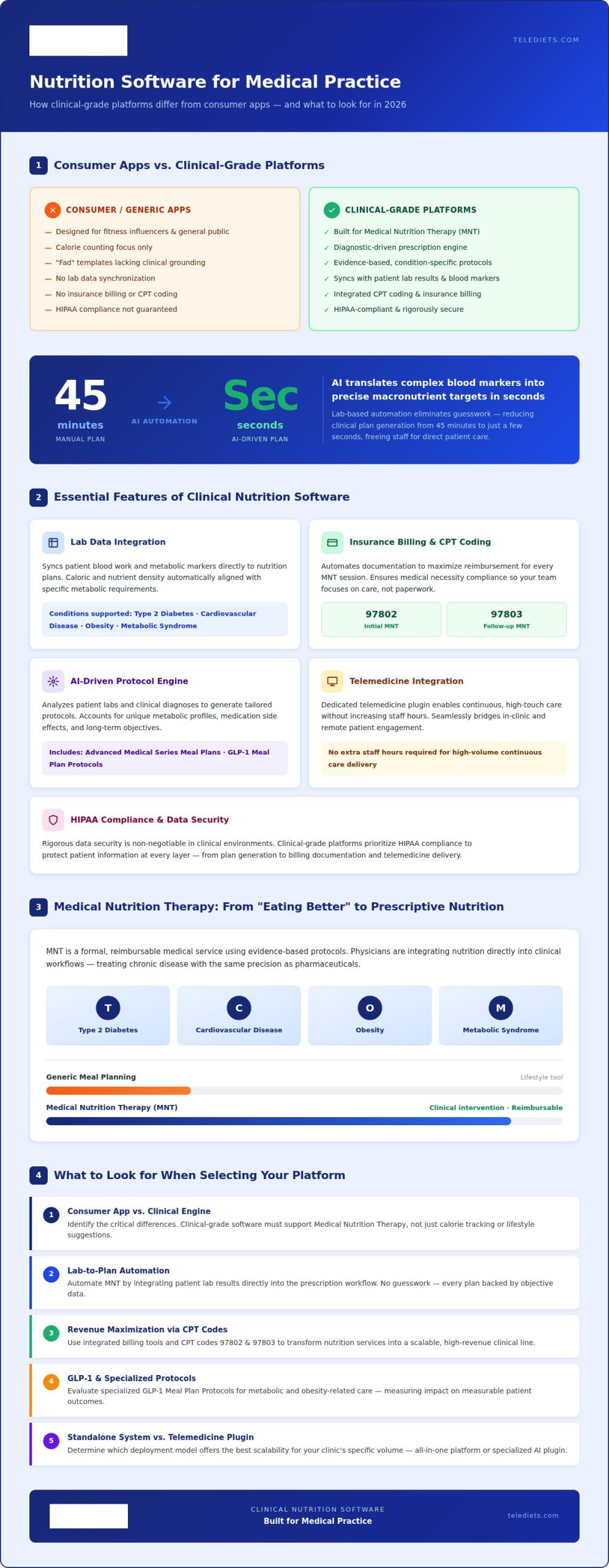
In 2026, nutrition is no longer a peripheral wellness suggestion. It’s a core clinical intervention. For high-volume providers, clinical-grade nutrition software for medical practice acts as a diagnostic-driven engine rather than a simple meal tracker. While consumer apps focus on calorie counting for individuals, medical-grade platforms are built for Medical Nutrition Therapy (MNT). This shift allows you to treat chronic diseases like obesity and metabolic syndrome with the same precision as pharmaceuticals. Physicians are increasingly moving away from referring patients to external specialists; instead, they’re integrating nutrition directly into their workflow to maintain continuity of care.
The Shift from Meal Planning to Medical Nutrition Therapy
MNT is a formal medical service, often reimbursable through specific CPT codes. Unlike casual meal planning, MNT requires evidence-based protocols that respond to a patient’s specific health status. Effective nutrition software for medical practice must support this by providing clinical frameworks, such as Advanced Medical Series Meal Plans, which are designed for chronic disease management. This transition ensures that the dietary advice your practice provides is both scientifically valid and professionally documented. It’s about moving from “eating better” to “prescriptive nutrition.”
Why Generic Software Fails the Clinical Workflow
Generic software often relies on “fad” templates that lack clinical grounding. In a medical setting, these can be counterproductive. Your practice requires a solution that prioritizes HIPAA compliance and rigorous data security. More importantly, clinical tools must synchronize with lab data. Without the ability to match a nutrition plan to a patient’s blood work or metabolic markers, the software remains a lifestyle tool rather than a medical instrument. You need a system that understands the nuances of a clinical environment, from insurance billing to patient safety.
Essential Features: Lab Integration, CPT Coding, and AI Protocols
Selecting the right nutrition software for medical practice requires looking beyond basic meal templates. In a clinical environment, the software must function as a precision instrument that bridges the gap between diagnostic data and therapeutic action. Modern platforms now use AI-driven engines to analyze patient labs and clinical diagnoses, generating tailored protocols that support specific medical goals. This level of automation is essential for practices managing complex conditions like type 2 diabetes, cardiovascular disease, or obesity, where generic advice is insufficient.
Efficiency is the primary driver of this technological shift. High-volume clinics can’t afford the administrative burden of manual meal planning. By utilizing specialized GLP-1 Meal Plan Protocols and a dedicated telemedicine plugin, providers can offer continuous, high-touch care without increasing staff hours. These tools ensure that every patient receives a plan that accounts for their unique metabolic profile, medication side effects, and long-term health objectives.
Lab-Based Nutrition Prescription Automation
Automation transforms how you deliver care. Modern AI engines translate complex blood markers into precise macronutrient targets, removing the guesswork from clinical nutrition. This technology reduces the time required to generate a clinical plan from 45 minutes to just a few seconds. TeleDIETS uses lab data to tailor the Advanced Medical Series by automatically aligning caloric and nutrient density with the patient’s specific metabolic requirements. This ensures your prescriptions are always backed by objective data.
Integrated Insurance Billing and CPT Coding Tools
Revenue sustainability is a core requirement for any clinical tool. Advanced software automates the documentation for CPT codes 97802 and 97803, ensuring that every Medical Nutrition Therapy session is recorded with clinical accuracy. These tools help your practice maintain compliance with medical necessity requirements while maximizing reimbursement for professional services. If you’re ready to enhance your practice’s financial and clinical efficiency, consider implementing professional billing tools to streamline your MNT services. This integration allows your team to focus on patient care while the system handles the complexities of coding and compliance.
The Provider Selection Framework: Standalone vs. Integrated Plugins
When evaluating nutrition software for medical practice, you must decide between an all-in-one operating system and a specialized AI engine. Many standalone platforms are built for independent practitioners who need basic scheduling and CRM tools. However, for a medical clinic already utilizing a robust EHR, these broad systems often create redundant workflows. A specialized engine focuses entirely on the clinical prescription. This allows your team to generate Advanced Medical Series Meal Plans without leaving your primary digital environment. This modular approach ensures scalability for high-volume patient loads while maintaining the clinical depth required for complex care.
The choice of architecture significantly impacts how your staff interacts with the tool daily. A system that requires manual data entry or separate logins will eventually face low adoption rates. Instead, look for a solution that prioritizes clinical protocols over administrative fluff. By focusing on the depth of the medical series provided, you ensure that the software remains a stable partner in your patient’s long-term health journey.
Workflow Compatibility: The Telemedicine Plugin Advantage
Clinicians often face “tab fatigue” when forced to toggle between multiple software applications. A telemedicine plugin solves this by centralizing nutrition data directly within your existing platform. This integration streamlines the clinical visit, making nutrition therapy a natural extension of the consultation rather than a separate administrative task. It keeps your focus on the patient while the AI handles the complex calculations in the background.
Protocol Specificity: Supporting the GLP-1 Patient
The rise of obesity medicine has made GLP-1 meal plan protocols a necessity. Standard diets don’t address the unique physiological changes associated with GLP-1 receptor agonists, such as the risk of lean muscle loss or gastrointestinal distress. A clinical-grade protocol prioritizes protein sparing and gastrointestinal support to ensure that weight loss is both healthy and sustainable. You can integrate these specialized medical protocols into your practice today to provide the high-level support your patients require for metabolic success.
Implementing TeleDIETS: Scaling Clinical Nutrition in Your Practice
Integrating TeleDIETS into your daily operations is a straightforward process designed to empower your entire care team. While physicians oversee the clinical strategy, mid-level providers like Nurse Practitioners and Physician Assistants can use the AI engine to deliver high-quality, lab-based care without requiring extensive nutritional training. This distribution of labor allows your clinic to scale its services while maintaining the clinical precision expected of top-tier nutrition software for medical practice. By standardizing the delivery of nutrition therapy, you ensure that every patient receives a consistent, evidence-based experience regardless of which provider they see.
Measuring the success of your implementation involves tracking both patient outcomes and financial growth. The revenue generated through reimbursed MNT services often far exceeds the monthly subscription costs, creating a sustainable model for chronic disease management. Looking ahead, the future of MNT lies in this fully automated, diagnosis-based approach. By removing the manual barriers to entry, you’re positioning your practice at the forefront of modern metabolic care.
From Diagnosis to Prescription in Seconds
A standard clinical visit shouldn’t be derailed by lengthy dietary discussions. The TeleDIETS workflow is built for speed: you review the labs, enter the diagnosis, and the system delivers the automated MNT protocol instantly. Patient adherence is then supported through an integrated mobile app experience, which keeps the nutrition plan accessible at all times. This digital connection ensures that the therapeutic goals set during the visit are translated into daily habits without additional administrative follow-up.
Setting Up for Billing Success
Financial sustainability depends on accurate documentation and correct coding. Best practices for 2026 involve training your administrative staff to utilize integrated insurance billing tools to capture all available revenue for nutrition services. By automating the application of CPT codes for initial and follow-up MNT sessions, your practice can maximize its reimbursement potential while maintaining strict compliance. To begin enhancing your clinic’s service offerings, you can start your clinical nutrition integration with TeleDIETS today. This step moves your practice toward a more efficient, high-margin model of patient care.
Transforming Patient Care Through Prescriptive Nutrition
The transition to a digital, lab-driven workflow represents the next evolution in metabolic health. By moving beyond manual meal planning, your clinic can deliver precise Medical Nutrition Therapy that aligns with the highest clinical standards of 2026. You’ve seen how the right nutrition software for medical practice eliminates administrative bottlenecks by automating the path from lab results to patient prescriptions. This approach doesn’t just save time; it creates a new revenue stream through integrated CPT coding and improves long-term outcomes for those on specialized protocols.
Choosing a partner that understands the nuances of a clinical environment is essential for sustainable growth. TeleDIETS is trusted by healthcare providers nationwide to provide the evidence-based Advanced Medical Series and seamless billing tools necessary for professional success. It’s time to reclaim your staff’s hours and offer the high-touch care your patients deserve. Empower your practice with TeleDIETS clinical nutrition software and lead the way in modern obesity medicine. Your journey toward a more efficient, high-impact practice starts today.
Frequently Asked Questions
What CPT codes are used for medical nutrition therapy software?
The primary CPT codes for Medical Nutrition Therapy are 97802 for the initial assessment and 97803 for follow-up visits. Advanced nutrition software for medical practice automates the documentation required for these codes, ensuring your clinic meets medical necessity requirements for reimbursement. This integration allows your staff to focus on patient interaction rather than administrative coding complexities, making the billing process much more efficient.
Can nutrition software integrate with my existing medical EHR?
Yes, modern nutrition platforms are designed to integrate with existing medical EHRs through specialized telemedicine plugins. This architecture prevents the need for double data entry and centralizes patient information within your current digital environment. By using a modular AI engine, you can generate clinical protocols directly within your established workflow. This approach significantly reduces administrative friction and “tab fatigue” for your providers.
How does lab-based nutrition software differ from standard meal planners?
Standard meal planners are lifestyle tools designed for general wellness, whereas lab-based software is a diagnostic instrument. Clinical-grade nutrition software for medical practice uses objective blood markers and metabolic data to generate precise nutrient prescriptions. This automated approach ensures that every meal plan is a direct response to the patient’s unique physiological needs, moving beyond generic templates toward true Medical Nutrition Therapy.
Is there specific nutrition software for patients on GLP-1 medications?
Specialized GLP-1 Meal Plan Protocols are essential for patients utilizing GLP-1 receptor agonists. These protocols focus on protein sparing to protect lean muscle mass and include specific dietary adjustments to manage common gastrointestinal side effects. Using a targeted clinical protocol ensures that weight loss remains healthy and sustainable. It also provides the necessary support for the patient’s overall metabolic transition during medication use.
Is medical nutrition therapy software HIPAA compliant?
HIPAA compliance is a non-negotiable standard for any clinical nutrition software used in a medical setting. These platforms utilize encrypted data handling and secure laboratory synchronization to protect sensitive patient information. Unlike consumer apps, provider-facing engines are built to satisfy the rigorous security and privacy requirements of a professional healthcare environment. This ensures all patient data remains confidential and protected according to federal standards.
Leave a Reply