
Why are high-volume clinics still treating Medical Nutrition Therapy as a manual, secondary process when it’s the foundation of chronic disease management? You’ve likely found that manual meal planning is simply too slow for a modern practice, especially as the demand for specialized dietary support for GLP-1 patients rises. Integrating a dietitian telemedicine plugin directly into your clinical workflow allows you to move beyond fragmented data and generic handouts. It’s about providing precision care that’s both scalable and sustainable for your team.
You understand that patient outcomes improve when nutrition is integrated, not isolated. We’ll show you how to automate the generation of lab-based meal plans and streamline insurance billing using reimbursable nutrition codes like 97802 and 97803. This guide explores how to enhance your telehealth platform to support complex medical series protocols with clinical efficiency. You’ll learn how to turn a complex administrative hurdle into a seamless revenue driver that empowers your staff and provides your patients with the evidence-based support they deserve.
Key Takeaways
- Understand how a dietitian telemedicine plugin acts as a clinical bridge, allowing you to offer evidence-based Medical Nutrition Therapy without leaving your current telehealth environment.
- Learn to automate the transition from lab results to nutritional prescriptions, generating specialized meal plans for GLP-1 patients and chronic conditions in seconds.
- Discover why a modular plugin approach prevents data silos and avoids the technical burden of migrating your entire practice to a new EHR.
- Identify the essential billing features and CPT coding tools needed to capture insurance-reimbursable revenue for nutrition services.
- Explore how AI-powered engines provide the precision required for Advanced Medical Series protocols while maintaining high clinical standards.
What is a Dietitian Telemedicine Plugin and Why Does Your Practice Need One?
A dietitian telemedicine plugin is much more than a simple video portal. It functions as a sophisticated software bridge, embedding clinical nutrition capabilities directly into your existing telehealth or Electronic Health Record (EHR) environment. While many practices still rely on external referrals or generic wellness apps, a dedicated plugin allows you to prescribe Medical Nutrition Therapy (MNT) as a fundamental part of your clinical workflow. This transition marks a critical shift from providing general “lifestyle tips” to delivering evidence-based, lab-driven interventions that are fully integrated into the patient’s medical record.
The Problem with Fragmented Nutrition Care
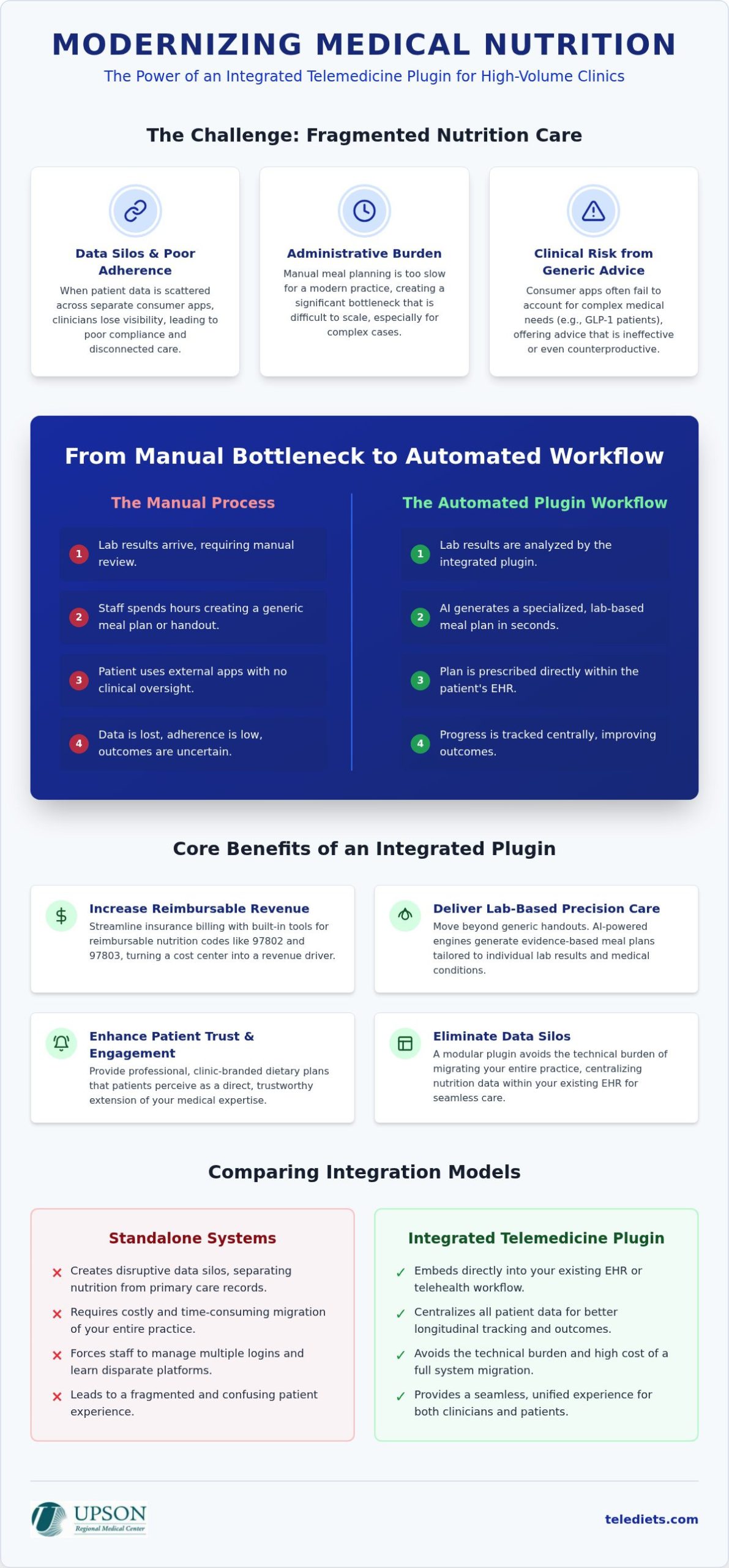
Fragmented nutrition care is one of the most common obstacles to successful patient outcomes. When dietary data is “siloed” within separate consumer apps, clinicians lose essential visibility into patient compliance. This lack of transparency often leads to poor adherence, as patients feel disconnected from their primary care plan. Additionally, the administrative burden of managing multiple logins and disparate platforms creates friction that slows down your team. Relying on generic consumer tools also introduces clinical risk. These apps often provide standardized advice that fails to account for complex medical requirements, such as the specific nutritional needs of GLP-1 patients or those with advanced metabolic disorders. Without a direct link to clinical data, these tools can provide guidance that is not only ineffective but potentially counterproductive to your medical goals.
Key Benefits of Seamless Integration
Integrating a professional dietitian telemedicine plugin transforms nutrition into a strategic clinical asset. Centralizing patient records allows for better longitudinal care, as you can track nutritional progress alongside lab results and medication adjustments. This level of integration fosters deep patient trust. When a patient receives a professional, clinic-branded dietary plan, they perceive it as a direct extension of your medical expertise rather than a generic handout.
The role of AI in this process is transformative for high-volume clinics. Modern plugins utilize AI-powered engines to generate lab-based meal plans in seconds, replacing the manual labor that traditionally made nutrition therapy difficult to scale. You can move from reviewing a patient’s lab results to prescribing a specialized Medical Series protocol almost instantly. This efficiency allows your practice to capture more revenue through insurance-reimbursable codes without increasing your administrative overhead. By automating these complex workflows, you ensure that every patient receives precision-grade care that is both medically sound and operationally sustainable.
How a Nutrition Therapy Plugin Transforms Clinical Workflows
Clinical efficiency depends on the speed at which data becomes actionable. For many providers, the transition from reviewing lab results to providing a concrete dietary plan is a significant bottleneck. A dietitian telemedicine plugin removes this friction by acting as an intelligence layer within your telehealth suite. By automating the selection of evidence-based protocols, you can provide specialized care without increasing your administrative load. You aren’t just giving a patient a meal plan; you’re prescribing a therapeutic intervention that is directly tied to their medical record. It’s about transforming a complex administrative hurdle into a streamlined clinical asset that empowers both your staff and your patients.
This integration supports a wide range of patient needs, from those requiring a Standard Series for general health to those needing an Advanced Medical Series for complex pathologies. By implementing a dietitian telemedicine plugin, you ensure that nutrition isn’t an afterthought but a central component of the treatment plan. The American Telemedicine Association recently highlighted the value of integrating nutritious food into healthcare as a way to improve chronic disease management. When nutrition is treated as a medical prescription, patient outcomes follow a more predictable and positive trajectory.
Lab-Based Protocol Generation
The plugin interprets biomarkers to suggest specific dietary interventions based on real-time data. This process drastically reduces the “thinking time” for physicians, ensuring clinical accuracy remains high even in high-volume settings. You can customize suggestions based on ICD-10 diagnoses to ensure every protocol is medically justified. For patients on GLP-1 medications, the plugin provides dedicated GLP-1 Meal Plan Protocols to manage unique gastrointestinal side effects and nutritional shifts often associated with these treatments.
Automated Patient Delivery Systems
Once approved, meal plans are delivered instantly through secure, clinic-branded patient portals. This ensures strict HIPAA compliance during the digital transmission of Medical Nutrition Therapy. Patients receive plans in digital formats that encourage long-term adherence. You can explore integration options to see how this automation reduces the administrative burden on your staff. Real-time monitoring within the clinical dashboard also allows you to track patient progress between visits, so you don’t have to worry about manual tracking or data silos.
Comparing Integration Models: Standalone EHR vs. Telemedicine Nutrition Plugins
Choosing the right technical architecture is just as important as the clinical protocols themselves. Many providers fall into the “all-in-one” trap, assuming that a standalone platform for nutrition is the simplest path forward. However, standalone systems often result in data silos that prevent a holistic view of patient health. If your clinic already uses a robust telehealth platform, adding a separate system for nutrition therapy creates redundant workflows and requires your team to manage multiple logins. A dietitian telemedicine plugin solves this by layering specialized functionality directly over your existing infrastructure. This modular approach supports the American Telemedicine Association’s push for integrating nutritious food into healthcare without the technical burden of a full data migration.
The cost-benefit analysis favors plugins for most established practices. Instead of paying for a massive enterprise EHR upgrade, you can enhance your current setup with a targeted nutrition engine. This allows you to scale your services rapidly while keeping your core operations intact. As your patient volume grows, the ability to license specialized AI engines becomes a major competitive advantage, ensuring your clinical team isn’t bogged down by manual admin tasks.
When to Choose a Standalone Platform
Standalone platforms are typically ideal for solo practitioners who are starting from scratch and don’t yet have a primary EHR. These apps provide basic scheduling and billing in a single, nutrition-focused environment. While they’re helpful for small operations, they’re often too limited for high-volume settings. The manual data entry required to sync these apps with a medical record becomes a significant drain on resources as your practice expands. If you’re managing complex cases that require frequent lab monitoring, a standalone app can feel like a step backward.
Why Large Clinics Prefer Telemedicine Plugins
Established clinics prioritize maintaining a “Single Source of Truth.” By using a dietitian telemedicine plugin, all nutritional interventions remain tied to the primary patient record. This reduces technical friction for IT departments and ensures clinical staff have immediate access to longitudinal data. It’s far more efficient to license a specialized AI engine to enhance your current platform than it is to rebuild your entire clinical workflow. This strategy allows you to deliver Advanced Medical Series meal plans with the same level of precision as your other medical treatments, all within a familiar interface.
Key Features to Evaluate in a Dietitian Telemedicine Plugin
Identifying the right dietitian telemedicine plugin requires looking beyond basic video conferencing capabilities. You need a tool that handles the clinical heavy lifting, from data security to the specific medical logic used to generate patient recommendations. A truly integrated solution should act as a clinical assistant that understands the nuances of Medical Nutrition Therapy (MNT). When evaluating your options, prioritize features that reduce administrative friction while enhancing the scientific validity of the care you provide. This ensures that your practice remains both compliant and profitable as you scale your nutrition services.
Insurance Billing and CPT Coding Tools
Revenue generation is a primary goal for many clinics, yet nutrition billing is often viewed as a complex hurdle. You should look for plugins that automate the documentation required for CPT codes 97802 and 97803. These codes represent the initial assessment and subsequent re-assessments for MNT. A high-quality dietitian telemedicine plugin will integrate these codes directly into the session notes, ensuring your billing department has the necessary evidence to satisfy Medicare and private payer reimbursement guidelines. This level of automation drastically reduces the rate of claim denials. It also provides a clear audit trail, which is essential for maintaining compliance with evolving payer requirements. By streamlining this process, your practitioners can spend more time on patient care and less time on manual coding.
Evidence-Based Clinical Protocols
Not all dietary plans are created equal. It’s vital to differentiate between general “lifestyle” meal plans found in consumer apps and true, peer-reviewed Medical Nutrition Therapy. Your chosen plugin must offer a library of medically-backed protocols that clinicians can trust. This includes a Standard Series for general wellness and an Advanced Medical Series designed for chronic disease management, such as renal or cardiovascular care. With the rapid adoption of GLP-1 receptor agonists in obesity management, having specialized GLP-1 Meal Plan Protocols is no longer optional. These protocols are essential for managing common gastrointestinal side effects and ensuring patients maintain lean muscle mass during significant weight loss. Choosing a platform that prioritizes clinical precision ensures your advice remains grounded in the latest nutritional science.
Security and customizability are the final pillars of an effective tool. HIPAA compliance is non-negotiable in the modern telehealth environment. Ensure the plugin uses end-to-end encryption for all data transmissions and provides secure messaging for patient-provider communication. Furthermore, the ability to tailor interventions for specific medical conditions like Diabetes ensures that the guidance provided is always clinically relevant to the individual patient. If you’re ready to see these professional features in action, you can view our clinical nutrition solutions to learn how we support modern practice workflows.
TeleDIETS: The AI-Powered Plugin for Modern Medical Nutrition Therapy
TeleDIETS provides the essential technical layer that transforms a standard video call into a comprehensive clinical encounter. By licensing our AI engine, your practice gains the ability to deliver evidence-based Medical Nutrition Therapy without the usual administrative friction. This dietitian telemedicine plugin acts as a seamless extension of your current clinical environment, ensuring that nutritional prescriptions are just as precise as pharmacological ones. It’s the missing piece for clinics that want to provide high-level care without the burden of manual plan creation.
Physicians can now move from lab results to actionable nutritional protocols in seconds. Whether your patient requires a Standard Series for preventative care or an Advanced Medical Series for complex chronic conditions, the TeleDIETS engine automates the heavy lifting. Our specialized GLP-1 Meal Plan Protocols address the surging demand for dietary support in weight management clinics. These protocols don’t just provide a menu; they manage the nutritional nuances required for patients on GLP-1 receptor agonists, supporting long-term metabolic health and improving patient adherence.
Capturing revenue for these services is simplified through our integrated Insurance Billing & CPT Coding Tools. By automatically documenting the requirements for codes 97802 and 97803, TeleDIETS empowers your practice to turn nutrition therapy into a sustainable revenue stream. You don’t need to be a billing expert to ensure your MNT services are reimbursed accurately. This built-in coding support protects your practice from claim denials while maximizing the financial value of every patient consultation.
Seamless Integration for Healthcare Teams
Provider burnout often stems from the technical debt of managing multiple apps. TeleDIETS fits directly into your existing telemedicine workflow, meaning your team doesn’t have to learn a new, standalone system. In digital-first clinics, this level of clinical automation is the only way to scale without overwhelming staff. By removing the manual burden of meal planning, you allow your practitioners to focus on high-level patient care while the AI handles the complex protocol generation. This integration ensures a single source of truth for all patient data.
Getting Started with TeleDIETS
The first step toward integrating the TeleDIETS plugin is to request a demo for your clinical team. During this consultation, we’ll show you how to customize the AI engine to meet the unique needs of your patient demographics. Whether you’re a high-volume metabolic clinic or a specialized bariatric practice, our platform adapts to your specific requirements. You can visit telediets.com to see how our technology can enhance your clinical outcomes and streamline your practice today. Our goal is to empower your team with the tools they need to succeed in a modern, digital-first healthcare environment.
Modernizing Your Clinical Nutrition Strategy
Integrating medical nutrition therapy into your existing workflow shouldn’t be a technical burden. By adopting a specialized dietitian telemedicine plugin, you can bridge the gap between lab results and actionable patient care. You’ve seen how clinical automation allows for the generation of evidence-based protocols in seconds, ensuring that every patient receives precision guidance. This approach not only improves outcomes for complex cohorts like GLP-1 patients but also secures your practice’s financial health through integrated CPT coding tools for 97802 and 97803 reimbursement.
Your practice is ready to move beyond manual meal planning and fragmented data. It’s time to empower your clinical team with tools that prioritize scientific validity and operational efficiency. We invite you to Request a Demo of the TeleDIETS Telemedicine Plugin to see how our AI-powered engine can enhance your telehealth platform. Trusted by modern healthcare teams for specialized GLP-1 support, our technology ensures you stay at the forefront of medical innovation. Take the next step toward a more integrated, profitable, and patient-centered future.
Frequently Asked Questions
What is the difference between a dietitian telemedicine plugin and a standalone EMR?
A dietitian telemedicine plugin is a modular software bridge that adds specialized nutrition capabilities to your existing platform. In contrast, a standalone EMR is an entirely separate practice management system that requires its own login and data storage. Using a plugin allows you to maintain a single source of truth within your primary EHR, avoiding the technical burden and data silos associated with migrating to a new system.
How does a nutrition plugin help with insurance billing for Medical Nutrition Therapy?
The plugin automates the documentation and coding required for CPT codes 97802 and 97803. By integrating these codes directly into the clinical workflow, the system ensures that your claims meet the specific reimbursement guidelines for Medicare and private payers. This level of automation reduces the administrative load on your billing team and significantly decreases the risk of claim denials for nutrition services.
Can I use a telemedicine plugin for patients on GLP-1 medications?
Yes, the dietitian telemedicine plugin includes specialized GLP-1 Meal Plan Protocols designed to manage the unique needs of these patients. These protocols address common gastrointestinal side effects and focus on lean muscle mass retention during rapid weight loss. Providing this targeted support ensures your obesity management program remains clinically effective and supports long-term patient adherence.
Does the plugin integrate with my existing Electronic Health Record (EHR)?
Most professional plugins are designed to integrate seamlessly with your current EHR or telehealth suite through secure API connections. This allows the nutrition engine to interpret patient lab data and push nutritional prescriptions directly into the medical record. It’s an efficient way to enhance your clinical infrastructure without requiring a massive technical overhaul or staff retraining on a new platform.
Are the meal plans in the plugin evidence-based and clinically reviewed?
Every protocol within the system, including the Standard and Advanced Medical Series, is peer-reviewed and grounded in current nutritional science. These aren’t generic wellness plans; they’re therapeutic interventions designed to manage specific chronic conditions and metabolic shifts. This clinical precision ensures that the guidance your practice provides is both medically sound and aligned with the latest evidence-based standards.
Is a dietitian telemedicine plugin HIPAA compliant?
HIPAA compliance is a non-negotiable feature that includes end-to-end encryption for all data transmissions and secure patient messaging. A professional dietitian telemedicine plugin will provide a signed Business Associate Agreement (BAA) to ensure your practice meets all federal privacy requirements. This protection is essential for maintaining patient trust and safeguarding sensitive health information within a digital environment.
How long does it take to generate a personalized nutrition plan using the AI engine?
The AI-powered engine can generate a personalized, lab-based nutrition plan in just a few seconds. By instantly interpreting biomarkers and ICD-10 diagnoses, the tool removes the manual “thinking time” traditionally required for complex meal planning. This speed allows your clinic to scale its nutrition services effectively, even when managing a high volume of patients with diverse medical needs.
Do I need a registered dietitian on staff to use a nutrition therapy plugin?
The plugin is designed to empower your entire healthcare team, allowing physicians to prescribe evidence-based protocols directly. While a registered dietitian can use the tool to streamline their own workflow, the automation handles the complex administrative and planning tasks. It acts as a clinical intelligence layer that provides your staff with the tools needed to deliver high-quality Medical Nutrition Therapy with confidence.
A shift toward virtual care requires tools that are as agile as the providers using them. A dietitian telemedicine plugin allows you to embed nutrition planning directly into your virtual visit window, making it a breeze!