
What if prescribing nutrition could start with a patient’s lab results, not hours of manual meal planning? Primary care teams know medical nutrition therapy can support chronic disease care, but building tailored plans and tracking follow-through can strain busy workflows. The right nutrition prescription software for primary care can help turn clinical information into evidence-based protocols in seconds, while keeping providers responsible for reviewing recommendations.
This guide explains how to integrate nutrition therapy into your practice without losing sight of clinical oversight or operational demands. You’ll learn how lab-informed protocol generation can streamline plan creation, how insurance billing and CPT coding tools may support MNT reimbursement, and how specialized protocols can support nutrition care for patients using GLP-1 medications. We’ll also cover practical ways to fit nutrition services into primary care workflows and assess patient follow-up. An AI-powered platform such as TeleDIETS can help make nutrition more actionable within clinical workflows.
Key Takeaways
- Distinguish clinical medical nutrition therapy from general dietary advice to identify where structured nutrition services fit into primary care.
- Use nutrition prescription software for primary care to connect clinical data with relevant meal plan protocols, while keeping provider judgment central.
- Build a consistent MNT billing workflow by checking payer coverage, qualifying diagnoses, documentation, and applicable CPT codes.
- Consider how specialized protocols can support nutrition care for patients using GLP-1 medications and managing chronic conditions.
Beyond General Advice: The Rise of Medical Nutrition Therapy in Primary Care
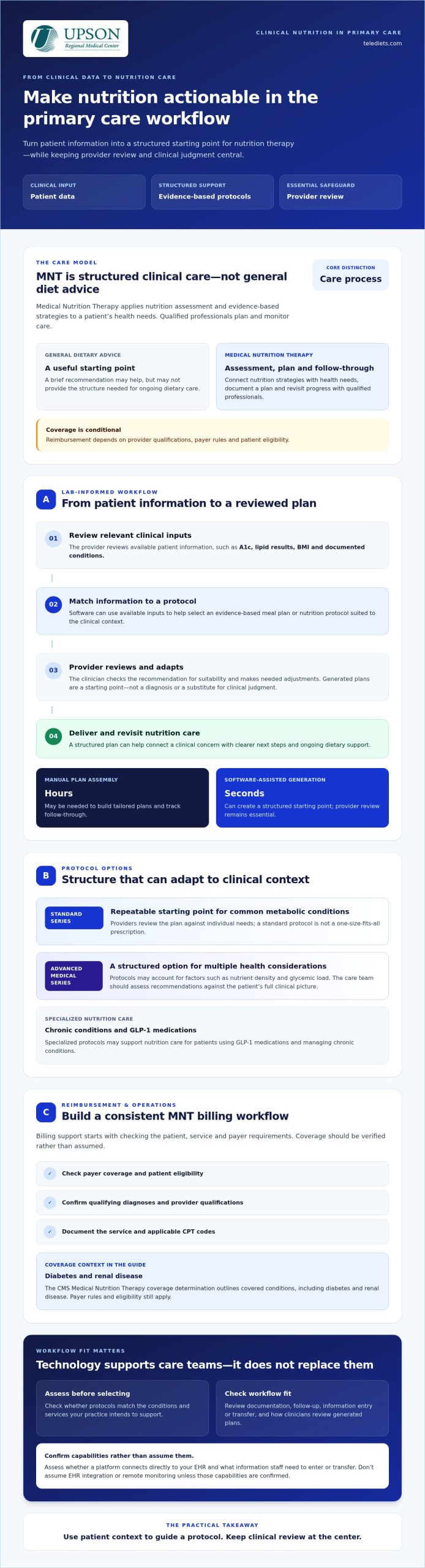
Medical Nutrition Therapy (MNT) is a structured clinical intervention, not a general wellness conversation. It applies nutrition assessment and evidence-based strategies to a patient’s health needs, with care planned and monitored by qualified professionals. The broader field of Clinical nutrition focuses on using nutrition to support health and manage disease; MNT brings that focus into a defined care process. Coverage and reimbursement depend on provider qualifications, payer rules, and patient eligibility.
In a high-volume primary care practice, clinicians may identify a nutrition-related need but have limited time to translate it into individualized guidance, document a plan, and revisit progress. A brief recommendation can be a useful starting point, but it may not provide the structure needed for ongoing dietary care. Evidence-based protocols can help connect nutrition interventions with chronic disease management, while clinical decisions remain with the care team.
The Clinical Gap Between Lab Results and Patient Action
A diagnosis or abnormal result can signal that nutrition deserves attention, but patients also need clear next steps. The gap is often operational: a clinical concern is recognized, but the workflow for providing consistent dietary support is not in place. Nutrition prescription software for primary care can help organize available patient information into protocols suited to the clinical context. Providers review and adapt recommendations rather than creating every plan manually.
Standardizing Care with Evidence-Based Protocols
For common metabolic conditions, a Standard Series plan can give the care team a repeatable starting point. The provider can review the plan against the patient’s needs before using it, supporting a more consistent approach without treating a standard protocol as a one-size-fits-all prescription.
Clinical software can help teams use shared protocols across a provider network while preserving clinician oversight of individual decisions. When evaluating a platform, check whether its protocols match the conditions and services your practice intends to support, and how providers review the generated plans.
Using Nutrition Prescription Software for Primary Care to Turn Lab Data into Protocols
Lab-informed automation turns clinical information into a structured starting point for nutrition care. A typical workflow begins with the provider reviewing relevant patient data, such as A1c, lipid results, BMI, and documented conditions. The software uses available inputs to help select an evidence-based meal plan or protocol. The clinician then reviews it for suitability and makes any needed adjustments. This connects the plan to the patient’s clinical context rather than relying on generic dietary advice.
With nutrition prescription software for primary care, plan generation can take seconds rather than hours of manual assembly. That can make nutrition support more practical to deliver, but provider review remains essential. Patient eligibility and payer rules also matter. The CMS Medical Nutrition Therapy coverage determination outlines covered conditions, including diabetes and renal disease.
The Role of AI in Precision Nutrition
An AI engine can organize clinical inputs against established nutrition protocols, helping providers move from data review to a relevant plan. Just as clinical AI platforms like MayaMD assist care teams in managing patients with chronic conditions, specialized algorithms in nutrition software help translate complex health data into actionable steps. For more complex needs, the Advanced Medical Series offers a structured option for cases involving multiple health considerations. Protocols may account for factors such as nutrient density and glycemic load, but the care team should check that recommendations fit the patient’s full clinical picture. An algorithmic output is not a diagnosis or a substitute for clinical judgment.
Integration with Telemedicine and EHR Workflows
A telemedicine plugin can support the delivery of nutrition care through a provider’s remote-care workflow. Before selecting a platform, assess how it fits your existing documentation and follow-up processes. Ask whether it connects directly to your EHR, what information staff need to enter or transfer, and how clinicians review generated protocols. Don’t assume EHR integration or remote monitoring unless those capabilities are confirmed. TeleDIETS combines lab-informed protocols with a telemedicine plugin, offering practices an AI-powered clinical nutrition platform to consider for their workflow.
Revenue and Reimbursement: Navigating CPT Codes for Nutrition Services
MNT can create a reimbursable service pathway for eligible patients, but revenue depends on more than submitting a claim. Practices need to confirm coverage, provider qualifications, diagnosis requirements, documentation, and payer-specific billing rules. For Medicare, MNT coverage is limited to qualifying conditions, and since August 3, 2026, claims without a qualifying diagnosis code are subject to denial. Treat reimbursement as something to assess, not a guarantee of payment.
A practical billing workflow starts by verifying patient and payer eligibility, then confirming the diagnosis and the professional providing the service. Document the assessment or reassessment, time spent, and care delivered. Select the applicable code, submit the claim, and review denials for possible workflow gaps. Nutrition prescription software for primary care can support this process with integrated insurance billing and CPT coding tools, helping staff organize claim information and reduce administrative friction. Your team remains responsible for accurate documentation and payer-specific requirements.
Essential CPT Codes for Nutrition Prescriptions
CPT 97802 describes an initial individual MNT assessment and intervention; CPT 97803 describes individual reassessment and intervention. Both are time-based codes billed in 15-minute units, so record service time clearly and follow applicable coding and payer guidance. Medicare coverage and reimbursement differ from other payer policies, so verify current requirements before billing.
Assessing Practice ROI with Automated MNT
When comparing a SaaS platform with adding dedicated staff, consider expected eligible patient volume, workflow capacity, reimbursement rules, and the administrative time each approach requires. Software may help a practice extend existing workflows without immediately building a full-time nutrition team, but it does not replace qualified clinicians or ensure claims will be paid. Assess the platform’s features and subscription terms against your practice’s needs. You can explore clinical MNT software subscription options and consider how integrated billing tools may fit your reimbursement workflow.
For a closer look at tools designed for clinical nutrition workflows, review TeleDIETS’ MNT platform.
Scaling Specialized Care with GLP-1 and Chronic Disease Protocols
Primary care teams need nutrition workflows that support patients using GLP-1 receptor agonists alongside medical treatment. Reduced appetite or changes in food tolerance can make it harder for some patients to meet nutritional needs. Structured follow-up helps clinicians assess dietary adequacy, consider muscle preservation as part of care, and keep nutrition support connected to broader metabolic goals. Protocols should complement, not replace, medication oversight.
Specialized GLP-1 Meal Plan Protocols
There isn’t one appropriate macronutrient ratio for every patient. Protein, carbohydrate, and fat targets should reflect the patient’s clinical context and be determined by qualified professionals. A GLP-1 meal plan protocol can provide a structured starting point for clinician review, with adjustments guided by patient tolerance and progress. Nutrition software can help organize those adjustments, but it shouldn’t independently change a plan based on weight-loss velocity or direct medication decisions.
For patients reporting gastrointestinal concerns, individualized nutrition guidance may consider food choices and eating patterns while the care team assesses symptoms and determines next steps. Software can make it easier to deliver and revisit a consistent protocol, but it doesn’t diagnose or treat medication-related side effects.
Managing Comorbidities with Advanced Medical Series
Nutrition support for patients using GLP-1 receptor agonists may need to sit alongside care for conditions such as diabetes or hypertension. An Advanced Medical Series can help clinicians structure plans for complex needs, while patient-specific recommendations remain subject to professional review. The goal is continuity: nutrition support that addresses current clinical priorities and remains relevant as care evolves, including during longer-term metabolic management.
For primary care teams, nutrition prescription software for primary care can organize specialized protocols within a repeatable workflow. TeleDIETS offers GLP-1 Meal Plan Protocols and Advanced Medical Series Meal Plans, helping practices incorporate clinical nutrition support into metabolic care without presenting software as a substitute for clinician judgment.
Make Nutrition Care a Practical Part of Primary Care
Medical nutrition therapy can connect clinical findings with structured, evidence-based support for chronic conditions. The right workflow helps your team move beyond brief dietary advice, translate patient information into reviewed protocols, and make follow-up more manageable. Nutrition prescription software for primary care can also support administration with integrated CPT coding tools, while your team verifies coverage, documentation, and payer requirements.
Specialized GLP-1 protocols and advanced medical meal plans offer a consistent framework for addressing complex nutritional needs. A telemedicine-ready AI engine can bring these resources into provider workflows, with clinicians retaining oversight of individual recommendations.
Explore how TeleDIETS brings together GLP-1 protocols, insurance billing and CPT coding tools, and a telemedicine plugin for clinical nutrition workflows. Explore TeleDIETS’ medical nutrition therapy platform to assess how it could fit your practice’s care and reimbursement workflows.
Frequently Asked Questions
What CPT codes are used for medical nutrition therapy in primary care?
Common MNT codes include CPT 97802 for an initial individual assessment and intervention, 97803 for individual reassessment and intervention, and 97804 for group MNT. Codes 97802 and 97803 are time-based, billed in 15-minute units. Coverage depends on the patient’s diagnosis, provider qualifications, documentation, and payer rules, so verify current requirements before submitting a claim.
Can primary care physicians bill for nutrition prescriptions without a dietitian?
For Medicare MNT reimbursement and many other payers, services generally must be provided by a qualified Registered Dietitian Nutritionist (RDN). A physician shouldn’t assume that prescribing a nutrition plan alone qualifies for MNT billing. Requirements vary by payer and service, so check current coverage and provider rules before billing. Software can support coding and documentation, but it doesn’t establish eligibility or replace required qualifications.
How does nutrition prescription software integrate with existing EHR systems?
Integration varies by platform, so confirm whether a specific tool connects directly to your EHR or requires a separate workflow. Ask about data exchange, documentation transfer, and how staff review patient information and generated protocols. Nutrition prescription software for primary care can help organize lab-informed plans, but don’t assume automatic EHR syncing or monitoring unless the vendor confirms those capabilities.
What are the benefits of GLP-1 meal plan protocols for clinics?
GLP-1 meal plan protocols give clinics a structured starting point for nutrition support alongside clinician-managed medication care. They can help teams address nutritional adequacy and follow-up consistently, while recommendations are reviewed for each patient’s needs and tolerance. Protocols don’t replace medical oversight or provide dosing guidance. The care team remains responsible for assessing concerns and deciding whether further evaluation is appropriate.
Is clinical nutrition software HIPAA compliant?
Don’t assume a platform is HIPAA compliant based on its clinical focus or software features. Ask the vendor for relevant privacy and security documentation, including information about how patient data is handled, and have your organization’s privacy or legal advisors assess the arrangement. Compliance responsibilities can depend on the parties and how the system is used, so obtain qualified guidance for your practice’s circumstances.
Leave a Reply