
If your practice is still treating nutrition as a secondary lifestyle recommendation rather than a billable clinical intervention, you’re likely leaving both patient outcomes and significant revenue on the table. You understand that medical nutrition therapy is essential for managing chronic disease, but the manual effort required to create valid plans often feels impossible in a high-volume clinical setting. Research shows that nearly 90% of healthcare leaders now identify AI as critical for streamlining these operational efficiencies. By implementing a clinical nutrition AI engine, you can bridge the gap between diagnostic data and actionable, evidence-based nutrition prescriptions without increasing your administrative burden.
In this guide, you’ll discover how to automate the creation of medical-grade meal plans that integrate directly with patient lab results. We’ll show you how to scale your practice revenue by utilizing precise CPT-coded protocols for insurance reimbursement, including codes 97802 and 97803. We’ll also cover the latest 2026 Medicare telehealth extensions and FDA guidelines to ensure your workflow remains compliant and efficient. From streamlining documentation to supporting remote care via telemedicine plugins and specialized GLP-1 protocols, this is your roadmap to modernizing nutrition services and empowering your patients with precision care.
Key Takeaways
- Distinguish between consumer-grade calorie trackers and a professional clinical nutrition AI engine to ensure your nutrition prescriptions meet rigorous medical standards.
- Learn to automate the transition from diagnostic lab data to actionable meal protocols using evidence-based Advanced Medical Series and Standard Series plans.
- Optimize your practice’s financial performance by leveraging integrated CPT coding tools designed for efficient insurance reimbursement.
- Streamline your clinical workflow with a telemedicine-ready platform that generates precise, ICD-10 aligned dietary protocols in seconds.
- Enhance patient support for chronic disease and GLP-1 medication management with specialized, clinically validated nutrition protocols.
What is a Clinical Nutrition AI Engine for Providers?
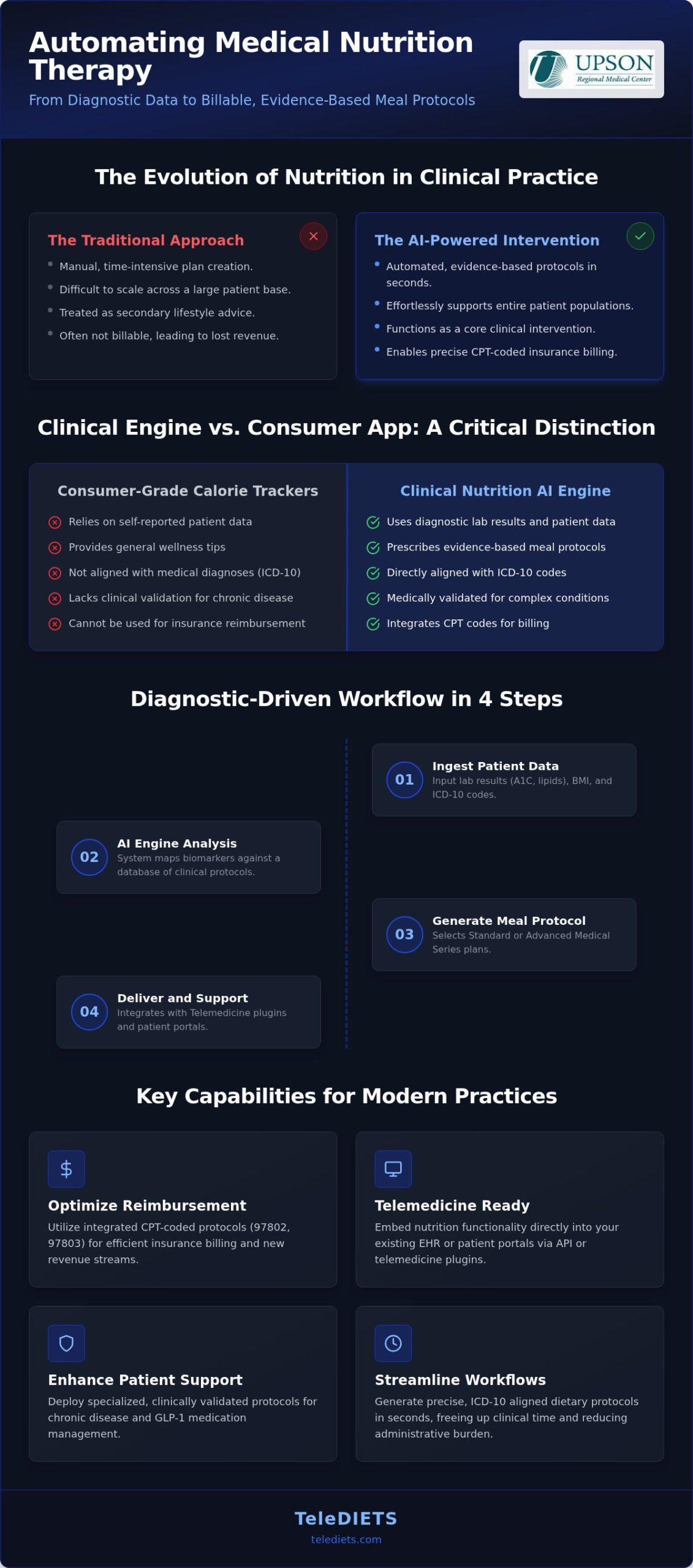
A clinical nutrition AI engine is a sophisticated SaaS or API-driven system designed to automate the delivery of Medical Nutrition Therapy (MNT). Unlike consumer-grade calorie trackers that rely on self-reported data and general wellness tips, a clinical-grade engine functions as a diagnostic execution layer. It allows you to prescribe evidence-based meal plans that are directly aligned with a patient’s medical history, lab results, and specific ICD-10 codes. By integrating these tools, you can move beyond the traditional bottleneck of manual dietitian referrals and provide immediate, physician-led nutrition prescriptions.
Understanding what is clinical nutrition in a modern context requires recognizing the shift toward automated, data-driven care. In chronic disease management, precision is everything. An engine ensures that every dietary protocol is scientifically validated and safe for the patient’s specific condition. This includes access to both Standard Series Meal Plans for general wellness and Advanced Medical Series Meal Plans for complex chronic conditions. These systems empower you to treat nutrition with the same clinical rigor as any other medical intervention.
The Difference Between SaaS and AI Engine Licensing
Clinics typically access this technology through two primary models. A standalone SaaS platform provides a full-featured interface where your staff can manage patient profiles and dietary protocols directly. Alternatively, a clinical nutrition AI engine can be licensed as a telemedicine plugin or API. This allows telemedicine platforms and large health systems to embed nutrition functionality into their existing electronic health records or patient portals, creating a seamless experience for both provider and patient.
Why 2026 is the Year of Automated MNT
The demand for metabolic health support has reached a critical point. With the widespread adoption of GLP-1 medications and a growing focus on obesity management, physicians need tools that scale. You can’t hire enough dietitians to support every patient on a weekly basis. Automated MNT allows you to provide high-quality, clinical-grade support to your entire patient population without increasing your headcount or administrative overhead. It’s the only way to meet the rising volume of patients requiring specialized GLP-1 Meal Plan Protocols while maintaining a high standard of care.
How Diagnostic-Driven AI Converts Lab Results into Meal Protocols
Bridging the gap between a lab report and a patient’s kitchen requires more than just general advice. It demands a systematic translation of biomarkers into specific nutrient targets. When you input data such as A1C levels, lipid panels, or BMI into a clinical nutrition AI engine, the system doesn’t just suggest a diet. It maps these values against a database of clinical protocols to ensure every meal supports the primary diagnosis. By analyzing the future of AI in clinical nutrition, it’s clear that this shift toward algorithmic matching is the new standard for precision care.
The engine uses ICD-10 codes to determine the appropriate depth of intervention. For patients focused on preventative health, the system selects from the Standard Series Meal Plans. However, when pathology is present, it pivots to the Advanced Medical Series Meal Plans. This ensures that a patient with Stage 3 Chronic Kidney Disease receives a protocol with strictly controlled phosphorus and potassium levels, rather than a generic heart-healthy plan. This level of precision is achieved through Z-score matching, which aligns the nutrient density of every meal with the patient’s physiological requirements. If you’re looking to enhance your diagnostic execution, you can integrate these medical protocols into your patient workflows today.
Specialized Protocols: The GLP-1 Meal Plan Series
Patients on GLP-1 receptor agonists face unique challenges, particularly the risk of losing lean muscle mass alongside adipose tissue. Our specialized protocols prioritize high-quality protein and specific macronutrient ratios to mitigate this loss and maintain metabolic health. The clinical nutrition AI engine also adjusts caloric density and fiber intake during titration periods. This helps minimize common gastrointestinal side effects, ensuring better medication adherence and long-term success for your patients.
Evidence-Based Validity and Clinical Safety
Every protocol generated by the engine adheres to USDA and established clinical guidelines to ensure total patient safety. The system acts as a digital safeguard, preventing the risks often associated with restrictive or unmonitored dieting. The engine utilizes a predictive nutrient-gap analysis to identify and correct potential micronutrient shortfalls before a plan is ever delivered to the patient. This ensures that even the most restricted medical diets remain nutritionally complete and clinically sound.
Integrating Clinical AI into Practice Workflow and Billing
Integrating a clinical nutrition AI engine into your medical workflow doesn’t require a total overhaul of your operations. The process follows a logical four-step progression that prioritizes both clinical efficacy and administrative efficiency. It begins with a standard patient assessment through lab work and clinical diagnosis. Once you enter the data, the engine generates a personalized dietary protocol within seconds. This plan is delivered via a secure patient portal or a dedicated Telemedicine Plugin. Finally, the system provides automated documentation to support insurance reimbursement using specific CPT codes.
This structured approach addresses the common friction points that prevent physicians from offering nutrition services. As highlighted in the Mayo Clinic AI in Clinical Nutrition Review, the ability of AI to synthesize complex data into actionable clinical support is a cornerstone of modern value-based care. By automating the transition from diagnosis to prescription, you ensure every patient receives a high-standard protocol without the need for manual calculations or extensive staff intervention.
Maximizing Reimbursement with CPT Coding Tools
Revenue generation is often the biggest hurdle in clinical nutrition. Our integrated Insurance Billing & CPT Coding Tools simplify this by aligning your documentation with the requirements for CPT 97802 for initial individual MNT assessments and CPT 97803 for subsequent sessions. The engine generates the necessary clinical notes based on the patient’s diagnosis and the prescribed plan. This reduces the risk of claim denials and ensures your practice is fairly compensated for the medical necessity of these interventions.
Scaling with the Telemedicine Plugin
For modern practices, remote care is no longer optional. The Telemedicine Plugin allows you to seamlessly integrate nutrition therapy into your virtual consultations. This digital-first approach enhances patient retention by providing high-touch support between traditional office visits. You can activate your practice’s billing and workflow tools to begin scaling these services immediately. This creates a stable revenue stream while providing the metabolic health support your patients increasingly demand.
Evaluating Clinical Nutrition Engines: Why TeleDIETS Leads
TeleDIETS stands apart from modern AI startups because it is built on three decades of innovation by Lifestyles Technologies, Inc. Founded in 1995, the company has spent 30 years refining the algorithms that power its clinical nutrition AI engine. This longevity provides a level of scientific validity and reliability that newer, consumer-focused apps simply cannot match. For telemedicine platforms and large health systems, TeleDIETS offers a stable, scalable backbone that transforms nutrition from a vague recommendation into a high-standard clinical service.
Security remains a non-negotiable priority when handling Protected Health Information (PHI). TeleDIETS adheres to strict HIPAA standards, ensuring that every data point processed by the clinical nutrition AI engine is protected. By establishing formal Business Associate Agreements (BAAs), the platform allows providers to integrate nutrition therapy with total confidence in their compliance posture. This transition from basic diet advice to formal medical nutrition therapy ensures your practice meets the high-level professional standards required in the current 2026 medical environment.
Customization and Provider Control
While the AI automates the heavy lifting, you remain the ultimate authority. Physicians have the flexibility to override or fine-tune any AI-generated protocol to account for a patient’s unique nuances or rare comorbidities. You can choose to license the engine as a backend plugin for your existing platform or utilize the full SaaS suite for a turnkey solution. This control ensures that the technology supports your clinical judgment rather than replacing it.
Getting Started with Clinical AI
Implementing this technology depends on your clinic’s specific volume and operational goals. Whether you’re managing a small private practice or a multi-state health system, there’s a configuration designed to match your workflow. Selecting the right license level allows you to scale at a pace that fits your patient load. You can empower your practice with the TeleDIETS clinical engine today to start delivering precise, billable nutrition protocols. By choosing a partner with a 30-year track record, you’re investing in a stable future for your patients and your practice revenue.
Modernizing Your Clinical Nutrition Strategy
The shift toward automated medical nutrition therapy isn’t just about clinic efficiency; it’s about providing the level of precision care that modern patients expect. By integrating a clinical nutrition AI engine into your daily workflow, you eliminate the manual bottlenecks that have historically sidelined nutrition services. You now have the tools to convert diagnostic data into billable protocols in seconds, allowing you to support complex cases like metabolic disease and GLP-1 management with absolute confidence.
With over 30 years of clinical nutrition software expertise, TeleDIETS provides the stability and rigor your practice requires. You can capture revenue more effectively through integrated CPT coding for 97802 and 97803 visits while utilizing specialized Advanced Medical Series protocols. It’s time to move beyond general dietary advice and embrace a diagnostic-driven approach that empowers both your staff and your patients. We’re ready to help you lead the way in metabolic health and provider-led nutrition.
Scale your clinic’s nutrition therapy with TeleDIETS today
Frequently Asked Questions
What is a clinical nutrition AI engine and how does it differ from a regular app?
A clinical nutrition AI engine is a medical-grade software system that automates Medical Nutrition Therapy (MNT) based on objective clinical data. Unlike consumer apps that focus on self-reported calorie counting or general wellness tips, this engine uses lab results and ICD-10 codes to generate precise prescriptions. It acts as a diagnostic execution layer in your practice, ensuring every plan meets professional standards for safety and clinical efficacy.
Can I bill insurance for meal plans generated by an AI engine?
Yes, you can bill insurance for these services by using our integrated CPT coding tools. The engine supports reimbursement for codes 97802 and 97803 by providing the specific clinical documentation required to prove medical necessity. This allows your practice to scale nutrition therapy as a billable service rather than an uncompensated lifestyle suggestion, creating a sustainable revenue stream for your clinic.
How does the AI engine handle patients with multiple chronic conditions?
The engine manages complex cases by utilizing the Advanced Medical Series protocols designed for specific pathologies. It applies algorithmic matching to ensure that a patient with comorbid conditions, such as diabetes and hypertension, receives a plan that balances conflicting nutrient requirements. This sophisticated approach prevents common risks like excessive sodium or improper glycemic loads in restricted medical diets while maintaining nutrient density.
Is the TeleDIETS engine compatible with my existing telemedicine platform?
The TeleDIETS engine is designed for seamless integration through a dedicated Telemedicine Plugin or a flexible backend API. This allows you to add professional clinical nutrition AI engine functionality to your current patient portal or EHR without switching platforms. It’s a stable solution that fits into your existing digital infrastructure to support remote consultations and enhance long-term patient retention.
Do I need a registered dietitian on staff to use a clinical nutrition AI engine?
You don’t need a registered dietitian on staff to provide high-quality nutrition support with this technology. The system is built to empower physicians to lead nutrition prescriptions directly using evidence-based protocols. While it’s a valuable tool for dietitians, it also allows clinics without specialized staff to offer valid Medical Nutrition Therapy to their patient population with confidence and clinical rigor.
Leave a Reply