
What if your most effective prescription for chronic disease management didn’t come from a pharmacy, but from a data-driven meal plan that updates in real-time based on your patient’s latest lab results? Most physicians recognize that nutrition is the cornerstone of metabolic health. However, you likely find that manual meal planning is far too time-consuming for a high-volume clinic. Finding a clinical-grade platform for prescribing therapeutic diets is no longer just a luxury for boutique practices; it’s a necessity for any provider looking to improve outcomes without sacrificing their schedule.
You already know that bridging the gap between a diagnosis and a patient’s dinner plate is where most treatment plans fail. This guide will show you how to streamline that process using sophisticated technology that automates evidence-based dietary prescriptions and simplifies the complexities of insurance billing. We’ll explore how to integrate CPT codes for medical nutrition therapy, provide essential support for patients on GLP-1 medications, and turn nutrition services into a reliable revenue driver for your practice in 2026.
Key Takeaways
- Transition from generic nutritional advice to evidence-based Medical Nutrition Therapy (MNT) to elevate your standard of care.
- Evaluate the core benefits of a clinical-grade platform for prescribing therapeutic diets, focusing on lab-based automation and precision protocols.
- Seamlessly integrate nutrition prescriptions into your current digital environment using a specialized telemedicine plugin.
- Capture revenue opportunities that don’t require extra administrative overhead by using integrated insurance billing and CPT coding tools.
- Support patients on GLP-1 medications with specialized protocols that enhance drug efficacy and patient adherence without adding to your team’s workload.
The Evolution of Clinical Nutrition: Why a Dedicated Platform for Prescribing Therapeutic Diets is Essential
Clinical nutrition has undergone a significant transformation, moving from a secondary consideration to a primary therapeutic intervention. A modern platform for prescribing therapeutic diets is far more than a simple meal planner; it’s a sophisticated clinical tool designed to translate complex medical data into actionable patient care. This shift reflects the broader integration of clinical nutrition into standard medical practice, where precision and evidence-based Medical Nutrition Therapy (MNT) replace generic dietary advice.
For high-volume healthcare practices, manual dietary protocols often create a significant operational bottleneck. Physicians understand the necessity of nutrition in managing chronic conditions, yet the time required to manually match lab results with specific nutrient requirements is often prohibitive. AI technology now bridges this gap by instantly aligning clinical diagnoses with patient-ready meal protocols, ensuring that the prescription is as accurate as any pharmaceutical intervention.
Moving Beyond Static Dietary Guidelines
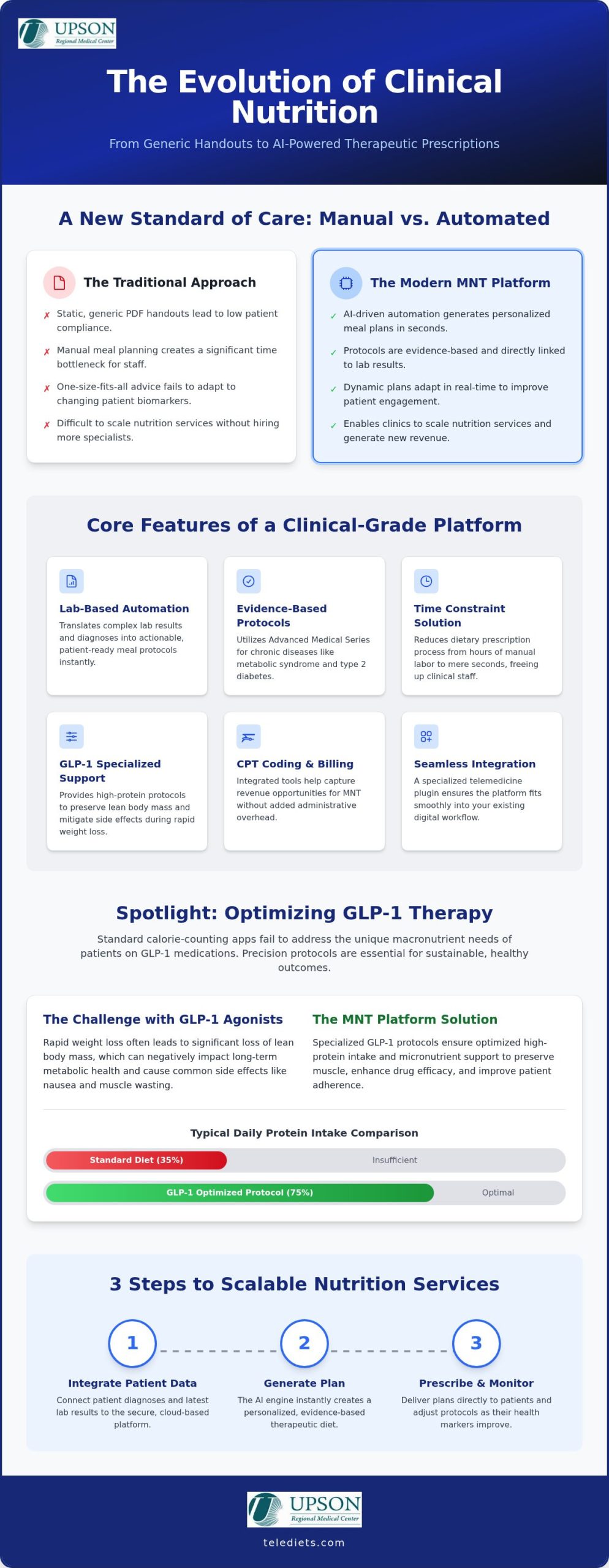
The days of handing a patient a generic, photocopied PDF are over. These static documents fail to account for the dynamic nature of chronic disease and rarely lead to long-term compliance. Real-time data integration allows for a more responsive approach, where dietary protocols adapt as a patient’s biomarkers change. This level of personalization increases patient engagement because the plan feels relevant to their specific health journey, rather than a one-size-fits-all suggestion.
Addressing the Provider Time Constraint
Time is the most valuable resource in a clinical setting. While traditional nutrition planning could take a provider or staff member hours of research and calculation, automated engines handle the heavy lifting. TeleDIETS reduces the dietary prescription process from hours of manual labor to mere seconds. By automating the generation of these plans, your clinic can scale its nutrition services without the need to hire additional specialized staff, allowing you to focus on direct patient care and complex decision-making.
Core Features of a Professional Medical Nutrition Therapy SaaS
A modern platform for prescribing therapeutic diets must do more than just house recipes; it’s designed to act as a clinical decision support tool. Precision matters in MNT. By integrating directly with patient lab results and specific diagnoses, the software generates personalized protocols in seconds. This automation ensures every patient receives a plan tailored to their unique metabolic profile, whether they require the Standard Series for general wellness or the Advanced Medical Series for complex chronic conditions.
Evidence-Based Protocols for Chronic Disease
The Advanced Medical Series is specifically designed to manage high-stakes conditions like metabolic syndrome and type 2 diabetes. These protocols prioritize nutrient density, which is essential for supporting pharmaceutical interventions. Synergy drives adherence. When a patient’s diet is optimized to work alongside their medication, you’ll often see improved glycemic control and better overall adherence. This clinical approach ensures that nutrition isn’t just an afterthought but a core component of the treatment plan.
The Clinical Advantage of GLP-1 Specialized Support
As the use of GLP-1 receptor agonists becomes more common, physicians face the challenge of managing rapid weight loss while preserving lean body mass. Standard calorie-counting apps don’t address the unique macronutrient targets these patients need. Specialized GLP-1 Meal Plan Protocols focus on high protein intake and micronutrient support to mitigate common side effects like nausea or muscle wasting. By providing this level of precision, you help patients achieve sustainable results while maintaining their metabolic health.
Cloud-based accessibility ensures your entire team stays aligned, whether you operate a single clinic or a multi-location health system. As an AI engine for modern telemedicine, the system allows you to manage patient progress and adjust protocols from any device. Utilizing a professional platform for prescribing therapeutic diets ensures that your nutrition services remain consistent across all points of care. If you’re ready to see how these tools integrate into your workflow, you can review the advanced clinical protocols to start enhancing your patient outcomes today.
Integrating Nutrition Therapy into Your Practice Workflow
Integrating nutrition therapy into your daily operations shouldn’t feel like an administrative burden. A clinical platform for prescribing therapeutic diets serves as the connective tissue between your initial diagnosis and the patient’s long-term success. By setting specific clinical triggers, such as an elevated BMI or a chronic kidney disease diagnosis, you can trigger a nutritional prescription automatically. This eliminates the traditional handoff friction and ensures that the patient receives their plan while the consultation is still fresh in their mind.
Security remains a non-negotiable priority in this process. Since the temporary HIPAA enforcement waivers have expired, utilizing a fully compliant software solution is essential for protecting patient privacy. Professional platforms provide the necessary Business Associate Agreements (BAAs) and encryption to ensure that sensitive lab data and dietary protocols remain secure across your entire digital ecosystem. Utilizing a sophisticated platform for prescribing therapeutic diets ensures that your practice meets these rigorous 2026 standards while maintaining a smooth clinical workflow.
Maximizing Revenue with Insurance Billing and CPT Coding Tools
Capturing the value of your nutritional services requires precise documentation. Integrated tools help you identify the correct CPT codes for Medical Nutrition Therapy, such as 97802 or 97803, reducing the likelihood of claim denials. Automated coding ensures that your billing team has the exact data needed to process reimbursements efficiently. You can learn how to automate your clinical workflow to capture this revenue without increasing your staff’s workload.
Telehealth Integration and Remote Patient Monitoring
Delivering care in 2026 means meeting patients where they are. A dedicated telemedicine plugin allows you to offer MNT within your existing digital health environment. This integration supports remote patient monitoring, allowing you to track adherence to prescribed protocols in real-time. When patients have digital access to their dietary plans, they’re more likely to stay engaged with their treatment, leading to the sustainable outcomes your practice strives to achieve.
To see how these tools fit your specific practice model, explore our clinical integration options.
Scaling Your Clinic with the TeleDIETS AI Nutrition Engine
Scaling a clinical practice usually requires a linear increase in headcount. However, an AI-powered SaaS engine changes this equation by automating the most labor-intensive aspects of Medical Nutrition Therapy. By adopting a professional platform for prescribing therapeutic diets, you can expand your patient capacity without the overhead of hiring additional specialized staff. This efficiency allows you to position your practice as a leader in whole-person care, offering sophisticated, data-driven interventions that actively reduce the long-term complications of chronic disease.
Why TeleDIETS is the Partner for Modern Providers
Lifestyles Technologies, Inc. brings decades of heritage in professional nutrition software to every clinical interaction. We operate as your “Trusted Expert Guide,” providing the validated science and technical infrastructure you need to remain a stable partner for your patients. You don’t have to be a nutrition specialist to offer expert nutrition. The platform handles the clinical precision, allowing you to focus on the high-level medical management that only a physician can provide. It’s about empowering you to deliver better care with less effort.
Getting Started: From Subscription to First Prescription
Implementing a clinical-grade nutrition platform is a streamlined process designed for busy medical environments. The onboarding for the TeleDIETS SaaS application is intuitive, allowing your team to move from initial setup to the first prescription in minimal time. You can choose the model that best fits your operational goals, whether that’s the high-volume AI engine licensing for large health systems or the flexible SaaS subscription for growing clinics. Professional empowerment starts with having the right tools at your fingertips.
If you’re ready to integrate these tools into your workflow, you can start your clinical subscription and begin generating lab-based protocols today. Transitioning to a data-driven model ensures your practice remains at the forefront of metabolic health through 2026 and beyond.
Elevating Patient Outcomes Through Digital Nutrition Integration
The transition toward a data-driven clinical environment is no longer a future goal; it’s a current standard for providers who prioritize metabolic health. By automating the handoff between lab results and dietary prescriptions, you remove the administrative friction that once made Medical Nutrition Therapy a bottleneck. This shift allows you to provide evidence-based care for over 360 conditions while capturing revenue through integrated CPT coding tools that simplify reimbursement processes.
Adopting a professional platform for prescribing therapeutic diets ensures that your practice remains efficient, compliant, and scalable in a competitive landscape. Developed by Lifestyles Technologies, Inc., industry leaders since 1995, this technology empowers you to deliver precision nutrition without the need for additional headcount. You can empower your practice with the TeleDIETS clinical nutrition platform today and lead the way in comprehensive, whole-person care. We’re proud to be your partner in clinical excellence and sustainable patient success.
Frequently Asked Questions
What are the most common CPT codes for medical nutrition therapy?
The primary codes used for these services are 97802 for the initial face-to-face assessment and 97803 for follow-up reassessments and interventions. If you provide services in a group setting, 97804 is the appropriate designation. Using a professional platform for prescribing therapeutic diets helps you select these codes accurately, ensuring your billing team has the precise documentation needed to reduce claim denials.
Can this platform integrate with my existing Electronic Health Record (EHR) system?
Integration is achieved through a specialized telemedicine plugin or a cloud-based SaaS interface that operates alongside your current digital environment. This setup allows you to move from a clinical diagnosis to a nutritional prescription without manual data entry. By leveraging these tools, you maintain a unified workflow while utilizing a specialized AI engine to handle complex nutrient calculations that standard EHR systems aren’t designed to perform.
Is there a specific meal plan protocol for patients on GLP-1 medications?
Yes, the platform offers dedicated GLP-1 Meal Plan Protocols specifically designed to support patients on receptor agonists. These plans prioritize high-quality protein and micronutrient density to help preserve lean body mass while managing common gastrointestinal side effects. Providing this level of targeted support ensures your patients achieve sustainable weight loss results while maintaining their overall metabolic health.
How does the platform use lab results to generate a therapeutic diet?
The AI engine analyzes patient biomarkers, such as lipid profiles, glycemic markers, and renal function data, to automatically align nutrient targets with the clinical diagnosis. It generates a personalized, prescription-grade plan in seconds by matching these lab values against evidence-based dietary standards. This process ensures that every meal protocol is scientifically validated and tailored to the patient’s current physiological needs.
Does insurance typically cover medical nutrition therapy prescribed through a platform?
Insurance coverage for MNT is robust, especially for managing chronic conditions like diabetes and renal disease. Medicare has extended its telehealth flexibilities through December 31, 2027, which allows for the remote provision and billing of these services regardless of the patient’s geographic location. Utilizing a sophisticated platform for prescribing therapeutic diets with integrated billing tools helps you navigate these regulations and capture the revenue your practice deserves.
Leave a Reply