
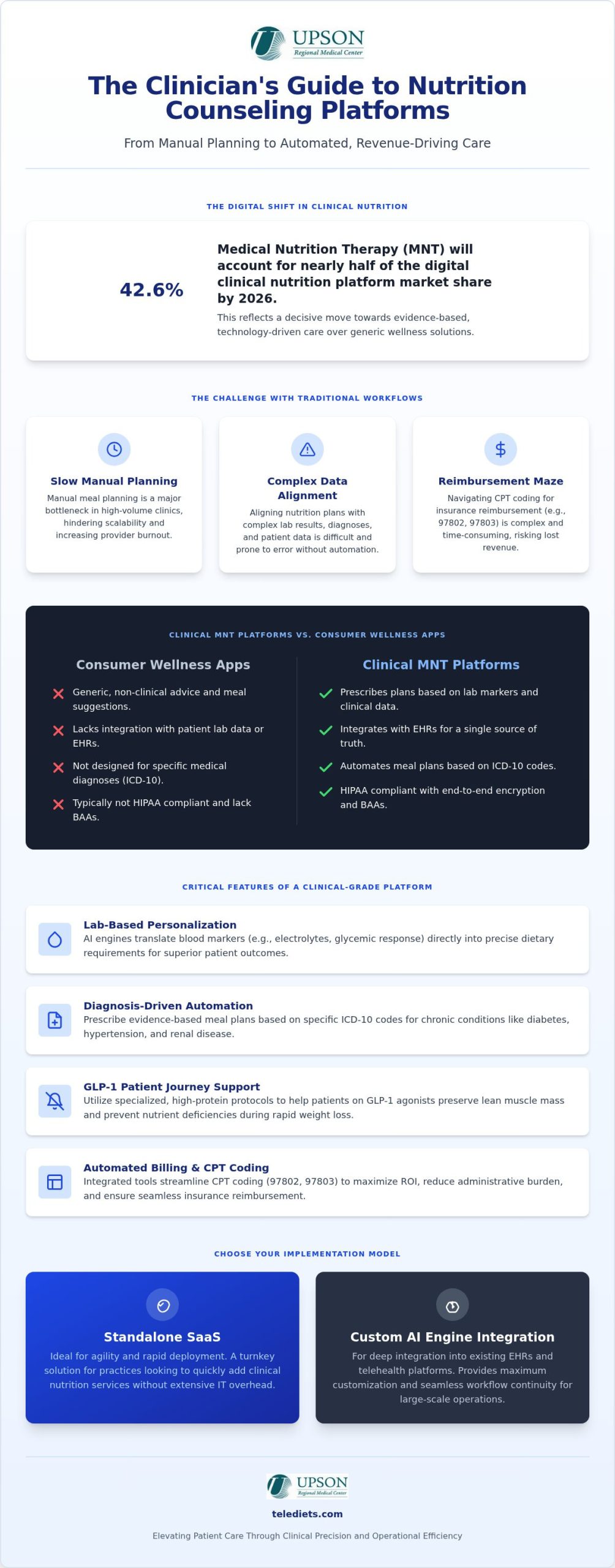
Did you know that medical nutrition therapy accounts for 42.6% of the digital clinical nutrition platform market share in 2026? As a clinician, you likely feel that manual meal planning is far too slow for high-volume clinics. It’s difficult to align nutrition plans with complex lab results, and navigating CPT coding for reimbursement often feels like a full-time job. Selecting a sophisticated nutrition counseling platform for telehealth is no longer just about virtual meetings; it’s about clinical precision and operational efficiency.
This guide helps you evaluate and integrate a clinical-grade platform that automates medical nutrition therapy while maximizing practice revenue. You’ll learn how to implement automated, lab-based nutrition prescriptions that improve outcomes for chronic disease and GLP-1 support. We will also break down the 2026 reimbursement landscape for codes 97802 and 97803 to ensure your practice captures the full value of its expertise. It’s time to move beyond basic tools and adopt a system that acts as a true partner in patient care.
Key Takeaways
- Identify the critical distinctions between consumer wellness apps and clinical-grade MNT engines that utilize lab data for precision care.
- Evaluate the essential features of a nutrition counseling platform for telehealth to automate meal planning and support chronic disease management.
- Discover strategies for maximizing practice ROI by integrating automated CPT coding tools for seamless insurance reimbursement.
- Determine the ideal implementation model for your clinic, comparing the agility of standalone SaaS with the depth of custom AI engine licensing.
What is a Clinical Nutrition Counseling Platform for Telehealth?
A clinical nutrition counseling platform for telehealth is a specialized ecosystem built to deliver Medical Nutrition Therapy (MNT) in a remote environment. MNT currently accounts for 42.6% of the digital clinical nutrition market share, reflecting a clear shift toward evidence-based digital care. While many mistake these systems for consumer wellness apps, the difference lies in clinical validity. A professional platform functions as a medical engine, using lab data and specific diagnoses to drive patient outcomes. This transition from external referrals to in-house digital nutrition prescriptions allows your practice to retain patient engagement and ensure continuity of care.
Data security is the foundation of these systems. As of August 2026, all telehealth platforms must strictly adhere to HIPAA regulations, including signed Business Associate Agreements (BAAs) and end-to-end encryption. This ensures that sensitive patient metrics remain protected during every virtual consultation.
The Evolution from Video Calls to Integrated MNT
Relying on a simple video link is no longer sufficient for modern clinical standards. You need a nutrition counseling platform for telehealth that provides structured, evidence-based protocols. Manual meal planning is often the primary bottleneck in high-volume clinics. By utilizing automated meal plan generation, you can provide high-quality care in seconds; this significantly reduces provider burnout and operational friction while maintaining a high standard of patient support.
Key Components of a Professional Telehealth Engine
- Diagnosis-Based Interface: The ability to prescribe meal plans based on specific ICD-10 codes or lab markers.
- EHR Integration: Seamless data flow between your nutrition engine and existing Electronic Health Records to maintain a single source of truth.
- Automated Billing: Integrated tools for CPT codes like 97802 and 97803 to streamline the reimbursement process.
For practices ready to scale, choosing between a standalone SaaS or a deeply integrated telemedicine plugin depends on your current workflow and volume requirements. Both options aim to bridge the gap between physician diagnosis and patient execution.
Critical Features for Clinical-Grade Nutrition Software
Selecting a nutrition counseling platform for telehealth requires more than a simple interface; it demands clinical intelligence. A professional system must provide automated meal plan generation rooted in specific clinical diagnoses. For patients managing chronic conditions such as diabetes, hypertension, or renal disease, evidence-based protocols ensure that dietary interventions align with medical standards. The Academy of Nutrition and Dietetics emphasizes that these digital tools must support the practitioner’s ability to provide high-quality, standardized care remotely through secure, compliant channels.
Lab-Based Personalization: The Gold Standard
True clinical precision happens when a platform’s AI engine translates blood markers directly into dietary requirements. Precision matters in chronic care. Instead of generic advice, Advanced Medical Series plans adjust for specific electrolyte levels or glycemic responses. This automation allows you to move from a physician’s diagnosis to a patient’s execution in seconds. By integrating these engines with a functional telemedicine plugin, you can host consultations and update prescriptions within a single, secure environment without toggling between multiple windows.
Supporting the GLP-1 Patient Journey
With the rise of GLP-1 receptor agonists, preserving lean muscle mass has become a primary clinical priority. Standardized nutritional protocols are now essential to prevent the nutrient deficiencies often associated with rapid weight loss. Utilizing specialized GLP-1 Meal Plan Protocols ensures your patients receive the high-protein, nutrient-dense support they need to succeed. If you’re looking to enhance your practice’s digital capabilities, you can explore clinical-grade meal planning tools to streamline these complex workflows. Implementing a dedicated nutrition counseling platform for telehealth ensures that your patients remain supported throughout their entire therapeutic journey, bridging the gap between prescription and daily habit change.
Maximizing ROI: Insurance Billing and CPT Coding
A sophisticated nutrition counseling platform for telehealth shouldn’t just be a cost; it should be a primary revenue driver. By keeping nutrition services in-house rather than referring patients out, you capture the full value of Medical Nutrition Therapy (MNT). Success hinges on understanding the primary CPT codes: 97802 for the initial assessment and 97803 for subsequent follow-ups. Both are billed in 15-minute units. In 2026, private insurers like Aetna offer national average reimbursements as high as $55.71 for an initial unit, making clinical nutrition a highly viable service line for modern clinics.
Navigating MNT Reimbursement
Securing these reimbursements requires meticulous documentation. You must demonstrate the medical necessity of the intervention and track specific patient progress markers throughout the care cycle. Integrated billing tools reduce administrative overhead by automating much of the coding process and significantly minimizing claim denials. TeleDIETS simplifies this by aligning your clinical notes with the specific documentation requirements for 97802 and 97803. This ensures your team spends less time on paperwork and more time on high-impact care. These integrated tools also help you track patient engagement, providing the quantitative data necessary for value-based care reporting and contract negotiations.
Scaling Through Automation
Efficiency is the primary lever for scaling a high-volume practice. When you use an automated clinical engine, you can reduce the time spent on manual meal planning from hours to just a few seconds. This time savings allows your providers to manage larger patient panels without increasing burnout or operational costs. You can explore member checkout options to see which platform tier fits your current volume and long-term growth goals. To start capturing these efficiencies today, access our integrated insurance billing and CPT coding tools to streamline your practice’s financial workflow. Moving these services in-house ensures both improved patient outcomes and a much stronger bottom line.
Implementation: SaaS vs. AI Engine Integration
Deciding how to deploy a nutrition counseling platform for telehealth depends on your current infrastructure and long-term volume goals. For smaller clinics or solo practitioners, a “Standalone SaaS” model offers the fastest path to deployment. It provides a turnkey solution without requiring extensive technical resources. Conversely, established telemedicine platforms often benefit from “AI Engine Licensing.” This allows for deep integration into existing workflows, ensuring the nutrition engine feels like a native part of your practice management system rather than a disconnected tool.
Choosing the Right Deployment Model
You’ll need to evaluate whether a dedicated telemedicine plugin or a full EHR integration best suits your needs. Plugins are excellent for adding specific functionality to your current site quickly, while EHR integrations ensure seamless data sharing across the entire care team. White-label options are also critical for maintaining brand consistency; they allow the platform to reflect your clinic’s identity, which reinforces patient trust. Regardless of the model, prioritize customization. This ensures that meal plan protocols, whether from the Standard or Advanced Medical Series, align perfectly with your practice’s specific medical philosophy.
Next Steps for Your Practice
Before a full-scale rollout, conducting a pilot program with a small patient cohort is a prudent strategy. This allows you to refine your clinical workflow and ensure your team is comfortable with the diagnosis-based prescription interface. As you finalize your choice, use this checklist to ensure the platform meets your professional standards:
- Security: Full HIPAA compliance and a signed Business Associate Agreement (BAA).
- Clinical Validity: Lab-based automation and evidence-based protocols for chronic care.
- Scalability: The ability to handle increased patient volume without manual bottlenecks.
By integrating a sophisticated clinical engine, you position your clinic as a comprehensive digital health leader. You’re no longer just providing advice; you’re delivering holistic, data-driven care that scales with your success.
Empowering Your Clinic for the Future of Care
Integrating a clinical nutrition engine is more than a technical upgrade; it’s a strategic shift toward data-driven, profitable care. You’ve seen how moving nutrition services in-house allows your practice to capture revenue through integrated CPT coding tools while improving patient execution. By utilizing evidence-based Advanced Medical Series protocols and specialized GLP-1 support, you ensure that every dietary prescription is as precise as a medical one.
Selecting the right nutrition counseling platform for telehealth empowers your team to deliver high-quality Medical Nutrition Therapy at scale. Whether you choose a standalone SaaS or a deep engine integration, the result is a more efficient workflow and better chronic disease management. You’re now equipped to bridge the gap between diagnosis and daily habit change.
Ready to transform your service delivery? You can upgrade your practice with the TeleDIETS clinical nutrition engine to start maximizing your ROI today. Your clinic has the potential to lead the next era of comprehensive digital health, and we’re here to support that journey every step of the way.
Frequently Asked Questions
What CPT codes are used for telehealth nutrition counseling?
The primary codes for medical nutrition therapy are 97802 for the initial assessment and 97803 for individual follow-up sessions. Both codes are billed in 15-minute units. In 2026, Medicare and private insurers like Aetna and Cigna continue to reimburse these codes for services delivered via a nutrition counseling platform for telehealth, provided the documentation meets specific clinical requirements.
Can physicians prescribe medical nutrition therapy without a registered dietitian?
Physicians can certainly prescribe medical nutrition therapy, and modern platforms allow them to bridge the gap between diagnosis and execution. By using an AI-powered engine, you can generate diagnosis-based meal plans in seconds without needing an on-staff dietitian for every interaction. This enables your clinic to offer comprehensive, in-house nutrition support that aligns directly with your medical philosophy and patient lab results.
Is nutrition counseling software for telehealth HIPAA compliant?
Professional nutrition counseling platform for telehealth solutions are designed to be fully HIPAA compliant. This requires end-to-end encryption and a signed Business Associate Agreement (BAA) between the provider and the software vendor. Since the expiration of COVID-19 public health emergency waivers, all platforms must adhere to these strict data security standards to protect patient information and maintain the clinical integrity of your remote practice.
How do GLP-1 meal plan protocols differ from standard weight loss plans?
GLP-1 meal plan protocols differ from standard plans by prioritizing lean muscle mass preservation and specific nutrient density. These specialized protocols address the unique metabolic changes and appetite suppression associated with GLP-1 receptor agonists. While standard plans focus on general caloric deficits, these clinical-grade protocols ensure patients receive high protein and essential micronutrients to prevent nutritional deficiencies during rapid weight loss.
What are the hardware requirements for a telemedicine nutrition plugin?
Implementing a telemedicine nutrition plugin typically requires no specialized hardware beyond a standard computer, high-definition webcam, and a stable internet connection. Because these systems are cloud-based, the AI engine handles complex calculations on secure remote servers. You simply need a modern web browser and a private environment to conduct secure consultations, ensuring your practice can scale its digital services without significant capital investment in equipment.
Leave a Reply