
What if the biggest barrier to better patient outcomes isn’t clinical knowledge, but the systems you’re working with? For many healthcare providers, that question hits close to home. Implementing personalized clinical weight loss protocols for providers is often more complex than it should be, tangled in workflow friction, inconsistent documentation, and the persistent challenge of securing reimbursement for nutrition services.
You already understand that a one-size-fits-all approach to weight management doesn’t serve your patients well. The evidence is clear, and your clinical instincts confirm it. What you need is a practical, scalable framework that translates that understanding into consistent, billable, patient-centered care without adding hours to your day.
This guide is designed to do exactly that. You’ll discover how to build and implement evidence-based weight loss protocols tailored to individual patient needs, learn how platforms like TeleDIETS can integrate seamlessly into your existing clinical workflows, and gain clarity on navigating the reimbursement landscape for medical nutrition therapy. From AI-powered meal planning to integrated CPT coding tools, the path to more effective, efficient weight management care is closer than you think.
Key Takeaways
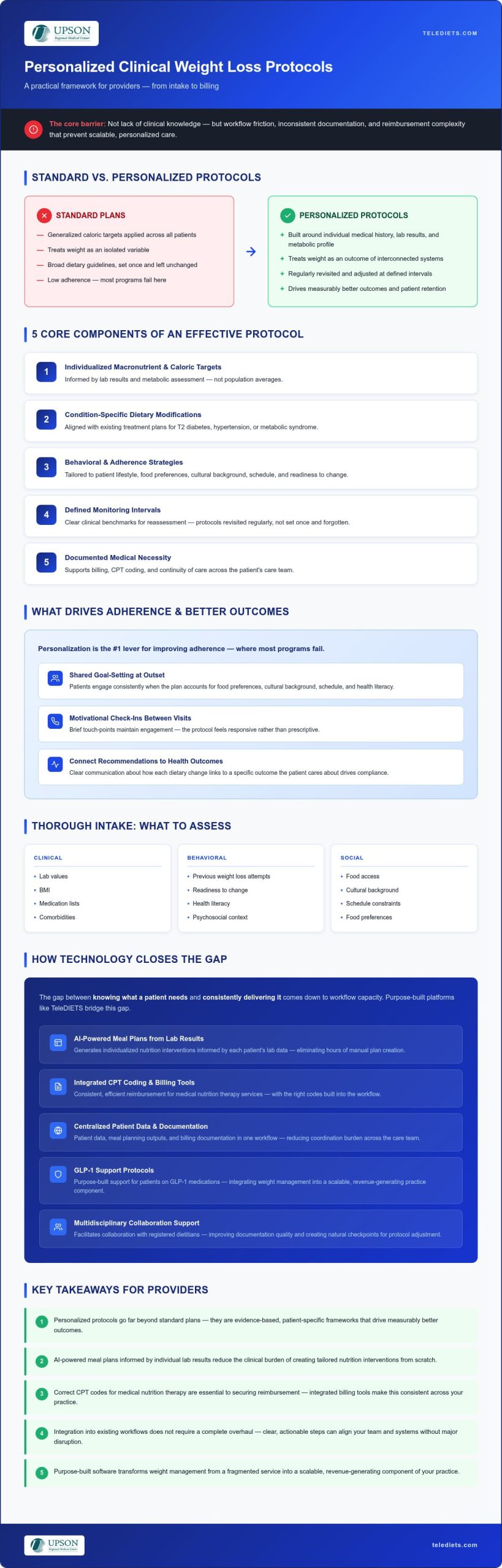
- Personalized clinical weight loss protocols for providers go far beyond standard weight management plans, offering evidence-based, patient-specific frameworks that drive measurably better outcomes.
- Technology platforms like TeleDIETS can generate AI-powered meal plans informed by individual patient lab results, reducing the clinical burden of creating tailored nutrition interventions from scratch.
- Understanding the correct CPT codes for medical nutrition therapy is essential to securing reimbursement – and the right billing tools can make that process consistent and efficient across your practice.
- Integrating personalized protocols into your existing workflows doesn’t require a complete operational overhaul; there are clear, actionable steps to get your team trained and your systems aligned.
- From GLP-1 support protocols to integrated insurance billing tools, purpose-built software can transform weight management from a fragmented service into a scalable, revenue-generating component of your practice.
Understanding Personalized Clinical Weight Loss Protocols
A personalized clinical weight loss protocol is a structured, evidence-based intervention framework built around an individual patient’s medical history, metabolic profile, comorbidities, dietary preferences, and behavioral patterns. Unlike standard weight loss plans, which apply generalized caloric targets and broad dietary guidelines across a patient population, these protocols are designed to respond to the specific clinical picture in front of you. The distinction matters because patient variability is not an exception in weight management; it’s the rule.
Standard plans tend to treat weight as an isolated variable. Personalized clinical weight loss protocols for providers treat it as an outcome of interconnected systems, including hormonal function, chronic disease burden, medication interactions, and psychosocial context. That shift in framing changes everything about how care is delivered and measured.
The clinical benefits extend well beyond weight reduction. When nutrition interventions are calibrated to a patient’s specific conditions, whether that’s type 2 diabetes, hypertension, or metabolic syndrome, the protocol becomes a chronic disease management tool, not just a weight management plan. This is where the evidence base is strongest and where reimbursement opportunities are most clearly defined.
An effective protocol typically integrates several core components:
- Individualized macronutrient and caloric targets informed by lab results and metabolic assessment
- Condition-specific dietary modifications aligned with existing treatment plans
- Behavioral and adherence strategies tailored to patient lifestyle and readiness to change
- Defined monitoring intervals with clear clinical benchmarks for reassessment
- Documented medical necessity to support billing and continuity of care
The Role of Personalization in Weight Loss
Adherence is where most weight management programs fail, and personalization is the most clinically defensible lever for improving it. When patients receive a plan that accounts for their food preferences, cultural background, schedule constraints, and health literacy, they’re more likely to engage consistently. Clinical settings that have moved toward individualized nutrition counseling report stronger patient retention in weight management programs, particularly when protocols are revisited and adjusted at regular intervals rather than set once and left unchanged.
Patient engagement deepens when the protocol feels responsive rather than prescriptive. Practical strategies that support this include shared goal-setting at the outset, brief motivational check-ins between formal visits, and clear communication about how each dietary recommendation connects to a specific health outcome the patient cares about.
Key Considerations for Providers
Effective implementation begins with a thorough intake process. Assessing not just lab values and BMI, but also medication lists, previous weight loss attempts, food access, and readiness to change, gives you the clinical foundation to build a protocol that’s both appropriate and achievable. Integrating the weight loss protocol with existing treatment plans for conditions like insulin resistance or cardiovascular disease ensures coherence across the patient’s care team.
Collaboration with registered dietitians strengthens this process considerably. A multidisciplinary approach distributes the clinical workload, improves documentation quality, and creates natural checkpoints for protocol adjustment. Platforms designed to support personalized clinical weight loss protocols for providers can facilitate this collaboration by centralizing patient data, meal planning outputs, and billing documentation in a single workflow, reducing the coordination burden on your team.
Leveraging Technology for Personalized Nutrition Plans
Building individualized nutrition interventions at scale requires more than clinical expertise. It requires infrastructure. For most practices, the gap between knowing what a patient needs and consistently delivering it comes down to workflow capacity. That’s precisely where purpose-built medical nutrition therapy software changes the equation.
TeleDIETS is designed to close that gap. The platform enables healthcare providers to generate AI-powered meal plans informed directly by patient lab results, translating raw clinical data into structured, condition-specific nutrition interventions without requiring hours of manual protocol development. The result is a more efficient pathway to delivering personalized clinical weight loss protocols for providers who are already managing full patient panels.
Telemedicine integration extends that capability further. Rather than limiting meaningful nutrition support to in-office visits, a telemedicine plugin allows providers to maintain consistent patient contact between appointments. Ongoing touchpoints improve adherence, surface early signs of protocol drift, and create a documented record of patient progress that supports both clinical decision-making and billing continuity.
Features of Effective Nutrition Therapy Software
Not all nutrition platforms are built for clinical environments. The features that matter most in a provider-facing tool are those that reduce manual burden without sacrificing clinical specificity. Effective software in this category typically delivers:
- AI-driven meal planning that generates patient-specific plans based on lab values, comorbidities, and dietary parameters rather than generic templates
- Condition-specific protocol libraries, including GLP-1 Meal Plan Protocols for patients on receptor agonist therapy
- Integrated insurance billing and CPT coding tools that align documentation with reimbursement requirements from within the same workflow
- A provider-facing interface built for clinical efficiency, not consumer usability
Implementing Technology in Your Practice
Integration works best when it’s staged rather than immediate. Begin by mapping your current intake and follow-up workflows, then identify the points where nutrition protocol development currently creates the most friction. Introducing software at those specific junctures, rather than attempting a full workflow replacement at once, reduces disruption and gives your team time to build confidence with the tools.
Staff training should focus on the clinical outputs the software produces, not just its technical operation. When your team understands how AI-generated meal plans connect to patient lab data, they can communicate that logic clearly to patients, which strengthens engagement. Outcome measurement follows naturally: track protocol adherence rates, patient retention in your weight management program, and billing completion rates as your primary indicators of whether the technology is performing as intended.
Practices implementing personalized clinical weight loss protocols for providers through integrated software platforms are positioned to move from reactive, visit-driven nutrition support to a proactive, data-informed care model. If you’re ready to see how that looks in practice, explore TeleDIETS’ medical nutrition therapy platform to find the tier that fits your clinical environment.
Navigating Billing and Coding for Nutrition Therapy
Reimbursement is where many well-designed nutrition interventions stall. The clinical work is sound, the patient outcomes are measurable, but if the billing documentation doesn’t align with payer requirements, that work goes uncompensated. Understanding the CPT code landscape for medical nutrition therapy is not optional; it’s a foundational competency for any practice building sustainable weight management services.
The primary codes governing medical nutrition therapy reimbursement are 97802, 97803, and 97804. Code 97802 applies to the initial individual assessment and intervention, typically billed in 15-minute increments. Code 97803 covers re-assessment and subsequent intervention sessions for individual patients. Code 97804 is reserved for group medical nutrition therapy sessions. For obesity counseling delivered by a physician or qualified non-physician practitioner, codes G0447 and G0473 are relevant under Medicare, covering individual and group intensive behavioral therapy for obesity respectively. Selecting the correct code depends on the provider type, the patient’s diagnosis, and the specific service delivered, not just the time spent.
Diagnosis coding matters equally. Linking nutrition therapy services to an appropriate ICD-10 code, such as E11 for type 2 diabetes, I10 for hypertension, or E66 for obesity, establishes the medical necessity that most payers require before approving reimbursement. When implementing personalized clinical weight loss protocols for providers, this diagnostic linkage should be built into your documentation workflow from the outset, not added as an afterthought at billing time.
Best Practices for Nutrition Therapy Billing
Consistent, accurate documentation is the single most effective safeguard against claim denials. Each patient encounter should include a clear record of the intervention provided, the time spent, the patient’s current clinical status, and any protocol adjustments made. Vague or incomplete notes are the most common reason reimbursable services go unbilled or are denied on review.
- Match codes to provider credentials: Medicare’s MNT benefit requires a registered dietitian or nutrition professional. Physician-delivered counseling bills under different codes. Mixing these up is a frequent and costly error.
- Verify payer-specific coverage rules: Commercial insurers vary significantly in how they cover nutrition therapy. Some require a referral; others limit annual sessions. Confirming coverage before the first encounter prevents billing surprises downstream.
- Use integrated coding tools: Platforms with built-in CPT coding support, like TeleDIETS’ Insurance Billing and CPT Coding Tools, reduce the margin for human error by surfacing the appropriate codes within the same workflow where clinical documentation is completed.
- Document medical necessity explicitly: Don’t assume the diagnosis code alone carries the argument. A brief clinical rationale in the note strengthens the record and supports appeals if a claim is initially denied.
Resources for Providers
Staying current on coding changes requires active engagement with reliable sources. The American Dietetic Association’s coding resources and the CMS Medicare Benefit Policy Manual are authoritative starting points for MNT billing guidance. The Academy of Nutrition and Dietetics publishes regular updates on reimbursement policy, and many regional dietetic associations offer billing-focused continuing education. For practices implementing personalized clinical weight loss protocols for providers at scale, investing in periodic billing audits, either internally or through a qualified medical billing consultant, helps identify patterns of underbilling or documentation gaps before they become systemic revenue losses.
If your current workflow lacks integrated coding support, that’s a practical gap worth closing. Explore TeleDIETS’ Insurance Billing and CPT Coding Tools to see how purpose-built billing integration can bring consistency and accuracy to your nutrition therapy reimbursement process.
Next Steps: Implementing Personalized Protocols in Your Practice
Knowing what to build is one thing. Knowing where to start is another. For practices ready to move from intention to implementation, the most effective approach is a structured rollout that respects your current operational capacity while creating clear momentum toward a fully integrated model of personalized clinical weight loss protocols for providers.
Begin with an honest audit of your current state. Which patient populations in your panel would benefit most immediately from a structured nutrition intervention? Where are the documentation gaps that currently prevent billing? Who on your team is positioned to take ownership of the nutrition care workflow? These questions don’t require lengthy analysis; they require honest answers that will shape your implementation sequence.
Creating a Timeline for Implementation
A phased rollout reduces risk and builds team confidence. A practical three-phase approach looks like this:
- Phase 1 (Weeks 1 to 4): Select a focused patient cohort, such as those with type 2 diabetes or metabolic syndrome, and pilot your intake and protocol generation workflow with that group. Identify friction points before scaling.
- Phase 2 (Weeks 5 to 10): Expand to additional patient populations, bring staff fully up to speed on documentation standards, and activate integrated billing tools to ensure every completed session generates a clean claim.
- Phase 3 (Weeks 11 and beyond): Evaluate outcomes against your baseline metrics, including protocol adherence rates, patient retention, and billing completion, then adjust your approach based on what the data shows.
Staff training should be woven through each phase rather than front-loaded into a single session. When your team learns in the context of real patient encounters, the knowledge sticks and the workflow adjustments are more durable.
Engaging Patients in Their Weight Loss Journey
Patient engagement isn’t a soft metric. It’s a clinical outcome driver. When patients understand the reasoning behind their personalized plan, including how their lab results shaped their macronutrient targets or why their protocol differs from a standard recommendation, they’re more likely to follow through between visits.
Structured follow-ups are essential here. Brief, scheduled check-ins between formal appointments don’t need to be lengthy to be effective. They surface adherence barriers early, before they become reasons for dropout. A telemedicine-enabled workflow makes this practical at scale without straining your scheduling capacity.
Gathering patient feedback at defined intervals also strengthens your protocols over time. What’s working, what isn’t, and what feels unmanageable are all clinically relevant data points. Building that feedback loop into your standard process transforms personalized clinical weight loss protocols for providers from a static framework into a continuously refined care model.
Continuing education keeps your clinical approach current. The Academy of Nutrition and Dietetics, the Obesity Medicine Association, and CMS all publish regular updates relevant to nutrition therapy reimbursement and evidence-based weight management practice. Designating a team member to monitor these resources ensures your protocols stay aligned with current standards.
If you’re ready to put these steps into motion, explore TeleDIETS’ medical nutrition therapy platform to find the tier that fits your practice’s current scope and growth trajectory.
Your Next Step Toward Scalable, Patient-Centered Weight Management
The path to more effective weight management care doesn’t require reinventing your practice. It requires the right framework and the right tools working together. Implementing personalized clinical weight loss protocols for providers becomes significantly more achievable when AI-driven meal planning, evidence-based chronic disease protocols, and integrated billing support are built into a single, cohesive workflow.
You’ve seen how personalization strengthens adherence, how technology reduces the clinical burden of building individualized interventions, and how accurate documentation is the foundation of sustainable reimbursement. Those aren’t isolated improvements; they compound. When each element functions well, the whole model becomes more efficient, more consistent, and more profitable.
Your patients need care that responds to their specific clinical picture. Your practice deserves a platform that makes delivering that care practical at scale. Explore TeleDIETS’ Medical Nutrition Therapy Software Today and take the first concrete step toward a weight management program that works as hard as you do.
Frequently Asked Questions
What are personalized clinical weight loss protocols?
Personalized clinical weight loss protocols are structured, evidence-based intervention frameworks built around an individual patient’s metabolic profile, comorbidities, lab results, medication history, and behavioral patterns. They differ from generic weight management plans by treating weight as an outcome of interconnected clinical systems rather than an isolated variable.
In practice, these protocols incorporate individualized macronutrient targets, condition-specific dietary modifications, defined monitoring intervals, and documented medical necessity. For providers managing patients with chronic conditions like type 2 diabetes or metabolic syndrome, the protocol functions as a chronic disease management tool with clear reimbursement pathways attached.
How can I integrate technology into my weight loss practice?
The most effective integration approach is staged rather than immediate. Start by identifying the specific points in your current workflow where nutrition protocol development creates the most friction, then introduce purpose-built tools at those junctures first. Platforms like TeleDIETS support this by generating AI-powered meal plans from patient lab data and centralizing documentation, meal planning outputs, and billing support within a single workflow.
A telemedicine plugin extends your reach further by enabling consistent patient contact between formal appointments. This keeps adherence high without straining your scheduling capacity, and it creates a documented record of patient progress that supports both clinical decision-making and billing continuity.
What CPT codes should I use for nutrition therapy?
The core codes for medical nutrition therapy are 97802 for initial individual assessment, 97803 for re-assessment and subsequent individual sessions, and 97804 for group sessions. Under Medicare, G0447 and G0473 apply to individual and group intensive behavioral therapy for obesity when delivered by a physician or qualified non-physician practitioner.
Code selection depends on provider credentials, patient diagnosis, and the specific service delivered. Registered dietitians bill MNT services under different codes than physicians, and mixing these up is a frequent source of claim denials. Pairing the correct CPT code with an appropriate ICD-10 diagnosis code establishes the medical necessity most payers require before approving reimbursement.
How do personalized protocols improve patient outcomes?
Personalized clinical weight loss protocols for providers improve outcomes primarily by strengthening adherence. When a plan accounts for a patient’s food preferences, cultural background, schedule constraints, and existing treatment regimen, patients engage more consistently and stay in the program longer. Adherence is where most generalized weight management programs fail, and individualization is the most clinically defensible lever for addressing it.
The benefits compound when protocols are revisited and adjusted at regular intervals rather than set once and left unchanged. Structured follow-ups surface adherence barriers early, and building a patient feedback loop into your standard process transforms a static framework into a continuously refined care model that responds to real clinical progress.
What resources are available for providers to learn about nutrition therapy?
The Academy of Nutrition and Dietetics publishes regular updates on reimbursement policy and evidence-based nutrition practice, making it a reliable starting point for both clinical and billing guidance. The Obesity Medicine Association offers continuing education focused specifically on weight management care, and the CMS Medicare Benefit Policy Manual remains the authoritative reference for MNT billing under Medicare.
For practices building out their billing competency, periodic internal audits or consultation with a qualified medical billing specialist can identify documentation gaps before they become systemic revenue losses. Platforms with integrated CPT coding tools, like TeleDIETS, also reduce the learning curve by surfacing appropriate codes within the same workflow where clinical documentation is completed.
Leave a Reply