
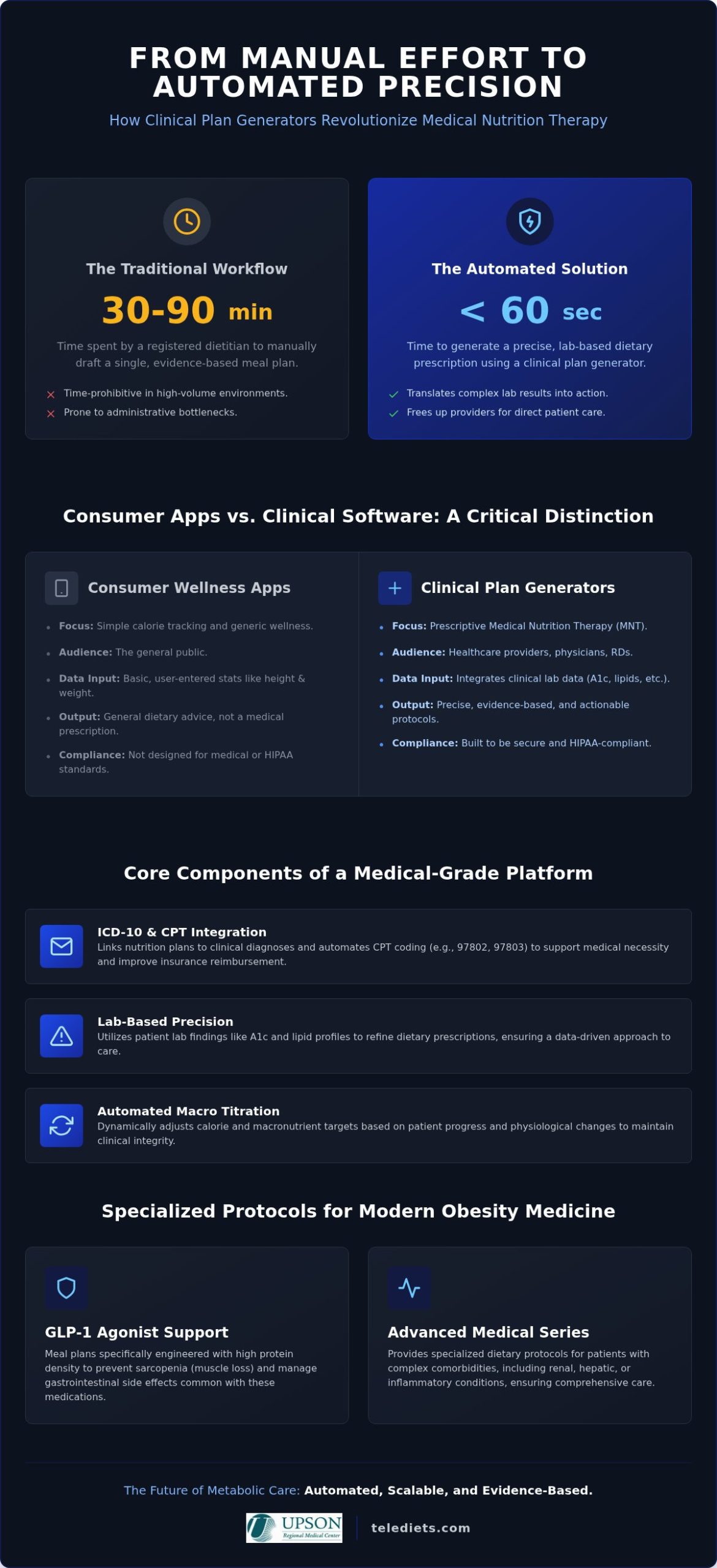
Did you know that registered dietitians often spend between 30 and 90 minutes manually drafting a single, evidence-based meal plan? In a high-volume medical environment, this manual approach is no longer sustainable. It’s often time-prohibitive and leaves providers struggling to manage the specific dietary needs of patients on GLP-1 receptor agonists. By implementing a sophisticated clinical weight loss plan generator, you can translate complex lab results into precise dietary prescriptions in under 60 seconds. This technology doesn’t just save hours, it ensures your protocols remain grounded in scientific validity while you focus on direct patient care.
You likely recognize that generic wellness apps fall short of the rigorous standards required for medical nutrition therapy. You need a solution that bridges the gap between clinical data and actionable patient guidance. This guide explores how clinical-grade automation transforms patient outcomes by streamlining evidence-based workflows. We’ll examine how to leverage integrated CPT coding for services like 97802 and 97803 to increase practice revenue. You’ll also learn how to support metabolic health through automated, lab-based protocols that drive better compliance and long-term success for every patient in your care.
Key Takeaways
- Understand the critical distinction between consumer-facing diet apps and professional software designed to automate complex Medical Nutrition Therapy prescriptions.
- Discover how a clinical weight loss plan generator utilizes patient lab data to provide precise nutritional support for those on GLP-1 receptor agonists.
- Streamline your practice workflow by integrating automated CPT coding tools and telemedicine plugins to improve insurance reimbursement and practice ROI.
- Explore how evidence-based automation allows you to scale high-quality clinical nutrition services without the administrative burden of manual meal planning.
Beyond Calorie Counting: What Defines a Clinical Weight Loss Plan Generator?
A clinical weight loss plan generator is much more than a digital recipe book; it’s a sophisticated diagnostic-driven prescription engine. While consumer diet apps focus on simple calorie tracking for the general public, these clinical tools are built for providers who must deliver precise Medical Nutrition Therapy (MNT). By converting patient lab data and health history into actionable protocols, these platforms allow you to cut through the dietary noise generated by social media influencers and provide care rooted in clinical nutrition.
Physicians and registered dietitians are increasingly adopting these automated systems to manage complex chronic conditions like metabolic syndrome and obesity. This shift ensures that every dietary recommendation is evidence-based and HIPAA-compliant, providing a level of security and validity that consumer-grade software simply cannot match. It’s about moving from general advice to a medical-grade prescription that patients can trust. Instead of spending 90 minutes on a single manual plan, you can generate a tailored protocol that addresses the physiological needs of your patient immediately.
The Core Components of Medical-Grade Generators
To be truly effective in a healthcare setting, a clinical weight loss plan generator must integrate directly with professional workflows. This requires more than just a list of ingredients. Key features include:
- ICD-10 Integration: Linking nutrition plans to specific clinical diagnoses ensures that your documentation supports the medical necessity of the intervention.
- Nutrient Precision: Utilizing Standard and Advanced Medical Series to ensure macro and micronutrient targets meet the rigorous demands of clinical protocols.
- Operational Scalability: Transitioning from hours of manual work to AI-assisted efficiency allows your practice to see more patients while maintaining high standards of care.
This technology empowers you to deliver high-touch care at scale. By automating the technical heavy lifting, your practice can focus on the human side of metabolic health without sacrificing clinical accuracy or professional standards.
The Science of Precision: Integrating Lab Data and Medical Protocols
Precision medicine requires data that goes beyond basic anthropometrics. While consumer tools rely on height and weight, a professional clinical weight loss plan generator integrates laboratory findings like A1c and lipid profiles to refine dietary prescriptions. This data-driven approach allows you to address metabolic adaptation through automated calorie and macro-titration. It ensures that the patient’s nutritional intake evolves alongside their physiological changes, maintaining the integrity of the clinical intervention.
Clinical accuracy is especially vital when managing patients on GLP-1 receptor agonists. These medications often lead to rapid weight loss, which can inadvertently include significant muscle mass reduction. By adopting a clinical weight loss plan generator, you can prioritize protein density and gastrointestinal tolerance to mitigate these risks. This level of oversight ensures compliance with evidence-based standards for diabetes and cardiovascular health. Understanding the nuances of reimbursement for nutrition services is essential as you integrate these sophisticated tools into your billing workflow.
Specialized Protocols for Modern Obesity Medicine
One-size-fits-all generators fail in a clinical environment because they don’t account for complex comorbidities. A medical-grade system provides the necessary depth for specialized care:
- GLP-1 support meal plans: These are engineered to prevent sarcopenia and manage common gastrointestinal side effects.
- Advanced Medical Series: These provide specialized dietary support for renal, hepatic, or inflammatory conditions.
- Lab-based titration: This feature allows for adjusting macros in real-time based on patient progress and blood work.
These specialized tools allow you to provide the high-level care your patients expect. If you’re ready to enhance your practice’s offerings, you can explore the Advanced Medical Series to see these protocols in action. By choosing a platform like TeleDIETS, you ensure your practice remains at the forefront of obesity medicine.
Optimizing Clinical Workflow: Billing, Coding, and Telemedicine
Administrative friction is often the primary barrier to delivering high-quality Medical Nutrition Therapy (MNT). While a registered dietitian might spend up to 90 minutes manually drafting a single protocol, a clinical weight loss plan generator automates this process in under 60 seconds. This efficiency isn’t just about saving time; it’s about making nutrition services financially viable within a busy medical practice. By reducing the administrative burden, you can focus on patient engagement rather than spreadsheet management.
Integrated insurance billing tools are essential for achieving a positive practice ROI. For 2026, the national reimbursement rate for CPT code 97802 (initial assessment) is $36.74 per 15-minute unit, while CPT 97803 (follow-up) is $31.73 per unit. Medicare Part B covers three hours of MNT in the first year of treatment and two hours in subsequent years. Automated systems ensure your documentation reflects these specific 15-minute unit calculations accurately, which is crucial for securing reimbursement and reducing claim denials.
Telemedicine has become a permanent fixture in clinical nutrition. Medicare’s flexibilities allowing the patient’s home as an originating site are extended through December 31, 2027. Using Place of Service (POS) 10 for home-based services and Modifier 95 for real-time audio-visual sessions, you can deliver remote MNT seamlessly. Digital plugins and remote patient monitoring tools allow for continuous oversight, ensuring that patient progress is tracked even between scheduled visits.
Monetizing Nutrition Services in Private Practice
Implementing a clinical generator creates a sustainable revenue stream for primary care and specialty clinics. By streamlining the documentation of medical necessity, you can confidently bill for services that were previously uncompensated. You can maximize MNT reimbursement by leveraging tools that automatically generate signed ADIME-structured notes and track benefit-year hours. This professional approach ensures your practice captures every billable unit while delivering evidence-based care.
Ready to scale your clinical offerings? Explore integrated billing and telemedicine solutions to transform your workflow today.
TeleDIETS serves as the AI-driven engine powering the next generation of metabolic health. By utilizing a clinical weight loss plan generator, you can deliver high-volume, high-quality Medical Nutrition Therapy (MNT) without the overhead of additional staff. The platform integrates seamlessly through SaaS architecture and specialized telemedicine plugins, allowing you to provide remote care that meets modern patient expectations. This technology empowers you to transition from being a simple provider of meal plans to a comprehensive clinical nutrition partner for your patients.
Scaling your practice requires tools that grow with you. With medical nutrition therapy accounting for 42.6% of the digital clinical nutrition platform market share in 2026, the demand for professional automation is clear. You can manage larger patient panels while maintaining the precision required for complex cases. It’s about working smarter, not harder. This approach allows you to focus on clinical decision-making while the software handles the time-consuming logistics of protocol generation.
Implementation and Practice Integration
Choosing the right level of support is essential for patient success. You can select between the Standard Series for general weight management or the Advanced Medical Series for patients with specific comorbidities. This flexibility ensures that every protocol matches the clinical needs of your population. Professional-grade, branded meal plans have been shown to improve patient retention, as they reinforce the provider-patient relationship at every meal. When patients receive a plan that carries your brand and reflects their specific medical data, they’re more likely to remain compliant.
Establishing a clinical standard in your practice builds long-term trust and professional authority. You can start your clinical nutrition subscription to scale your obesity medicine practice today. This investment ensures your clinic remains a leader in evidence-based metabolic care while maximizing your operational efficiency.
The Future of Metabolic Care Automation
Transitioning to a modern practice model means moving beyond manual workflows. By adopting a clinical weight loss plan generator, you align your practice with the future of precision medicine. You’ve seen how lab-result-to-prescription automation eliminates administrative friction while ensuring your protocols meet the highest evidence-based standards. With integrated CPT 97802 and 97803 coding tools, your practice can finally capture the revenue it deserves for high-value Medical Nutrition Therapy. Whether you’re managing complex comorbidities or providing specialized GLP-1 support protocols, the right technology ensures your patients receive the care they need without overwhelming your staff.
Ready to transform your workflow? Upgrade your practice with the TeleDIETS Clinical AI Engine and provide the expert guidance your patients depend on. Your expertise combined with our automation creates a powerful partnership for long-term clinical success.
Frequently Asked Questions
Can a clinical weight loss plan generator integrate with my EHR?
Yes, professional platforms utilize FHIR-based APIs to integrate seamlessly with modern EHR systems. This allows the clinical weight loss plan generator to read patient lab data and write back signed ADIME-structured notes directly into the medical record. Such integration ensures data consistency across your practice and reduces manual entry errors, supporting a more efficient clinical workflow for high-volume medical environments.
Is medical nutrition therapy (MNT) covered by most insurance plans?
Medical nutrition therapy is widely covered by Medicare Part B and many private insurance carriers. Medicare specifically covers patients with diabetes or non-dialysis renal disease for three hours in the first year and two hours annually thereafter. Most private payers have expanded these benefits to include obesity management, provided the documentation demonstrates medical necessity and follows evidence-based clinical protocols.
What CPT codes are used for billing automated nutrition services?
Providers primarily use CPT codes 97802 for the initial assessment and 97803 for follow-up MNT sessions. For 2026, the national reimbursement rate for 97802 is $36.74 per 15-minute unit, while 97803 is reimbursed at $31.73 per unit. Accurate billing requires that at least eight minutes of face-to-face care be provided to claim a single unit, with documentation supporting the total time spent.
How do clinical generators support patients taking GLP-1 medications?
A clinical weight loss plan generator supports patients on GLP-1 receptor agonists by providing protocols focused on high protein density and gastrointestinal tolerance. These specialized plans help mitigate common side effects like nausea while actively working to prevent muscle loss during rapid weight reduction. By automating these titration-based prescriptions, you ensure patients receive the specific metabolic support required for successful long-term outcomes.
Do I need a registered dietitian on staff to use a clinical generator?
While a registered dietitian is often required for specific Medicare MNT billing, physicians and other qualified healthcare professionals can utilize the platform to generate evidence-based protocols. The software acts as an expert guide, automating the complex calculations that traditionally required a specialist. This allows your existing clinical team to deliver high-quality nutrition prescriptions and manage metabolic health without necessarily increasing your specialized headcount.
Leave a Reply