
Why is your practice still losing hours to manual meal planning when three in four Americans now live with at least one chronic disease? As the patient load grows, the gap between clinical diagnosis and effective nutritional intervention is widening, leaving many providers struggling to maintain both care quality and profitability. You likely recognize that providing precise, medical-grade nutrition is essential. However, the administrative burden of billing and the frustration of inconsistent patient adherence often feel like an uphill battle. It’s difficult to scale a practice when manual workflows and a lack of lab integration hold you back.
This guide will show you how to evaluate and integrate the right software for chronic disease nutrition management to bridge that gap. You’ll discover how to transform your dietary protocols into data-driven interventions that improve patient outcomes and practice efficiency. We’ll explore the essential features of clinical-grade tools, from automated protocol generation based on lab results to integrated CPT coding for seamless insurance reimbursement. By the end, you’ll have a clear roadmap for selecting a platform that empowers your clinical expertise and streamlines your daily operations.
Key Takeaways
- Understand why clinical-grade software for chronic disease nutrition management is now a requirement for practices transitioning away from inefficient manual meal planning.
- Learn to leverage lab-to-protocol integration to ensure every dietary intervention is scientifically grounded in your patient’s specific diagnostic data.
- Identify the specific CPT codes and documentation workflows needed to maximize your reimbursement for Medical Nutrition Therapy services.
- Discover the importance of specialized protocols, including the Advanced Medical Series and GLP-1 support, for patients with complex co-morbidities.
The Role of Software in Modern Chronic Disease Nutrition Management
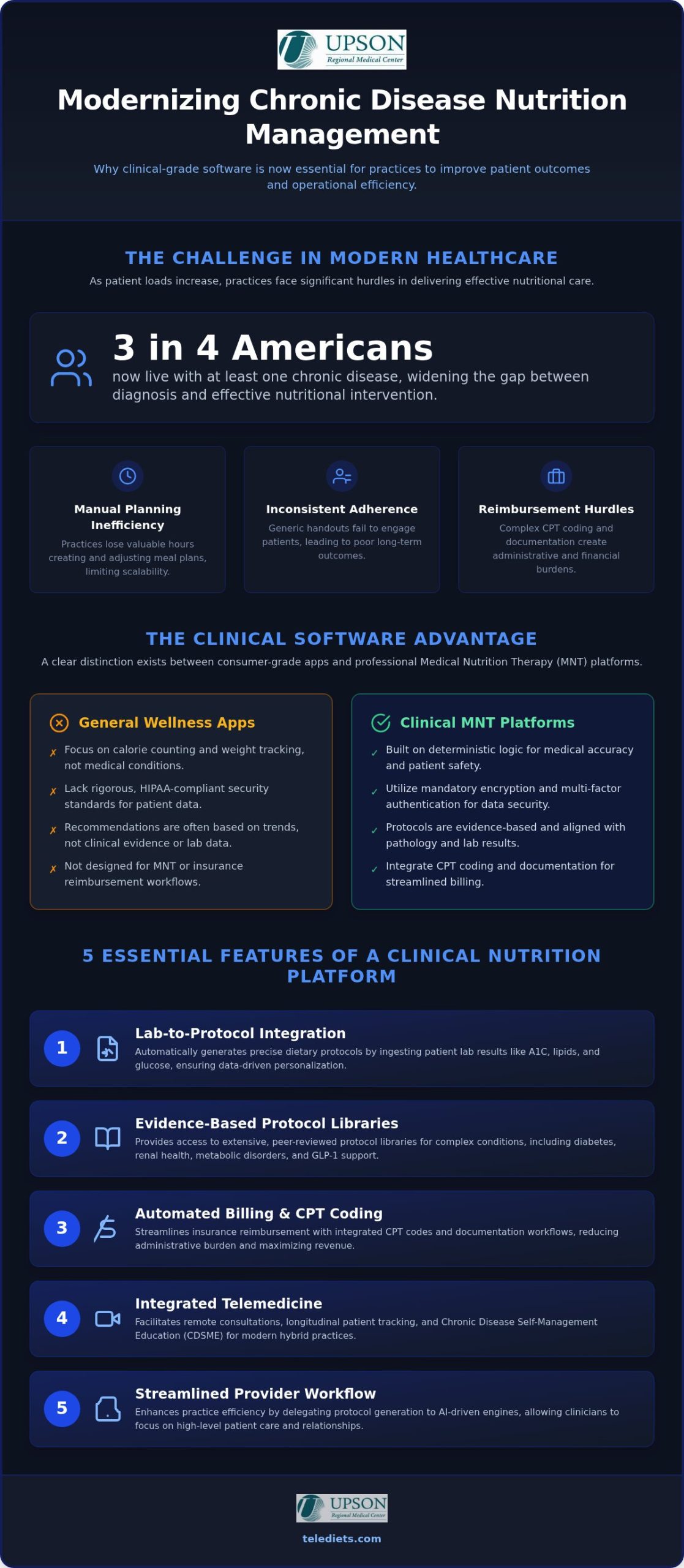
In the current clinical environment, software for chronic disease nutrition management functions as a sophisticated extension of your professional expertise. It is no longer just an administrative aid. It has evolved into a core clinical tool designed specifically for the delivery of Medical Nutrition Therapy (MNT). As we move through 2026, the sheer volume of patients requiring specialized care has made manual meal planning an operational liability. With approximately 75% of Americans now managing at least one chronic condition, your practice requires a system that treats nutrition as a primary medical intervention within a value-based care model. This clinical software serves as the bridge that translates a complex medical diagnosis into a precise, actionable dietary prescription in seconds.
Why General Wellness Apps Fall Short for Clinicians
There is a vast divide between consumer calorie counters and professional MNT platforms. While consumer apps focus on general wellness and weight tracking, clinical software for chronic disease nutrition management is built on deterministic logic to ensure medical accuracy. Security is another critical differentiator. Following the proposed 2026 HIPAA Security Rule updates, providers must ensure their tools utilize mandatory encryption and multi-factor authentication. You cannot risk patient data on platforms that lack the rigorous cybersecurity standards required for modern healthcare environments. Clinical tools prioritize scientific validity over social trends, ensuring that dietary protocols align strictly with pathology and lab results.
Addressing the Scalability Gap in Nutrition Therapy
Automation is the only viable solution for the growing scalability gap in specialty care. High-volume practices can’t afford to spend hours on manual protocol generation without risking provider burnout. By delegating the heavy lifting to AI-driven engines, you can prescribe evidence-based nutrition in the same amount of time it takes to write a traditional medication script. This efficiency allows you to focus on the patient relationship rather than the administrative burden of meal construction. It’s about empowering your team to provide high-level care at scale while maintaining the clinical precision your patients deserve. For those ready to upgrade their clinical workflow, choosing a professional-grade platform is the first step toward true practice modernization.
5 Essential Features of a Clinical Nutrition Management Platform
Selecting the right software for chronic disease nutrition management requires a focus on clinical utility rather than just aesthetics. You need a platform that acts as a decision-support engine, ensuring every meal plan aligns with the latest medical standards. Transitioning to a digital-first approach allows you to move away from static handouts toward dynamic, responsive care plans that evolve with your patient’s health status. These tools don’t just organize data; they actively assist in the therapeutic process.
- Lab-to-Protocol Integration: The ability to ingest patient lab results to tailor meal plans automatically.
- Evidence-Based Protocol Libraries: Access to specialized series for diabetes, renal health, and metabolic disorders.
- Telemedicine Plugin: Integrated support for remote consultations and longitudinal patient tracking.
- Automated Billing Tools: Built-in features for streamlining insurance reimbursement through accurate CPT coding.
The Importance of Lab-Based Personalization
Precision in nutrition therapy depends on real-time data. When you ingest clinical markers like A1C, fasting glucose, or lipid profiles directly into the system, the software can automatically adjust macronutrient ratios. This level of personalization reduces the risk of contraindications, such as unintended sodium or potassium spikes in renal protocols. It transforms the meal plan from a generic suggestion into a targeted medical intervention that supports your broader treatment goals. By grounding every recommendation in hard data, you build greater trust with your patients and improve clinical outcomes.
User Interface and Provider Workflow Integration
Your software should enhance your workflow, not complicate it. High-performing platforms integrate with your existing clinical environment, allowing for a unified patient record. For the modern hybrid practice, a Telemedicine Plugin is no longer optional. It facilitates the remote delivery of Chronic Disease Self-Management Education (CDSME) programs, ensuring patients stay engaged between office visits. This connectivity is vital for maintaining adherence to complex dietary protocols. If you’re ready to optimize your professional workflow with specialized software for chronic disease nutrition management, you can access our clinical-grade nutrition tools to start improving patient care today.
Optimizing Practice Workflow and Reimbursement
Efficiency in a clinical setting isn’t just about the speed of care; it’s about the accuracy of the documentation that follows. For many providers, the primary barrier to offering comprehensive nutrition therapy is the administrative burden of billing. Clinical-grade software for chronic disease nutrition management solves this by automating the data capture required for insurance reimbursement. When dietary protocols are generated through a specialized platform, the system can automatically log the necessary clinical markers and time spent. This ensures that your documentation meets the rigorous standards of payers in a value-based care environment.
Navigating CPT Codes 97802 and 97803
Successful reimbursement depends on using the correct codes for specific patient interactions. CPT code 97802 is designated for the initial medical nutrition assessment and intervention, while 97803 covers subsequent follow-up visits. Professional software ensures that these codes are applied correctly by tracking the duration of the visit and the complexity of the intervention. By capturing all necessary data points for a clean claim, you reduce the likelihood of denials and ensure your practice is fairly compensated for its expertise. These automated billing tools significantly reduce administrative overhead for clinic staff, allowing them to focus on patient management rather than paperwork.
Scaling Nutrition Services via Telehealth
The shift toward remote care has opened new avenues for managing chronic conditions outside the traditional office setting. Utilizing telenutrition for chronic disease allows for more frequent touchpoints, which is essential for improving long-term patient adherence. Digital tracking features within the software provide real-time visibility into how patients are following their dietary prescriptions. This constant feedback loop helps you identify barriers to adherence before they lead to poor clinical outcomes. In 2026, where chronic care management reimbursement rates for codes like 99490 have reached $66.13, integrating these services is a sound financial strategy. To expand your reach, you can learn how to integrate clinical nutrition into your remote workflow and begin scaling your services effectively.
Specialized Protocols: GLP-1 and Advanced Medical Series
The clinical landscape is shifting rapidly due to the widespread adoption of GLP-1 receptor agonist therapies. While these medications are highly effective, they require specific nutritional support that generic meal plans simply cannot provide. Patients with complex co-morbidities, such as those managing both Type 2 Diabetes and Stage 3 Renal Disease, need more than a basic calorie goal. They require a sophisticated software for chronic disease nutrition management that offers a deep library of Advanced Medical Series protocols. These specialized tools ensure that every dietary prescription accounts for the unique metabolic demands of the patient while promoting sustainable, long-term health through “green” nutrition models.
Supporting Patients on GLP-1 Therapies
As patients undergo medication titration, their nutritional needs change significantly. Appetite suppression can lead to inadequate protein intake, increasing the risk of sarcopenia and various micronutrient deficiencies. High-quality software for chronic disease nutrition management uses automated protocols to prioritize nutrient density and muscle preservation. By adjusting macronutrient ratios in real-time, you can help your patients maintain their lean body mass while they achieve their weight loss goals. This level of precision is vital for ensuring that the health benefits of GLP-1 therapies aren’t undermined by poor nutritional status.
Future-Proofing Your Practice with AI Nutrition Engines
Modern SaaS platforms have evolved from simple databases into intelligent clinical partners. These AI-driven engines allow you to generate complex, evidence-based protocols in seconds, reducing the time spent on administrative tasks. TeleDIETS represents the logical conclusion for providers who demand clinical-grade efficiency without compromising on patient care quality. It serves as a bridge between your diagnostic insights and the practical, daily intervention your patients need to succeed. If you’re ready to integrate these advanced protocols into your clinical workflow, you can explore our Advanced Medical Series and GLP-1 protocols to begin future-proofing your practice today.
Modernizing Your Practice for the Future of Chronic Care
Professional practices can’t afford to rely on manual processes while managing the complexities of modern chronic disease. You’ve seen how integrating lab data and specialized protocols like the Advanced Medical Series transforms patient adherence and clinical outcomes. By leveraging clinical-grade software for chronic disease nutrition management, you eliminate the administrative bottlenecks that prevent your practice from scaling. This shift allows you to prioritize high-level medical decision-making while ensuring your documentation supports maximum reimbursement through CPT codes 97802 and 97803.
TeleDIETS provides the essential bridge between your diagnostic expertise and effective patient intervention. Trusted by physicians for over 30 years, our platform features a proprietary AI-driven protocol engine and integrated CPT coding tools designed for immediate ROI. You don’t have to navigate the transition to value-based care alone. Our system is built to support your clinical goals while streamlining your daily operations.
Upgrade your clinical nutrition workflow with TeleDIETS today.
Empower your team with the tools needed to deliver precise, medical-grade nutrition at scale. Your patients deserve the most accurate care possible, and your practice deserves a workflow that supports its long-term growth and stability.
Frequently Asked Questions
What is the best software for managing diabetes nutrition in a clinic?
The most effective clinical software provides automated, lab-integrated protocols that move beyond general wellness advice. TeleDIETS is a leading choice for clinicians because it utilizes an AI-powered engine to generate personalized dietary plans in seconds. By using the Advanced Medical Series meal plans, your practice can address the complex glycemic requirements of diabetes while ensuring the intervention is scientifically grounded in the patient’s specific lab results.
Can I bill insurance for medical nutrition therapy using software?
You can bill insurance for these specialized services when using professional-grade software for chronic disease nutrition management. The right platform includes integrated CPT coding tools that automate the documentation needed for Medical Nutrition Therapy (MNT). This ensures that your initial assessments and follow-up visits meet payer requirements, allowing your practice to secure consistent reimbursement for the expert care you provide to your patients.
How does nutrition software integrate with my existing EHR?
Modern clinical nutrition platforms are built to function as a bridge between your medical diagnosis and the final dietary intervention. These systems allow you to ingest lab data and diagnostic codes to generate a precise dietary prescription. This integration ensures that your nutritional recommendations become a seamless part of the patient’s medical record, which reduces manual data entry and minimizes the risk of clinical errors during the planning process.
What CPT codes are used for chronic disease nutrition management?
Providers primarily utilize CPT codes 97802 for initial nutrition assessments and 97803 for subsequent follow-up sessions. For broader longitudinal care, the 2026 Medicare Physician Fee Schedule includes codes like 99490 for chronic care management, which carries a national average reimbursement of $66.13 per month. Utilizing these codes correctly is essential for maintaining the financial health and sustainability of a modern, value-based medical practice.
Does nutrition software support patients on GLP-1 medications?
Advanced software for chronic disease nutrition management now offers specialized GLP-1 Meal Plan Protocols designed specifically for patients on these therapies. These protocols are essential for managing the unique nutritional demands that arise during medication titration. They prioritize high protein intake and nutrient density to help prevent muscle loss, ensuring that the patient’s weight loss is both healthy and sustainable over the long term.
Leave a Reply