
What makes a nutrition protocol useful is not just its clinical depth, but how consistently your team can apply it. For clinicians, advanced medical series nutrition should connect diagnoses and lab data with a repeatable medical nutrition therapy workflow, not add another layer of manual work. That distinction matters when translating nutrition evidence into diagnosis-informed care.
The practical challenge is finding an approach that supports clinical judgment and fits the way your practice works. This guide explains what Advanced Medical Series Meal Plans support and how to assess their clinical relevance, adaptability, and workflow fit. It also covers how TeleDIETS generates nutrition plans based on clinical diagnoses and lab data, and how to evaluate the platform as a SaaS application or AI engine.
Key Takeaways
- Assess advanced medical series nutrition as a provider-facing resource for structured MNT, not a consumer meal plan.
- Consider how diagnosis and lab inputs connect clinical assessment with a documented nutrition plan.
- Use a practical evaluation sequence to assess protocol relevance, adaptability, and fit with your practice workflow.
- Review how TeleDIETS’ Advanced Medical Series Meal Plans and delivery formats fit your clinical processes.
What Is an Advanced Medical Nutrition Series for Clinical Practice?
An advanced medical nutrition series is a provider-facing set of structured nutrition protocols designed to support medical nutrition therapy (MNT) in clinical practice. Unlike a consumer meal plan, it organizes nutrition planning around clinical context rather than offering general food ideas. TeleDIETS’ Advanced Medical Series Meal Plans support providers delivering nutrition care in chronic disease management.
Protocols can help make the transition from assessment to a usable plan more consistent across a practice. They do not make clinical decisions or guarantee patient outcomes. The clinician interprets available information, considers the individual’s needs, and applies professional judgment. For foundational context on MNT, see Medical Nutrition Therapy (MNT).
How is a clinical protocol series different from a nutrition textbook?
A textbook primarily supports learning by explaining concepts, evidence, and approaches to clinical nutrition. A protocol series is oriented toward application, providing structured resources that support provider workflows. The two serve different purposes: educational materials build knowledge, while protocols help a team apply its established processes more consistently. Advanced medical series nutrition is a practice resource, not a substitute for clinical education.
Who may evaluate an advanced medical nutrition series?
Physicians, dietitians, and clinic leaders can assess whether a protocol series fits their MNT delivery model. Start with the diagnoses and care contexts your practice commonly supports. Then map how clinicians move from assessment to a documented plan, and identify where staff need a more repeatable process. These are practice-level questions, not a guide to selecting treatment for an individual patient.
For a practical evaluation, map the series against your current workflow: who reviews clinical information, who develops and documents nutrition plans, and where protocols support that process. This keeps the focus on clinical relevance and operational fit while preserving the clinician’s role in tailoring care.
How Diagnosis-Informed Nutrition Protocols Support Advanced MNT
Nutrition planning can draw on more than a general template. Clinical diagnoses and lab results provide relevant inputs for organizing a plan around the documented care context. TeleDIETS uses diagnoses and lab data to generate nutrition plans, giving providers a structured starting point for review. Clinical inputs can inform a tailored nutrition plan, while the clinician remains responsible for interpreting those inputs and making care decisions.
What clinical information can inform a nutrition plan?
Providers may consider the clinical diagnosis and available laboratory data as part of nutrition planning. These inputs help frame plan generation, but they do not independently determine appropriate care. The clinician evaluates their relevance, considers the broader assessment, and applies professional judgment before deciding how to use a plan.
Where do protocols fit in the MNT workflow?
A structured protocol can connect assessment information to a plan without replacing the practitioner’s role. A practical workflow may move through these steps:
- Review the assessment. The provider considers the documented diagnosis and relevant lab data.
- Generate a starting plan. A protocol-supported platform uses those inputs to produce a nutrition plan for review.
- Apply professional judgment. The clinician evaluates the plan in context and determines whether it is appropriate to use.
- Document the care plan. The provider records decisions and next steps within the practice’s process.
This approach can make the transition from clinical inputs to plan documentation more repeatable. The Academy of Nutrition and Dietetics Standards of Practice offer a professional reference point for dietetics practice. Advanced medical series nutrition supports workflow structure; it does not replace assessment, documentation, or clinical accountability.
To see how diagnosis- and lab-informed plan generation fits into provider workflows, explore TeleDIETS’ MNT platform.
How to Evaluate an Advanced Medical Nutrition Series for Your Practice
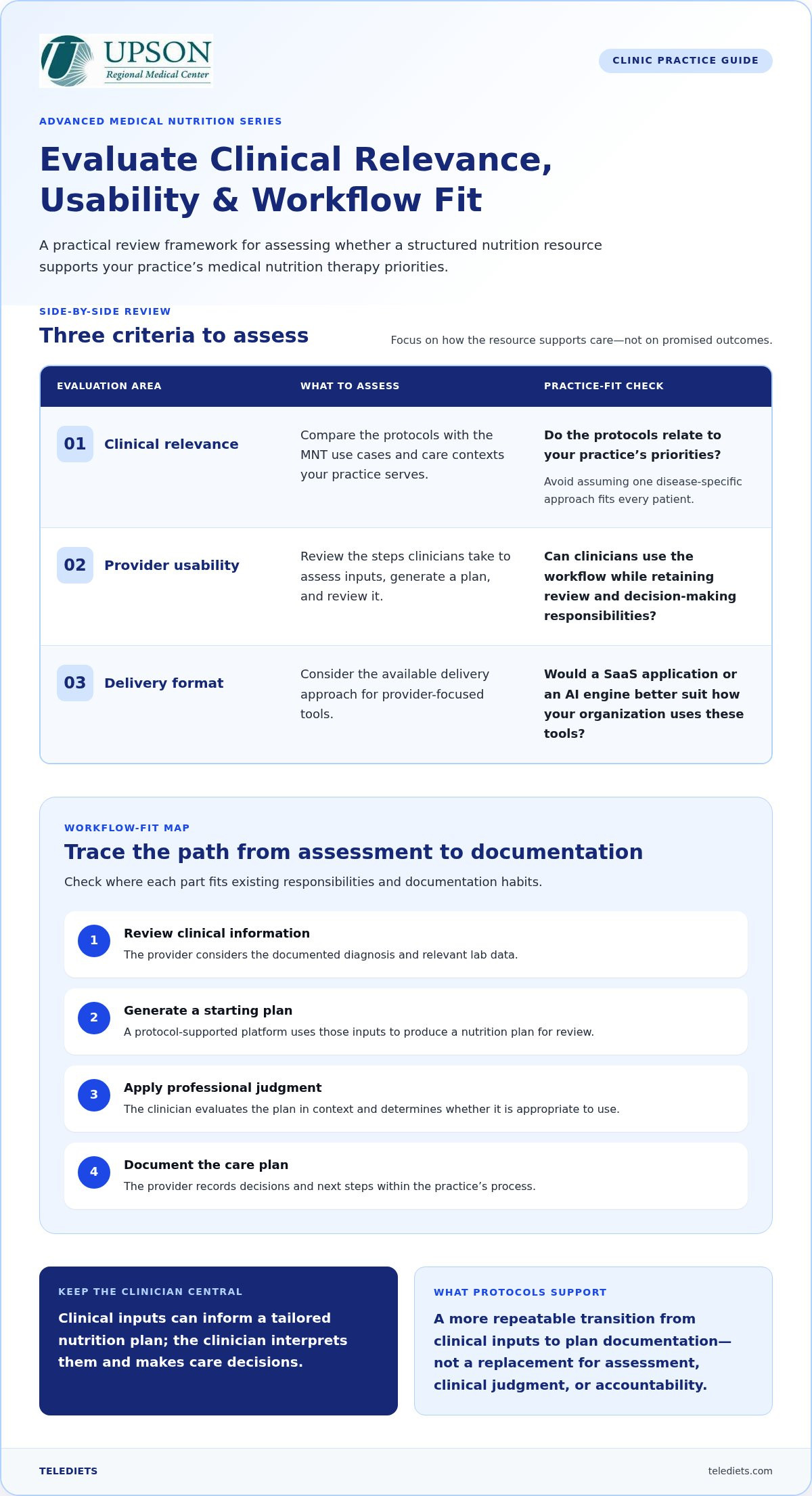
Assessing an advanced medical nutrition series is less about the number of protocols and more about how well they support your practice’s MNT priorities. Start with clinical scope: do the protocols relate to the care contexts your team serves? Next, consider provider usability, the steps required to review inputs and generate a plan, and whether the delivery format fits your practice. Evaluate how the resource supports care, not whether it promises a particular clinical outcome.
Which evaluation criteria matter most to a clinic?
Use a short review sequence to keep the assessment practical:
- Check clinical relevance. Compare the protocols with your practice’s MNT use cases. Avoid assuming one disease-specific approach fits every patient.
- Review provider usability. Assess whether clinicians can follow the workflow while retaining appropriate review and decision-making responsibilities.
- Assess delivery format. Consider whether a SaaS application or an AI engine better suits how your organization uses provider-focused tools.
These criteria help distinguish a structured clinical resource from a broad meal-planning tool, while keeping expectations grounded in what a protocol can support.
How should a practice assess workflow fit?
Map the process from start to finish: when does a clinician review diagnoses and lab data, when is a plan generated, and where does provider review happen before the plan enters care delivery? Check that the process fits existing responsibilities and documentation habits rather than assuming a new tool will automatically reduce work. For practices delivering care through telemedicine, include telemedicine integration in the workflow review.
TeleDIETS provides Advanced Medical Series Meal Plans and provider-focused nutrition tools, with plan generation based on clinical diagnoses and lab data. Explore provider-focused nutrition protocols to see how this approach fits your practice’s evaluation criteria.
How TeleDIETS Connects Advanced Nutrition Protocols to Provider Workflows
TeleDIETS combines specialized meal-plan protocols with provider-focused nutrition software. Its Advanced Medical Series Meal Plans are designed for professional use, and the platform generates nutrition plans based on clinical diagnoses and lab data. Clinicians can review the resulting plan within their established MNT process, using professional assessment and judgment to determine how it should be applied.
What does TeleDIETS bring to an advanced MNT workflow?
TeleDIETS is available as a SaaS application or an AI engine. These delivery formats give practices options to consider when evaluating their workflow needs. Diagnosis- and lab-informed plan generation connects clinical inputs with specialized protocols. Advanced medical series nutrition is therefore not only a set of protocols, but part of a provider-facing process for moving from available information to a plan for clinical review.
TeleDIETS also provides a telemedicine plugin and insurance billing and CPT coding tools. These capabilities support practices that include remote care or billing documentation in their workflow. They do not guarantee reimbursement, determine coverage, or establish compatibility with a clinic’s other systems. Practices remain responsible for clinical decisions and billing processes.
What is a sensible next step for interested providers?
Start by mapping your current process: identify where clinical diagnoses and lab data are reviewed, how nutrition plans are developed, and where clinicians document decisions. Then decide whether a SaaS application or AI engine better fits your practice’s approach. This workflow review grounds the evaluation in clinical needs rather than features alone.
If your clinic is assessing a more structured MNT workflow, Explore TeleDIETS for clinical nutrition workflows. Review the Advanced Medical Series Meal Plans alongside the platform’s delivery options, telemedicine plugin, and billing tools to assess how they fit your existing care processes.
Make Your Next Evaluation Practical
Turn your interest in advanced medical series nutrition into a focused workflow review. Identify where your team needs greater consistency, which staff members would use a protocol resource, and what a workable review-and-documentation process should look like. These criteria give your clinic a clear basis for assessing whether a provider-focused platform supports its priorities without displacing professional judgment.
Include the people who shape and deliver MNT in the evaluation. A shared view of the current workflow can surface practical considerations early, from how clinicians review generated plans to how the process fits broader care delivery. Keep the discussion centered on usability, relevance, and alignment with the work your practice already does.
TeleDIETS provides Advanced Medical Series Meal Plans and platform-based plan generation from lab data and clinical diagnoses. Explore TeleDIETS provider solutions to assess how its approach fits your clinical workflow. Review the platform’s protocols and workflow tools with your team to determine how they support your practice’s MNT process.
Frequently Asked Questions
What is an advanced medical nutrition series?
An advanced medical nutrition series is a provider-oriented resource for organizing specialized nutrition protocols within medical nutrition therapy. Advanced medical series nutrition is relevant when a clinic needs structured support for MNT services rather than general meal ideas for consumers. Physicians, dietitians, and clinic leaders can assess how protocols relate to their scope of care and how clinicians will review and use them.
How is an advanced medical nutrition series different from a textbook or course?
A textbook or course primarily supports education through explanations, learning activities, or clinical examples. A protocol series supports application in practice, so its value depends on how it fits provider processes. The resources can complement one another: education informs professional understanding, while protocols offer structure for routine MNT work.
Can clinical nutrition software create plans from diagnoses and lab results?
Yes. TeleDIETS generates nutrition plans using clinical diagnoses and lab data. The generated plan supports the provider’s workflow; it is not an independent clinical decision. A clinician reviews the available inputs and resulting plan, then determines how to consider it within the practice’s established care process. Interpretation and care decisions remain the clinician’s responsibility.
How should a clinic evaluate an advanced nutrition protocol series?
Begin by identifying the MNT services the clinic wants to support and the staff who would use the protocols. Assess whether the clinical scope is relevant, the workflow is clear to providers, and the delivery format suits the organization. Reviewing the steps from input review to plan documentation can surface practical workflow questions before broader adoption.
Leave a Reply