
What if the strongest case for medical nutrition therapy isn’t a sweeping promise, but a small, well-defined test? If you’re considering how to convince practice partners to add MNT, the clinical rationale is only part of the discussion. Partners also need to see how nutrition care fits the practice’s scope, who will deliver it, how it affects workflow, and what reimbursement may depend on.
A credible proposal addresses those questions directly. MNT can support care for eligible patients, but coverage, documentation, and payment vary. Ground projections in the practice’s needs and verified requirements, not assumed outcomes. This article will help you connect patient needs with practice priorities, prepare practical responses to common objections, and define a manageable next step. You’ll learn how to scope a pilot, clarify staffing and workflow, and use clinical protocols and billing resources to make the proposed process concrete.
Key Takeaways
- Connect MNT to shared clinical priorities, and clarify how it fits within your practice’s scope.
- Build a case from practice-specific patient needs, workflow realities, and clearly stated financial assumptions.
- Prepare for concerns about staffing, time, payer variation, and accountability with practical options rather than guarantees.
- Propose a small pilot with defined roles, a review date, and measures partners can use to assess feasibility.
Why Add MNT to a Practice? Start With Shared Clinical Priorities
Nutrition needs often intersect with conditions a practice already manages. Medical nutrition therapy (MNT) is nutrition care delivered in a clinical context by appropriately qualified professionals. To decide whether it belongs in your practice, start with a shared question: are patients’ nutrition needs being addressed in a coordinated way, and could a defined service model fit the practice’s approach to care?
Adding MNT means deciding who provides the service, which patients it is designed to support, how referrals and follow-up work, and how nutrition care connects with existing treatment. It is more than distributing meal plans. A useful proposal links a clear clinical purpose to specific responsibilities and workflow, while keeping financial expectations separate until they can be assessed using practice-specific information.
Which practice priorities can MNT support?
Start with needs your team recognizes. For example, patients may need structured nutrition support alongside care for a chronic condition, or clinicians may want a clearer process for coordinating nutrition-related care. These are reasons to explore fit, not evidence that every patient is appropriate or that a particular outcome is assured.
Keep the clinical rationale distinct from the business case. Review relevant patient needs and existing referral patterns to understand potential demand. Then assess staffing capacity, service activity, payer coverage, and financial assumptions separately. Clinical need alone does not establish demand, available capacity, or reimbursement.
Who needs to support the proposal?
Involve the people who will shape, deliver, and sustain the service. Each group will have different questions, so clarify responsibilities early:
- Clinical partners will ask which patients may be appropriate and how MNT complements existing care.
- Administrative and operational leads will want to understand scheduling, referrals, and handoffs.
- Billing staff will need clarity on documentation, coding, and payer-specific requirements.
- Nutrition professionals will need a defined role, scope, and workable care process.
Bring these perspectives together before asking for a decision. Shared ownership helps surface practical constraints and gives the team a stronger basis for designing a service model to evaluate.
Build a Credible Business Case for Adding MNT
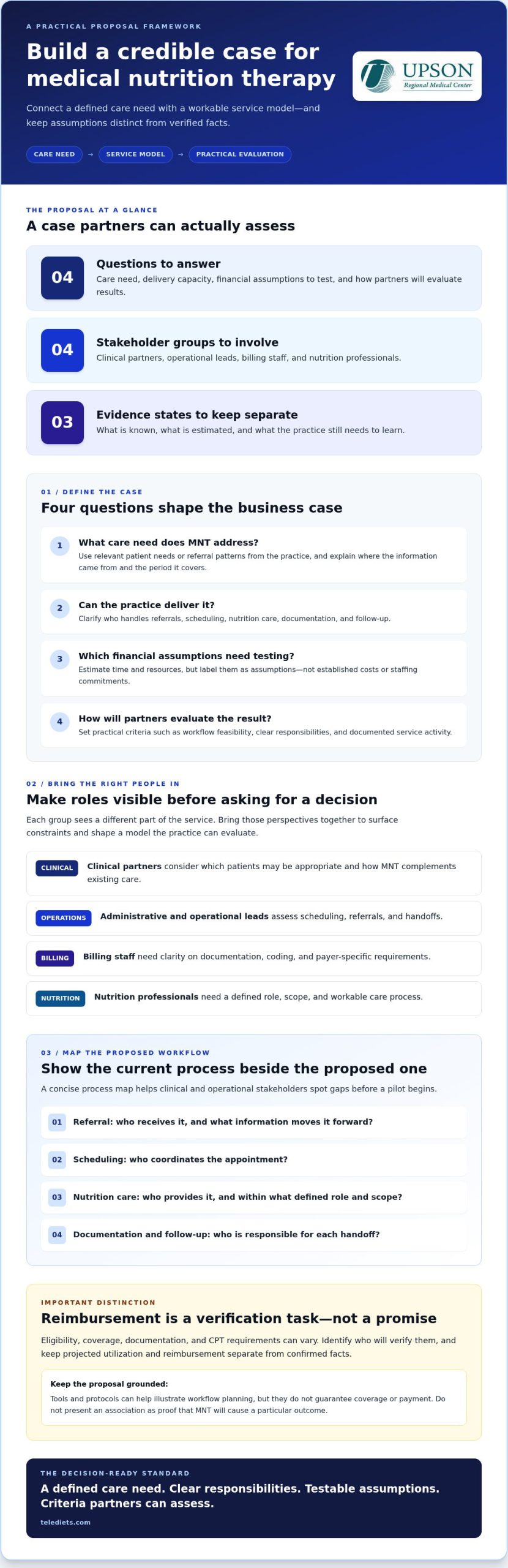
A persuasive case separates what is known from what is estimated and what the practice still needs to learn. Organize the proposal around four questions: What care need does the service address? Can the practice deliver it? Which financial assumptions need testing? How will partners evaluate the result?
A strong MNT proposal links a defined care need with a workable service model. Support the clinical rationale with relevant professional guidance, such as the Academy of Nutrition and Dietetics on MNT, and information from your practice. For example, summarize relevant patient needs or referral patterns, explain where the data came from, and state the period it covers. Do not present an association as proof that MNT will cause a particular outcome.
What evidence should the proposal include?
Use a concise evidence table or briefing page. Separate published guidance from internal observations, and note each source’s date and limitations. Then map the proposed service: who handles referrals, scheduling, nutrition care, documentation, and follow-up? Estimate time and resources, but label these figures as assumptions for partner review rather than established costs or staffing commitments.
Make the proposal easy to assess by showing the current process alongside the proposed one. Identify each handoff, the staff role responsible for it, and any information needed to move a referral forward. This helps clinical and operational stakeholders spot gaps before a pilot begins.
How should you explain reimbursement and operational fit?
Present payer review as a verification task, not a revenue promise. Eligibility, coverage, documentation, and CPT requirements can vary, so identify who will check them and how the findings will inform the proposal. Keep projected utilization and reimbursement separate from confirmed facts. Insurance billing and CPT coding tools can support workflow planning, while clinical software and protocols can make the proposed service process easier to picture. Neither guarantees coverage or payment. Explore clinical nutrition workflow tools as one way to illustrate how nutrition care could be operationalized.
Close the business case with decision criteria partners can assess, such as whether the workflow is feasible, responsibilities are clear, and service activity can be documented. These criteria create a practical bridge from evidence to a bounded evaluation.
Address Practice Partners’ Concerns Before the Decision Meeting
A decision meeting is more productive when operational questions are already visible. Before you meet, list concerns about time, staffing, professional scope, workflow, payer variation, and accountability. Treat each as a design question, not resistance to overcome. Explain what is known, identify what remains uncertain, and offer a practical way to evaluate fit.
Address objections with practice-specific evidence and clear limits, not promises. Use a concise agenda to keep the discussion focused:
- Shared need: Confirm which patient-care gap the proposal aims to address.
- Proposed model: Describe who would provide MNT and how patients enter the service.
- Resource questions: Review staffing, time, scheduling, documentation, and workflow implications.
- Risks and unknowns: Surface scope, payer, and accountability questions that need follow-up.
- Decision requested: Agree on whether to evaluate a limited model and who owns the next step.
How can you respond to workload concerns?
Map the work from referral through follow-up. Specify who receives a referral, schedules the service, provides nutrition care, documents it, and handles billing tasks. Note when each task occurs and which existing workflow it touches. If the added workload is uncertain, say so. Propose testing a limited process, then review what staff experience before recommending broader adoption.
How can you respond to reimbursement uncertainty?
Be direct: coverage and payment depend on payer rules, patient eligibility, documentation, and applicable codes. Have the billing lead verify requirements for the practice’s relevant payers before approving financial projections. Record what is confirmed, what still needs review, and who will resolve open questions. Billing and coding tools can support this work, but they do not guarantee reimbursement.
Keep the discussion collaborative. TeleDIETS’ billing and coding tools can help partners make nutrition-service workflow considerations concrete as they assess implementation options.
Propose a Small MNT Pilot and Agree on the Next Step
A pilot gives partners a defined way to assess fit without committing to a broader rollout. Keep its scope narrow, assign ownership, and agree in advance on what the team will review. This turns the proposal into a concrete, limited decision.
- Define the scope. Identify the patient group and service activities the pilot will cover.
- Assign roles. Name who handles referrals, nutrition care, scheduling, documentation, and billing-related tasks.
- Map the workflow. Trace each handoff so the team can see how MNT fits with current processes.
- Set a review date. Agree on a calendar date and the period of activity you’ll examine.
- Evaluate the findings. Review what happened, what needs adjustment, and whether to continue, revise, or stop the test.
What belongs in a practical MNT pilot?
Focus the review on measures partners can interpret: whether planned workflow steps were completed, whether patients participated, and what service activity was documented. Decide who will collect each measure and where the information will come from. Treat the results as a feasibility review, not proof of clinical outcomes, reimbursement, or efficiency gains.
How can TeleDIETS support an MNT workflow?
Implementation options can make the service model easier to picture. TeleDIETS offers clinical protocols, including Standard Series and Advanced Medical Series meal plans. Its platform enables clinicians to generate personalized nutrition plans based on patient lab results and clinical diagnoses. Insurance billing and CPT coding tools support nutrition-service workflows, and a telemedicine plugin integrates into provider workflows. These tools support clinician-led care, not autonomous diagnosis or guaranteed results.
Use the pilot findings to guide the next decision, and explore clinical nutrition workflow options as you consider how the proposed model could fit your practice.
Turn Partner Alignment Into a Practical Next Step
The next conversation does not need to settle every question about adding MNT. Aim to agree on what the practice will examine, who will take the first action, and when you’ll revisit the decision. That gives partners a clear way to move from interest to evaluation without treating projections as promises.
Make the proposed workflow tangible. Clinical meal-plan protocols and personalized nutrition plans informed by lab results and diagnoses can help illustrate how care might be structured. Insurance billing and CPT coding tools, along with a telemedicine plugin, can help partners consider operational needs. Their value depends on how well they fit the practice’s model and responsibilities.
Use the next meeting to choose a manageable step, such as reviewing a workflow, assigning a payer verification task, or defining a pilot’s measures. Explore clinical nutrition workflow options with TeleDIETS to see how its platform and protocols can support your service planning. Thoughtful evaluation gives your team room to make a decision grounded in its patients, capacity, and priorities.
Frequently Asked Questions
How do I convince a physician to add medical nutrition therapy?
Start with a clinical priority the physician already recognizes, not a software pitch. Bring a concise example from practice data, such as recurring nutrition-related questions during visits, and explain how a proposed service might address that need. Clarify who would coordinate care, then invite the physician to help define a small evaluation with clear responsibilities and review measures.
What is the strongest business case for adding MNT to a medical practice?
The strongest case shows why MNT is worth evaluating without treating a projected return as certain. Connect a documented care need to the resources and workflow required to serve it. For example, distinguish current referral patterns from estimated participation, and label staffing or utilization figures as assumptions. Include a plan to assess whether the proposed model fits the practice before making broader financial claims.
How can a practice add MNT without disrupting existing workflows?
Start by identifying where a referral could occur without adding unnecessary handoffs. For example, compare a referral initiated during a scheduled visit with one routed through an existing care-coordination process. Choose one pathway to test, clarify where documentation belongs, and ask staff to record obstacles as they arise. Use those observations to refine the process before deciding whether to expand it.
Can medical nutrition therapy be reimbursed by insurance?
It may be reimbursable, but coverage and payment depend on payer policy, patient eligibility, the service provided, documentation, and applicable coding requirements. Have the billing lead check current rules with each relevant payer before using reimbursement estimates in a business case. A CPT code or billing tool can support the process, but neither confirms coverage nor guarantees payment for a claim.
What should I include in a proposal to practice partners for MNT?
Give partners enough information to make a specific decision. Along with the clinical rationale, include the intended patient group, a simple referral pathway, role assignments, documentation needs, and unresolved payer questions. Cite external evidence and label local estimates clearly. Close with an actionable request, such as authorizing a workflow review or assigning a billing lead to verify requirements.
Leave a Reply