
What if chronic disease meal planning software could turn diagnoses and lab data into practical nutrition protocols without taking clinical judgment out of your hands? For care teams, individualized planning can take staff time, and translating clinical information into consistent nutrition guidance can be difficult to scale. The challenge is finding a tool that supports the work without creating a separate, disconnected process.
This guide explains how to evaluate software for clinical use, from the information used to tailor plans to provider review and fit with billing and telemedicine workflows. You’ll learn which capabilities matter, how to assess whether protocols suit your team’s needs, and what to consider in insurance billing and CPT coding tools. We’ll also look at how a provider-facing platform such as TeleDIETS connects diagnosis- and lab-informed planning with workflow support. The aim is to help you identify an approach that supports consistent nutrition services while keeping providers responsible for reviewing and adapting recommendations.
Key Takeaways
- Distinguish chronic disease meal planning software built for clinical nutrition protocols from consumer recipe, tracking, and meal-delivery tools.
- Evaluate tools in a practical sequence: define care needs, assess clinical inputs, review protocol scope, and map the software to your practice workflow.
- Keep provider oversight central by reviewing generated recommendations and adapting protocols to clinical judgment.
- TeleDIETS brings diagnosis- and lab-informed plan generation together with specialized meal plans, billing and CPT coding tools, and a telemedicine plugin.
What chronic disease meal planning software should help a clinical team do
Chronic disease meal planning software is provider-facing technology that helps healthcare teams develop nutrition protocols as part of chronic disease care. Instead of simply suggesting meals, it can help turn relevant clinical information into a plan a professional can assess and adapt. Because chronic diseases are long-term health conditions, nutrition support may need to account for a patient’s broader clinical context, not just general food preferences. A foundational overview of chronic disease helps explain why a consistent, individualized approach matters.
Who uses clinical meal planning software?
Physicians, dietitians, clinics, and telemedicine platforms may use clinical planning tools to organize nutrition services. Their workflows differ, but they share an operational need: make individualized planning more manageable and create a consistent process across a team. A tool that supports protocol development can reduce repetitive manual work while giving providers the opportunity to review recommendations and decide how they fit into care. The software should support the clinical workflow, not create a parallel process that staff must maintain separately.
What makes chronic disease planning different from general meal planning?
General recipe, calorie-tracking, and meal-delivery tools focus on food selection, personal tracking, or convenience. Clinical planning starts with care context. Diagnoses and relevant lab data can inform a nutrition protocol, helping a provider shape recommendations around the needs under consideration rather than relying only on a generic menu. For example, a team can use diagnosis-related information and available lab results as inputs when preparing a plan for professional review.
The difference is purpose and oversight. Software can organize information and support protocol creation, but it doesn’t independently diagnose, determine what care a person needs, or replace clinical judgment. Providers remain responsible for interpreting context, checking generated material, and personalizing the final plan. This balance helps practices make nutrition support more systematic without treating automation as a substitute for professional expertise.
How software turns clinical inputs into a reviewable nutrition protocol
A structured workflow helps teams use automation without handing over clinical decisions. With chronic disease meal planning software, the process can start with relevant diagnoses and lab data, then move to plan generation, professional review, and use of an appropriate protocol in care. TeleDIETS generates tailored nutrition plans from diagnoses and lab data within seconds, giving clinicians a structured starting point and reducing the need to build every plan from scratch.
- Enter relevant clinical information. Use diagnoses and lab data that are appropriate to the planning task.
- Generate a plan. The software uses those inputs to produce a nutrition protocol for review.
- Review and adapt. The clinician considers whether the output is relevant, complete, and appropriate in context.
- Use it in care. The provider decides how the reviewed protocol fits the care workflow.
What should clinicians review before using a generated plan?
First, check that the information used is relevant to the planning task. Then assess whether the generated material is complete enough for professional consideration and fits the broader clinical context, including whether it needs adjustment. A generated plan is a starting point for review, not a substitute for provider assessment. This checkpoint keeps responsibility with the clinician, even when software makes plan creation faster.
Decision-support software can organize clinical inputs and generate a protocol for review, but it doesn’t independently diagnose or decide treatment.
Where do protocols fit into chronic disease care?
Structured protocols can give a practice a consistent starting point for nutrition services while leaving room for providers to review and personalize recommendations. TeleDIETS offers Standard Series Meal Plans and Advanced Medical Series Meal Plans as distinct options. The clinician assesses their relevance to the care context rather than relying on a software label alone. Learn more about TeleDIETS meal planning software and its role in provider-led protocol development.
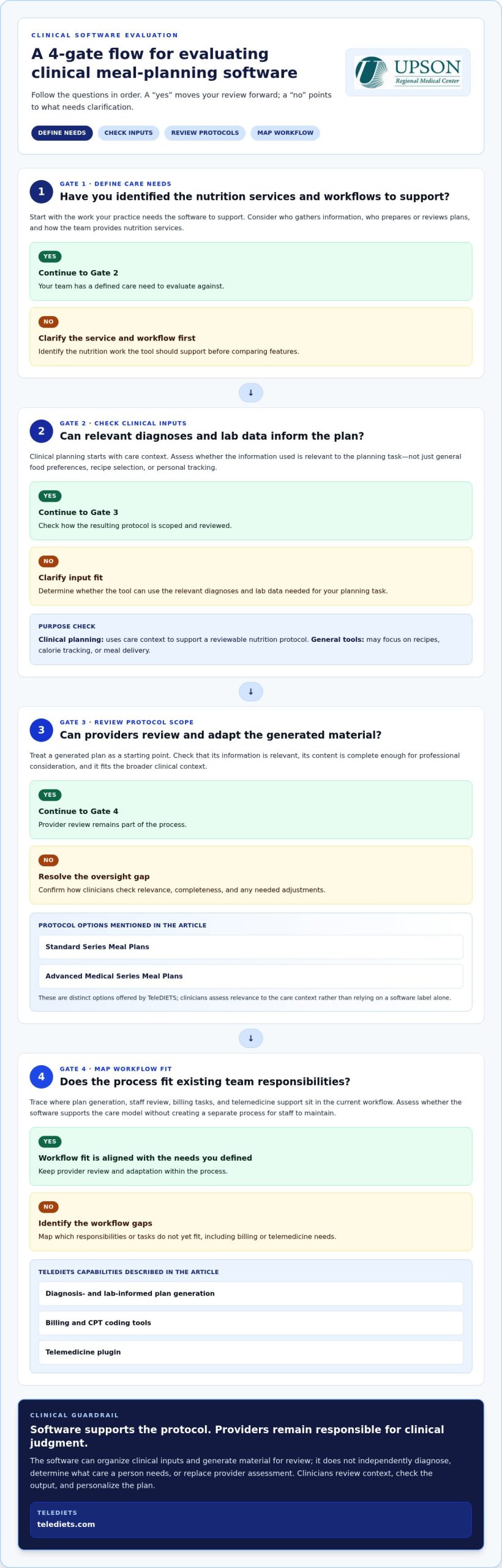
How to evaluate chronic disease meal planning software for your practice
Assess chronic disease meal planning software against the work your team needs it to do, not just the features on a product list. Start with the nutrition services your practice provides. Then consider which information shapes planning, how protocols are reviewed, and where billing or telemedicine tasks fit. This sequence helps show whether a platform supports your care model without adding unnecessary steps.
- Define care needs. Identify the nutrition services and clinical workflows the software should support.
- Assess clinical inputs. Determine whether relevant diagnoses and lab data can inform tailored plans.
- Review protocol scope. Consider whether the available plans suit your team’s work and preserve provider review.
- Map workflow fit. Trace how plan generation, staff review, billing tasks, and telemedicine support relate to existing responsibilities.
Which capabilities matter for a clinical workflow?
Map the current process before evaluating tools: who gathers information, who prepares or reviews plans, and how nutrition services are used in care. Then assess plan generation, provider review, billing and CPT coding tools, and telemedicine workflow support. Consider billing functionality separately from payer coverage or reimbursement. Software tools can support billing tasks, but they don’t guarantee payment.
A practical checklist: evaluate relevant clinical inputs, tailored protocols, provider oversight, workflow fit, billing tools, and telemedicine support.
How can a practice assess adoption and oversight?
Make responsibilities explicit before introducing a new workflow. Identify which staff members prepare inputs, review generated plans, document decisions, and handle billing-related tasks. Clarify where the provider’s final assessment takes place. This helps teams understand how software may fit and which responsibilities need to be assigned.
To test the workflow, trace a representative planning task from input through review and documentation. Note unclear handoffs, duplicated work, or information staff still need to manage elsewhere. Use those observations to assess workflow fit and oversight needs, rather than assuming a particular efficiency gain or rollout schedule.
Learn how TeleDIETS supports clinical meal planning with diagnosis- and lab-informed protocols, billing and CPT coding tools, and a telemedicine plugin.
How TeleDIETS supports provider-led chronic disease meal planning
For clinics evaluating chronic disease meal planning software, the practical question is how clinical inputs and planning tools can support provider-led care. TeleDIETS is medical nutrition therapy software for healthcare professionals. It uses patient diagnoses and lab data to generate tailored nutrition protocols within seconds, giving clinicians a structured starting point to review and adapt instead of building every plan from scratch.
Which TeleDIETS capabilities align with provider needs?
TeleDIETS offers Standard Series Meal Plans and Advanced Medical Series Meal Plans, along with GLP-1 Meal Plan Protocols for provider-facing nutrition support. The platform also includes insurance billing and CPT coding tools to support related practice tasks, plus a telemedicine plugin for provider workflows. These capabilities address different parts of nutrition service delivery, so clinics can consider how each relates to their planning and care processes.
Billing tools can support coding and billing workflows, but they don’t guarantee payer coverage or reimbursement. Generated protocols are intended for clinician review as well. Providers retain responsibility for deciding whether and how a plan fits the clinical context, then personalizing it as appropriate.
What is a practical next step for a clinic?
Start by mapping one existing nutrition workflow, from the clinical information used through plan development, professional review, and use in care. Then consider where diagnosis- and lab-informed plan generation may fit and how meal plan options, billing tools, or telemedicine support relate to staff responsibilities. This keeps the evaluation grounded in your practice’s needs rather than a feature list alone.
Explore the TeleDIETS platform to see how its provider-facing capabilities support clinical nutrition workflows.
Plan a practical next step for your practice
You don’t need to change every nutrition task at once. Choose one recurring workflow and identify what your team needs from it, such as a more structured starting point for planning or a clearer review handoff. Then assess whether chronic disease meal planning software can support that priority while keeping providers in control.
Consider the full workflow, from diagnosis- and lab-informed plan generation to staff review, insurance billing and CPT coding tools, and telemedicine support. These capabilities are most useful when they fit your practice’s responsibilities and care processes, not simply because they appear on a feature list. Keep clinical oversight central as you assess fit.
Explore TeleDIETS for clinical nutrition workflows and see how its provider-focused tools can support your team’s planning process.
Frequently Asked Questions
What is chronic disease meal planning software?
Chronic disease meal planning software is a clinical tool that helps healthcare professionals prepare nutrition protocols as part of care. Unlike consumer tools focused on recipes, food tracking, or delivery, it is designed around provider workflows and clinical information. A practice can use it to create a structured starting point for nutrition planning, then apply its own assessment and review process before using the plan in care.
How does meal planning software use diagnoses and lab results?
Software can use entered diagnoses and lab results as inputs to generate a tailored nutrition protocol for professional review. The relevance of those inputs depends on the clinical context and the information available, so providers should make sure the data is appropriate for the planning task. The software organizes and applies inputs; clinicians interpret their significance and decide whether the resulting plan is suitable.
Can clinical meal planning software replace a dietitian or physician?
No. Clinical meal planning software supports professional work but doesn’t replace a dietitian’s or physician’s assessment, expertise, or decisions. A clinician remains responsible for reviewing generated material, considering factors the software may not capture, and determining how a protocol fits within care. Treat the output as material for professional consideration, not an independent diagnosis or treatment decision.
Does meal planning software guarantee insurance reimbursement for nutrition services?
No. Billing and CPT coding tools can support administrative workflows, but they don’t guarantee that a payer will cover a service or reimburse a claim. Coverage and payment depend on factors outside the software’s control. Practices should treat coding functionality as workflow support and follow their established billing procedures when preparing and handling claims.
What should a clinic look for in chronic disease meal planning software?
Choose chronic disease meal planning software that fits the clinic’s actual care process. For a practical assessment, have staff trace a representative planning task: identify the information they need, who reviews the resulting protocol, where decisions are documented, and how related billing or telemedicine steps are handled. This exercise can surface workflow gaps and clarify whether the tool supports provider oversight without adding unnecessary handoffs.
Leave a Reply