
A more efficient nutrition workflow should give clinicians more room for clinical judgment, not less. When assessment, care planning, documentation, billing, and follow-up happen in separate processes, coordination can take time away from patient care.
To streamline clinical nutrition workflow, teams need a repeatable path from relevant clinical information to tailored nutrition support, with clear points for clinician review. The goal is not to standardize away individual needs or delegate decisions to software. It is to reduce avoidable handoffs while keeping clinical context and professional judgment central.
This article explains how to connect assessment, protocols, documentation, and follow-up. It also covers how TeleDIETS supports provider workflows with protocols informed by lab results and diagnoses, insurance billing and CPT coding tools, and a telemedicine plugin. Use the steps below to clarify responsibilities, reduce repeated work, and keep clinicians involved in care decisions.
Key Takeaways
- Map each step from nutrition-care referral through follow-up to find delays, duplicate work, and unclear ownership.
- Use relevant clinical inputs to inform tailored protocols, with clinician review guiding care decisions.
- Link planning and documentation with follow-up to streamline clinical nutrition workflow.
- Match protocol, billing, and telemedicine tools to specific stages in the team’s workflow.
Where Clinical Nutrition Workflows Lose Time, and What to Map First
A clinical nutrition workflow is the sequence of steps that moves a nutrition-care need from identification to follow-up. It may begin with a referral or a concern raised during care, then continue through information review, nutrition planning, documentation, administrative coordination, and follow-up. Mapping the process as it actually happens helps your team find where context gets lost, work is repeated, or responsibility becomes unclear before selecting tools.
Which workflow steps should a clinic map first?
Start at the referral point. Record who identifies the need, what information is available, and how the referral reaches the nutrition professional. Follow the handoffs between clinicians, administrative staff, and telemedicine tools. At each step, note what information is entered, reviewed, or passed along, and who owns the next action. Define the endpoint as a documented follow-up plan, not simply a completed visit.
- Record who initiates nutrition care, what triggers the referral, and how it reaches the team.
- Note where clinical information is reviewed and who develops or approves the plan.
- Track who handles documentation, scheduling, billing-related tasks, and follow-up.
Include the tools used at each step, but map what staff actually do rather than what a process diagram says they should do. For example, note whether information is copied into another system, whether a staff member has to chase a missing handoff, and where a clinician pauses to review a protocol. These details make workflow friction visible.
How can teams distinguish clinical work from administrative friction?
Separate tasks that require professional assessment, interpretation, and clinical review from coordination tasks such as scheduling, transferring information, and preparing billing documentation. Then look for duplicate entry, disconnected records, delayed handoffs, or uncertainty about who owns the next action. These can be useful improvement targets, but a manual step is not automatically wasteful. Some steps protect accuracy or support clinician review.
To streamline clinical nutrition workflow, reduce avoidable process friction without automating clinical judgment. Ask where staff need easier access to relevant information and where task ownership needs to be clearer. Preserve the review points clinicians use to consider individual context.
Streamline Clinical Nutrition Workflow from Clinical Inputs to Follow-Up
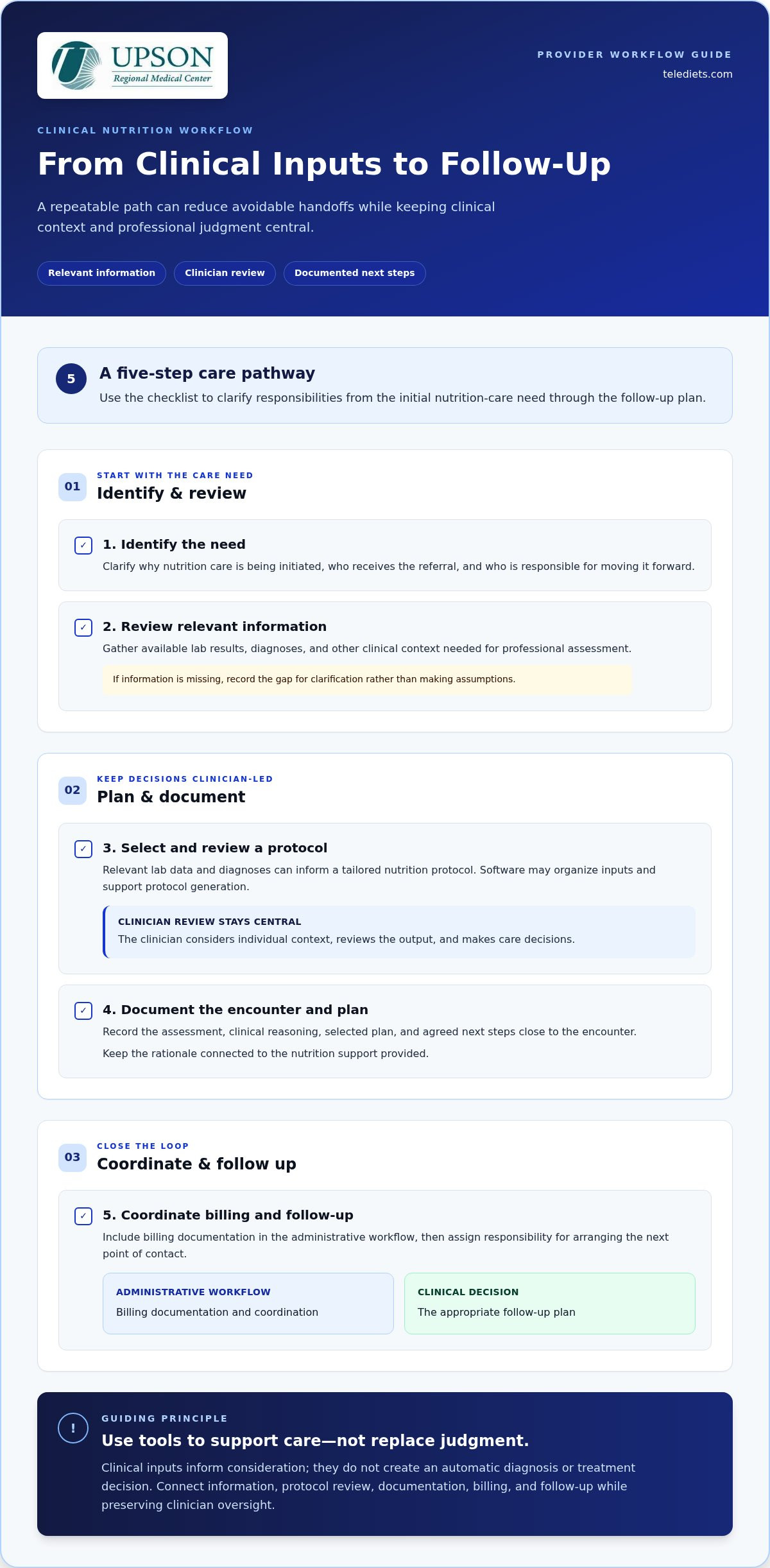
A dependable process connects clinical information to a documented plan and a clear next step. The Academy of Nutrition and Dietetics’ Nutrition Care Process offers a professional framework for organizing nutrition care. Your team can map its operational workflow around these stages:
- Identify the need. Clarify why nutrition care is being initiated, who receives the referral, and who is responsible for moving it forward.
- Review relevant information. Gather available lab results, diagnoses, and other clinical context needed for professional assessment. Record gaps that require clarification rather than making assumptions from missing information.
- Select and review a protocol. Relevant lab data and diagnoses can inform a tailored nutrition protocol. Software can organize inputs and support protocol generation, but the clinician reviews the output, considers individual context, and makes care decisions.
- Document the encounter and plan. Record the assessment, clinical reasoning, selected plan, and agreed next steps close to the encounter. Keep the rationale connected to the nutrition support provided.
- Coordinate billing and follow-up. Include billing documentation in the administrative workflow, then assign responsibility for arranging the next point of contact. The appropriate follow-up plan remains a clinical decision.
When evaluating personalized nutrition planning based on lab results, the key principle is that clinical inputs inform consideration, not an automatic diagnosis or treatment decision. TeleDIETS supports provider workflows with protocols informed by lab results and diagnoses, along with insurance billing and CPT coding tools. Coding details should be handled using current authoritative guidance and requirements relevant to the practice.
A connected workflow links clinical inputs, protocol review, documentation, billing, and follow-up. That structure can reduce unnecessary handoffs while keeping clinician oversight in place. Explore TeleDIETS clinical nutrition workflow tools to see how these capabilities support provider workflows.
Reduce Workflow Burden Without Losing Clinician Oversight
Workflow software should reduce coordination friction, not add an unchecked layer between clinical information and care decisions. Structured protocols can make recurring steps more consistent, while clinician review keeps plans responsive to relevant individual context. Standardize the sequence and documentation prompts where that helps, but preserve flexibility in assessment and professional judgment.
How can a clinic introduce workflow changes with less disruption?
Begin with one defined care pathway. Document its current steps, handoffs, and tools before changing the process, then test a revised workflow with the team members who use it. Assign clear ownership for clinical review, documentation, and administrative follow-through so tasks do not fall between roles.
- Track whether staff enter the same information more than once.
- Note where handoffs are delayed or ownership is unclear.
- Ask clinicians and administrative staff which steps help or hinder their work.
Use these observations to refine the process before extending it to other pathways. Practical indicators can reveal friction, but they are signals for review, not proof that every manual task should be removed. Keep changes that support accuracy and make necessary clinical review easier to complete.
What should remain under provider review?
Qualified providers are responsible for interpreting patient context and making clinical decisions. Generated protocols can support a more structured process, but they still require appropriate professional review. A clinician should assess whether the information is relevant, identify exceptions, and determine whether the proposed approach fits the care context.
To streamline clinical nutrition workflow responsibly, make the review step explicit rather than treating it as an optional check. Define who reviews protocol outputs, where that review is documented, and how the team handles questions or incomplete information.
For provider-facing tools that support nutrition protocols and related workflow tasks, explore clinical nutrition workflow support.
Connect Clinical Nutrition Workflow Tools Around the Care Team
Once a clinic has mapped its care pathway, it can assess which tools support each stage and where staff still coordinate manually. A provider-facing platform can bring nutrition planning resources, billing tools, and telemedicine workflow support into a clearer sequence. These capabilities support the team’s process; they do not replace clinical review or determine care decisions.
Which platform capabilities support different workflow stages?
TeleDIETS provides protocols informed by lab results and diagnoses, insurance billing and CPT coding tools, and a telemedicine plugin. Each capability supports a different part of the team’s work:
| Workflow stage | Capability | How it supports the team |
|---|---|---|
| Nutrition planning | Tailored protocols | Uses relevant lab results and diagnoses as inputs for protocol generation, subject to provider review. |
| Administrative follow-through | Billing and CPT coding tools | Supports billing-related tasks alongside care documentation. |
| Remote care workflow | Telemedicine plugin | Supports integration into provider workflows for remote medical nutrition therapy. |
Map each tool to a specific workflow stage so the team can address a defined need rather than add technology without a purpose. For example, protocol tools support nutrition planning, while billing tools support a separate administrative responsibility. The telemedicine plugin supports integration into provider workflows for remote medical nutrition therapy.
How can providers take the next step?
Compare your current pathway with the stages you mapped. Identify where clinical information enters, who reviews it, how the plan is documented, and how follow-up is coordinated. Then match a specific workflow gap to protocol, billing, or telemedicine support. Keep review responsibilities and task ownership clear as your team incorporates the tools.
Explore TeleDIETS for Clinical Nutrition Workflows
Explore clinical nutrition workflow support and see how TeleDIETS can support your team’s provider workflows.
Make Your Next Workflow Improvement Deliberate
Choose one handoff your team wants to improve and define what a clearer process would look like. Keep the measure practical. For example, check whether responsibilities are easier to follow or whether staff need to enter information fewer times. This gives the team a grounded way to assess change without assuming every step should be automated.
As you work to streamline clinical nutrition workflow, consider how provider-facing protocols informed by lab data and diagnoses, insurance billing and CPT coding tools, and telemedicine integration fit your existing process. The right support should make coordination clearer while leaving clinical decisions with your team.
Explore TeleDIETS clinical nutrition workflow support to connect your identified workflow needs with provider-facing protocols, billing tools, and telemedicine integration.
Frequently Asked Questions
What does a clinical nutrition workflow include?
It includes the coordinated activities that move a nutrition-care request through assessment, planning, recordkeeping, and ongoing care coordination. A useful workflow definition also identifies entry and closure criteria. For example, a referral enters when the team receives the information needed to begin its process, and the episode reaches its next stage when a responsible team member records the follow-up plan. Clear boundaries help staff know what is complete and what remains to be done.
How can clinics streamline clinical nutrition workflow without replacing clinician judgment?
Clinics can streamline clinical nutrition workflow by reducing repetitive coordination while requiring clinician review before a care plan is finalized. Define who may approve, revise, or set aside a suggested protocol, and document how exceptions are handled. During testing, ask clinicians to review routine and atypical scenarios so the process supports their decisions rather than obscuring how recommendations were produced.
Can nutrition software use lab results to support clinical meal planning?
Yes. Nutrition software can use relevant lab results as inputs to support provider-facing planning, but those results must be interpreted in clinical context. TeleDIETS supports protocols tailored using lab data and diagnoses. Providers should review information for accuracy and relevance, account for missing or outdated data, and decide whether a generated protocol is appropriate before using it in care.
How do billing tools fit into a medical nutrition therapy workflow?
Billing tools support the administrative work surrounding a nutrition encounter. They can help staff organize coding and claim preparation alongside documentation, while clinicians ensure the record accurately reflects the service and its clinical rationale. TeleDIETS includes insurance billing and CPT coding tools. Practices should maintain coding review steps and verify applicable requirements using current authoritative guidance.
What should a clinic evaluate when improving its nutrition workflow?
Evaluate whether the workflow fits staff roles, supports review of clinical information, and makes task ownership visible. Check how well the tools accommodate corrections, exceptions, and handoffs between clinical and administrative work. A small pilot can show whether staff can complete a representative case without unnecessary duplicate entry or confusion. Gather feedback before expanding the process, then refine it based on actual use.
Leave a Reply