
What makes meal plan software suitable for clinical practice, rather than simply convenient? The phrase clinical grade meal plan software isn’t a universal designation, so a polished interface alone can’t tell you whether a platform supports diagnosis-led nutrition care. When manual plan creation takes time and general meal-planning tools don’t reflect clinical needs, evaluate how the software connects relevant patient information to a clinician-led workflow.
This guide outlines practical criteria for evaluating clinical relevance, clinician oversight, and fit with your practice. You’ll learn what to consider when assessing clinical inputs, protocol options, documentation, billing, and telemedicine workflows. TeleDIETS generates plans from lab results and clinical diagnoses, with Standard Series, Advanced Medical Series, and GLP-1 protocols, as well as billing and CPT coding tools and a telemedicine plugin. Use the criteria below to assess how a platform fits your workflow while keeping professional judgment at the center of individualized nutrition care.
Key Takeaways
- Assess clinical grade meal plan software by how it supports diagnosis-led care and keeps clinicians in control of plan review.
- Distinguish medical nutrition therapy workflows from tools designed mainly for consumer meal planning or recipe organization.
- Map your current process, identify friction points, and test how a platform fits the path from clinical information to plan review and patient communication.
- Consider how TeleDIETS’ clinical inputs, specialized protocols, billing tools, and telemedicine plugin support your practice workflow.
What Makes Meal Plan Software Clinical-Grade?
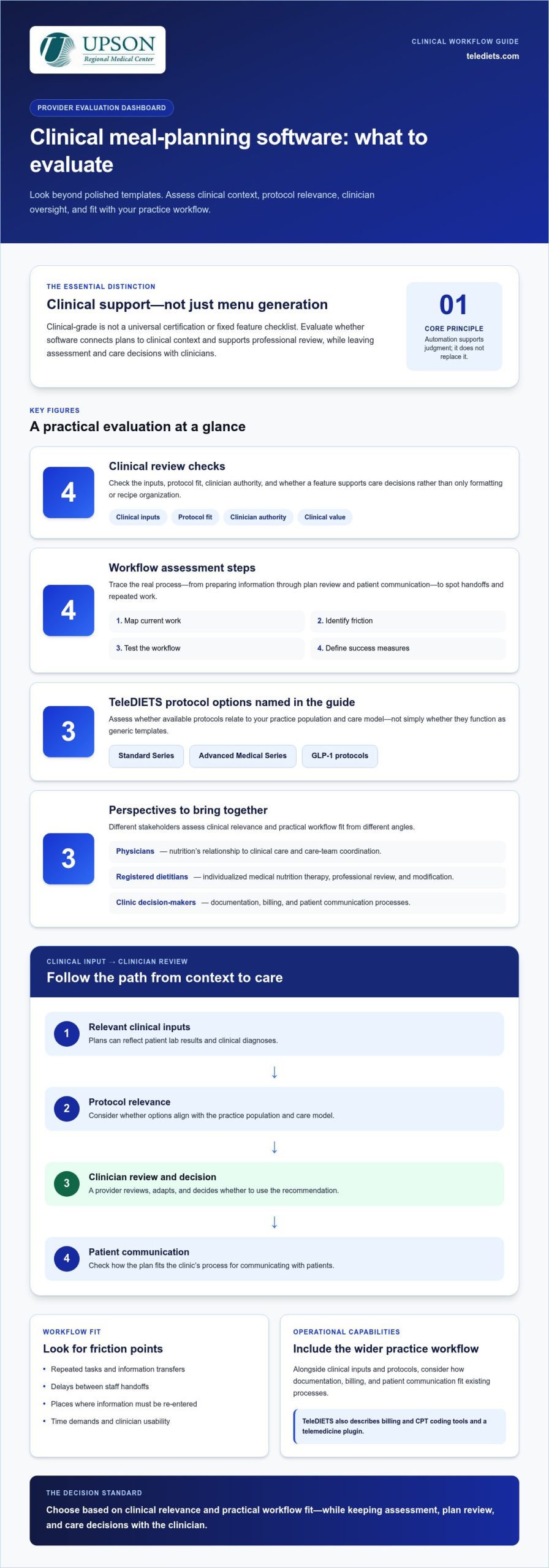
Clinical-grade meal plan software supports provider-led nutrition care by connecting plans to clinical context while leaving assessment, review, and care decisions with clinicians. The phrase isn’t a universal certification or a fixed checklist of features. Evaluate the software based on its intended role in practice, the clinical information it uses, and the oversight built into its workflow.
Clinical nutrition concerns nutrition in relation to health conditions, distinguishing medical nutrition therapy from meal planning organized mainly around recipes, preferences, or general goals. For providers, the key question is whether software helps translate clinical information into a plan for professional review, rather than simply generating a menu.
Clinical nutrition software versus general meal-planning tools
General planning tools may organize recipes or tailor options to stated preferences. Those features can be useful, but they don’t establish that a platform supports clinical care. A professional audience alone isn’t enough either. Look for workflows that use diagnoses and other appropriate clinical inputs to inform plans, while allowing clinicians to assess and adapt them.
Automation can reduce repetitive work, but it should support, not replace, professional judgment. The clinician remains responsible for deciding whether a generated plan is appropriate in context.
Who evaluates clinical meal plan software?
Different stakeholders assess different parts of the fit:
- Physicians consider how nutrition planning relates to clinical care and supports coordination with the care team.
- Registered dietitians assess whether plans and protocols can inform individualized medical nutrition therapy while allowing professional review and modification.
- Clinic decision-makers focus on operational needs, including how the tool fits existing processes for documentation, billing, and patient communication.
Bring these perspectives together when evaluating a platform. The right fit supports clinical relevance and practical workflow needs without shifting care decisions from the provider to the software.
Which Clinical Capabilities Should Providers Evaluate?
Evaluate clinical function before presentation or convenience. Attractive templates and broad recipe libraries may make plans easier to use, but they don’t show whether a platform supports diagnosis-informed nutrition care. When assessing clinical grade meal plan software, focus on the connection between clinical inputs, protocol relevance, and clinician review.
Assess clinical inputs and protocol relevance
Start by checking whether plans can be generated using relevant patient lab results and clinical diagnoses. Then assess whether the available protocols suit the populations your practice serves and your care model. Different protocol types can support varied provider needs, but check that options relate to clinical context rather than functioning only as generic templates.
Keep clinician oversight central
Automation can help with repetitive plan creation, but it shouldn’t make care decisions on a provider’s behalf. Trace the workflow from input to output: Can a clinician review the recommendation, make adjustments, and decide whether to use it? Identify the review point before evaluating a platform so professional responsibility stays clear.
Use this checklist during a platform review:
- Clinical inputs: Can plans reflect relevant diagnoses and lab results?
- Protocol fit: Do the available protocols align with your practice population and care model?
- Clinician authority: Is it clear where providers review, adapt, and approve recommendations?
- Clinical value: Does the feature support care decisions, or mainly improve formatting and recipe organization?
Use the answers to separate core clinical capabilities from secondary conveniences. TeleDIETS generates plans from lab results and clinical diagnoses and offers Standard Series, Advanced Medical Series, and GLP-1 protocols. Explore clinical nutrition software to see how these capabilities fit within its platform.
How Can a Clinic Assess Workflow Fit Before Adoption?
A platform can support clinical planning and still create friction if it doesn’t suit the way your clinic works. Before adopting clinical grade meal plan software, trace a typical workflow from preparing clinical information to reviewing a plan and communicating it to the patient. This shows where software can support the process and where staff need clear responsibilities.
Map the workflow before selecting software
List the people involved at each handoff. One team member may prepare relevant clinical information, a dietitian may review the plan, and another staff member may support patient communication. Clinics divide these tasks differently, so map your actual process. Mark repeated steps, such as transferring information or preparing materials, and note where those tasks occur.
Use this four-step assessment:
- Map current work: Record who prepares information, reviews plans, and communicates with patients.
- Identify friction: Note repeated tasks, delays between handoffs, and places where information must be re-entered.
- Test fit: Walk through a representative workflow, from clinical inputs to clinician review and patient communication.
- Define success measures: Agree on practical indicators before adoption, such as process consistency, clinician usability, and the time demands of key tasks.
Set practical adoption measures
Automation doesn’t have to mean less control. Define where it assists and where a clinician reviews, adjusts, or decides whether to use a plan. During a workflow test, make those decision points explicit. Gather feedback from the people doing the work and compare task steps and time demands with your agreed measures, rather than assuming software will save time or improve outcomes.
Workflow fit depends on clear roles, reliable handoffs, and clinician oversight where care decisions are made. Once your clinic has defined its needs and measures, review TeleDIETS platform options as part of your evaluation.
How TeleDIETS Supports Clinical Meal Planning Workflows
For practices evaluating clinical grade meal plan software, TeleDIETS brings clinical inputs and provider workflow tools together in a medical nutrition therapy platform. Healthcare professionals can use it as a SaaS platform or AI engine. Plans can be generated using patient lab results and clinical diagnoses, giving providers a starting point grounded in clinical context. The technology supports plan creation; clinicians remain responsible for reviewing recommendations and deciding how to use them in care.
Connect clinical protocols with provider workflows
TeleDIETS offers Standard Series and Advanced Medical Series Meal Plans, as well as GLP-1 Meal Plan Protocols. Providers can use these protocols within their medical nutrition therapy workflow, applying clinical judgment to individual decisions. The platform also includes insurance billing and CPT coding tools to support administrative tasks. These tools don’t guarantee coverage, payment, or reimbursement. Together, the platform’s planning and operational features support provider workflows while leaving clinical oversight with the care team.
Support remote nutrition care
For practices that deliver care remotely, TeleDIETS’ telemedicine plugin supports nutrition planning within a telemedicine workflow. Plan how it fits your care process, including who reviews plans and how the team handles patient communication. Set clear procedures for how information and responsibilities move through the remote-care workflow.
Choosing clinical software is ultimately about fit: relevant clinical inputs, protocols suited to provider-led care, and workflow support that preserves clinician authority. Explore TeleDIETS for your practice to see how its platform, protocols, billing tools, and telemedicine plugin support clinical nutrition workflows.
Make Your Next Software Decision Deliberate
Turn your evaluation into a shared practice decision. Bring clinical and operational stakeholders together to agree on what your team needs from clinical grade meal plan software, which responsibilities must remain clinician-led, and how you’ll assess adoption. Clear priorities make it easier to determine whether a platform supports the way your practice intends to deliver nutrition care.
Keep the decision practical. Identify the workflow needs that matter most, decide how the team will evaluate the platform’s fit, and set a point to revisit the decision after implementation. A structured review helps new technology serve your care model rather than dictate it.
TeleDIETS provides medical nutrition therapy software with clinical inputs, specialized protocols, billing tools, and a telemedicine plugin. Explore clinical nutrition software for your practice and take the next step in evaluating a platform for your team.
Frequently Asked Questions
Can clinical-grade meal plan software support multiple clinical diagnoses?
It can if the platform can account for coexisting diagnoses, but support varies. During evaluation, walk through a representative workflow involving more than one diagnosis and see whether the relevant information can be considered together. TeleDIETS generates plans tailored to clinical diagnoses. Providers should assess how its outputs fit their multi-condition workflows and apply clinical judgment when reviewing them.
Does clinical meal planning software replace a registered dietitian?
No. Software can assist with plan preparation, but it doesn’t replace a registered dietitian’s expertise in assessing nutritional needs, discussing practical barriers, and adapting care as circumstances change. A generated plan may need review to account for a patient’s preferences or care priorities. Use software to support the work, not to replace professional assessment and communication.
Can clinical nutrition software be used in a telemedicine practice?
Yes. Clinical nutrition software can support a telemedicine workflow when its capabilities fit the practice’s remote-care process. Consider how clinicians will prepare for a virtual visit, review nutrition materials with patients, and handle follow-up communication. TeleDIETS offers a telemedicine plugin for provider workflows. Define how your team will use it within its remote-care procedures and responsibilities.
What should a clinic measure when evaluating meal plan software?
Assess how the software performs in routine work, not just during a demonstration. During a pilot, record where staff repeat steps, correct information, or need help completing a task. Gather feedback from clinicians and administrative staff who use the workflow. Compare these observations with your team’s success measures to identify friction and judge whether the tool fits.
How is clinical meal plan software different from an electronic health record?
An electronic health record generally supports a broad patient-record workflow, while clinical meal plan software focuses on nutrition planning. A clinic may use both for different purposes, but information shouldn’t be assumed to move between them automatically. Before adoption, map where nutrition plans are prepared and how relevant information is recorded in the patient record, then establish a clear process for each step.
Leave a Reply