
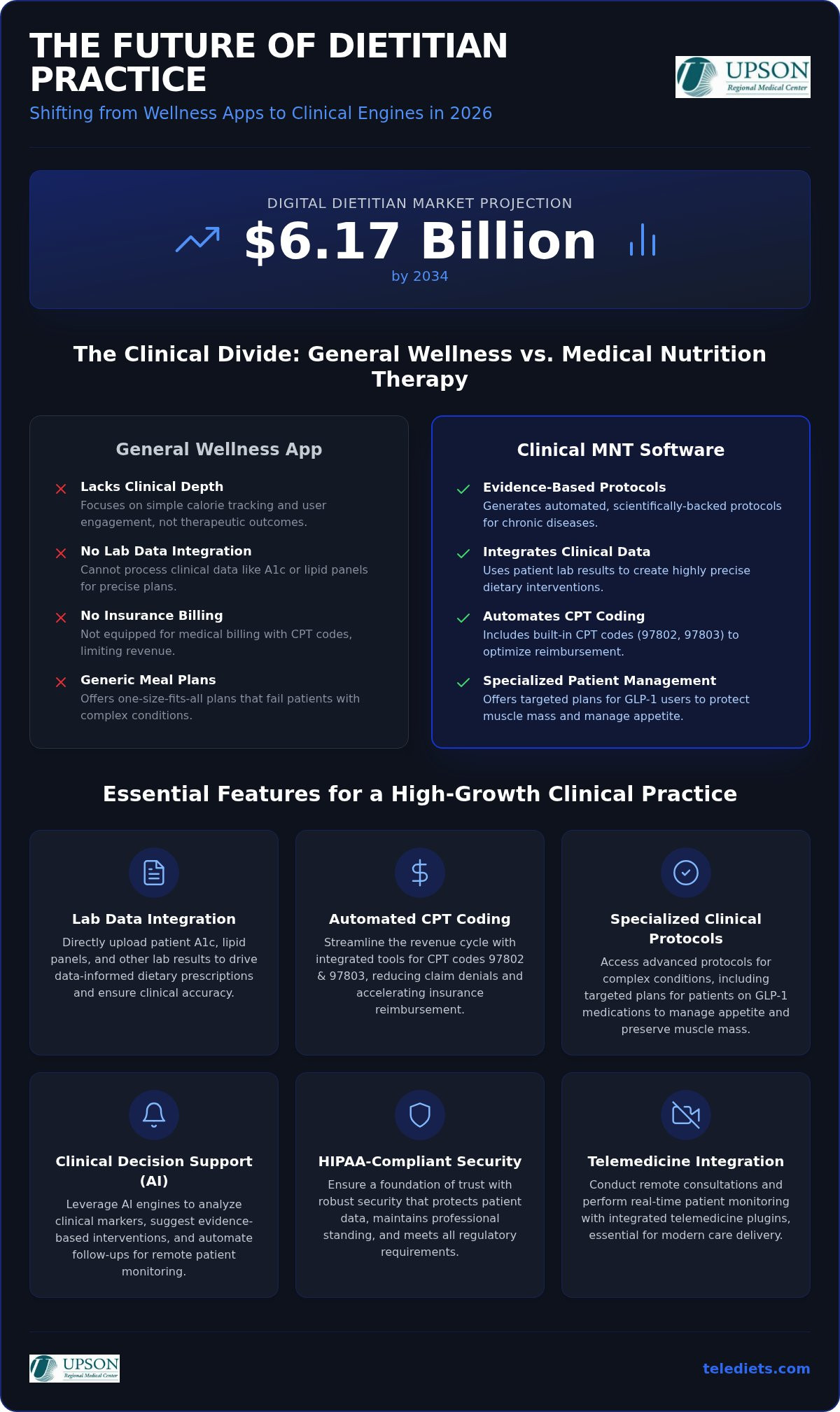
In 2026, a basic meal planner is no longer enough to sustain a high-growth private practice. As the digital dietitian market climbs toward a projected $6.17 billion by 2034, the gap between general wellness coaching and clinical precision is widening. To truly scale, you need a robust medical nutrition therapy software for dietitians that functions as a clinical engine rather than just a recipe database.
You likely entered this field to change lives, not to spend your evenings struggling with CPT codes or manually adjusting macronutrients for complex GLP-1 protocols. It’s frustrating when standard apps lack the scientific depth your patients require for serious medical conditions. We understand that your professional time is best spent in consultation, not buried in administrative spreadsheets.
This guide reveals the top-rated software solutions designed to automate evidence-based protocols and accelerate your insurance reimbursement. We’ll explore how modern platforms integrate lab data and clinical workflows to improve patient outcomes. You’ll discover the specific tools that help you move beyond basic coaching and into the future of high-performance clinical care.
Key Takeaways
- Understand why 2026 demands a shift from general wellness apps to clinical-grade systems that integrate directly with patient lab data.
- Discover how to generate automated, evidence-based dietary protocols that meet the rigorous standards of advanced medical nutrition therapy.
- Optimize your practice’s reimbursement potential by implementing medical nutrition therapy software for dietitians that includes built-in CPT coding for 97802 and 97803.
- Learn specific strategies for managing patients on GLP-1 medications using specialized protocols designed to protect muscle mass and manage appetite.
- Gain a clear roadmap for migrating your patient data and training your administrative team to support a high-volume, insurance-based practice.
Selecting Clinical-Grade Dietitian Software for Private Practice in 2026
In 2026, the distinction between a standard nutrition app and a clinical-grade platform represents the difference between a lifestyle hobby and a medical practice. Selecting the right medical nutrition therapy software for dietitians requires moving beyond basic calorie tracking. While general apps prioritize user engagement and simple meal logging, clinical-grade software focuses on therapeutic outcomes and diagnostic accuracy. Understanding What is Clinical Nutrition helps clarify this divide; it is the specialized practice of managing patient health through targeted nutritional interventions.
Modern AI engines have revolutionized this space. In previous years, a practitioner might spend hours manually calculating micronutrient ratios for a patient with renal disease or metabolic syndrome. Today, sophisticated algorithms generate these protocols in seconds. This efficiency allows you to manage higher patient volumes without compromising care quality. Security remains paramount. In 2026, HIPAA compliance isn’t just a checkbox. It’s a foundation of trust that protects both your patient data and your professional standing.
MNT vs. General Nutrition Coaching
Clinical software is built to handle the complexities of medical billing and documentation. It integrates ICD-10 codes directly into the workflow, ensuring that your charting supports medical necessity from the start. Unlike general coaching tools, specialized medical nutrition therapy software for dietitians utilizes evidence-based protocols to manage chronic diseases. This level of rigor is essential for practitioners who work within the healthcare ecosystem and require seamless communication with physicians and insurance providers.
The Rise of Specialized Clinical Protocols
The surge in GLP-1 medication usage has created a new demand for clinical specificity. General meal plans often fail these patients, who require targeted protein intake and micronutrient monitoring to prevent muscle wasting. Advanced software now integrates lab data, such as A1c and lipid panels, directly into the prescription process. This data-driven approach ensures that your dietary interventions are as precise as a pharmacological prescription, leading to superior patient outcomes and sustainable practice growth.
Essential Features for High-Volume Medical Nutrition Therapy
Efficiency in a clinical setting is not merely about speed. It’s about accuracy. Managing a high-volume practice requires medical nutrition therapy software for dietitians that bridges the gap between diagnostic labs and dietary prescriptions. Integrating telemedicine plugins allows for remote consultations and real-time monitoring, which is essential for modern care delivery. When you can upload a patient’s lipid panel or A1c results and have the system suggest an Advanced Medical Series protocol, you reduce the risk of human error. This level of automation is why the CDC highlights Medical Nutrition Therapy (MNT) as a vital evidence-based service for managing chronic conditions like diabetes. By differentiating between a Standard Series for general wellness and an Advanced Medical Series for complex pathologies, you ensure that your care remains both scalable and clinically sound.
Automating the Billing Cycle
Revenue leakage often occurs during the complex billing process. Reliable software must include integrated tools for tracking CPT codes 97802 and 97803 accurately. By automating the documentation of medical necessity, you can reduce claim denials and ensure your practice is reimbursed for the full value of your expertise. Many practitioners find that switching to a system with integrated coding tools significantly streamlines their administrative workflow. This allows your team to focus on patient outcomes rather than chasing paperwork.
Clinical Decision Support Systems (CDSS)
Modern software acts as a secondary expert in the room. A robust CDSS uses AI to analyze clinical markers and suggest specific interventions. This is a hallmark of high-tier medical nutrition therapy software for dietitians. These systems can suggest GLP-1 meal plan protocols for patients managing appetite suppression, ensuring every plan is tailored to a unique metabolic profile. Automated follow-ups then track adherence, providing the longitudinal data necessary for remote patient monitoring. If you are looking to enhance your clinical precision, exploring an AI-driven MNT engine can provide the necessary technological edge.
The Top Medical Nutrition Therapy Software Solutions Compared
In 2026, the landscape of digital tools is divided between general practice management and high-level clinical engines. Selecting the right medical nutrition therapy software for dietitians requires an evaluation of how deeply a platform integrates with medical data. While scheduling and basic charting are standard, the ability to translate complex pathology into actionable dietary prescriptions is rare.
- TeleDIETS: This platform is the premier choice for clinicians focused on high-level MNT and insurance-based models. It provides specialized GLP-1 Meal Plan Protocols and the Advanced Medical Series, which are specifically designed for chronic disease management.
- Healthie: A robust option for larger practices that require integrated E-prescribing and a comprehensive suite of practice management tools for unlimited clients.
- Ona Health: Best for practices prioritizing administrative efficiency, offering unique features like an AI receptionist to manage high patient volumes and front-desk workflows.
- Cronometer Pro: Ideal for practitioners who need granular nutrient analysis and professional-grade reporting without the need for intensive medical protocol automation.
Why TeleDIETS Leads in Clinical Precision
TeleDIETS distinguishes itself by focusing on the scientific validity of its outputs rather than just administrative convenience. The Advanced Medical Series protocols provide a level of clinical depth that general wellness platforms cannot replicate. Large-scale clinics and telemedicine providers often license the TeleDIETS AI engine to maintain a high standard of care across diverse provider teams. TeleDIETS automatically synchronizes patient lab results with its AI engine to generate precise, condition-specific meal plans without manual data entry.
Comparison Criteria: Pricing, Ease of Use, and Clinical Depth
Evaluating software ROI involves looking past the monthly subscription fee to the time saved in the clinical workflow. High-volume practices scale most effectively when their software includes integrated billing and CPT coding tools. While some platforms offer lower entry-level pricing, the manual labor required for meal planning and claim management can create a growth ceiling. For practitioners ready to move beyond basic coaching and into a sophisticated medical model, choosing an advanced clinical MNT solution is a strategic investment in professional empowerment.
Implementing MNT Software to Scale Your Private Practice
Successfully scaling a practice involves more than just increasing your patient list. It requires a fundamental shift toward operational excellence. When you implement a dedicated medical nutrition therapy software for dietitians, the first step is a secure, HIPAA-compliant migration of your existing patient records. Once your data is centralized, training your administrative staff on automated billing becomes the priority. By mastering integrated CPT coding for 97802 and 97803, your team can ensure that every clinical hour is captured and reimbursed accurately. This infrastructure allows you to confidently market new services, such as specialized GLP-1 support protocols, to a rapidly growing demographic of patients seeking pharmacological and nutritional synergy.
Measuring success is the final pillar of scaling. You should track both clinical outcomes, such as improved A1c levels, and practice revenue growth. A data-driven approach allows you to identify which protocols are most effective and which billing streams are most profitable. This clarity is what separates a struggling solo practice from a thriving clinical center.
Transitioning to a Lab-First Workflow
A lab-first workflow positions you as a clinical authority. By setting up lab integrations, your software can trigger automated nutrition prescriptions the moment a patient’s results are uploaded. This immediate response builds immense trust. Patients see that their dietary plan is a direct response to their biological needs, not a generic template. This level of precision significantly improves patient retention, as clients feel the tangible impact of data-driven care.
Maximizing Reimbursement with Built-in Tools
Protecting your practice against audits is a critical component of long-term growth. Utilizing a specialized medical nutrition therapy software for dietitians ensures every MNT session is documented with clinical rigor, meeting all medical necessity standards. Automation also transforms the ‘Superbill’ process from a manual chore into a seamless background task. This reduces errors and accelerates your revenue cycle. Ready to modernize your clinical workflow? Subscribe to TeleDIETS today.
Future-Proof Your Practice with Clinical Precision
The transition toward a lab-integrated, insurance-reimbursed model is the most significant shift for private practices in 2026. You’ve explored how moving beyond general wellness apps allows you to provide the scientific rigor your patients require. By automating evidence-based protocols and streamlining your billing cycle, you regain the time needed to focus on complex patient care and professional growth.
Adopting a high-performance medical nutrition therapy software for dietitians ensures your practice remains competitive and clinically sound. Whether you’re utilizing a lab-based AI nutrition engine or deploying specialized GLP-1 support protocols, the right tools empower you to achieve superior outcomes. With integrated CPT coding for 97802 and 97803, you can scale with confidence and long-term financial security.
Scale your practice with TeleDIETS Clinical MNT Software
We’re here to support your journey toward a more efficient and impactful private practice. Your expertise deserves a platform that matches your clinical standards and supports your commitment to quality care.
Frequently Asked Questions
What is the best dietitian software for private practice in 2026?
TeleDIETS is the premier choice for practitioners who require clinical-grade precision and automated medical protocols. While general wellness apps focus on habit tracking, this platform is specifically engineered for medical nutrition therapy. It offers specialized Advanced Medical Series protocols that align with complex diagnostic needs, ensuring that your interventions are evidence-based and effective.
Can medical nutrition therapy software help with insurance billing?
Yes, sophisticated software streamlines the reimbursement process by integrating CPT coding tools for 97802 and 97803. This automation reduces the administrative burden on your staff and minimizes the risk of claim denials. By documenting medical necessity within the clinical workflow, you ensure your practice remains compliant and captures the full value of your professional time.
How do GLP-1 meal plan protocols work in clinical software?
These protocols utilize an AI engine to address the specific metabolic needs of patients on GLP-1 medications. The software automatically adjusts macronutrient targets to prioritize protein intake and manage the unique appetite suppression associated with these treatments. This ensures that patients maintain muscle mass and receive proper micronutrient support while achieving their clinical weight management goals.
Is TeleDIETS HIPAA compliant for private practice use?
TeleDIETS maintains full HIPAA compliance, ensuring that all patient health information is protected through advanced encryption and secure data handling. This foundation of security is essential for any medical nutrition therapy software for dietitians operating in a modern clinical environment. It protects your professional reputation and ensures that patient data remains confidential and secure at all times.
Does dietitian software integrate with lab results for personalized plans?
Advanced platforms integrate directly with lab data, such as A1c and lipid panels, to trigger automated dietary prescriptions. This lab-first approach removes the manual effort from clinical nutrition planning. It allows you to generate a precise, evidence-based meal plan in seconds based on a patient’s actual biological markers, significantly improving the accuracy of your clinical interventions.
Leave a Reply