
What if the most profitable component of your practice wasn’t the medication itself, but a nutrition counseling business model for weight management clinics that runs on autopilot? You likely recognize that while GLP-1 protocols are the primary revenue driver in 2026, the manual overhead of custom meal planning and the complexity of MNT insurance billing often erode your margins. It’s frustrating to see clinical outcomes fluctuate simply because dietary advice isn’t standardized across your team of providers.
This guide shows you how to transform nutrition from a logistical burden into a high-margin, insurance-reimbursable engine using automated clinical protocols. You’ll discover how to integrate a scalable workflow that delivers consistent results for every patient without the need for excessive staffing. We’ll explore how to leverage sophisticated software to maximize CPT reimbursements, reduce administrative friction, and ensure your clinic remains a stable, reliable leader in a competitive medical landscape.
Key Takeaways
- Learn why transitioning from a cash-only approach to an insurance-integrated clinical hub is essential for long-term practice growth.
- Implement a high-margin nutrition counseling business model for weight management clinics by leveraging automated billing and clinical tools.
- Maximize your revenue by utilizing CPT codes 97802 and 97803, supported by lab-driven data to establish medical necessity.
- Streamline your operations with evidence-based protocols that ensure every patient receives consistent, high-quality dietary guidance without increasing staffing costs.
The Evolution of the Weight Management Business Model
The weight management landscape has shifted dramatically. In the past, many clinics operated as high-volume, medication-only centers. Today, the most successful practices have transitioned into comprehensive medical nutrition therapy (MNT) hubs. This change is driven by a need for better clinical outcomes and more diverse revenue streams. By adopting a modern nutrition counseling business model for weight management clinics, providers can offer a more holistic approach that goes beyond the prescription pad. Various weight management techniques, including behavioral changes and structured dietary support, are now central to these clinical frameworks. This evolution allows you to treat the root causes of metabolic dysfunction rather than just masking symptoms with pharmaceuticals.
While the cash-pay model once offered simplicity, it’s losing ground to insurance-integrated systems. Patients in 2026 expect their coverage to work for them, especially as CMS and private payers recognize the value of MNT. Relying solely on cash payments limits your patient base and creates revenue volatility that can destabilize a growing practice. Integrating insurance-reimbursable services provides a stable, predictable income floor while improving patient retention. A robust nutrition counseling business model for weight management clinics allows you to capture these reimbursements while delivering superior care. The Integrated Nutrition Model is the standard for 2026 clinics, combining medical oversight with automated, evidence-based dietary protocols to ensure long-term success.
Addressing the GLP-1 Support Gap
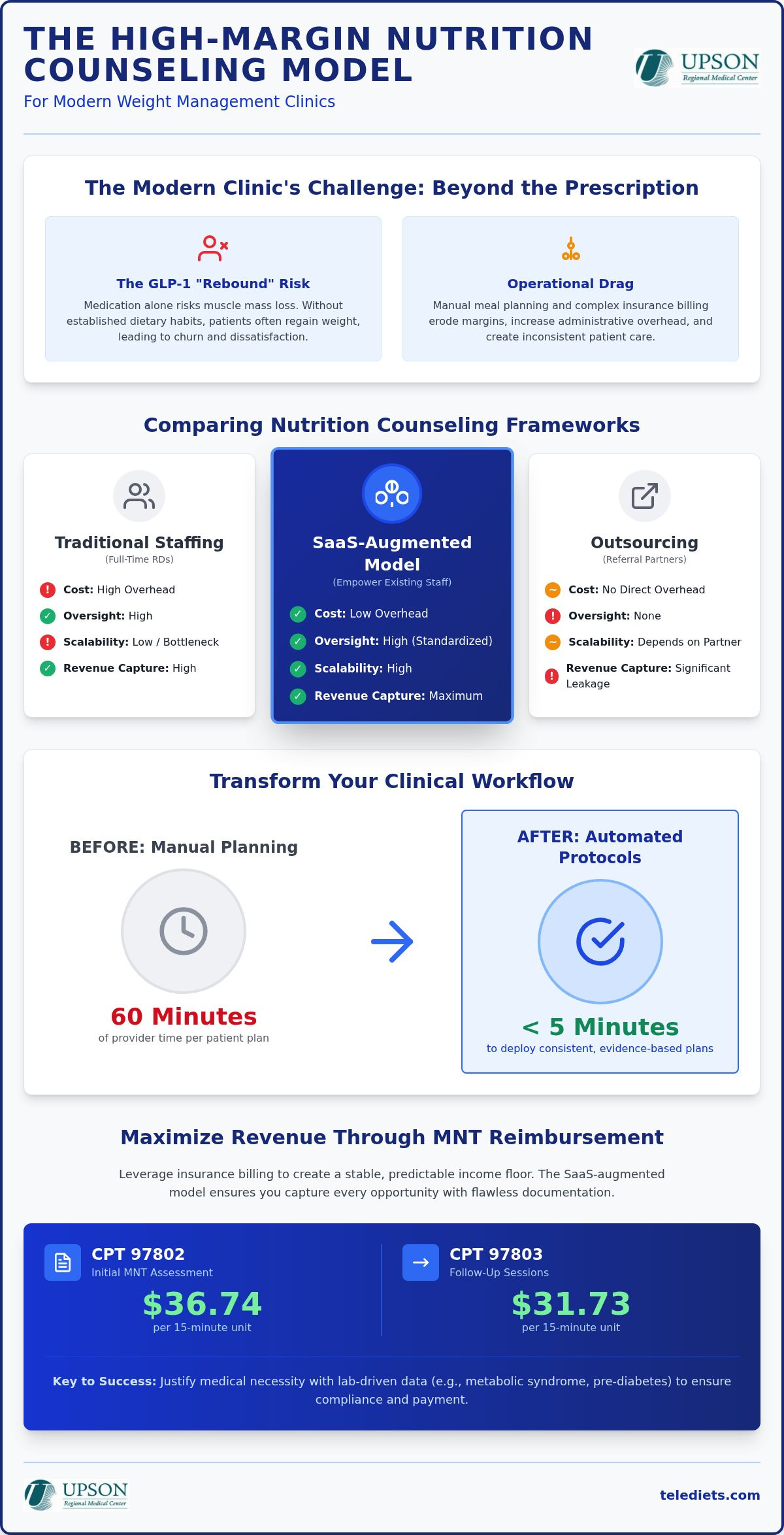
Medication alone often fails to address the risk of muscle mass loss during rapid weight reduction. Without muscle-sparing nutritional protocols, patients face a significant business risk: the “rebound” effect. When patients stop medication without established dietary habits, they often regain weight, leading to dissatisfaction and churn. Nutrition services mitigate this risk by providing the clinical structure necessary to maintain lean body mass and lock in results.
Comparing In-House Nutrition Counseling Frameworks
Selecting the right nutrition counseling business model for weight management clinics requires balancing clinical excellence with operational costs. Traditional staffing, while providing high-touch care through full-time Registered Dietitians (RDs), often creates a bottleneck. High salaries and benefits increase your overhead, making it difficult to maintain margins unless your patient volume is consistently high. Conversely, outsourcing might seem easier, but it results in significant revenue leakage and a total loss of clinical oversight. When you refer patients out, you can’t guarantee they’re following the muscle-sparing protocols essential for GLP-1 success.
A SaaS-augmented model offers a more resilient alternative. By equipping your existing NPs and PAs with sophisticated tools, you empower them to deliver MNT without the need for specialized new hires. The efficiency gains are stark. Manual meal planning typically consumes 60 minutes of provider time; however, automated clinical protocols reduce this to mere minutes. This allows your team to focus on patient interaction rather than administrative data entry. This streamlined nutrition counseling business model for weight management clinics ensures you capture every billing opportunity without increasing your payroll. You can easily scale your nutrition services as your patient list grows.
The Hybrid Efficiency Model
A hybrid approach maximizes reach while minimizing physical overhead. Integrating a Telemedicine Plugin allows your staff to conduct nutrition check-ins remotely, freeing up valuable exam room space for new patient intakes. This digital-first strategy is supported by centralized SaaS protocols, which ensure that every provider across multiple locations delivers identical, high-quality care. Whether you’re prescribing the Standard Series or the Advanced Medical Series, the clinical output remains consistent. To see how these tools integrate into your workflow, you can explore automated nutrition platforms to find the best fit for your clinic’s needs.
Maximizing Revenue through MNT Reimbursement and Billing
A sustainable nutrition counseling business model for weight management clinics relies on high-precision billing. For 2026, the national Medicare reimbursement rate for CPT 97802, which covers the initial MNT assessment, is $36.74 per 15-minute unit. Follow-up sessions under CPT 97803 are reimbursed at $31.73. These rates allow clinics to generate significant revenue, provided the documentation is flawless. By using lab results to justify medical necessity, such as metabolic syndrome or pre-diabetes diagnoses, you ensure that your services meet the rigorous standards of payers like Highmark, which updated its coverage policies for October 2026. TeleDIETS integrates CPT coding directly into the clinical workflow, ensuring your revenue cycle remains efficient and uninterrupted.
Manual coding is a liability that often leads to revenue leakage. Automated billing tools reduce claim denials by aligning prescriptions with specific ICD-10 codes and lab-verified data. This digital oversight turns a complex administrative task into a repeatable, profitable process. It empowers your staff to focus on clinical care rather than battling with insurance adjusters over technicalities. You don’t have to worry about manual errors when you automate your billing workflow to capture these reimbursements without expanding your back-office team or increasing administrative costs.
Insurance vs. Cash-Pay: Finding the Sweet Spot
While insurance provides a baseline, a hybrid model offers the highest ROI. You can structure premium cash-pay packages for patients on GLP-1 protocols, offering specialized meal plans that aren’t always covered by traditional MNT hours. Additionally, bundling nutrition counseling into existing chronic care management (CCM) programs creates a holistic care environment that increases patient lifetime value. This diversified approach ensures your nutrition counseling business model for weight management clinics stays resilient against policy shifts or reimbursement caps. By offering both options, you provide accessible care for all patients while maximizing the financial health of your practice.
Implementing a Scalable Clinical Nutrition Workflow
Moving from financial planning to execution requires a structured, four-step approach. A successful nutrition counseling business model for weight management clinics integrates seamlessly with your existing clinical data. First, you must integrate patient lab markers directly into a nutrition prescription engine. This ensures every meal plan is biochemically relevant. Second, select the appropriate evidence-based protocol. You might choose the Standard Series for general weight loss or the Advanced Medical Series for patients with complex co-morbidities like metabolic syndrome.
Third, deliver the “Nutrition Prescription” using a telemedicine plugin or an in-person digital interface. This removes the friction of physical handouts and ensures the patient has immediate access to their plan. Finally, monitor patient progress through follow-up clinical markers, adjusting protocols as metabolic health improves. This closed-loop system ensures your nutrition counseling business model for weight management clinics remains clinically valid and highly responsive to individual patient needs. It transforms a complex medical requirement into a repeatable administrative success.
Reducing Provider Burnout with Automation
Clinical burnout often stems from the manual overhead of dietary planning. AI-powered meal plan generators save over 30 minutes per patient consultation, allowing your team to focus on high-value clinical interactions. This technology empowers medical assistants to facilitate the workflow under provider supervision, which optimizes your staff’s time and increases clinic capacity. By standardizing these processes, you ensure care quality never wavers, regardless of which staff member is on duty. To begin transforming your practice, explore the various TeleDIETS membership options available for professional implementation.
Future-Proofing Your Clinical Revenue
The shift from medication-only centers to comprehensive MNT hubs is essential for 2026. By adopting a modern nutrition counseling business model for weight management clinics, you secure a stable financial future while ensuring patients achieve sustainable results. You’ve seen how automated workflows and insurance-integrated billing eliminate the overhead barriers that once made in-house nutrition services cost-prohibitive. Leveraging a lab-result-to-protocol AI engine allows your team to provide precision care without manual meal planning. With integrated CPT coding tools and specialized GLP-1 support protocols, your practice can maximize reimbursements while maintaining high clinical standards. It’s time to empower your staff and protect your margins. Upgrade your clinic with the TeleDIETS MNT SaaS engine today to unlock a new level of operational efficiency. Your commitment to quality care deserves a partner that prioritizes your success as much as your patients’ clinical outcomes.
Frequently Asked Questions
What are the most common CPT codes for nutrition counseling in a weight loss clinic?
The most common CPT codes for Medical Nutrition Therapy (MNT) are 97802 for the initial assessment and 97803 for follow-up visits. Each code represents a 15-minute unit of service. For group settings, you should utilize CPT code 97804. These codes are essential for building a sustainable nutrition counseling business model for weight management clinics, allowing for consistent reimbursement across various insurance payers.
Can a physician bill for nutrition counseling, or do I need a Registered Dietitian?
Physicians can bill for nutrition services, though many clinics utilize Registered Dietitians or supervised clinical staff like NPs and PAs to deliver the care. While some payers require specific credentials for MNT codes, your clinic can often bill under the physician’s NPI for incident-to services. Using automated clinical protocols ensures that regardless of who delivers the advice, the nutritional guidance remains evidence-based and professional.
How does an automated nutrition business model improve patient ROI?
An automated nutrition counseling business model for weight management clinics improves patient ROI by increasing adherence through personalized, lab-driven meal plans. When patients receive precise, muscle-sparing protocols, they see faster clinical results and fewer weight rebounds. This consistency builds trust and encourages long-term engagement with your practice. Automated systems also reduce the time-to-delivery for meal plans, ensuring patients start their journey immediately without delays.
Is medical nutrition therapy software HIPAA compliant for weight loss clinics?
Professional medical nutrition therapy software is designed with robust security measures to ensure full HIPAA compliance. These platforms protect sensitive patient health information through encrypted data storage and secure communication channels. It’s vital to choose a partner that provides a Business Associate Agreement (BAA) to safeguard your practice. This clinical precision ensures that your patient data remains private while you focus on delivering high-quality, technology-forward medical care.
What is the average reimbursement rate for CPT code 97802 in 2026?
The 2026 national unadjusted Medicare reimbursement rate for CPT code 97802 is $36.74 per 15-minute unit. This rate serves as a baseline for the initial assessment, though actual payments may vary based on geographic location and specific private payer contracts. Understanding these figures is critical for calculating the ROI of your nutrition services. It allows you to project revenue accurately while integrating high-margin MNT into your workflow.
Leave a Reply