
What if your practice could translate complex lab results into a billable, evidence-based nutrition plan in the time it takes to refresh your inbox? You likely find that manual meal planning is the primary bottleneck in your clinical workflow. It’s exhausting to balance direct patient care with the administrative weight of insurance billing, especially when navigating the specific requirements for CPT codes like 97802 and 97803. Consistency often suffers when different providers in the same clinic use varying dietary protocols, leading to fragmented care.
This guide reveals how the right virtual nutrition counseling software transforms these burdens into an automated engine for practice growth and superior patient outcomes. By integrating clinical-grade tools into your workflow, you can finally bridge the gap between diagnosis and dietary intervention. We’ll detail how to generate Medical Nutrition Therapy (MNT) protocols from lab data in seconds, scale your virtual services without a massive increase in headcount, and ensure every plan is both evidence-based and fully billable. You’ll discover how to reclaim your time while providing the precise, data-driven care that modern medicine demands.
Key Takeaways
- Understand the critical distinction between consumer-grade diet apps and HIPAA-compliant platforms designed specifically for clinical Medical Nutrition Therapy.
- Learn how to automate evidence-based protocols for chronic conditions by integrating patient lab results directly into your clinical workflow.
- Optimize practice revenue by using virtual nutrition counseling software to simplify documentation and ensure accurate billing for CPT codes 97802 and 97803.
- Scale your services to meet the rising demand for GLP-1 support through specialized protocols that prioritize nutrient density and lean mass preservation.
Defining Virtual Nutrition Counseling Software for Clinical Settings
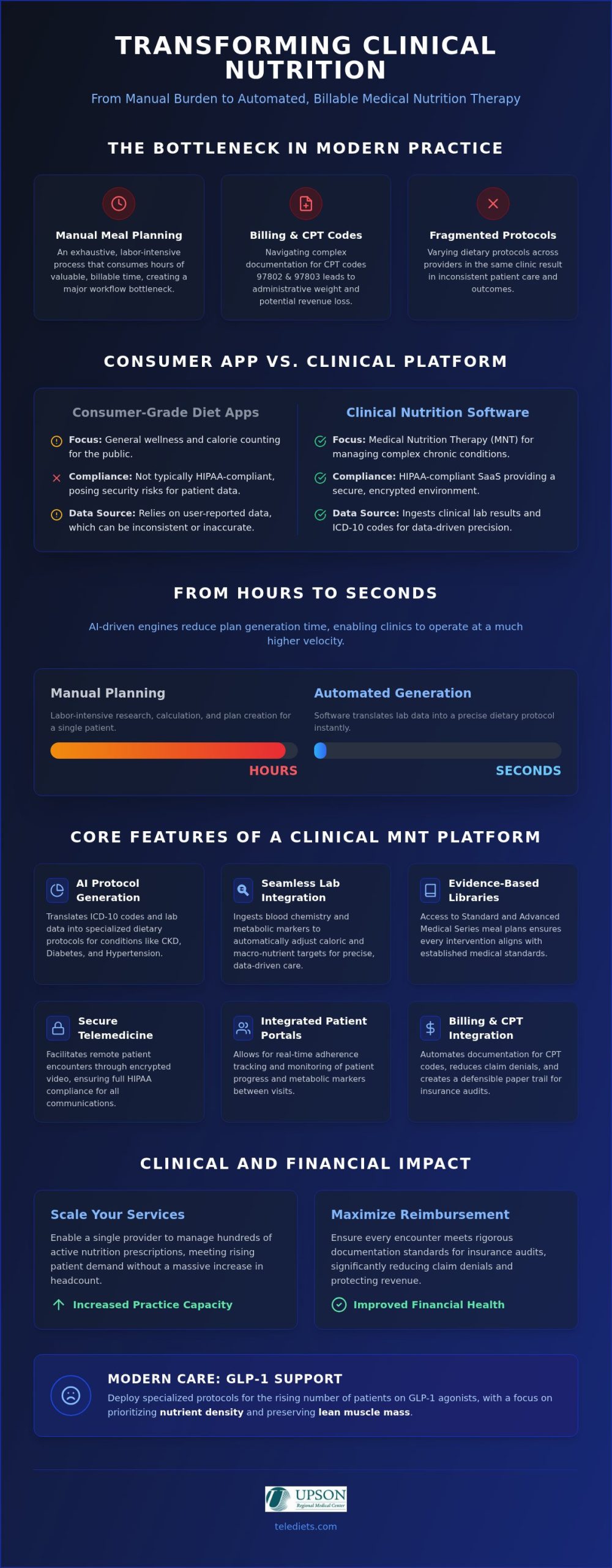
Clinical virtual nutrition counseling software isn’t a simple food tracker; it’s a HIPAA-compliant SaaS platform engineered specifically for Medical Nutrition Therapy (MNT). While consumer-grade apps focus on general wellness and calorie counting, clinical-grade systems empower providers to manage complex chronic conditions with scientific precision. These platforms operate within the established framework of Telehealth, providing a secure, encrypted environment for remote patient encounters and the exchange of sensitive medical data.
In 2026, practices face a significant increase in chronic disease volume and a surge in patients requiring metabolic support. You need an AI engine that does more than store files. It must actively translate clinical diagnoses and lab markers into precise dietary prescriptions. This level of automation is essential for modern clinics. It allows you to scale high-quality care using Standard and Advanced Medical Series meal plans without the manual labor typically associated with personalized meal planning.
The Core Components of a Clinical Nutrition SaaS
A robust clinical platform integrates several vital tools into a single workflow to ensure efficiency and compliance:
- Secure Telemedicine Plugins: These tools facilitate remote encounters through encrypted video, moving beyond the security risks of non-compliant consumer communication platforms.
- Automated Protocol Generation: By ingesting ICD-10 codes and metabolic lab data, the software generates specialized dietary protocols tailored to specific conditions like CKD or hypertension in seconds.
- Integrated Patient Portals: Real-time adherence tracking through a portal lets you monitor patient progress and metabolic markers, ensuring the virtual nutrition counseling software serves as a continuous point of care.
Key Features to Evaluate in MNT Software Platforms
Evaluating virtual nutrition counseling software requires moving beyond basic scheduling features to examine the clinical engine under the hood. For a high-volume practice, the most critical feature is seamless lab integration. Your software must ingest blood chemistry and metabolic markers to automatically adjust caloric and macro-nutrient targets. This automation ensures every intervention is data-driven and precise, removing the guesswork from Medical Nutrition Therapy.
A clinical platform should provide extensive evidence-based protocol libraries. Access to Standard and Advanced Medical Series for complex conditions like CKD, Diabetes, and Hypertension allows you to deploy specialized care without the burden of manual research. This level of standardization is the key to scalability. It enables a single provider to manage hundreds of active nutrition prescriptions across a diverse patient base. While you can tailor plans to specific patient preferences or cultural needs, the underlying clinical integrity remains uncompromised.
AI-Driven Protocol Generation vs. Manual Planning
Manual meal planning is the primary bottleneck in virtual nutrition care. It’s a labor-intensive process that consumes hours of billable time. Advanced AI engines reduce plan generation time from hours to mere seconds, allowing your clinic to operate at a much higher velocity. These systems utilize clinical guardrails to prevent errors and ensure all recommendations align with established medical standards. By automating the technical heavy lifting, your team can focus on the human element of counseling and patient motivation. If you’re ready to modernize your workflow, exploring specialized MNT tools can help you streamline patient management and increase your practice’s capacity.
Maximizing Reimbursement: Billing and CPT Coding Integration
Effective virtual nutrition counseling software serves as a critical financial safeguard by ensuring every encounter meets the rigorous documentation standards required for insurance audits. It’s not enough to simply provide care; you must prove clinical necessity through detailed, evidence-based charting. Integrated billing tools automate the connection between specific ICD-10 diagnosis codes and the nutritional interventions provided, creating a transparent and defensible paper trail for payers. This automation significantly reduces claim denials by validating that every meal plan and protocol aligns with established medical standards before a bill is even generated. By pre-validating these clinical connections, you protect your revenue stream and reduce the time your staff spends on manual administrative corrections.
Navigating CPT Codes for Medical Nutrition Therapy
Understanding the mechanics of MNT billing is essential for practice sustainability. CPT 97802 covers the initial assessment, while 97803 handles subsequent re-assessments. Both are time-based codes billed in 15-minute increments. For 2026, CMS national reimbursement rates sit at approximately $36.74 per unit for 97802 and $31.73 for 97803. When utilizing virtual nutrition counseling software, tracking encounter duration becomes a background task rather than a manual chore. High-quality platforms monitor session length automatically, ensuring your coding accuracy reflects the actual time spent with the patient. This precision is vital for maintaining compliance and maximizing your per-encounter reimbursement. Implementing automated CPT coding is a direct investment in your practice ROI, as it eliminates the administrative friction that often leads to under-billing or lost revenue. To secure your practice’s financial future, you should consider adopting integrated insurance billing and CPT coding tools that simplify the entire reimbursement lifecycle.
Scaling Modern Care: GLP-1 Support and Remote MNT
The 2026 surge in GLP-1 receptor agonist prescriptions has redefined the landscape of obesity management. While these medications are highly effective, they require rigorous nutritional oversight to prevent significant muscle wasting and ensure adequate nutrient density during periods of suppressed appetite. Virtual nutrition counseling software provides the clinical framework necessary to manage these complex cases at scale. By deploying specialized protocols that prioritize protein intake and micronutrient balance, you can ensure that weight loss is both healthy and sustainable for your patients. This transition from simple weight management to data-driven metabolic health allows your practice to function as a comprehensive center for chronic disease intervention.
Telemedicine plugins are vital for maintaining the high-touch care required for metabolic patients. These tools facilitate frequent, short-duration check-ins that are essential for monitoring side effects and dietary adherence during medication titration. These digital encounters allow you to provide continuous support without the scheduling bottlenecks of traditional in-office visits. Using virtual nutrition counseling software ensures that every remote session is backed by evidence-based data, allowing for immediate adjustments to a patient’s plan based on their progress and metabolic markers.
Implementing GLP-1 Meal Plan Protocols
Clinical success for patients on weight-loss medications depends on specific, high-protein, and micronutrient-dense dietary plans. Your practice can utilize the Advanced Medical Series to automate these complex metabolic interventions, ensuring every patient receives a plan tailored to their unique clinical needs. This level of automation removes the manual burden of plan creation, allowing your team to focus on patient motivation and counseling. To access these clinical-grade tools, you can view professional licensing options for specialized protocols. These resources empower your clinic to deliver the precise, evidence-based Medical Nutrition Therapy required for modern metabolic care.
Elevating Clinical Standards in the Digital Era
Transitioning to a high-performance clinical environment requires more than just digital communication; it demands a sophisticated engine that bridges the gap between lab data and actionable care. By implementing virtual nutrition counseling software, you replace time-consuming manual planning with AI-driven precision. You’ve seen how specialized GLP-1 and Advanced Medical protocols protect patient health while integrated CPT coding for 97802 and 97803 ensures your practice remains financially sustainable. This technological shift doesn’t just improve your workflow; it empowers your team to deliver evidence-based Medical Nutrition Therapy that is both scalable and highly personalized. As chronic disease volumes continue to rise, having the right tools allows you to focus on what matters most: patient transformation and quality outcomes. You’re now equipped to lead your clinic into a future where nutrition is a seamless, billable, and essential part of metabolic health. Scale your clinical nutrition practice with TeleDIETS professional software and begin generating personalized dietary protocols from lab results in seconds today.
Frequently Asked Questions
Is virtual nutrition counseling software HIPAA compliant?
Yes, clinical-grade software is designed with end-to-end encryption and secure data storage to meet all HIPAA requirements. Unlike consumer apps, this software includes a Business Associate Agreement (BAA) to protect your practice and patient privacy. It ensures that every remote encounter and metabolic data exchange remains confidential. Maintaining these standards is essential for avoiding penalties and building long-term trust with your patients in a digital environment.
Can I bill insurance for virtual nutrition counseling using this software?
You can definitely bill insurance for virtual MNT services when using a platform that includes integrated billing tools. The software simplifies the reimbursement process by documenting clinical necessity and automating the connection between diagnosis codes and interventions. This reduces the administrative burden on your staff while ensuring every session is billable. Using virtual nutrition counseling software helps you maximize revenue by providing the precise documentation required for successful claims processing.
Does the software integrate with existing Electronic Health Records (EHR)?
Most clinical-grade platforms offer integration capabilities to ensure a seamless flow of patient data across your existing medical ecosystem. These integrations allow you to import lab results and ICD-10 codes directly into the nutrition engine. By syncing with your EHR, the software eliminates duplicate data entry and reduces the risk of manual errors. This creates a unified workflow where metabolic interventions are perfectly aligned with the patient’s broader medical history.
How do automated meal plan protocols ensure clinical accuracy?
Automated protocols ensure accuracy by utilizing an AI engine that maps dietary prescriptions directly to verified lab results and clinical diagnoses. These systems use established medical guidelines to create Standard and Advanced Medical Series meal plans. By following these clinical guardrails, the software prevents human error and ensures consistency across all providers in your clinic. Every plan remains evidence-based, allowing you to deliver high-quality interventions for complex conditions like CKD or diabetes.
What CPT codes are most commonly used with virtual MNT software?
The most common codes for Medical Nutrition Therapy are 97802 for initial assessments and 97803 for follow-up re-assessments. Both are time-based codes billed in 15-minute increments. Some practices also utilize 97804 for group sessions. Advanced virtual nutrition counseling software tracks the duration of each encounter automatically. This ensures your billing is accurate and reflects the actual time spent providing care, which is vital for maintaining compliance during insurance audits.
Leave a Reply