
What if your nutrition guidance was treated with the same clinical precision as a pharmaceutical prescription, yet required only seconds of your time to generate? You likely recognize that manual meal planning is no longer sustainable for a modern practice, especially as patient demand for specialized GLP-1 receptor agonist protocols and chronic disease management continues to rise. Adopting integrated nutrition software for medical practices allows you to move away from fragmented dietary advice and toward a unified, evidence-based approach.
This guide reveals how to automate nutrition prescriptions based on real-time lab results while maximizing practice revenue through optimized CPT-coded billing. We’ll explore the 2026 landscape of clinical nutrition technology, from seamless telemedicine integration to the latest Medicare reimbursement rates for medical nutrition therapy. By the end, you’ll have a clear roadmap for scaling your services and improving patient outcomes without increasing administrative burnout. It’s time to transform nutrition from a secondary service into a primary driver of clinical success and sustainable practice growth.
Key Takeaways
- Transition from static meal planning to evidence-based Medical Nutrition Therapy (MNT) to manage chronic conditions with clinical precision.
- Discover how integrated nutrition software for medical practices uses lab-based automation to generate personalized nutrition protocols in seconds.
- Unlock consistent practice revenue by utilizing automated CPT coding tools that simplify the insurance reimbursement process for nutrition services.
- Adopt a phased implementation strategy that empowers your clinical staff to deliver specialized protocols without increasing your administrative burden.
The Shift from Meal Planning to Medical Nutrition Therapy (MNT)
Medical nutrition therapy isn’t just about weight loss; it’s a critical intervention for chronic disease management. To understand the foundation of this field, it’s helpful to define What is Clinical Nutrition? Essentially, it’s the practice of using evidence-based dietary protocols to treat conditions like diabetes, hypertension, and renal failure. In 2026, the healthcare industry has fully embraced “Nutrition as Medicine” as a pillar of value-based care. Unlike consumer-grade apps that lack HIPAA compliance and lab integration, integrated nutrition software for medical practices treats these protocols as clinical prescriptions. This shift ensures nutrition is viewed as a billable medical service rather than a generic value-add.
Why Medical Practices Need Integrated Solutions
Manual meal planning creates significant administrative friction. Clinicians often spend hours creating static PDFs that don’t account for changing patient data. Integrated systems eliminate this by standardizing care across your entire team. Whether a patient sees a nurse practitioner or a physician, they receive consistent, evidence-based protocols. This uniformity is essential for maintaining high clinical standards and ensuring patient safety in a high-volume environment.
The Role of AI in Clinical Nutrition
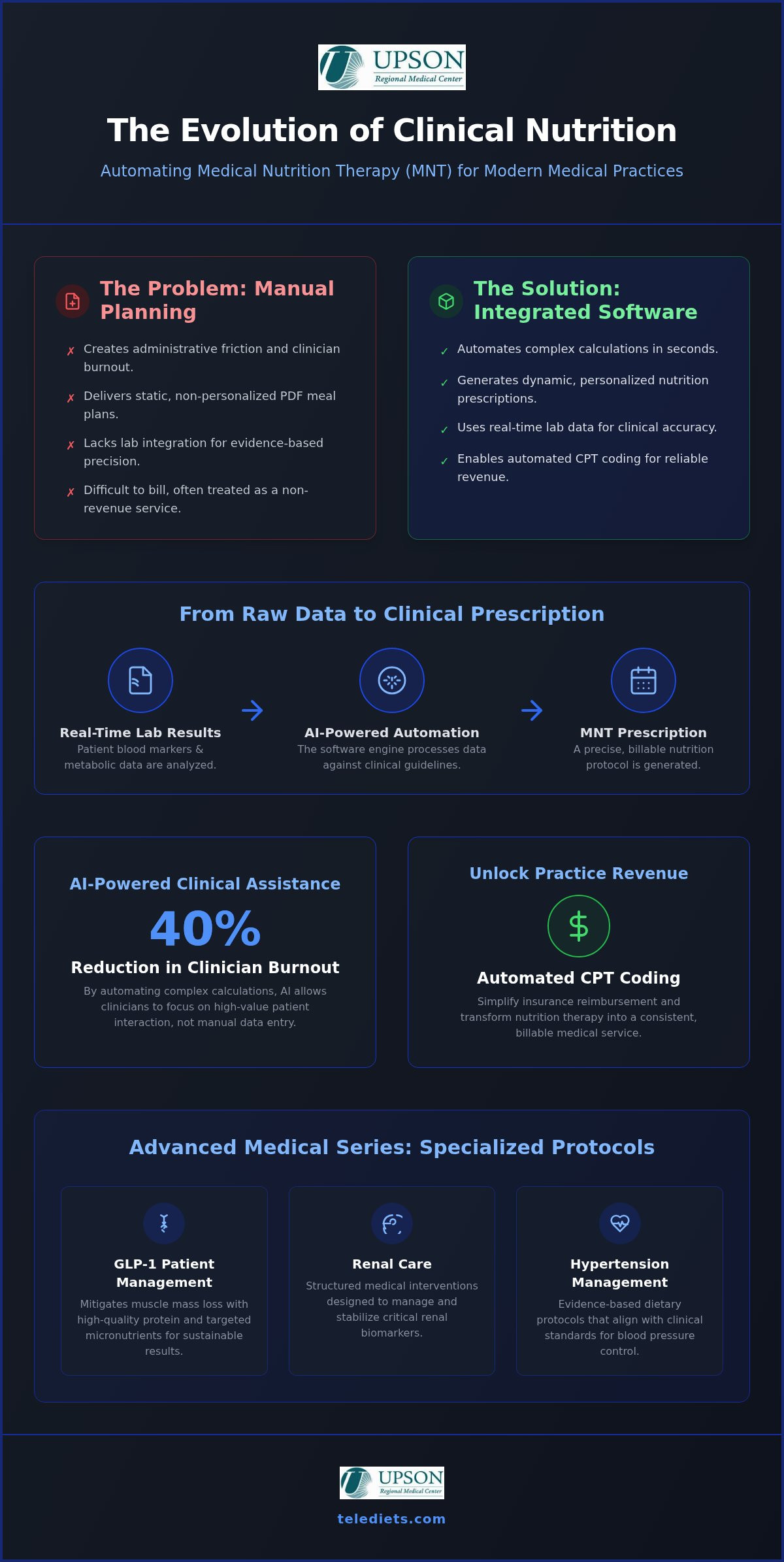
AI engines now serve as sophisticated clinical assistants. They analyze blood markers and metabolic data to generate actionable prescriptions in seconds. By automating these complex calculations, AI-powered MNT software reduces clinician burnout by 40%. Adopting integrated nutrition software for medical practices allows you to focus on patient interaction rather than manual data entry. It bridges the gap between raw lab results and practical, life-saving dietary guidance.
Core Features of Clinical Nutrition Software: Automation and Precision
Modern integrated nutrition software for medical practices goes beyond digital templates. It functions as a clinical engine that converts blood markers and metabolic data into precise dietary prescriptions. By automating this process, you ensure that every intervention is tailored to a patient’s specific diagnosis, whether they’re managing renal care or hypertension. This level of Evidence-Based Nutritional Management reinforces your practice’s authority and improves adherence through data-backed recommendations. It’s about moving from “what to eat” to “how to heal.”
The Advanced Medical Series: Specialized Protocols
The Advanced Medical Series provides evidence-based protocols for complex chronic conditions. These plans aren’t generic suggestions; they’re structured medical interventions designed to stabilize biomarkers. For a physician, this means having a reliable library of protocols that align with current clinical standards. This specialized approach ensures that patients with comorbidities receive guidance that doesn’t conflict with their medical treatments. If you want to see how these integrate into your workflow, you can explore specialized clinical protocols designed for medical environments.
Managing the GLP-1 Patient Journey
Standard diets often fail patients using GLP-1 receptor agonists because they don’t address rapid muscle mass loss or the need for extreme nutrient density. TeleDIETS’ GLP-1 meal plan protocols provide the necessary clinical guardrails to manage these risks. By focusing on high-quality protein and specific micronutrient targets, you help patients achieve sustainable results without compromising metabolic health. Telemedicine plugins further enhance this journey by delivering MNT directly during virtual consultations. This integration ensures that nutrition therapy remains a central, billable part of the medication management process. It allows your clinical team to provide consistent guidance regardless of the patient’s location.
Maximizing Practice Revenue: Insurance Billing and CPT Coding
Integrating Medical Nutrition Therapy (MNT) into your clinical workflow isn’t just about patient care; it’s a strategic revenue driver. Many practices overlook the financial viability of nutrition services because they lack the tools to bill accurately. Using integrated nutrition software for medical practices changes this by automating the coding process and ensuring every encounter meets the documentation standards required for reimbursement. You can learn how to scale your practice with billable nutrition services through our specialized licensing tiers.
Essential CPT Codes for Medical Nutrition
Clinicians must focus on two primary codes to capture revenue effectively. CPT 97802 covers the initial individual medical nutrition therapy assessment, which carries a 2026 national Medicare reimbursement rate of $36.74 per 15-minute unit. Documenting these sessions manually is often where revenue leaks occur. CPT 97803 is used for re-assessment and follow-up, reimbursed at $31.73 per unit. Software that tracks face-to-face time and patient progress automatically reduces the risk of claim denials. It ensures your clinical team is fairly compensated for their expertise while maintaining a clear audit trail.
The Workflow of a Billable Nutrition Visit
A streamlined workflow is essential for making nutrition services scalable and profitable. First, you review lab results and enter the diagnosis into the software to establish medical necessity. Second, the system triggers the automated generation of an evidence-based MNT prescription tailored to those markers. Finally, the encounter is finalized through integrated billing tools that apply the correct CPT codes based on the visit duration. This methodical approach transforms nutrition from an administrative burden into a reliable profit center. To optimize your billing accuracy and see immediate results, explore our integrated CPT coding tools.
Implementing Integrated Nutrition Software: A Success Framework
Successful adoption of integrated nutrition software for medical practices requires a methodical, phased approach rather than an overnight overhaul. Start by deploying the Standard Series Meal Plans for general wellness patients to build team familiarity and confidence. Once the process is seamless, transition to the Advanced Medical Series and specialized GLP-1 protocols for higher-acuity cases. This progression ensures your clinical staff feels supported while maintaining high standards of care and operational efficiency.
Choosing the Right Integration Model
Deciding between a standalone SaaS platform and AI engine licensing depends entirely on your existing tech stack. If you already utilize a robust telemedicine platform, licensing an AI engine adds medical nutrition therapy (MNT) capabilities without disrupting your current interface. Alternatively, a dedicated telemedicine plugin offers a turnkey solution for remote patient monitoring. This flexibility allows you to track clinical outcomes like A1c and BMI alongside financial ROI from automated billing. Measuring these metrics provides a clear picture of how nutrition improves both your patients’ health and your practice’s bottom line.
Future-Proofing Your Practice
Empowering medical assistants (MAs) and nurse practitioners (NPs) to manage the software under physician supervision maximizes your clinical bandwidth. By 2026, integrated nutrition will be essential for thriving under value-based reimbursement models. Patients now expect digital connectivity; using integrated portals and telemedicine tools increases adherence and strengthens the provider-patient bond. It’s time to move beyond fragmented advice and embrace a unified, data-driven strategy. You can Join the clinical nutrition revolution with TeleDIETS to secure your practice’s place in the future of modern medicine.
Advancing Your Practice with Clinical Nutrition
Modern patient care in 2026 requires a shift from generic advice to high-precision medical nutrition therapy. Adopting integrated nutrition software for medical practices transforms your workflow into a data-driven environment where dietary protocols function as clinical prescriptions. Automated CPT coding integration and an AI-driven lab-to-prescription engine eliminate administrative friction while maximizing practice revenue. These tools empower your team to provide specialized GLP-1 clinical protocols with confidence, ensuring superior outcomes in a value-based care model.
It’s time to bridge the gap between lab results and actionable patient health. You have the opportunity to transform nutrition into a reliable profit center that enhances your clinical reputation. Don’t let manual processes limit your practice’s growth or patient success. Scale your practice with TeleDIETS Clinical Nutrition Software today to lead the future of integrated medicine. Your journey toward a more efficient, evidence-based clinical environment starts with the right technology partner.
Frequently Asked Questions
What are the most common CPT codes for medical nutrition therapy?
The primary CPT codes include 97802 for initial assessments and 97803 for follow-up sessions. For group therapy involving two or more patients, clinicians utilize code 97804. Using integrated nutrition software for medical practices ensures these time-based codes are documented with clinical precision. This automation simplifies the billing process and helps your practice maintain compliance with 2026 Medicare standards while capturing all billable minutes during patient encounters.
Can integrated nutrition software connect with my current EHR system?
Most professional platforms integrate with your current EHR through secure API connections or HL7 standards. This connectivity ensures that nutrition prescriptions and lab data flow bi-directionally between systems. By syncing these records, your team avoids the risks associated with manual data entry and fragmented patient charts. It creates a unified clinical environment where dietary interventions are visible to every member of the care team, from medical assistants to specialist physicians.
How does lab-based nutrition automation work in a clinical setting?
Lab-based automation functions by analyzing specific blood markers, such as glucose levels or renal panels, to trigger tailored dietary prescriptions. The software’s AI engine compares these values against established clinical protocols to generate a plan in seconds. This allows you to deliver a precise medical nutrition therapy prescription during the actual consultation. It bridges the gap between diagnostic results and actionable patient guidance without requiring hours of manual calculation by your staff.
Is nutrition software for medical practices HIPAA compliant?
Yes, any software designed for clinical use must adhere to strict HIPAA compliance standards to protect patient data. This includes end-to-end encryption, secure access controls, and the provision of a Business Associate Agreement (BAA). Choosing integrated nutrition software for medical practices that prioritizes these safeguards is essential for maintaining patient trust. These protocols ensure that protected health information remains secure whether you’re using the platform in-office or through a telemedicine plugin.
Do GLP-1 patients require specialized nutritional protocols?
Patients using GLP-1 receptor agonists definitely require specialized protocols to address risks like sarcopenia and nutrient deficiencies. These clinical frameworks prioritize high protein intake and micronutrient density to preserve muscle mass during rapid weight loss. Standard diets often fail this population because they don’t account for the unique metabolic changes induced by the medication. Specialized software provides the necessary guardrails to manage these complex cases safely and effectively within your practice.
Leave a Reply