
A nutrition screening is only as reliable as the follow-up it sets in motion. If staff ask different questions, use different tools, or document results inconsistently, a potential concern can be difficult for the care team to act on. That’s why training medical assistants on nutrition screening should cover more than how to administer a questionnaire.
Consistent screening matters in busy clinics, where each step needs to fit the workflow. Medical assistants also need clear role boundaries: screening identifies possible nutrition risk, while clinical assessment and care planning belong to qualified professionals. Training should make that distinction, along with the steps for escalating concerns, clear from the start.
This guide outlines a practical, role-appropriate process for selecting and using a clinic-approved screening tool, documenting results, and routing concerns according to clinic policy. It also explains how to reinforce the process over time so screening stays consistent and supports appropriate clinical follow-up.
Key Takeaways
- Set clear role boundaries so screening identifies possible risk without turning into diagnosis or clinical assessment.
- Make training medical assistants on nutrition screening consistent by teaching the clinic-approved tool, then demonstrating and observing its use.
- Use clinic protocols to document responses and route concerns for appropriate clinical review.
- Keep procedures and escalation contacts current, and review clinic-defined measures to identify workflow gaps.
Why Nutrition Screening Training Belongs in the Medical Assistant Workflow
Nutrition screening works best as a consistent part of an established clinic workflow. It is a brief, structured process for identifying possible nutrition risk, not a diagnosis or a plan of care. A useful distinction for staff is: A screening result signals that further review may be appropriate; a clinical nutrition assessment evaluates the patient’s needs and informs care planning.
That distinction matters to clinic leaders and educators setting procedures, as well as medical assistants handling intake or follow-up tasks. Consistent prompts and documentation give the care team comparable information across visits and make it easier to identify when a clinician should review a concern. Screening supports clinical judgment; it doesn’t replace it.
Where screening fits in a patient visit
Choose a specific point in intake or follow-up that suits the clinic’s workflow, and teach staff when to complete the approved screening. The sequence may vary by setting, but the timing, prompt, documentation location, and handoff should be explicit. For example, define whether screening takes place during rooming or a scheduled follow-up, where the result is entered, and which team member receives it. This makes routine information gathering more consistent without asking medical assistants to interpret results. Nutrition analysis describes a separate area of nutrition work; collecting screening responses does not require staff to conduct that analysis.
Set role boundaries before training begins
Before training medical assistants on nutrition screening, leaders should align the workflow with employer policy, applicable scope-of-practice rules, and supervisor guidance. Teach staff to ask the approved questions neutrally, record the patient’s responses accurately, and route concerns rather than diagnose or make care decisions. Specify who receives routine escalations, how results are handed off, and how urgent concerns follow existing clinic procedures. Clear boundaries help staff act confidently while leaving interpretation and clinical decisions to appropriately qualified professionals.
Teach Medical Assistants the Difference Between Screening and Assessment
Training medical assistants on nutrition screening starts with a firm boundary: staff administer the clinic-approved instrument and capture responses, while qualified clinicians interpret concerns and decide what review or care is appropriate. A screening result signals that further review may be needed; it is not a diagnosis or a clinical nutrition assessment. Reinforce that a score is a prompt for the next step, not a conclusion.
Teach tool use without adding unsupported questions
Show staff where to find the current form and its instructions. Teach the exact wording, response options, scoring steps, intended population, and stated limitations. Tools such as the Malnutrition Screening Tool (MST), Malnutrition Universal Screening Tool (MUST), and Mini Nutritional Assessment (MNA) are not interchangeable by default. The clinic should select and approve a tool suited to its setting and patient population.
Have staff practice completing every required field. If a patient can’t or doesn’t provide an answer, follow the tool and clinic instructions for recording unavailable information. Don’t guess, rephrase in a way that changes meaning, add questions, or independently interpret a score. Make sure trainees know where to find the current version so they don’t rely on an outdated copy.
Practice communication and escalation language
Use fictional, non-identifiable scenarios to rehearse documentation and handoff. For example, a practice case can include an unanswered item or a result that clinic policy says to route for review. Ask the trainee to record only what was reported, then identify the designated recipient and approved communication channel. This tests the workflow without turning practice into diagnosis.
Model neutral language, such as, “I’m going to record your response and share it with the clinician for review.” Avoid assumptions or comments about a patient’s choices. A concise handoff can state that screening was completed, summarize the recorded result or missing response, and indicate when and how it was routed. Medical assistants shouldn’t recommend diets or interpret clinical findings; their role is to follow the approved process and pass information to the care team.
How to Train Medical Assistants on Nutrition Screening Step by Step
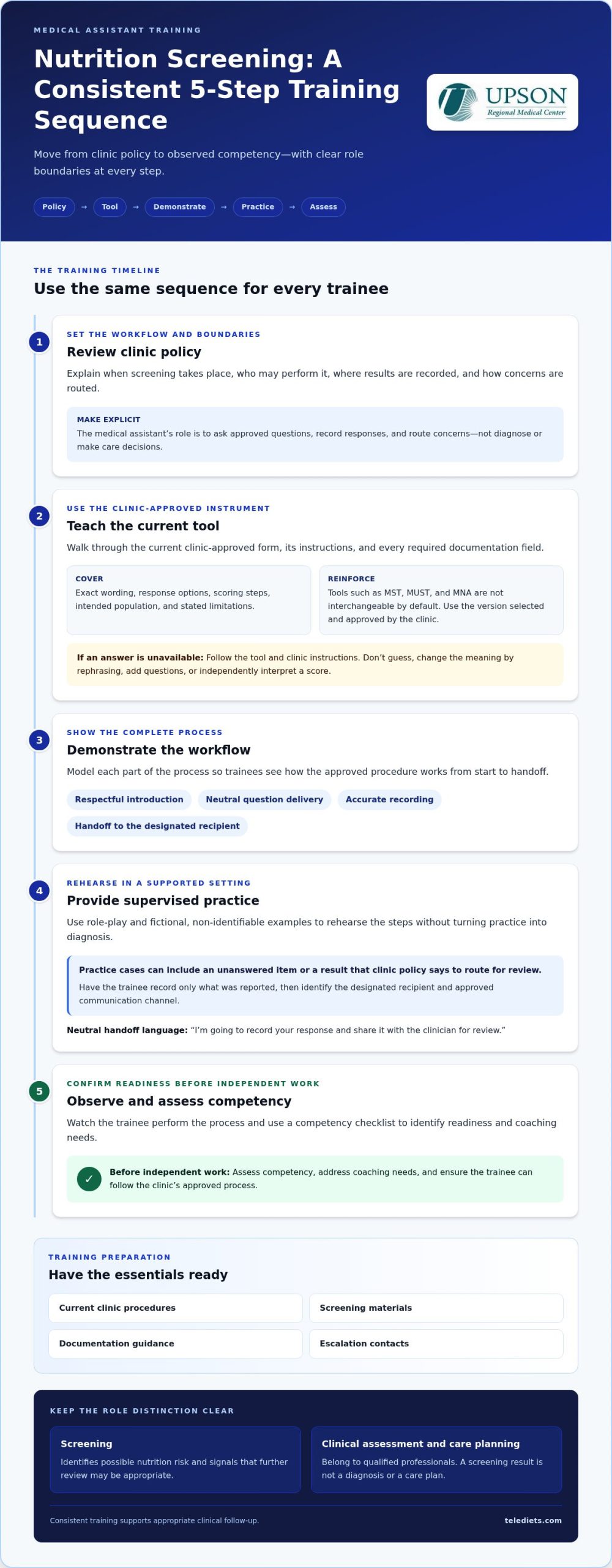
A reliable training process moves from policy review to observed competence, with a supervisor or qualified educator available to guide practice and answer questions. Use the same sequence for each trainee so expectations don’t depend on who delivers the instruction.
Review policy, teach the approved instrument, demonstrate the workflow, provide supervised practice, observe performance, and assess competency before independent work.
- Review policy: Explain when screening takes place, who may perform it, where results are recorded, and how concerns are routed.
- Teach the instrument: Walk through the current clinic-approved form, instructions, and documentation fields.
- Demonstrate: Model the full workflow, including a respectful introduction, question delivery, recording, and handoff.
- Practice: Use role-play and fictional examples so the trainee can rehearse each step.
- Observe and assess: Watch the trainee perform the process and use a competency checklist to identify readiness and coaching needs.
Prepare materials and demonstrate the workflow
Gather current procedures, screening materials, documentation guidance, and escalation contacts before training begins. Demonstrate a complete encounter with a fictional example, from locating the form to routing the completed record. If screening also occurs during telehealth visits, teach the approved remote workflow separately, including how staff access the instrument and document the interaction. Don’t assume an in-person demonstration covers every setting.
Observe practice and document competency
During supervised practice, assess whether the trainee follows the approved wording, completes required fields, and uses the designated escalation pathway. Record training completion, observed skills, coaching provided, and a next review date. Reassess after a workflow change or when quality reviews identify a training need. A brief checklist makes expectations visible and gives supervisors a practical basis for targeted coaching.
Once clinical review identifies an appropriate next step, structured nutrition protocols can support downstream care workflows. Clinical nutrition workflow tools can help providers organize nutrition care around clinician-entered lab results and diagnoses.
Maintain Consistent Screening and Connect Results to Appropriate Nutrition Care
Initial training sets expectations; ongoing ownership keeps them usable. Assign a clinic lead to maintain the current procedure, screening form, training materials, and escalation contacts. When any of these change, update the materials and tell affected staff what’s different. This prevents outdated instructions from becoming part of the routine.
Use refreshers and quality review to sustain skills
Schedule refreshers according to clinic policy, staff needs, and observed workflow changes. Review clinic-defined measures such as whether screenings are completed when indicated, required fields are documented, and concerns reach the intended recipient. Look at aggregate patterns to identify process gaps without exposing identifiable patient details. Route questions about clinical policy or compliance to the appropriate leader rather than relying on informal interpretations.
Use findings to guide practical adjustments. Repeated missing fields may point to a need to clarify documentation instructions, while inconsistent handoffs may signal that escalation contacts or channels need updating. Quality review should support learning and workflow improvement, not encourage medical assistants to interpret results or make care decisions.
Support clinician-led nutrition follow-up
Keep medical assistants focused on accurate screening, documentation, and handoff. A clinician or other qualified professional determines whether further assessment is appropriate and directs any nutrition care. After that review, structured protocols can support follow-up workflows. TeleDIETS provides medical nutrition therapy software with protocols tailored to clinician-entered lab results and diagnoses. Its provider-focused tools support clinical workflows but don’t replace staff training or clinical judgment.
A sustainable process connects current procedures, capable staff, reliable handoffs, and clinician-led next steps. For practices organizing nutrition-care workflows after clinical review, clinical nutrition workflow support brings structured protocols into provider-led care.
To see how structured protocols can support provider-led follow-up, explore the TeleDIETS platform.
Turn Screening Readiness Into Better-Connected Care
Use your next team review to identify one practical improvement: a clearer escalation contact, a more accessible current form, or a focused refresher based on workflow findings. That deliberate step can help keep training medical assistants on nutrition screening connected to the way your clinic works.
After appropriate clinical review, nutrition protocols tailored to clinician-entered lab results and diagnoses can support downstream care. TeleDIETS also includes insurance billing and CPT coding tools for nutrition services. These resources complement trained staff and clinician judgment; they don’t replace either.
Explore TeleDIETS clinical nutrition workflow tools to see how structured protocols and provider workflow features can support clinician-led nutrition care.
Frequently Asked Questions
Is nutrition screening the same as a nutrition assessment?
No. Screening is a brief way to flag possible nutrition risk, while assessment is a more detailed clinical evaluation by a qualified professional. A screening form may capture a response that needs follow-up, but it doesn’t establish why the concern exists or what care is appropriate. Staff training should help assistants recognize that difference and record information without drawing clinical conclusions.
Can medical assistants diagnose malnutrition from a screening score?
No. A screening score isn’t a diagnosis, and medical assistants shouldn’t use it to label a patient or determine treatment. If a result meets the clinic’s escalation criteria, the assistant should document it as directed and send it to the designated clinician. Training scenarios can help staff distinguish reporting the recorded result from explaining its clinical meaning.
How often should medical assistants receive nutrition-screening training?
There isn’t one schedule that fits every clinic. Set training and refresher timing through facility policy, then revisit it when the approved form or instructions change, responsibilities shift, or quality reviews point to a skills gap. For training medical assistants on nutrition screening, keep a record of instruction and competency review so leaders can identify who needs an update and why.
What should a medical assistant do if a patient declines nutrition screening?
Follow clinic procedures for recording the declined screening and notifying the appropriate team member. A neutral response might be, “That’s okay; I’ll document your choice and let the care team know.” Don’t pressure the patient, replace the approved questions with an informal interview, or guess at the reason for declining. The clinician or supervisor can determine any follow-up under clinic policy.
Can one nutrition-screening tool be used for every patient population?
Not necessarily. A tool’s intended population and setting matter, so clinic leaders should select the instrument that fits their practice and define where it applies. A tool approved for one patient group shouldn’t automatically be assumed suitable for another. Medical assistants should use the clinic’s designated form and raise questions about its use with the responsible clinical leader, rather than adapting it themselves.
Leave a Reply