
Choosing white-label nutrition planning software involves more than putting your organization’s logo on a platform. For clinical teams, the key questions are whether the software supports provider-led nutrition care, how plans are personalized, and how the tools fit into existing workflows. A polished patient experience is useful, but it does not by itself show whether a platform can support medical nutrition therapy.
This guide offers a practical framework for evaluating clinical fit, workflow integration, and branded delivery. You’ll learn what to assess in personalization, patient-facing features, billing workflows, and telemedicine support. TeleDIETS provides medical nutrition therapy software as a SaaS application or AI engine for healthcare professionals, with plans tailored to lab data and diagnoses, specialized protocols, insurance billing and CPT coding tools, and a telemedicine plugin. Use the criteria below to compare these needs and identify the capabilities that matter to your organization.
Key Takeaways
- Assess white-label nutrition planning software by clinical capability, not branding alone. A polished presentation doesn’t establish whether a platform supports provider-led care.
- Compare how plans use clinical inputs and protocols, and consider whether clinician oversight fits your care model.
- Map your existing workflows before evaluating billing and telemedicine features so you can identify the integrations your organization actually needs.
- Use a clear selection sequence: define users, map workflows, assess clinical needs, then evaluate platform fit.
What White-Label Nutrition Planning Software Means for Clinical Care
White-label nutrition software is a platform an organization can present under its own branding. The term describes how a service is presented, not the clinical depth behind it. For a foundational overview, see What is a White-Label Product? In healthcare, a branded portal or app can create a consistent patient experience, but a familiar logo alone doesn’t show whether the software supports medical nutrition therapy (MNT).
That distinction matters because tools built for content memberships or general coaching may focus on distributing meal plans and educational materials. Clinical care has different demands. Providers need to select and review plans in the context of their care model, and software should support that provider-led process rather than replace it.
How clinical nutrition software differs from consumer meal planners
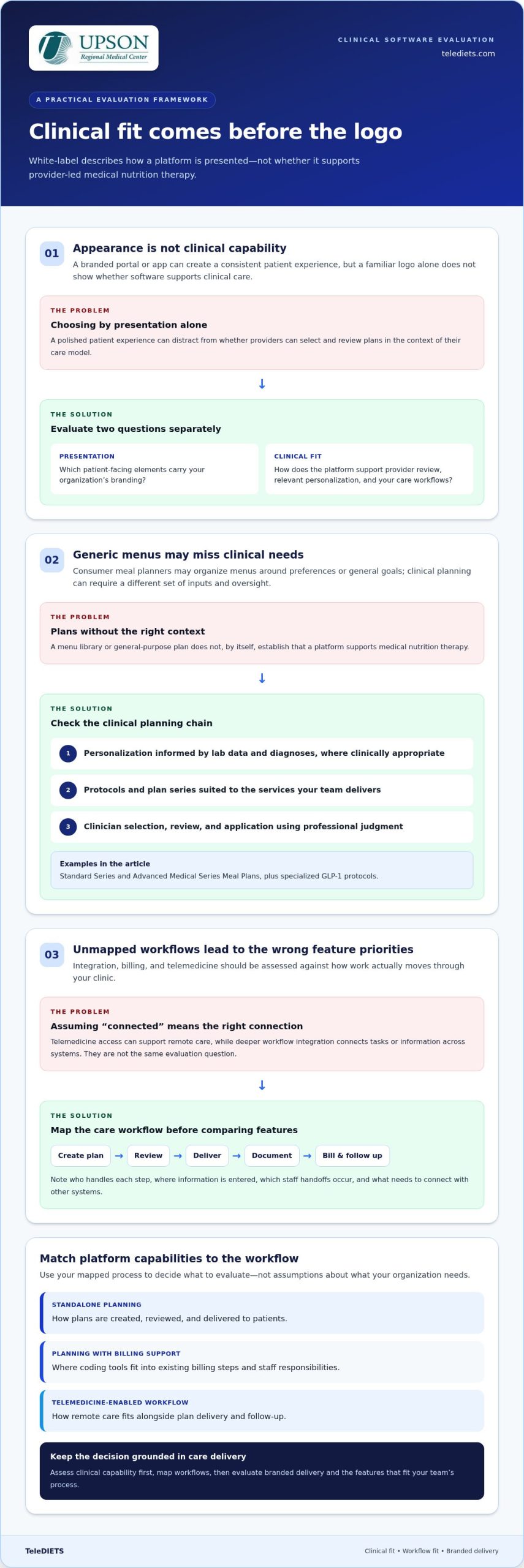
A consumer meal planner may organize menus around preferences or general goals. A clinical workflow may require personalization informed by patient lab data and diagnoses, with a qualified provider determining how a plan fits the care being delivered. Software can support plan generation, but the clinician reviews and applies the plan using professional judgment.
For example, TeleDIETS can generate personalized nutritional plans from lab data and clinical diagnoses. It also offers Standard Series and Advanced Medical Series Meal Plans, along with specialized GLP-1 protocols. These capabilities show how clinical planning inputs and protocols differ from a generic menu library. Branding alone does not establish clinical suitability.
As you assess white-label nutrition planning software, separate two questions:
- Presentation: Which patient-facing elements carry your organization’s branding?
- Clinical fit: How does the platform support provider selection and review, relevant personalization inputs, and the care workflows your organization uses?
Keeping these questions distinct helps you evaluate a branded experience without confusing appearance with clinical capability.
How to Evaluate White-Label Nutrition Planning Software
Use a clinical checklist before comparing visual customization. First determine whether the platform supports your care model from plan creation through follow-up. Then assess whether its branded presentation suits how your organization communicates with patients. Separating these steps helps prevent attractive design features from overshadowing essential clinical functions.
Which clinical capabilities should buyers assess?
Start with personalization and oversight. Determine whether plans can reflect diagnoses and lab data where clinically appropriate, which protocols the platform supports, and how clinicians select, review, and assign plans. Consider whether standard, advanced, and specialized clinical series align with the services your team delivers. The software should support provider judgment and keep responsibility for care decisions clear.
- Essential clinical functions: Relevant personalization inputs, suitable care protocols, clinician review, and a clear workflow for creating, delivering, documenting, and following up on plans.
- Optional branded features: Organization identity across patient-facing screens and plan materials, plus customization that fits your communication model.
What does white-label delivery need to cover?
Map each patient touchpoint. Does branding appear in the portal, the nutrition plans patients receive, or both? Consider whether patients primarily access materials digitally or receive plans through another communication process. Document how organizational content and branded assets are used and updated, and what happens to them if your platform arrangements change.
Next, walk through a representative workflow: a clinician creates or selects a plan, reviews it, delivers it, records relevant details, and follows up. Note staff handoffs and identify which steps need to connect with other systems. This exercise helps distinguish essential functions from appealing extras.
TeleDIETS provides medical nutrition therapy software for healthcare professionals, with plans generated from lab data and diagnoses, Standard Series and Advanced Medical Series Meal Plans, and specialized GLP-1 protocols. Its insurance billing and CPT coding tools and telemedicine plugin support connected provider workflows. Explore TeleDIETS’ clinical nutrition technology as you compare your requirements.
How Integration, Billing, and Telemedicine Affect the Buying Decision
Before comparing integrations, map how work moves through your clinic. Trace plan creation, review, delivery, documentation, billing, and follow-up. Note who handles each step and where information is entered. This baseline helps you identify actual workflow needs instead of assuming a connected platform will automatically save time.
Integration can mean different things. Telemedicine access may support remote care, while deeper workflow integration connects tasks or information across systems. Define which capabilities your team needs, and distinguish telemedicine access from a connection to an electronic health record.
| Workflow type | What to evaluate |
|---|---|
| Standalone planning | How plans are created, reviewed, and delivered to patients. |
| Planning with billing support | Where coding tools fit into existing billing steps and staff responsibilities. |
| Telemedicine-enabled workflow | How remote care fits alongside plan delivery and follow-up. |
How should buyers assess billing and CPT coding tools?
Identify where coding support belongs in your current billing process: who uses it, when, and what work remains outside the software. Treat these features as operational tools, not a promise of coverage, payment, or payer acceptance. As you assess clinical workflow requirements, consider how billing tasks relate to plan review and documentation rather than assuming they are automatically connected.
What should a telemedicine workflow review include?
Follow the provider journey from creating a plan to delivering it remotely and arranging follow-up. Assess whether a telemedicine plugin fits the clinic’s actual process, including handoffs between care delivery and nutrition planning. Define which steps need to happen in one platform and which can remain separate.
TeleDIETS combines medical nutrition therapy software with insurance billing and CPT coding tools and a telemedicine plugin. Explore TeleDIETS’ billing and telemedicine capabilities as you assess your clinic’s workflow needs.
Choosing a Clinical Platform That Fits Your Organization
A strong shortlist begins with your care model, not a feature count. Define who will use the system, how patients receive nutrition plans, and which clinical and operational tasks the platform needs to support. Then compare each option against the same requirements. This keeps branding in perspective and focuses the decision on practical fit for your team.
A practical shortlist process for clinics and platforms
Work through the decision in sequence:
- Define users. Document clinician roles, staff responsibilities, and patient access needs.
- Map workflows. Trace plan creation, review, delivery, documentation, billing, and follow-up to identify essential handoffs.
- Assess clinical needs. Specify relevant personalization inputs, protocols, and how clinicians retain oversight.
- Evaluate fit. Compare shortlisted platforms against the same clinical and operational criteria, then consider branding features.
Before implementation, identify questions about training, data handling, and ownership of each workflow step. Clear ownership helps your team understand how the platform will be used in practice and where responsibilities remain with clinicians or staff.
Where TeleDIETS fits in a clinical nutrition workflow
TeleDIETS provides medical nutrition therapy software for healthcare professionals as a SaaS application or AI engine. The platform generates plans from patient lab data and clinical diagnoses. It also offers Standard Series and Advanced Medical Series Meal Plans, specialized GLP-1 protocols, insurance billing and CPT coding tools, and a telemedicine plugin to support provider workflows.
These capabilities give clinics concrete clinical and operational functions to assess against their care protocols and workflow requirements. Consider clinical tools and branding as separate parts of the evaluation.
If you’re evaluating clinical nutrition tools, explore TeleDIETS clinical nutrition software and consider how its capabilities align with your provider workflows.
Turn Your Evaluation Into a Confident Next Step
Before selecting white-label nutrition planning software, turn your priorities into a short decision brief. Identify which needs are essential for clinical care, which workflow gaps matter most, and which branding elements would improve patient communication. This gives your team a shared basis for discussion and keeps attractive extras from outweighing practical fit.
Involve the people who will use the platform. Clinicians, operations staff, and decision-makers may have different requirements, from plan review to administrative handoffs. Agreeing on priorities before implementation can make the transition more deliberate and clarify ownership across the workflow.
Use your brief to assess how TeleDIETS’ medical nutrition therapy software, specialized protocols, billing tools, and telemedicine plugin align with your provider-led care model. Explore TeleDIETS clinical nutrition software as the next step in your evaluation.
Frequently Asked Questions
What is white-label nutrition planning software?
White-label nutrition planning software lets an organization deliver a software experience under its own brand. Branding may apply to selected patient-facing elements, depending on the platform. For clinic buyers, distinguish the branded interface from the underlying clinical functions, and assess each separately to determine whether the solution fits your service model.
Does white-label nutrition software replace an EHR?
Not necessarily. A nutrition platform may focus on nutrition planning or related care workflows, while an EHR serves broader clinical record needs. Before adopting one, identify which system remains the source of clinical documentation and how staff will handle information that needs to appear in both places. Branding or a telemedicine feature does not mean the software replaces an EHR.
Can clinical nutrition software support GLP-1 care?
Yes, it can support the nutrition-planning component of clinician-led care. For example, a platform may provide GLP-1-related meal plan protocols for provider use. That role is distinct from medication management: nutrition software should not be treated as a source of dosing or prescribing instructions. Clinicians determine how any protocol fits their professional judgment and the organization’s care processes.
Does CPT coding software guarantee insurance reimbursement for nutrition therapy?
No. CPT coding tools can support coding tasks, but they don’t guarantee that a service is covered, a claim is accepted, or payment is made. Reimbursement depends on applicable payer requirements and the circumstances of the service. Clinics should use their established billing review process and confirm relevant coverage and documentation requirements through appropriate payer channels.
Leave a Reply