
Clear nutrition advice alone does not ensure a therapeutic diet fits a person’s life. Improving patient adherence to therapeutic diets means considering how people process information and make decisions, alongside cultural and social contexts, personal perceptions, and practical barriers. In chronic kidney disease (CKD), education is more useful when it is understandable and tailored to the individual.
Clinicians know dietary changes can be difficult to sustain. The challenge is to make guidance clear, relevant, and workable while keeping clinical needs in view. Readable education helps patients understand how recommendations apply to everyday choices, while culturally responsive support can make those choices more compatible with their routines and preferences.
This article explores factors that shape dietary adherence in CKD, why health literacy and nutrition education matter, and how clinicians can adapt their approach over time. It also offers practical strategies for supporting long-term engagement and explains how structured medical nutrition therapy tools can fit into clinical workflows.
Key Takeaways
- Identify the practical, social, and personal factors that can make CKD dietary changes harder to follow.
- Make nutrition education easier to understand by using clear language and connecting guidance to everyday decisions.
- Adapt ongoing support to each person’s culture, preferences, and routines to make recommendations more relevant.
- Build adherence strategies around patients’ real eating patterns and the technology they already use.
1. Factors influencing dietary adherence in chronic kidney disease
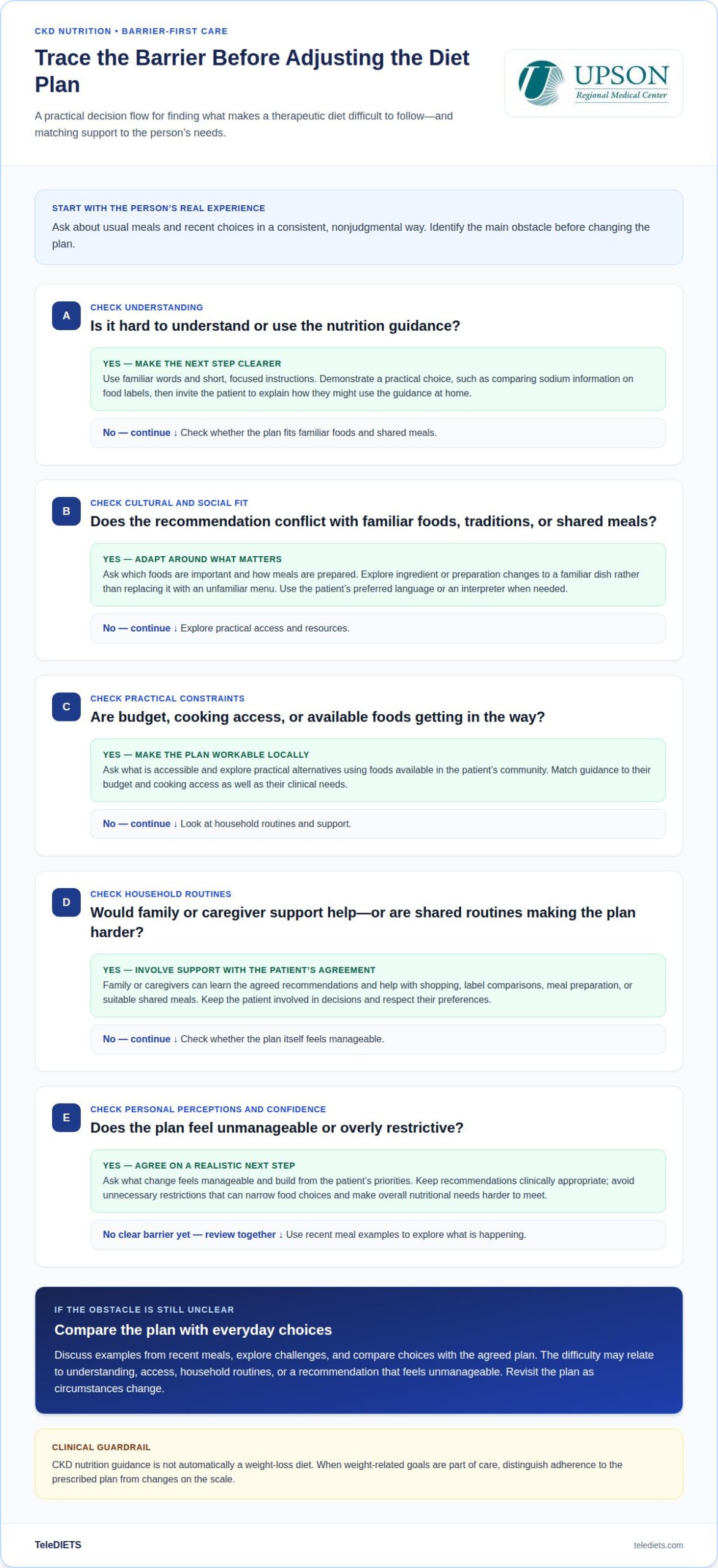
Dietary adherence in chronic kidney disease (CKD) involves more than knowing which foods to choose. Barriers can include difficulty processing information or making decisions, cultural and social contexts, personal perceptions, and external obstacles. For example, a patient may understand sodium guidance but struggle to compare labels or find familiar lower-sodium foods. Assessing these factors helps clinicians identify what makes a recommendation hard to follow.
Ask about the person’s usual meals, food traditions, budget, cooking access, and confidence with nutrition information. Then tailor guidance to their preferences and clinical needs. A familiar dish might be adapted through ingredient choices or preparation methods rather than replaced with an unfamiliar menu. Structured assessments can help clinicians match adherence strategies to individual needs.
Family and caregivers can support adherence by learning the agreed recommendations and helping include suitable foods in shared meals. They can also assist with shopping, label comparisons, or meal preparation while keeping the patient involved in decisions. Practical support works best when it respects the person’s preferences and routines.
Discuss what the patient actually eats in a consistent, nonjudgmental way. Ask for examples from recent meals, explore challenges, and compare reported choices with the agreed plan. This can show whether the main obstacle is understanding, access, household routines, or a recommendation that feels unmanageable. Revisit the plan as circumstances change.
Adherence can affect weight-related goals, but CKD nutrition guidance is not automatically a weight-loss diet. When a patient is pursuing weight-related goals, distinguish adherence to the prescribed plan from changes on the scale. Overly restrictive diets can narrow food choices and make it harder to meet overall nutritional needs. Focus on clinically appropriate recommendations rather than adding unnecessary restrictions.
Improving patient adherence to therapeutic diets starts by identifying the specific barrier and choosing a practical response. Clear explanations, preferred foods, and caregiver involvement can make a plan easier to use in daily life.
2. Health literacy and readability of nutrition education
Nutrition education helps only when patients can understand and use it. In chronic kidney disease (CKD), unfamiliar terms can make food guidance difficult to apply while shopping or preparing meals. Replace technical language with direct explanations. For example, explain how a recommendation can guide a choice between two packaged foods instead of relying on clinical terminology alone.
Readable materials use short sentences, familiar words, and clear organization. Keep each instruction focused on a practical decision, such as comparing sodium information on food labels. Define necessary terms when they first appear, then use them consistently. Avoid crowding several dietary changes into one dense paragraph. Patients should be able to find the relevant action without decoding complex wording.
Examples make abstract guidance easier to discuss. Instead of saying “modify your usual meals,” ask the patient to consider a familiar breakfast or dinner and identify an appropriate adjustment together. Use culturally relevant foods and the patient’s preferred language where possible. A handout with recognizable meal examples may feel more applicable than generic advice that overlooks household food traditions.
Check understanding through conversation rather than assumption. After explaining a recommendation, invite the patient to describe how they might use it at home. If they struggle to explain the next step, clarify the wording or offer a more concrete example. This can reveal confusion about written instructions before the patient has to act on them independently.
Review educational materials for readability before sharing them. Ask a colleague to flag jargon, lengthy instructions, and unclear actions. Revise the content, then test it with patients using questions about real situations, such as choosing a familiar snack or preparing a usual meal. For improving patient adherence to therapeutic diets, clear education connects clinical guidance with everyday decisions.
3. Longitudinal, culturally sensitive interventions
Dietary routines change with health, household needs, and access to familiar foods. Treat support as an ongoing process: revisit the plan, ask what has changed, and agree on a manageable next step. For example, a patient whose work schedule changes may need guidance that fits new break times.
Culturally responsive care starts with curiosity, not assumptions. Ask which foods matter to the patient, how meals are prepared, and who shares them. If a staple dish is important, discuss ways to adapt ingredients or preparation while preserving its place in family meals. Use interpreters or translated materials when language affects understanding.
Follow-up should build on the patient’s experience with the previous recommendation. Ask what worked, what felt difficult, and what they would change. If access to groceries is a barrier, explore practical alternatives using foods available in the patient’s community. If family meals create pressure, include household members in a discussion with the patient’s agreement.
Motivational interviewing can support adherence to therapeutic diets by helping patients express their own reasons for change. Use open questions, reflective listening, and affirmations instead of lectures. For example, ask, “What food change feels most manageable this week?” Then help the patient choose a specific action that fits their priorities.
Keep each follow-up focused. Review the agreed action, recognize the patient’s effort, and ask what they want to address next. Someone who tried a lower-sodium version of a familiar dish can describe its taste, preparation, and family response. Use that feedback to refine the next recommendation rather than treating difficulty as a lack of commitment.
Consistency across the care team matters. Document the patient’s chosen goal and the support that helped, so future conversations can build on the same plan. This makes culturally responsive care practical: clinicians can adapt recommendations as preferences, routines, and challenges evolve.
4. What strategies improve adherence to therapeutic diets?
Start with a plan patients can apply to their actual schedules. Some people do not eat three traditional meals each day, so ask when and where they usually eat. Align nutrition guidance with those patterns instead of assuming breakfast, lunch, and dinner are fixed. For example, discuss applying a recommendation to a workday snack or a meal eaten away from home.
Make the next action specific and easy to review. A patient might choose one grocery item to compare or identify a suitable option at a familiar restaurant. At follow-up, ask what happened and what made the action easier or harder. Use the answer to refine the plan rather than adding several new tasks at once.
Self-monitoring can help patients notice patterns and discuss them with clinicians. A 2011 systematic review on self-monitoring in weight loss appeared in the Journal of the American Dietetic Association, volume 111, pages 92-102. Its weight-loss focus does not establish a CKD-specific effect, but tracking food choices can provide concrete examples for a care conversation.
Choose a tracking method that suits the patient. A simple written note, food log, or phone reminder can help capture choices without requiring a complicated system. CKD nutrition guidance can also fit into technology patients already use, including smartphones and tablets. For instance, a patient might save a clear instruction on a device they regularly consult.
Improving patient adherence to therapeutic diets also means checking whether the plan remains practical. Review the patient’s chosen actions, eating schedule, and obstacles together. Keep the guidance focused on clinically appropriate priorities, and adjust the approach when daily routines or food access change. Explore structured nutrition planning tools as one way to support consistent delivery of therapeutic diet guidance.
TeleDIETS: Standard Series Meal Plans
TeleDIETS gives healthcare professionals medical nutrition therapy tools to integrate dietary planning into clinical workflows. Its Standard Series Meal Plans provide a structured option, while Advanced Medical Series Meal Plans support chronic disease management. Physicians and clinics can use the platform to prescribe evidence-based nutrition plans tailored to lab results and clinical diagnoses.
For practices addressing complex nutrition needs, these offerings can help connect clinical information with a defined plan. TeleDIETS also offers GLP-1 Meal Plan Protocols and Insurance Billing & CPT Coding Tools. These tools complement, rather than replace, clear education and ongoing conversations that help patients understand and follow recommendations.
If structured nutrition planning fits your practice’s workflow, contact TeleDIETS to learn more.
Make the Next Step Practical
Choose one improvement your care team can put into practice now. Review a patient handout for unclear instructions, build a follow-up prompt into your workflow, or discuss how nutrition guidance fits a patient’s everyday choices. A focused change gives the team something specific to observe and refine.
Over time, improving patient adherence to therapeutic diets depends on making recommendations useful beyond the clinical conversation. Invite patients to share what works in their routines, then use that feedback to guide future discussions. For practices seeking structured nutrition planning resources, TeleDIETS offers meal plan options designed for healthcare professionals.
Contact TeleDIETS for nutrition support and explore whether its tools fit your practice. A thoughtful next step can help your team make nutrition education more actionable and keep patient priorities at the center of care.
Frequently Asked Questions
What are common barriers to following a therapeutic diet?
Common barriers include difficulty understanding instructions, limited access to suitable foods, competing household preferences, and routines that make meal changes inconvenient. A recommendation may also feel too restrictive if its purpose is unclear. For example, someone relying on prepared foods may need help identifying practical options that fit their nutrition plan, rather than broad instructions to cook differently.
How can clinicians assess patient adherence to dietary recommendations?
Ask patients to describe specific recent choices, such as what they ate during a busy workday or how they handled a restaurant meal. Compare those examples with the agreed recommendations and invite them to explain any differences. A neutral tone helps uncover barriers without blame. Record the patient’s observations and revisit them in later care discussions.
How can dietitians tailor therapeutic diets to patient preferences and culture?
Start by asking which foods, cooking methods, and shared meals matter to the patient. Then explore adjustments that preserve familiar flavors and meal traditions while aligning with clinical goals. For example, discuss adapting a family’s usual preparation method rather than replacing a valued dish entirely. Confirm that the patient finds the proposed change acceptable.
Do meal planning, food delivery, or grocery assistance improve diet adherence?
Meal planning or grocery assistance may help patients follow a therapeutic diet when time, transportation, or food access creates obstacles. Its usefulness depends on whether available foods match the patient’s nutrition recommendations, budget, preferences, and cooking capacity. Food delivery does not replace clinical guidance. Review ingredient information and practical fit before incorporating prepared meals into a patient’s plan.
What digital tools or reminders help patients follow therapeutic diets?
Simple tools can support recall and organization. Patients might use a smartphone calendar for appointment reminders, save written recommendations in a notes app, or set a prompt to review a shopping list. A food log can also help them prepare for a clinical discussion. Choose tools the patient already understands and keep reminders specific, such as prompting them to bring questions to their next visit.
How should clinicians monitor progress and adjust a therapeutic diet?
Review the patient’s experience alongside relevant clinical information and care goals. Ask which recommendations fit daily life, where difficulties arose, and what has changed since the last discussion. If a plan feels impractical, identify the obstacle before revising it. Adjustments should preserve clinical priorities while making the next steps clear, manageable, and appropriate to the patient’s circumstances.
Leave a Reply