
Nutrition services make their strongest case when they connect patient needs with the priorities stakeholders already measure. Presenting the value of nutrition services to stakeholders means showing how nutrition care can support diabetes management, help address health risks, and make healthy eating relevant to chronic conditions. The case is clearer when it explains what the service does, who it supports, and how its role fits into care delivery.
It’s reasonable to expect evidence and practical detail before investing in a service or expanding its role. This article explains how to present the value of nutrition services to stakeholders: show their clinical relevance, describe outcomes without overstating them, and clarify their contribution to care and resource decisions. It also outlines how evidence-based nutrition plans and provider workflows can address the needs of people with diabetes and other chronic conditions.
Key Takeaways
- Frame nutrition services around diabetes care priorities, including supporting health outcomes and addressing risk, without promising results.
- Choose metrics that connect clinical progress, service use, and operational impact to stakeholder priorities.
- Build an ROI case by comparing program costs with measurable benefits and making the assumptions behind the calculation clear.
- Use relevant evidence and case studies to show how nutrition services can contribute to chronic disease care and organizational goals.
How do nutrition services improve health outcomes and reduce healthcare costs?
Nutrition services connect clinical goals with practical food choices. In diabetes care, a nutrition professional can review a person’s eating patterns, health conditions, preferences, and treatment goals, then tailor guidance on meals, carbohydrate sources, and routines. For example, a plan can help someone consider how breakfast choices fit their schedule and blood glucose management. The value comes from making nutrition guidance relevant to the person’s care, rather than offering generic advice.
Care can follow a clear sequence: assess, plan, support, and monitor. First, the care team identifies nutrition-related needs and barriers. Next, it develops an individualized approach linked to the person’s clinical goals. Follow-up can then review progress and adjust the approach as circumstances change. Measures such as blood glucose patterns and A1C can help clinicians assess diabetes management alongside other relevant clinical information. These measures show progress; they don’t, by themselves, prove nutrition services caused a change.
- Assess: Identify eating patterns, clinical needs, and practical barriers.
- Plan: Connect food guidance to diabetes care goals and daily routines.
- Monitor: Review relevant clinical measures and revise support when needed.
Nutrition services may also address risk factors associated with chronic conditions. Someone managing both diabetes and high blood pressure, for instance, may need food guidance that takes both conditions into account. Coordinated nutrition support can align everyday choices with the broader care plan. Its contribution is easier to assess when the team records the need addressed, the support provided, and the clinical measures tracked over time.
Cost impact follows a different pathway. Nutrition care requires staff time and operational resources, while better self-management may help prevent avoidable complications or unplanned care. The relationship depends on patient needs, access to services, follow-up, and other aspects of care. Distinguish potential cost avoidance from demonstrated savings. Presenting the value of nutrition services to stakeholders is more credible when clinical outcomes and resource use are reported separately, using a defined timeframe and comparison method.
What metrics demonstrate the value and impact of nutrition services?
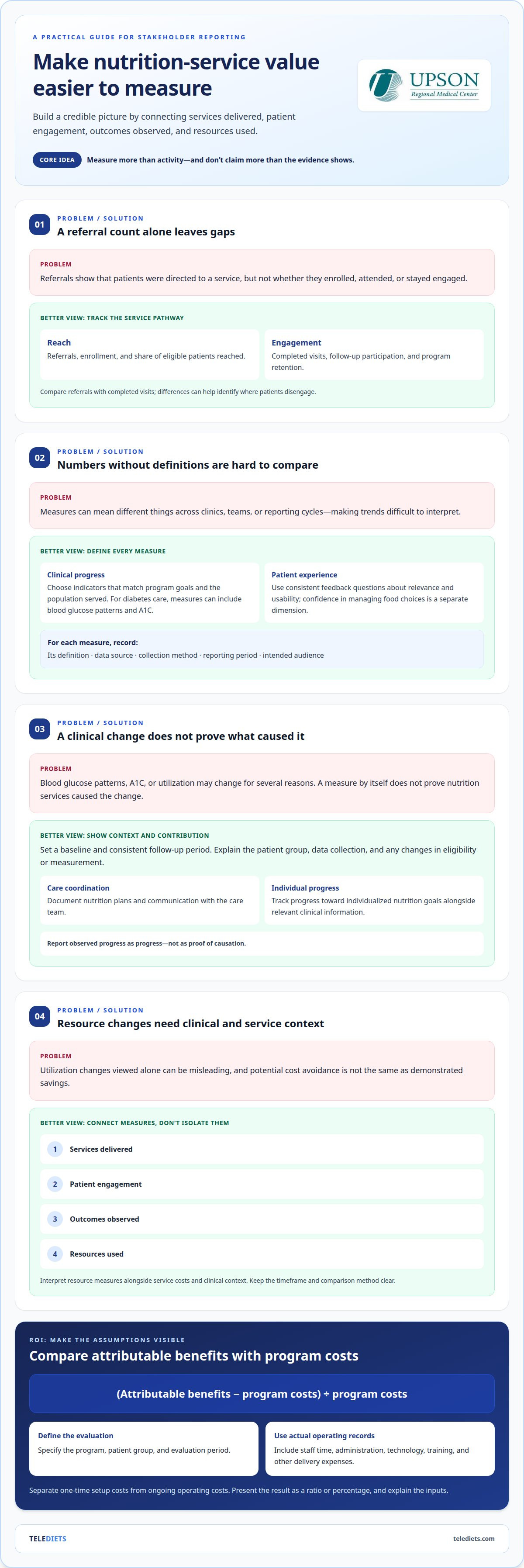
A useful dashboard separates clinical, service, and resource measures. For a diabetes program, define the patient group, reporting period, and baseline for each measure. This helps stakeholders distinguish changes in outcomes from changes in service activity. Completed nutrition visits, for example, measure service delivery, while patient-reported confidence reflects a different dimension. Use consistent definitions across clinics, teams, and reporting cycles.
Choose clinical measures that reflect the program’s goals and the population served. Alongside relevant clinical indicators, track whether participants meet individualized nutrition goals or report greater confidence managing food choices. A clinic supporting people with diabetes, for example, might record progress toward meal-planning goals. Report each measure with its collection method and timeframe. This gives decision-makers context without suggesting that one metric proves cause and effect.
- Reach: Track referrals, enrollment, and the share of eligible patients reached.
- Engagement: Record completed visits, follow-up participation, and program retention.
- Patient experience: Use consistent feedback questions about relevance and usability.
- Care coordination: Note documented nutrition plans and communication with the care team.
Operational measures show how well services fit existing workflows. Compare referrals with completed visits, then identify where patients disengage. A high referral count alongside fewer completed appointments, for example, may point to access or scheduling barriers. Review patterns by clinic or referral pathway to identify practical improvements. A measure is most useful when it informs a specific service decision.
Resource measures may include staff time, program participation, and healthcare utilization relevant to the initiative. Interpret them alongside service costs and clinical context, not in isolation. Changes in utilization can have several contributing factors, so don’t attribute them directly to the program without suitable analysis. Keep baseline and follow-up periods consistent, and explain changes in eligibility or data collection.
Organize stakeholder reporting around a clear chain: services delivered, patient engagement, outcomes observed, and resources used. This makes assumptions visible and helps leaders compare performance over time. A concise dashboard can list each measure, its definition, data source, reporting period, and intended audience. This structure supports a more credible account of nutrition services’ contribution to diabetes care.
How can organizations calculate the return on investment of nutrition services?
Start with a defined program, patient group, and evaluation period. For example, assess nutrition support for adults receiving diabetes care at one clinic. Compare program costs with financial benefits attributable to the service. A common calculation is: (attributable benefits minus program costs) divided by program costs. Present the result as a ratio or percentage, and explain the inputs.
Build the cost side from actual operating records. Include staff time, administration, technology, training, and other expenses required to deliver the service. Separate one-time setup costs from ongoing operating costs. If a dietitian’s time is shared across programs, for example, allocate only the portion associated with the diabetes initiative. Document the allocation method so finance and clinical teams can interpret it consistently.
Next, identify benefits that can be measured financially. A program might examine whether relevant healthcare utilization or related spending changed among participants. Use the organization’s claims, encounter, and accounting data to value those changes. Don’t count improved clinical indicators as cash savings unless the organization can link them to a defensible financial effect. Report observed savings separately from projected or potential benefits.
- Set the patient group, baseline, and follow-up period.
- Calculate direct and allocated program costs.
- Estimate attributable financial benefits using consistent data.
- Apply the formula and disclose assumptions.
For a diabetes initiative, compare participants with a suitable baseline or comparison group. Account for other changes, such as care redesign or enrollment shifts, that could affect utilization. Avoid counting the same avoided event in multiple benefit categories. These steps help distinguish an association from a credible estimate of the program’s contribution.
Finally, test how sensitive the result is to uncertain assumptions. Recalculate it using conservative estimates for attribution or benefit valuation. Report the underlying inputs beside the ROI, including excluded costs and data limitations. If different assumptions produce substantially different results, show the range rather than presenting one figure as definitive. This transparency helps stakeholders judge whether continued investment aligns with organizational priorities.
What evidence and case studies support investment in nutrition services
Strong investment cases combine clinical evidence with service-specific results. For diabetes care, prioritize research evaluating nutrition interventions in comparable populations. Then assess whether the setting, patient needs, intervention, and outcomes resemble your program. Research on school meals may illustrate access and nutrition benefits, for example, but cannot establish savings for diabetes services. Relevance matters as much as a positive finding.
Build a local case study around a defined service and patient group. Describe the need, intervention, participation, follow-up, and outcomes in sequence. A diabetes clinic, for example, could explain how its nutrition program supports care goals, then report engagement and clinical measures. Include the evaluation period and data sources. Separate measured results from projected effects, and note whether other care changes may have contributed.
Broader nutrition initiatives can illustrate different forms of value. A full, healthy school breakfast costs less than convenience store items. That comparison speaks to affordability and access, not diabetes treatment or healthcare savings. Globally, 350,000 children become blind each year, a figure discussed in connection with reaching end users with orange-fleshed sweet potato. This example highlights nutrition’s public-health importance, but it does not demonstrate outcomes for clinical nutrition services.
- Match evidence: Prioritize diabetes-care research relevant to your population and intervention.
- Show local results: Present participation, clinical measures, and operational context together.
- State limitations: Distinguish observed outcomes from possible explanations or future projections.
Stakeholders can interpret a case more confidently when it includes both supportive findings and limitations. A concise evidence brief should connect each claim to its population, intervention, outcome, and setting. Use case studies to show how services work in practice, then explain what differs in your organization. This supports a measured investment decision without treating unrelated nutrition examples as proof of impact on diabetes care.
The Scaling Up Nutrition Movement Civil Society Network launched its “We are all accountable” campaign in 2022 to support civil society reporting into the Nutrition Accountability Framework.
TeleDIETS
TeleDIETS helps healthcare professionals put evidence-based nutrition plans into practice and connect them with chronic disease care. The platform enables physicians and clinics to tailor plans to lab results and clinical diagnoses. This gives care teams a practical way to align nutrition support with patient needs and explain its role to stakeholders.
Organizations developing nutrition services can use Standard Series Meal Plans, Advanced Medical Series Meal Plans, or GLP-1 Meal Plan Protocols to support different clinical needs. Insurance Billing & CPT Coding Tools can also support the administrative side of delivering nutrition services. Together, these offerings can help providers structure nutrition care and its workflow.
If you’re considering how tailored nutrition plans and workflow tools could support your program, contact TeleDIETS to discuss your needs.
Make the Next Decision Evidence-Led
Turn your evaluation approach into a practical decision for your organization. Define what success means for your diabetes program, who will review progress, and how findings will shape future service decisions. A clear process helps stakeholders see how nutrition care fits their priorities without overstating its effects.
Presenting the value of nutrition services to stakeholders is an ongoing practice, not a one-time pitch. As your program develops, keep measures relevant, explain what the evidence can and cannot show, and use results to guide thoughtful adjustments. This creates a stronger basis for discussion across clinical and operational teams.
If you’re ready to explore how TeleDIETS could support your nutrition service workflow, discuss your program needs with TeleDIETS. A clear next step can help you move from evidence to a plan your team can evaluate with confidence.
Frequently Asked Questions
What are the benefits of nutrition services for patients, communities, and organizations?
Nutrition services can help patients connect food choices with health goals and care plans. Coordinated support delivered through healthcare settings can make clinical nutrition guidance more accessible. Organizations can use service data to understand which populations they reach and where care pathways may need attention. Referral patterns, for example, can show whether a diabetes program connects nutrition support with the patients clinicians intend to serve.
How should nutrition professionals present nutrition service outcomes to stakeholders?
Present outcomes in terms each stakeholder can use to make decisions. Clinical leaders may focus on relevance to care goals, while operational leaders may need to understand service capacity and workflow. When presenting the value of nutrition services to stakeholders, pair a concise finding with its implication and a clear next step. For example, explain what a participation pattern suggests the team should review, without claiming it proves a clinical effect.
Leave a Reply