
Better dietary adherence depends on more than giving patients a plan. Software to improve patient dietary adherence can help translate clinical nutrition recommendations into manageable actions through personalized guidance, feedback, and tools that support follow-through. Its value depends on how well those features meet patient needs and fit clinicians’ workflows.
A digital tool may make nutrition plans easier to follow, but a list of recommendations alone does not address every practical barrier patients face. Nutrition software can support care by helping clinicians tailor guidance, organize plans, and make next steps clearer, while keeping professional support central.
This guide explains what nutrition software can do and how to assess its usability, personalization, and fit with clinical workflows. It also covers practical ways digital tools can support adherence, including structured meal plans and information clinicians can use to tailor follow-up.
Key Takeaways
- Assess whether a platform fits your clinical workflow and gives patients practical ways to engage with their nutrition plan.
- Use personalized feedback and clinician follow-up to make recommendations more relevant to each patient’s needs.
- Look for digital tools that reduce friction in everyday actions, while accounting for patients’ technology access and comfort.
- Combine structured nutrition guidance with supportive interventions, and consider TeleDIETS meal plans and billing tools when they fit your practice.
1. Choosing the right patient engagement platform: What are the criteria?
Selecting software to improve patient dietary adherence means connecting nutrition guidance with actions patients can track. Assess whether it supports tailored plans, reminders, patient education, and communication with clinicians. For example, a patient may record a meal-plan action and share progress for follow-up. These features make monitoring more practical than relying on a plan patients rarely open.
Some dietary adherence apps integrate with EHRs and remote patient monitoring systems, but integration varies by platform and clinic setup. Assess whether the tool can exchange relevant information with your existing EHR or practice-management system, and how monitoring data reaches the care team. A smooth workflow helps clinicians use patient activity in follow-up rather than checking another disconnected dashboard.
Medication features should reflect distinct routines. For oral diabetes medications, scheduled reminders and dose logs can help patients record whether they followed their prescribed schedule. Insulin routines may require different prompts and tracking, based on the care plan. Software should support documentation and communication, not suggest changes to a prescribed medication regimen.
Nutrition care alongside GLP-1 medications also calls for clinician-guided context. A platform can present dietary recommendations and let patients record relevant actions or questions for follow-up. This keeps nutrition support connected to care without treating medication reminders as a substitute for a tailored meal plan or clinician judgment.
Digital nutrition guidance is most useful when patients can understand what to do next and clinicians can review how the plan is working. Choose clear meal-plan structures and a straightforward process for patients to raise questions. During follow-up, use those questions and reported challenges to make the discussion specific and actionable.
Software to improve patient dietary adherence should fit a practical assessment: usability on mobile devices, customization, scalability, privacy and security considerations, and vendor training or technical support. Check whether patients can easily record actions and whether clinicians can interpret those records. For example, a tool that makes meal tracking burdensome may create friction instead of supporting outcomes. Select features that fit the clinic workflow and patients’ ability to use them.
2. Personalized feedback and clinician support
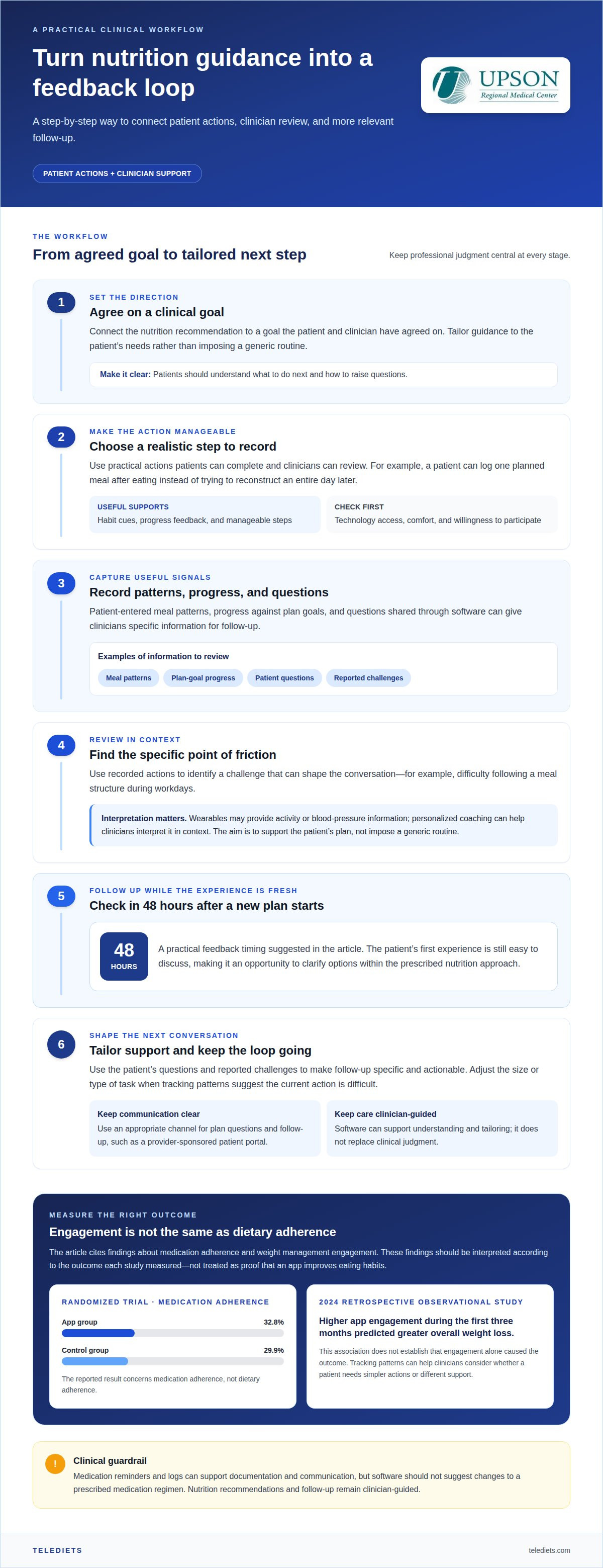
Useful feedback connects a patient’s recorded actions with the clinical goal they agreed on. Clinicians can track dietary adherence by reviewing patient-entered meal patterns, progress against plan goals, and questions shared through the software. That information helps identify a specific challenge, such as difficulty following a meal structure during workdays, and shape the next conversation around it.
Timing matters. A practical feedback loop is to follow up 48 hours after a new plan starts, while the patient’s first experience is still easy to discuss. If a person with diabetes reports that a planned lunch is difficult to prepare, the clinician can clarify options within the prescribed nutrition approach. Software-supported meal planning should make guidance easier to understand and tailor, not replace clinical judgment.
Guidelines can feel complex when they span diet, physical activity, and lifestyle changes. Digital tools can break them into relevant actions, such as recording a meal choice and noting whether a planned activity was manageable. Wearables may provide activity or blood-pressure information, while personalized coaching can help clinicians interpret that information in context. The aim is to support a patient’s plan, not impose a generic routine.
Patient adoption deserves attention during assessment. Discuss whether the patient can and wants to use the technology, and consider whether a family member could encourage participation when appropriate. For example, a family supporter might help a patient remember to record meals, while the clinician remains responsible for interpreting the information and guiding care.
For communication, a provider-sponsored patient portal can give patients access to selected information in their electronic health records. Use an appropriate channel for plan questions and follow-up, and make the next step clear, such as sending a meal-planning question before the next clinical review. Practices developing structured nutrition workflows can explore medical nutrition support as one possible fit.
3. Digital tools for simplifying patient actions
Digital support works best when it makes the next medical action clear and easy to complete. A patient might log one planned meal after eating, rather than reconstructing an entire day later. Habit cues, progress feedback, and manageable steps can connect tracking with behavior change. During implementation, clinics can identify which actions patients can realistically record and review.
Cardiovascular care offers a useful reminder to distinguish engagement from outcomes. In one randomized trial, medication adherence was 32.8% in the app group and 29.9% in the control group. The result concerns medication, not dietary adherence, so it shouldn’t be treated as proof that an app improves eating habits. It does show why clinics should evaluate the specific outcome a digital tool is meant to support.
Personalized digital adherence programs can make tasks more relevant by adapting prompts and feedback to recorded behavior. A 2024 retrospective observational study found that higher app engagement during the first three months of a weight management program predicted greater overall weight loss. That association supports monitoring engagement, but doesn’t establish that engagement alone caused the outcome. Clinicians can use tracking patterns to decide whether a patient needs simpler actions or different support.
Access is part of the assessment, not an afterthought. A smartphone app may be difficult to use for someone with limited data access, an older device, low digital literacy, or difficulty navigating its interface. Offer a straightforward way to record eating behaviors, explain each step, and consider a non-app route when technology creates a barrier. A study in China also found that people in high-income regions were more likely to lose weight with a mobile health app, underscoring the need to consider access differences.
For practical evaluation, ask patients to complete a sample task, such as recording a meal or viewing feedback. Note where navigation causes confusion, then simplify instructions or adjust the workflow. This small usability check helps clinics select digital tools that fit patients’ circumstances and produce information clinicians can use.
4. Interventions to improve dietary adherence
Software that helps patients follow prescribed diets combines tailored meal guidance, self-monitoring, and clinician feedback. Useful features include a practical way to record intake, review progress, and communicate questions about the plan. The goal is to make the next nutrition action clear, not to replace clinical care.
Effective interventions often combine approaches rather than relying on reminders alone. A review of 38 studies found that telephone follow-up, video, contracts, feedback, nutritional tools, and complex interventions each improved at least one dietary-adherence outcome. Across 123 comparisons, 32 outcomes favored intervention over control or usual care. This supports selecting platforms that can deliver nutrition tools alongside meaningful follow-up.
Match the intervention to the barrier. If a patient struggles to understand a meal plan, a clinician can use a clear digital plan and invite questions. If tracking intake feels burdensome, simplify the recording task and focus on information relevant to the agreed nutrition goals. Feedback should help patients and clinicians decide what to adjust in the care approach.
Evaluate digital nutrition support against a defined clinical goal. For example, a clinic might review whether patients can understand and discuss their meal plans during follow-up. Use the same measure consistently so the team can assess whether the workflow is useful and identify what needs improvement.
To choose software, assess whether it supports tailored plans, straightforward intake tracking, clinician feedback, and follow-up that fits the practice workflow. Consider how patients will use the platform on their available device, and whether staff can act on the information it collects. Structured medical nutrition plans can support this process when they fit the clinical need. Explore clinician-focused nutrition planning as a next step for building structured dietary support.
TeleDIETS
TeleDIETS helps healthcare professionals put evidence-based nutrition plans into clinical practice, tailored to lab results and diagnoses. It may fit clinics seeking structured dietary support alongside clinician-led follow-up, rather than a standalone reminder tool.
Its options include Standard Series Meal Plans, Advanced Medical Series Meal Plans, and GLP-1 Meal Plan Protocols for chronic disease management. Insurance Billing & CPT Coding Tools can also support practice workflows. These offerings give clinicians plan resources that can complement their own approach to patient monitoring and dietary adherence.
If your clinic is assessing nutrition software, consider whether tailored meal plans and clinical workflow tools fit your care model. Contact TeleDIETS to discuss how its platform can support your practice.
Put the Next Step Into Practice
Choosing software to improve patient dietary adherence is a clinical workflow decision, not simply a technology purchase. Consider what your team needs to deliver tailored nutrition guidance and how clinicians will use it in follow-up. Start with a practical implementation goal, then refine the process as your clinic learns what works for patients and staff.
TeleDIETS offers Standard Series Meal Plans, Advanced Medical Series Meal Plans, and GLP-1 Meal Plan Protocols. These options can support clinicians building nutrition services around different care needs. The best fit depends on how your practice intends to use structured meal plans within its clinical approach.
If you’re ready to explore how TeleDIETS may fit your practice, contact TeleDIETS to discuss your needs. A thoughtful next step can help your team build nutrition support that works with its care model and keeps patient actions at the center.
Frequently Asked Questions
What Is Nutrition Software?
Nutrition software helps healthcare professionals organize, deliver, and monitor nutrition care. Depending on its purpose, it may support nutrition assessments, personalized meal plans, patient tracking, communication, or practice workflows. For example, a clinician might use a platform to document a patient’s nutrition goals and review progress before a follow-up. It supports clinical work; it doesn’t replace professional assessment or individualized care.
Can I automate my nutrition coaching without losing the personal touch?
Yes, automation can handle repeatable tasks while clinicians retain control of individualized guidance. For example, software can deliver a plan or prompt a patient to record progress, then make that information available for a clinician’s review. The personal element comes from responding to the patient’s experience, not from manually sending every reminder. Keep automated messages relevant, and use patient feedback to guide the next interaction.
Choosing the right patient engagement platform: What are the criteria?
Start with your clinic’s workflow and the patient actions you want to support. Assess whether the platform is usable on patients’ devices, allows relevant customization, and can work with your existing clinical systems. Also consider privacy and security, scalability, staff training, and support. A short workflow test can reveal practical issues, such as whether staff can locate a patient’s recorded information during routine care.
How can software help with client accountability?
Software can make agreed actions visible by letting patients record progress and clinicians review it during follow-up. For example, a patient could log whether they used a planned meal structure on workdays, then note what made it easier or harder. Use the record to discuss barriers and adjust achievable goals. Accountability should support a constructive clinical conversation, not turn incomplete tracking into blame.
How do dietitian platforms compare for patient engagement and adherence?
Platforms differ in their focus: some emphasize meal planning, while others prioritize communication, tracking, or practice administration. Compare how each platform supports your clinical nutrition workflow and whether clinicians can use its information in follow-up. TeleDIETS provides personalized meal plans based on lab results and diagnoses, alongside insurance billing tools and a telemedicine plugin, to support nutrition services within provider workflows.
What evidence shows nutrition software improves dietary adherence and health outcomes?
Evidence is encouraging but varies by intervention and outcome measured. A 2021 randomized trial of a smartphone app linked to primary care electronic health records reported a relative risk of 1.07 for medication adherence, with a 95% confidence interval of 0.88-1.20 and p-value of 0.49. That medication finding does not establish dietary benefit. Clinics should evaluate nutrition-specific adherence and health outcomes directly.
Leave a Reply