
How much of your clinical expertise is currently being sidelined by the manual labor of calculating macronutrients and drafting grocery lists? You know that medical nutrition therapy is the cornerstone of chronic disease management, yet the hours required to build a single plan often make it impossible to scale. Implementing automated clinical nutrition plans solves this by bridging the gap between a patient’s lab results and their daily habits. It’s exhausting to provide high-level care when administrative hurdles and time constraints limit your impact, but modern technology is finally catching up to clinical needs.
In this article, you’ll learn how to transform manual dietary counseling into a scalable, evidence-based service. We’ll explore how to leverage AI-driven automation to reduce your time-to-prescription from hours to seconds while staying aligned with the March 2026 CMS nutrition guidelines. You’ll discover how to capture critical MNT reimbursement using CPT codes like 97802, which currently averages $35.00 per unit, to increase practice revenue. This guide provides a clear path to improving patient biomarkers without sacrificing the precision your patients deserve.
Key Takeaways
- Understand how automated clinical nutrition plans use diagnostic data and lab results to create evidence-based dietary protocols with clinical precision.
- Shift your practice from hours of manual meal planning to near-instant nutrition prescriptions using medical-grade AI engines.
- Explore the integration of telemedicine plugins and EHR-compatible tools to streamline your clinical workflow and improve patient adherence.
- Maximize practice revenue by identifying and capturing CPT reimbursement opportunities for medical nutrition therapy through automated billing tools.
The Shift Toward Automated Clinical Nutrition in Modern Medicine
The practice of clinical nutrition is undergoing a fundamental transformation. In the past, medical nutrition therapy (MNT) relied on manual calculations and generalized templates that often failed to account for complex patient biomarkers. Today, automated clinical nutrition plans represent a shift toward diagnostic-driven, evidence-based protocols that integrate directly with a patient’s medical profile. This evolution is driven by a critical clinical necessity: the rising tide of chronic disease and a concurrent shortage of specialized providers.
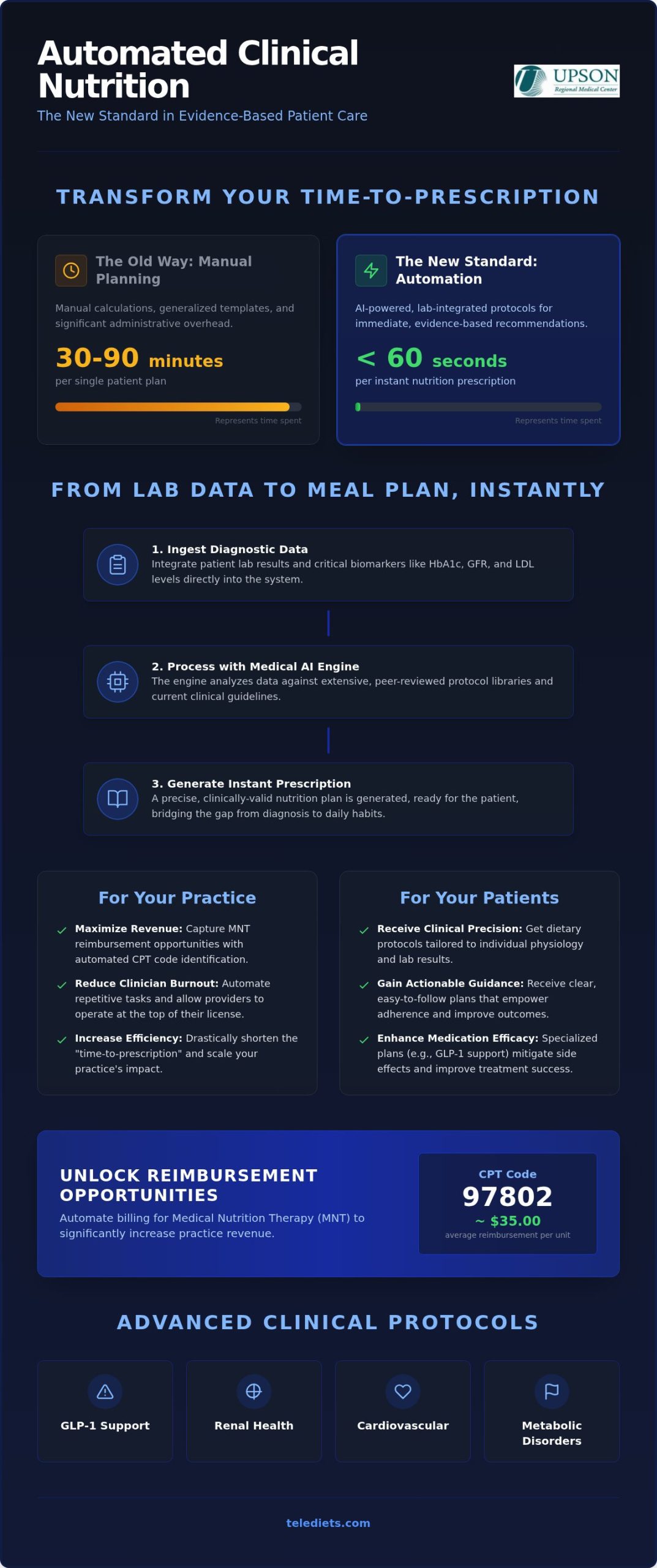
Traditional meal planning is notoriously time-intensive, often requiring 30 to 90 minutes of a clinician’s day for a single patient. In contrast, AI-powered systems generate precise, lab-based protocols in under 60 seconds. This dramatic reduction introduces a new efficiency metric for modern practices: “time-to-prescription.” By shortening the window between diagnosis and dietary intervention, clinics can ensure that patients receive immediate, actionable guidance when their motivation is highest.
Solving the Provider Burnout Crisis with MNT Automation
Clinician burnout is frequently fueled by the administrative burden of manual macronutrient adjustments and complex lab translations. When you automate these repetitive tasks, you’re empowered to operate at the top of your license. Instead of getting lost in spreadsheets, you can focus on high-value patient counseling and behavioral support. Implementing automated clinical nutrition plans acts as an essential engine that handles the technical heavy lifting, allowing for a more supportive and sustainable practice environment.
The Evolution of the Digital Dietitian Market in 2026
As technology-enabled care becomes the norm, the market has pivoted toward precision at scale. Providers now recognize that general wellness advice isn’t sufficient for managing metabolic or renal conditions. The 2026 standard for digital nutrition therapy is defined as lab-integrated and fully automated. This standard ensures that every dietary recommendation is backed by scientific validity and tailored to individual physiological needs.
The Science of Lab-Integrated Nutrition Prescription
Precision nutrition begins with the data. Automated clinical nutrition plans convert complex biomarkers like HbA1c, GFR, and LDL levels into specific nutrient targets. By utilizing extensive, peer-reviewed protocol libraries, these systems ensure every recommendation aligns with current clinical guidelines. This provides a layer of scientific validity that manual planning often lacks, especially when managing high-risk patients. For those with complex comorbidities, the Advanced Medical Series offers targeted interventions that address renal health, cardiovascular disease, and metabolic disorders with granular accuracy.
A significant advancement in 2026 is the integration of GLP-1 meal plan protocols. These medications are powerful for obesity management, but they require specific nutritional support to maintain efficacy and patient comfort. You can explore these specialized protocols to see how they integrate with your existing clinical workflow and support medication therapy.
Bridging the Gap Between Diagnosis and Daily Habits
Automated plans translate a clinical diagnosis into a physical plate for the patient. This standardization ensures every patient in your practice receives the same high-caliber care. It removes the variability often found in manual counseling, creating a reliable baseline for patient outcomes. When you provide a clear, actionable plan, patients feel empowered to follow through on your clinical recommendations.
GLP-1 Support: Enhancing Medication Efficacy Through Nutrition
Patients on GLP-1 receptor agonists often face unique challenges like muscle mass depletion and gastrointestinal distress. Targeted nutrition is essential for long-term success. Automated protocols prioritize high-quality protein and fiber-rich, low-volume foods to mitigate side effects. By focusing on nutrient density, clinicians help patients achieve sustainable weight loss while preserving lean tissue and improving overall medication tolerance.
Strategic Integration: Deploying AI Nutrition Engines in Clinical Workflows
Deploying a medical-grade AI engine requires a methodical approach to ensure it enhances rather than disrupts your practice. The first step involves assessing your specific clinical needs and selecting an engine that supports your patient demographics. Integration follows, typically through telemedicine plugins or EHR-compatible APIs that allow for a seamless data flow between systems. Once the technical foundation is set, training your staff on the “prescription in seconds” workflow is vital. This ensures that nutrition therapy becomes a standard, expected part of every patient encounter. Finally, monitoring patient progress through automated follow-up tools allows for data-driven adjustments that improve long-term outcomes.
Seamless Telemedicine and EHR Plugin Implementation
A dedicated telemedicine plugin is the most efficient way to deliver nutrition care within your existing digital health platform. Cloud-based SaaS models offer the scalability needed for remote MNT, allowing you to reach patients regardless of their physical location. This “plugin” approach bypasses the complex technical hurdles often associated with legacy systems, making it easier to adopt automated clinical nutrition plans. It’s a straightforward path to modernizing your clinical delivery. You can start integrating these tools today to expand your reach and improve care efficiency.
Standardizing Care for High-Volume Practices
High-volume practices benefit significantly from automated clinical nutrition plans by establishing a consistent baseline for care. The Standard Series Meal Plans are designed for general wellness and preventative care, ensuring every patient receives evidence-based guidance without adding to your workload. When you view nutrition as a vital sign that is tracked and managed automatically, you elevate the quality of your entire practice. This standardization reduces clinical variability and ensures that your practice operates with maximum efficiency while maintaining high standards for patient health.
Maximizing ROI: Monetizing Medical Nutrition Therapy Through Automation
Revenue leakage in clinical nutrition often stems from the gap between time spent and time billed. Manual meal planning is rarely profitable when you factor in the high cost of clinician hours. By implementing automated clinical nutrition plans, you turn a labor-intensive chore into a high-margin clinical service. Automation allows you to offer reimbursable medical nutrition therapy at a scale that was previously impossible. When you combine these rapid prescriptions with regular patient follow-ups, you create a sustainable synergy that benefits both your patients’ health and your practice’s bottom line.
TeleDIETS serves as the essential engine for capturing this lost revenue. Integrated billing tools streamline the submission of nutrition-related claims, ensuring that your team spends less time on paperwork and more time on care. This system ensures that every intervention is documented with the clinical precision required by modern payers. It’s a strategic move that aligns clinical outcomes with financial health.
Navigating CPT Codes and Insurance Reimbursement for MNT
Successful reimbursement relies on accurate coding and robust documentation. As of August 2026, the primary drivers for MNT revenue include:
- CPT Code 97802: Initial assessment and intervention, reimbursed at approximately $35.00 per 15-minute unit.
- CPT Code 97803: Re-assessment and subsequent interventions, reimbursed at approximately $31.73 per 15-minute unit.
Automated systems generate the evidence-based reports needed to support these claims. This reduces the risk of denials and ensures your practice is fairly compensated for the specialized care you provide. It’s about working smarter, not harder.
The Path to Sustainable Practice Growth
Integrating MNT into your standard patient care cycles creates a predictable revenue stream. When the time-to-prescription is reduced to seconds, the volume of patients you can support increases significantly without adding overhead. You can scale your practice today with the TeleDIETS SaaS platform to capture this potential. Transitioning to an automated model is the most direct route to achieving both clinical excellence and financial stability in a modern medical environment.
Modernizing Nutrition Care for 2026 and Beyond
Precision medicine requires a dietary strategy that is as sophisticated as the diagnostics driving it. By transitioning to automated clinical nutrition plans, you eliminate the administrative friction that has historically limited the reach of medical nutrition therapy. You’ve seen how lab-integrated protocols provide the scientific validity necessary for chronic disease management while integrated billing tools ensure your expertise is appropriately rewarded. This shift isn’t just about efficiency; it’s about providing supportive, evidence-based care that scales with your practice’s growth.
The ability to deploy clinical protocols instantly using a specialized AI engine allows you to focus on what matters most: your patients. With the Advanced Medical Series and integrated CPT coding tools, you have everything needed to bridge the gap between clinical data and patient lifestyle. Empower your practice with TeleDIETS automated MNT protocols to capture lost revenue and improve outcomes today. You’re ready to lead the next era of clinical nutrition with confidence and precision.
Frequently Asked Questions
Can I bill insurance for automated clinical nutrition plans?
Yes, you can bill insurance for these services. TeleDIETS includes specialized Insurance Billing and CPT Coding Tools to assist with this process. By using CPT codes like 97802 for initial assessments and 97803 for follow-ups, you’re able to capture revenue for the time spent providing nutrition therapy. The software generates the necessary evidence-based documentation to support these clinical claims during the reimbursement process.
How do automated nutrition plans handle complex comorbidities like renal disease?
Automated clinical nutrition plans manage complex comorbidities through the Advanced Medical Series. This specific protocol library translates biomarkers like GFR and albumin levels into nutrient targets. The system ensures that renal dietary needs are met with clinical accuracy. This removes the risk of manual calculation errors while maintaining the high standard of care required for chronic disease patients.
Is automated clinical nutrition software HIPAA compliant?
Yes, clinical-grade platforms like TeleDIETS are built with HIPAA compliance as a foundational requirement. These systems utilize secure data encryption and require a signed Business Associate Agreement (BAA) to protect patient information. In 2026, maintaining SOC2 compliance and adhering to strict PHI protection standards is mandatory for any software handling medical nutrition therapy data within a professional healthcare environment.
How long does it take to generate a clinical meal plan using an AI engine?
Generating a comprehensive 30-day meal plan takes less than 60 seconds using a medical-grade AI engine. This is a significant improvement over the 30 to 90 minutes typically required for manual creation. This rapid “time-to-prescription” allows you to finalize a dietary protocol during the patient encounter. It ensures immediate delivery of care while the patient is still in your office or on the telemedicine call.
Do automated nutrition plans require integration with my current EHR?
While full EHR integration is available via APIs, it isn’t a strict requirement for use. You can implement these tools through a dedicated telemedicine plugin that works alongside your existing digital health platforms. This cloud-based SaaS model allows your practice to scale quickly without needing a complex technical overhaul. It provides the flexibility to prescribe automated clinical nutrition plans regardless of your current electronic record system’s architecture.
Leave a Reply