
Nutrition education doesn’t have to happen only during a live appointment. Automating patient nutrition education through telehealth can deliver relevant learning materials and follow-up messages through a patient portal or text, while virtual visits give clinicians space to discuss individual needs. Used together, these approaches make nutrition guidance easier to revisit between appointments.
That matters when patients need practical information after a visit and care teams need education to fit established workflows. Telehealth can support nutrition care through real-time counseling, asynchronous instructions, remote monitoring, and digital tools for tracking relevant habits. Automation can organize parts of this process, while clinical judgment remains essential to tailoring guidance to each patient’s care plan.
This article explains how telehealth delivers nutrition education, where automation can support follow-up, and what clinicians should consider when putting these approaches into practice. It compares synchronous and asynchronous care, explains how patient data can inform education, and highlights why careful oversight matters when evidence is limited.
Key Takeaways
- Automated education can use markers in a patient record to prompt timely information or reminders, while clinicians oversee relevance to the care plan.
- Telehealth can pair live nutrition counseling with follow-up messages that help patients apply guidance between appointments.
- Evidence for automated nutrition delivery remains very low certainty, and differences among studies limit conclusions about which approaches work best in each setting.
- Asynchronous follow-up can include reviewing lab results and sending diet-related instructions, making continued education part of the care workflow.
AI-assisted patient education and clinician supervision
Automated education can use patient-record markers to trigger tailored nutrition messages without clinician intervention. Clinicians still shape the care plan, review exceptions, and address needs that require individual counseling.
Clinician Workload and Counseling
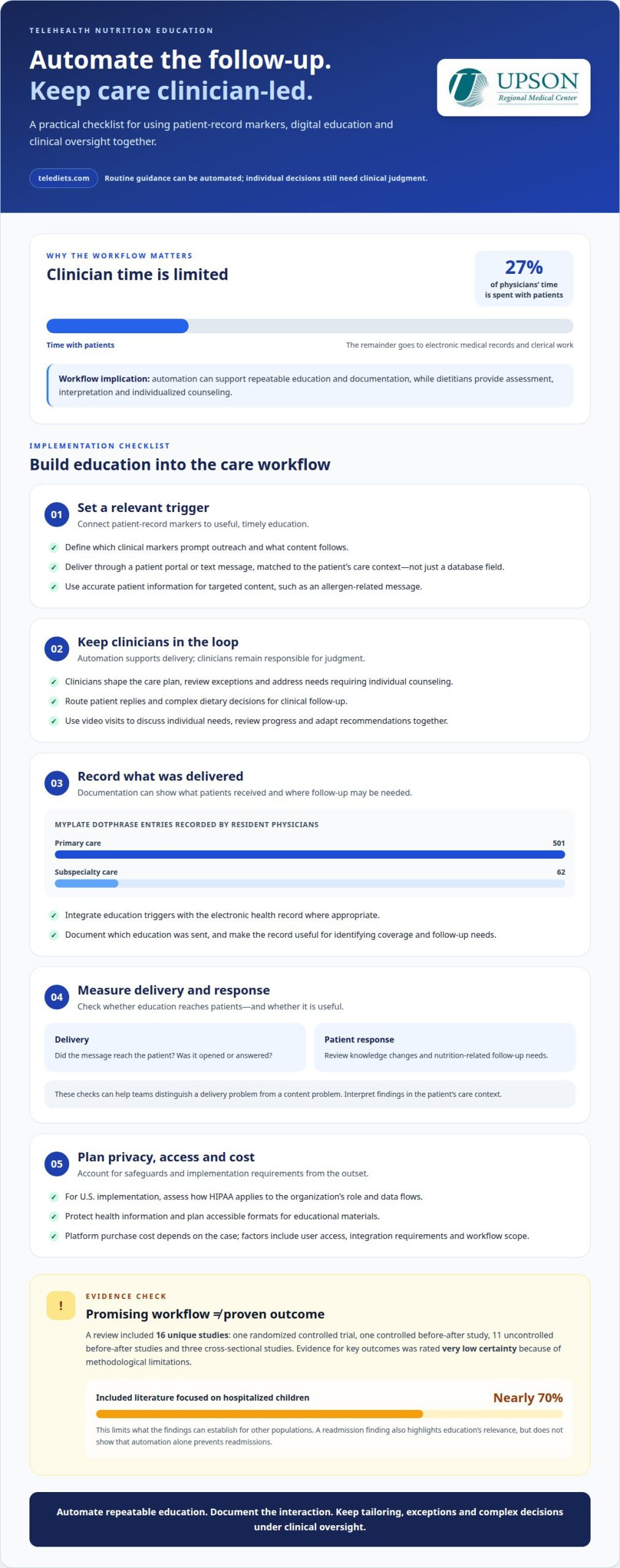
Automation can handle repeatable education and documentation tasks, while dietitians provide assessment, interpretation, and individualized counseling. That distinction matters when teams need to extend routine guidance without treating software as a substitute for clinical judgment. Physicians spend 27% of their time with patients; the remainder goes to electronic medical records and clerical work. A system can support delivery, but clinicians should remain responsible for context, accuracy, and complex dietary decisions.
Electronic health record integration can connect education triggers to recorded patient markers, then deliver messages through a portal or text. Documentation also matters: resident physicians recorded a MyPlate dotphrase 501 times in primary care and 62 times in subspecialty care. A workflow that records which education was sent can help teams see what was covered and identify follow-up needs.
Cost varies by platform and implementation. For a platform purchase, the price depends on the case and is given after a quote request; factors include user access, integration requirements, and workflow scope. Clinical outcomes also require careful interpretation: nearly 20% of 30-day readmissions among patients discharged home on enteral nutrition were directly related to enteral nutrition. That finding highlights education’s relevance, but does not show that automation alone prevents readmissions.
Measuring Engagement and Effectiveness
Evaluate both delivery and patient response. Track whether messages reach patients, whether they open or respond to them, and whether documentation records completed education. Then review relevant outcomes, such as changes in patient knowledge or nutrition-related follow-up needs. These measures help teams identify whether a problem lies in message delivery or in the content itself, while clinician review keeps findings grounded in each patient’s care context.
How is telehealth used to deliver nutrition care?
Telehealth combines live nutrition counseling with digital education and follow-up. Patient-record markers can prompt personalized outreach through a text message or patient portal.
Nutrition Care Plans and Meal Generation
A personalized nutrition care plan connects a patient’s condition and clinical goals with relevant dietary guidance. During a video visit, a nutrition professional can discuss the patient’s needs, review progress, and adapt recommendations together.
Digital tools can extend that conversation between visits. Some mobile applications use artificial intelligence to generate tailored meal plans, assess allergens from food labels, or estimate nutrition from a food photo. These functions can organize education around a patient’s questions, but they do not replace clinical assessment. For example, a clinician may use glucose-monitoring data to guide a discussion about dietary choices.
Automating patient nutrition education can help deliver relevant materials at useful points in care. A clinic might send condition-specific content through a portal, then use a later video appointment to discuss barriers to applying it. Remote group sessions can pair nutrition education with goal setting for shared patient populations. Teams can document what was delivered and route patient questions for clinical follow-up.
Automation Requirements
Tools for automating patient nutrition education can link a record marker to relevant content, deliver that content through a patient-facing channel, and record the interaction. The message should fit the patient’s care context, not simply match a field in a database.
For implementation in the United States, organizations should assess how HIPAA applies to their role and data flows, protect health information, and make materials accessible. Plan privacy safeguards and accessible formats as part of the platform and workflow.
Patient portals and text messages can deliver education, while electronic health record information can help determine which message is relevant. Define which clinical markers trigger outreach, what content follows, and how clinicians handle replies or exceptions. For example, an allergen-related message should be based on accurate patient information and provide a clear route for follow-up. These decisions help make personalized education useful across different patient populations and circumstances.
Evidence gaps and validation needs
Evidence on automated nutrition delivery remains limited. Organizations should distinguish promising workflows from proven outcomes, using the available review’s findings on study limitations and practical validation priorities.
Evidence Gaps
Evidence gaps are missing or weak findings about how automated nutrition delivery affects patients and care teams. They matter because successful message delivery alone is not enough for a hospital or clinical network to determine whether a tool improves care.
A review included 16 unique studies: one randomized controlled trial, one controlled before-after study, 11 uncontrolled before-after studies, and three cross-sectional studies. The evidence for key outcomes was rated very low certainty because of methodological limitations. Nearly 70 percent of the included literature focused on hospitalized children, limiting what findings can establish for other populations.
The review found no eligible published studies addressing staff experiences with automated nutrition delivery. Differences among studies also limited conclusions about which approaches work best in particular care settings or patient groups. Patient satisfaction, staff workflow, and longer-term outcomes therefore need direct assessment, not assumption.
Risks and Validation Needs
Risks include applying an approach beyond the population or setting studied and treating message completion as proof of clinical benefit. A patient opening dietary guidance does not establish understanding, behavior change, or improved outcomes.
Connect each tool’s intended purpose to measurable evidence. Organizations can monitor whether messages reach the intended patients, whether patients engage, and whether clinicians document follow-up. They can also review patient feedback and satisfaction alongside relevant clinical outcomes. For example, assess a portal education program separately for delivery, comprehension, and follow-through.
Before wider use, test message accuracy, trigger logic, accessibility, and escalation routes within the intended workflow. Review exceptions, such as a record marker that prompts irrelevant guidance, and correct the content or logic. Continued monitoring can reveal errors and differences in results across patient populations. This process builds local evidence without overstating what existing studies demonstrate.
Asynchronous messages and follow-up instructions
Asynchronous telehealth lets nutrition providers review lab results and send diet-related instructions without requiring a live appointment. Patients can read guidance later through a portal or text and use it when making daily meal decisions. This creates a follow-up point between visits while allowing clinicians to review and respond.
A clear program links each message to a clinical purpose. After reviewing a patient’s lab results, for example, a provider can send relevant dietary instructions and document the education provided. The message should identify a practical next step, such as discussing food choices in relation to the patient’s care plan. The patient’s reply can inform the next assessment or prompt a conversation during a scheduled visit.
A well-designed workflow distinguishes routine learning from questions that need clinician attention. Teams can define which record details inform a message, who reviews its content, and how patient replies are handled. A portal may suit detailed instructions, while a brief text can direct the patient to that material. Choose the channel and wording to fit the information being delivered.
Follow-up should support learning, not simply increase the number of messages. A useful sequence might introduce a concept, invite questions, and reinforce the key instruction later. Documentation can record what was sent and whether the patient responded. This helps clinicians avoid unnecessary repetition and identify topics for further discussion.
For example, a nutrition provider reviewing lab results can send a concise dietary follow-up, document it in the patient record, and revisit the topic at the next appointment. This connects assessment with counseling without presenting an automated message as an individualized consultation. At each step, clinician guidance remains tied to the patient’s care.
TeleDIETS
TeleDIETS supports healthcare professionals who want to connect nutrition education with clinical meal planning. Its platform enables physicians and clinics to prescribe evidence-based nutritional plans tailored to lab results and clinical diagnoses. For practices building structured education around different care needs, Standard Series Meal Plans and Advanced Medical Series Meal Plans provide options for their workflows. GLP-1 Meal Plan Protocols and Insurance Billing & CPT Coding Tools can support related practice needs.
Consider TeleDIETS if your team wants to incorporate evidence-based nutrition plans more systematically into care delivery. The platform is designed for healthcare professionals, not direct-to-consumer meal delivery or individual patient consultations. Contact TeleDIETS to discuss how its nutrition software may fit your practice’s workflow.
Build the Next Step Into Your Workflow
Start with a recurring education moment and define what patients should learn. A clear learning objective helps your team assess whether the message fits the moment, supports care, and prompts useful follow-up. Refine the approach with patient and clinician feedback before extending it to other workflows.
Automating patient nutrition education works best within an intentional care process: technology supports communication, and clinicians guide clinical decisions. The goal is not to automate every conversation, but to make relevant nutrition information easier to deliver and revisit while preserving attention to individual needs.
If you’re considering how evidence-based nutrition plans could support your practice workflow, connect with TeleDIETS to discuss the next step. Thoughtful implementation can help your team move forward with clarity and confidence.
Frequently Asked Questions
What tools and software automate nutrition education for patients?
Common tools include patient portals, text messaging, mobile health applications, and electronic health record systems that initiate educational outreach. Each has a distinct role: a record can provide a relevant trigger, while a portal or text delivers the message. Some applications also support food logging or nutrition estimates from food photos. For clinical use, choose tools that let teams manage content and review patient responses.
How can automated nutrition education be personalized to patient needs and health conditions?
Personalization starts with choosing education that reflects a patient’s clinical context, dietary needs, and learning preferences. A program might organize distinct content for someone managing diabetes and someone receiving nutrition support for kidney disease. Clinicians can review the material, adjust what patients receive, and direct complex questions to appropriate care. This avoids sending the same generic lesson to everyone.
What evidence shows automated nutrition education improves patient outcomes?
Evidence is promising for some education interventions, but it doesn’t establish that automation alone improves clinical outcomes. In a Louisiana primary-care study, 320 patients completed surveys, and 169 viewed a six-minute dietary education video. Those exposed showed better MyPlate knowledge (P=0.009) and greater motivation to discuss diet with their physician (P=0.04). These findings concern an education intervention, not proof of automated tools’ independent effects.
What steps are needed to implement automated nutrition education in a healthcare practice?
First, define the education goal, such as improving understanding of a dietary recommendation. Identify the patient group and relevant record triggers, prepare clinician-reviewed content, and choose a delivery channel. Test the workflow with a small group before expanding it. Track message delivery, patient responses, and relevant follow-up. Review the results with clinical staff, then refine triggers or materials when they do not meet patient needs.
Leave a Reply