
What if your clinical nutrition protocols could be generated with the same precision as a laboratory diagnostic, but in a fraction of the time? You’re likely already aware that manual meal planning is often too slow for high-volume clinics, making it difficult to maintain rigorous standards for chronic disease management. It’s a common frustration to feel caught between the need for personalized care and the reality of a demanding schedule. Implementing evidence-based nutrition software for clinics allows you to bridge this gap, transforming Medical Nutrition Therapy (MNT) from a time-consuming task into a streamlined, revenue-generating pillar of your practice.
This guide explores how to integrate medical-grade nutrition therapy directly into your clinical workflow. You’ll discover how to automate meal planning based on specific lab results and diagnoses, ensuring every prescription is scientifically sound. We’ll also examine the complexities of insurance billing, providing a clear path to seamless CPT code reimbursement for services like GLP-1 protocols or renal care. By the end of this article, you’ll understand how to deliver professional, lab-based nutrition plans that improve patient adherence and support your clinic’s long-term growth.
Key Takeaways
- Understand the critical distinction between general wellness applications and clinical-grade platforms that translate peer-reviewed science into patient-specific prescriptions.
- Discover how to leverage evidence-based nutrition software for clinics to automate meal plan generation using precise lab data and ICD-10 codes.
- Identify strategies for integrating nutrition therapy into your telemedicine workflow to capture insurance reimbursement through streamlined CPT coding tools.
- Learn how specialized protocols can enhance outcomes for patients on GLP-1 receptor agonists by prioritizing nutrient density and muscle mass preservation.
What is Evidence-Based Nutrition Software for Clinics?
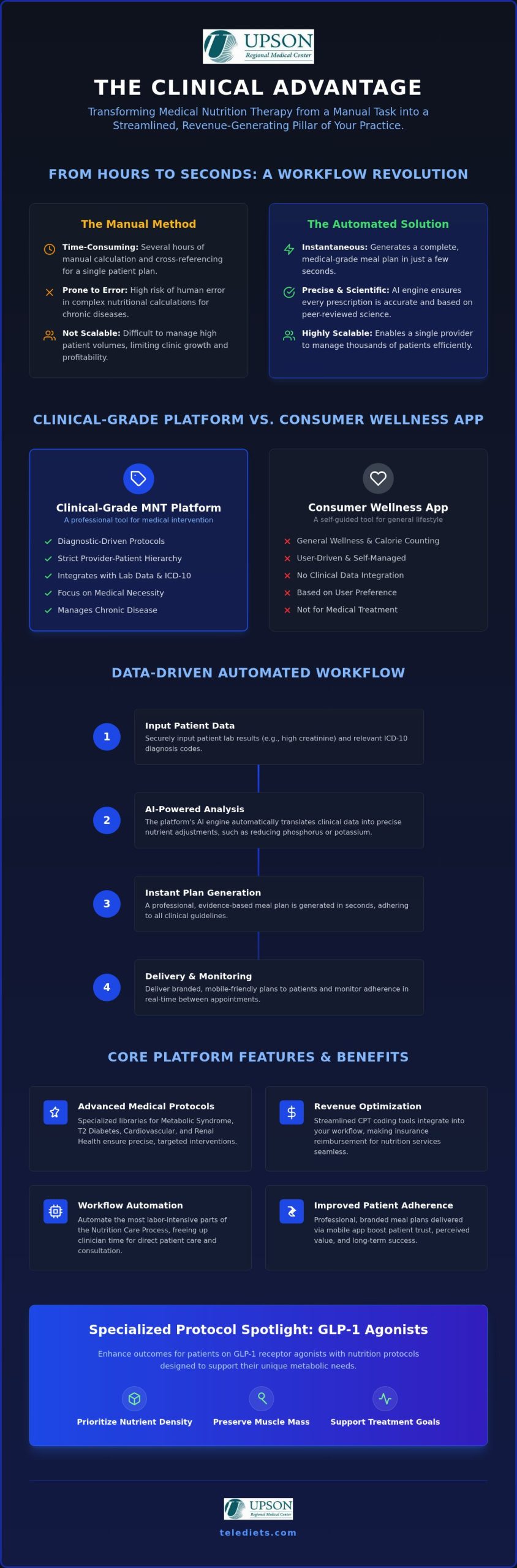
Evidence-based nutrition software for clinics serves as a sophisticated bridge between raw scientific data and actionable patient care. Unlike generic diet trackers, these platforms function as clinical tools that translate peer-reviewed research into precise dietary prescriptions. This approach is fundamental to the practice of Clinical Nutrition; it ensures that every meal plan aligns with the rigorous standards set by the Academy of Nutrition and Dietetics. By leveraging a high-performance AI engine, clinicians can reduce the time required to develop a professional, medical-grade plan from several hours of manual calculation to just a few seconds of automated processing.
Distinguishing Clinical Software from Consumer Apps
The primary difference lies in the objective and the underlying data structure. Consumer apps often focus on general wellness or simple calorie counting for the individual user. In contrast, clinical-grade Medical Nutrition Therapy (MNT) platforms prioritize diagnostic-driven protocols. They maintain a strict provider-patient hierarchy, allowing the clinician to oversee and adjust prescriptions based on medical necessity rather than user preference. This ensures that the patient receives a professional intervention tailored to their specific health profile, rather than a generic suggestion from a wellness database.
The Core Science: Lab Data and Diagnosis Integration
Modern evidence-based nutrition software for clinics integrates directly with lab markers and ICD-10 codes to trigger specific nutrient adjustments automatically. This functionality is essential for managing complex conditions. For instance, a high creatinine level might prompt an immediate reduction in dietary phosphorus or potassium. This level of automation ensures that protocols for chronic disease management, such as renal or diabetic care, are consistently accurate and safe. It empowers providers to deliver high-performance care without the manual burden of cross-referencing every nutrient against a laboratory report. You can explore these capabilities further through Advanced Medical Series Meal Plans designed for clinical environments.
Core Features of High-Performance MNT Platforms
High-performance MNT platforms transform clinical productivity by automating the most labor-intensive components of the Nutrition Care Process. Instead of manually calculating macronutrients, evidence-based nutrition software for clinics generates meal plans instantly based on specific ICD-10 codes and lab markers. This automation allows a single provider to manage thousands of patients without expanding administrative staff, ensuring the clinic remains scalable and profitable while maintaining a high standard of care. By utilizing both Standard Series and Advanced Medical Series libraries, clinics can address a wide spectrum of patient needs with scientific accuracy. Clinicians don’t have to spend hours on manual entry; instead, these systems ensure every recommendation is backed by current clinical guidelines, reducing the risk of human error in complex nutritional calculations.
Advanced Medical Series for Complex Conditions
Clinical libraries must go beyond basic wellness to address metabolic syndrome, type 2 diabetes, and cardiovascular health. While standard diets offer general healthy eating patterns, Advanced Medical Series protocols provide targeted nutrient ratios and ingredient exclusions specifically designed to manage pathological markers and chronic disease progression. These protocols ensure that patients receive specialized interventions that mirror the precision of their medical prescriptions. You can access these specialized tools through the Advanced Medical Series Meal Plans.
Patient Adherence and Delivery Systems
Professional, branded meal plans significantly boost patient trust and perceived value. When a patient receives a structured, mobile-friendly plan, they’re more likely to view nutrition as a critical component of their treatment. Utilizing mobile apps allows clinicians to monitor real-time adherence, providing data-driven insights into patient behavior between appointments. This digital delivery system replaces outdated paper handouts with an interactive experience that encourages long-term success. It’s a modern approach that bridges the gap between clinical advice and daily patient habits. If you’re looking to modernize your delivery, exploring evidence-based nutrition software for clinics can help you scale your impact without sacrificing quality.
Optimizing Clinical Workflows and Revenue
Integrating evidence-based nutrition software for clinics into existing telemedicine and EHR systems creates a seamless environment where nutrition isn’t an outlier. This turns nutrition into a central, billable pillar of your patient care model. Research into the Nutrition Care Process in Software Formats highlights how digital tools overcome traditional barriers like manual documentation and fragmented data. Automating clinical notes and lab-to-plan prescriptions helps slash provider fatigue, allowing your team to focus on patient interaction rather than repetitive administrative tasks.
Insurance Billing and CPT Coding Tools
Turning nutrition therapy into a consistent revenue stream requires precise coding and rigorous documentation. High-performance evidence-based nutrition software for clinics facilitates the use of CPT codes 97802 for initial assessments, 97803 for follow-ups, and G0270 for reassessments due to a change in diagnosis. Modern platforms automate the specific documentation needed for Medicare and private insurance reimbursement, ensuring that every session meets the clinical requirements for claim approval. This administrative automation secures your clinic’s financial health without adding a heavy burden to your billing department.
Telemedicine Plugins for Remote MNT
Delivering medical-grade nutrition therapy via remote patient monitoring (RPM) is now a standard expectation in a technology-forward practice. Specialized telemedicine plugins streamline the provider’s digital dashboard, centralizing patient metrics and video consultations in one secure, HIPAA-compliant location. It’s a modern approach that supports long-term adherence by making professional guidance accessible regardless of the patient’s location. To begin scaling your revenue and improving patient outcomes through these tools, you can explore Clinical Membership and Software Access options. Embracing these digital workflows ensures your practice remains competitive while providing the highest quality of care. You can optimize your clinical workflow today with a solution designed for the complexities of modern medical practice.
Specialized Protocols: GLP-1 and Weight Management
The surge in GLP-1 receptor agonist prescriptions has created an immediate need for specialized nutritional oversight. It’s not enough to rely on medication alone; long-term success requires a structured approach to nutrient density and lean muscle preservation. Evidence-based nutrition software for clinics allows providers to implement these complex strategies without adding hours of manual calculation to their day. By bridging the gap between pharmacotherapy and lifestyle changes, you can ensure your patients achieve sustainable outcomes while protecting their metabolic health.
GLP-1 Meal Plan Protocols for Providers
Designing diets for patients on GLP-1 therapy requires managing unique challenges like delayed gastric emptying and significant appetite suppression. Your protocols must prioritize small, frequent, and nutrient-dense meals to mitigate nausea while meeting daily micronutrient requirements. Protein-sparing protocols are essential in GLP-1 therapy to prevent the excessive loss of lean muscle mass that often accompanies rapid weight reduction. Using pre-built GLP-1 Meal Plan Protocols ensures that every patient receives a clinically validated plan that supports their specific medication journey.
Standard vs. Advanced Medical Series Implementation
Scaling specialized care depends on selecting the right tools for your patient’s acuity level. While Standard Series Meal Plans work well for general weight management, patients with complex comorbidities often require the Advanced Medical Series Meal Plans. These peer-reviewed templates allow you to launch specialized programs in a busy clinical environment within seconds. You can access these clinical tools through the Advanced Medical Series portal to enhance your practice’s offerings. This system enables your clinic to provide high-level, evidence-based care to a large volume of patients without sacrificing the precision that medical nutrition therapy demands.
Advancing Clinical Outcomes Through Precision Nutrition
Implementing evidence-based nutrition software for clinics is no longer just a way to save time; it’s a strategic move to future-proof your practice. By automating the transition from lab results to actionable dietary prescriptions, you can deliver a higher standard of care while significantly reducing administrative fatigue. You’ve seen how integrated CPT coding tools and specialized GLP-1 protocols turn nutrition into a billable, medical-grade service that supports both patient health and clinic revenue. TeleDIETS is already trusted by leading physicians and major telemedicine providers to bridge the gap between medication and long-term lifestyle success.
With the inclusion of our specialized GLP-1 medical series and robust billing support, you’re equipped to handle the most complex patient cases with confidence. We invite you to see these tools in action and discover how they can empower your team and improve patient adherence. Request a demo of the TeleDIETS clinical nutrition platform today to begin transforming your medical nutrition therapy workflow. Your patients deserve the precision of modern science, and your clinic deserves the efficiency of advanced clinical automation.
Frequently Asked Questions
What is the best evidence-based nutrition software for small clinics?
TeleDIETS is an ideal solution for small practices because it provides a scalable, AI-driven SaaS platform that automates complex nutritional prescriptions. It allows clinicians to generate professional plans based on lab results and diagnoses in just a few seconds. This evidence-based nutrition software for clinics empowers smaller teams to deliver medical-grade therapy and manage high patient volumes without the need for additional administrative staff or manual meal planning.
How do I bill insurance for medical nutrition therapy using software?
You can streamline insurance reimbursement by using integrated billing tools that support specific CPT codes, such as 97802, 97803, and G0270. The software automates the clinical documentation required by Medicare and private insurers, ensuring that your nutrition services meet all medical necessity criteria. This functionality turns nutrition therapy into a consistent, billable revenue stream by reducing the administrative burden typically associated with manual insurance claims and coding.
Can nutrition software integrate with my existing EHR system?
Modern clinical nutrition platforms are designed to work in tandem with your current EHR and telemedicine workflows. While specific integration levels can vary, the software often utilizes a dedicated telemedicine plugin to centralize patient metrics and consultations on a single digital dashboard. This coordination ensures that lab data and clinical diagnoses can trigger automated meal plan generation without disrupting your practice’s established patient management routines or digital environment.
Are there specific meal plan protocols for patients on GLP-1 medications?
Yes, specialized GLP-1 Meal Plan Protocols are specifically designed to address the unique challenges of GLP-1 receptor agonist therapy. These protocols focus on managing side effects like nausea while prioritizing high nutrient density and protein-sparing strategies to preserve lean muscle mass. By using evidence-based nutrition software for clinics, you can instantly deploy these peer-reviewed templates to provide the structured nutritional support necessary for long-term success with weight management medications.
Is medical nutrition therapy software HIPAA compliant?
Clinical-grade nutrition therapy software is built to meet all HIPAA compliance standards, ensuring that sensitive patient lab data and health information remain secure. These platforms utilize encrypted environments and provide Business Associate Agreements (BAA) to protect your practice and your patients. When you use a professional SaaS solution, you can be confident that your digital prescriptions and clinical notes are handled with the same level of security as your electronic health records.
Leave a Reply