
What if the clinical success of your GLP-1 program is actually determined by your billing department? As patient volumes surge, many providers find that manual meal planning is no longer sustainable, while the constant fear of claim denials for obesity-related counseling creates a significant administrative burden. It’s a common struggle to balance high-quality patient care with the complex nuances of MNT versus E/M billing. You need a reliable strategy to navigate the latest CPT codes for GLP-1 nutrition counseling without sacrificing your clinical workflow or patient outcomes.
This 2026 guide empowers you to master the specific documentation requirements and coding updates, including the new $33.40 Medicare conversion factor, needed to secure reimbursement while protecting patient lean muscle mass. We’ll examine the critical distinctions between codes 97802 and 97803, discuss the latest CMS diagnosis requirements for medical nutrition therapy, and provide a roadmap for integrating efficient, medical-grade protocols into your practice. By the end of this article, you’ll have the tools to transform your nutritional counseling from a clinical hurdle into a predictable, reimbursed service.
Key Takeaways
- Understand the clinical necessity of specialized medical nutrition therapy to prevent sarcopenic obesity and preserve lean muscle mass during GLP-1 treatment.
- Master the precise application of CPT codes for GLP-1 nutrition counseling, including 97802 for initial assessments and 97803 for subsequent interventions.
- Learn how to utilize the ADIME documentation format and accurate time-tracking to meet 2026 CMS standards and reduce the risk of claim denials.
- Discover efficient methods to scale your clinical workflow using automated GLP-1 meal plan protocols and integrated insurance billing tools.
Why GLP-1 Therapy Demands Specialized MNT: Preventing Muscle Loss
While GLP-1 receptor agonists are revolutionary for weight management, they present a unique clinical challenge: the rapid loss of lean muscle mass. Standard low-calorie diets often fail these patients because they don’t account for the accelerated muscle-to-fat ratio shift seen with medications like semaglutide or tirzepatide. This isn’t just about aesthetics. It’s about preserving the patient’s resting metabolic rate (RMR). Without specialized medical nutrition therapy (MNT), patients risk entering a state of sarcopenic obesity, where they lose weight but become metabolically fragile and physically weaker.
The Risk of Sarcopenic Obesity in GLP-1 Patients
Clinical observations indicate that a significant percentage of weight lost during rapid GLP-1 therapy can come from lean tissue rather than adipose tissue. This loss directly impacts long-term medication success and patient adherence. If muscle mass isn’t protected through high-protein, nutrient-dense protocols, the resulting metabolic damage can make weight maintenance nearly impossible. Preserving muscle is essential for maintaining the strength required for daily activity and long-term metabolic health.
Medical Necessity for Specialized Nutritional Intervention
Establishing medical necessity is the foundation for successful reimbursement. When documenting your use of CPT codes for GLP-1 nutrition counseling, you should frame the intervention as essential care for drug-induced side effects. You aren’t merely providing general advice; you’re treating specific clinical diagnoses such as protein-calorie malnutrition or secondary vitamin deficiencies that often accompany a suppressed appetite. Detailed documentation of these comorbid conditions clarifies why MNT is a mandatory clinical intervention rather than an optional wellness service. By focusing on muscle preservation and metabolic stability, you provide a high-value service that justifies the use of specialized billing codes and ensures better long-term patient outcomes.
Essential CPT Codes for GLP-1 Nutritional Counseling
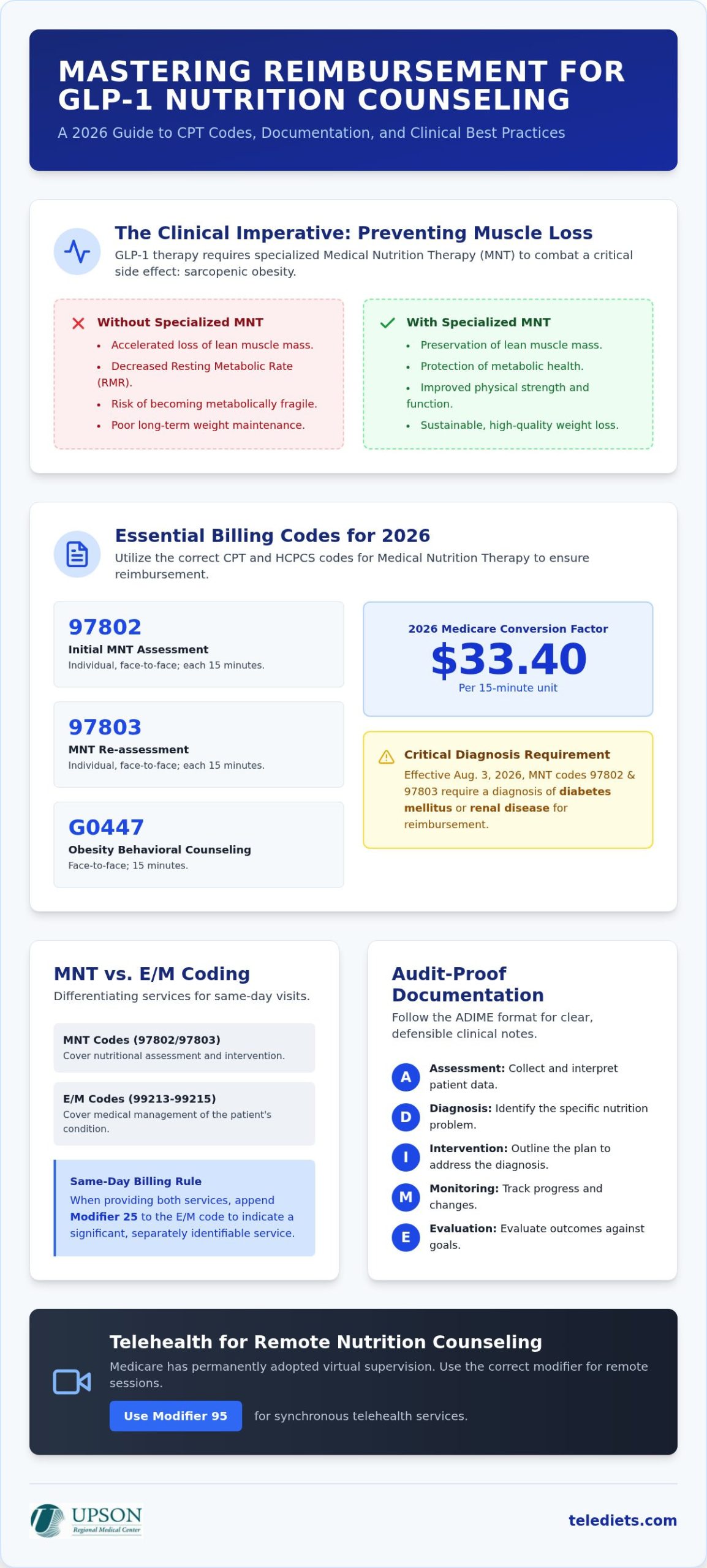
Navigating the financial side of clinical care requires precision. To secure reimbursement, you must utilize the correct CPT codes for Medical Nutrition Therapy. These codes are billed in specific time increments, making accurate documentation of your face-to-face time essential. As of CY 2026, the Medicare conversion factor is set at $33.40, which directly impacts your per-unit revenue for these services.
- 97802: Initial assessment and intervention, individual, face-to-face; each 15 minutes.
- 97803: Re-assessment and intervention, individual; each 15 minutes.
- 97804: Group MNT for two or more individuals; each 30 minutes.
- HCPCS G0447: Face-to-face behavioral counseling for obesity, 15 minutes.
Effective August 3, 2026, claims for MNT codes 97802, 97803, and 97804 will be denied if they aren’t billed with a diagnosis of diabetes mellitus or renal disease. For patients on GLP-1 medications without these specific comorbidities, HCPCS code G0447 often serves as the primary pathway for obesity-related behavioral therapy.
MNT Codes vs. Evaluation and Management (E/M) Codes
Clinicians often confuse 99213-99215 with MNT codes. While E/M codes cover the medical management of CPT codes for GLP-1 nutrition counseling, 97802 focuses strictly on nutritional intervention. If you provide both services on the same day, you must append Modifier 25 to the E/M code. This demonstrates that the nutrition counseling was a significant, separately identifiable service from the medication management visit.
Telehealth Modifiers for Remote Nutrition Counseling
Medicare’s permanent adoption of virtual supervision simplifies remote care. When conducting synchronous sessions, use Modifier 95 to indicate a telehealth service. Ensure your Place of Service (POS) codes align with 2026 standards for non-facility settings. Utilizing integrated billing tools can help automate these modifiers and reduce administrative errors in your workflow.
Maximizing Reimbursement: Documentation and Workflow
Securing payment for CPT codes for GLP-1 nutrition counseling requires more than just picking the right number. It demands a clinical narrative that withstands auditor scrutiny. The gold standard for this is the ADIME format: Assessment, Diagnosis, Intervention, Monitoring, and Evaluation. Your clinical notes must explicitly state the total face-to-face time spent during the session. Since codes like 97802 and 97803 are strictly time-based, failing to record these specific minutes is the fastest way to trigger a claim denial or an audit flag.
Accuracy in coding extends to your diagnosis selection. You should link your MNT intervention to specific ICD-10 codes, such as E66.01 for morbid obesity or E11.9 for type 2 diabetes. It’s also vital that the physician’s written referral is physically present or digitally linked within the Registered Dietitian Nutritionist (RDN) documentation. This paper trail confirms the service was medically necessary and officially ordered by the prescribing provider.
Justifying Medical Necessity for GLP-1 Patients
Your documentation should illustrate clinical complexity. Use recent lab results, such as A1C levels or lipid panels, to support the MNT prescription. It’s helpful to document a “failure of standard weight loss” prior to starting the GLP-1 and MNT combination. This proves that intensive counseling is a required medical intervention rather than a general wellness choice. Clear evidence of metabolic risk factors makes your use of CPT codes for GLP-1 nutrition counseling much harder for payers to contest.
Streamlining the MNT Referral Process
Handoffs between physicians and RDNs must be seamless to maintain a high-volume practice. Standardizing this process ensures every GLP-1 patient receives metabolic support without administrative delays. You can simplify this by using integrated insurance billing tools to generate necessary clinical documentation automatically. This reduces the manual burden on your staff while ensuring every note meets the highest compliance standards for 2026.
Scaling Your GLP-1 Practice with Automated MNT Protocols
Managing a high-volume GLP-1 program requires more than just clinical expertise; it demands operational efficiency. Manual meal planning is a bottleneck that prevents many practices from scaling effectively. By leveraging AI-powered software, you can generate evidence-based GLP-1 Meal Plan Protocols in seconds. This technology bridges the gap between clinical prescribing and the practical nutritional support patients need to succeed without adding hours to your workday.
Integrating TeleDIETS billing tools into your clinical workflow allows you to focus on patient care while the software handles the administrative complexities of CPT codes for GLP-1 nutrition counseling. This automation ensures that every intervention is documented accurately, reducing the risk of human error in your insurance claims. It’s a strategic way to protect your revenue while maintaining a high standard of care.
The Power of Diagnosis-Based Meal Planning
For complex patients, the Advanced Medical Series meal plans provide a higher level of clinical precision. These protocols are personalized based on lab results, ensuring that protein intake is sufficient to combat the muscle wasting discussed earlier. When patients receive a plan tailored to their specific metabolic profile, compliance rates typically improve. This structured approach moves beyond generic advice, providing a clear roadmap that aligns with their medication schedule.
Integrating Telemedicine Plugins for Hybrid Care
The shift toward remote care is a permanent fixture of modern medicine. Using a specialized telemedicine plugin allows you to deliver MNT protocols through a secure, HIPAA-compliant interface. This hybrid model enables you to track patient progress and outcomes in real-time. By documenting these digital touchpoints, you build a robust case for medical necessity, justifying the continued use of CPT codes for GLP-1 nutrition counseling during follow-up assessments. This data-driven workflow not only improves clinical outcomes but also secures the long-term financial health of your practice.
Future-Proofing Your GLP-1 Clinical Workflow
Success in GLP-1 therapy requires a dual focus on pharmaceutical efficacy and metabolic preservation. By prioritizing specialized medical nutrition therapy, you protect your patients from muscle loss while establishing a sustainable revenue stream for your practice. Mastering the CPT codes for GLP-1 nutrition counseling, such as 97802 and 97803, is no longer just an administrative task. It’s a clinical necessity that ensures your services meet the highest standards of 2026 compliance and medical necessity.
You don’t have to navigate these complexities alone. Implementing sophisticated tools allows you to scale your impact without increasing your workload. You can upgrade your clinic with TeleDIETS GLP-1 Billing & Coding Tools to access automated GLP-1 meal plan protocols, integrated insurance billing tools, and a seamless telemedicine workflow plugin. This partnership empowers you to deliver high-quality, diagnosis-based care efficiently. With the right systems in place, your practice is well-positioned to lead the future of metabolic health and achieve exceptional patient outcomes.
Frequently Asked Questions
Can I bill CPT 97802 and an E/M code on the same day for a GLP-1 patient?
Yes, you can bill both services provided they are distinct and separately documented. You must append Modifier 25 to the Evaluation and Management code (99212-99215) to show it was a significant, identifiable service from the nutrition therapy. Your notes must clearly separate the medical management of the GLP-1 medication from the nutritional intervention to meet 2026 compliance standards and ensure full reimbursement for both professional services.
Does Medicare cover CPT codes for GLP-1 nutrition counseling?
Medicare Part B covers these services only for patients with specific diagnoses. Effective August 3, 2026, you must link CPT codes for GLP-1 nutrition counseling to diabetes mellitus or renal disease. For patients using medications solely for obesity without these comorbidities, coverage for 97802-97804 is typically unavailable. In these cases, you should explore intensive behavioral therapy codes like G0447, which are designed for eligible beneficiaries focusing on weight management.
How much time is required to bill one unit of CPT 97803?
One unit of CPT 97803 represents 15 minutes of face-to-face time. This code is used for subsequent MNT re-assessments and interventions after the initial 97802 session. You must document the exact start and end times or total minutes spent to justify the units billed. Under current 2026 standards, accurate time-tracking is essential for calculating reimbursement using the updated Medicare conversion factor for physician services.
What ICD-10 codes best support medical necessity for GLP-1 MNT?
Codes like E11.9 for Type 2 diabetes and N18.3 for Chronic kidney disease are the primary drivers for coverage. For obesity-related counseling not covered under MNT, use E66.01 for morbid obesity. Linking these to secondary diagnoses like protein-calorie malnutrition (E44.0) can further justify specialized CPT codes for GLP-1 nutrition counseling. This documentation helps prove that intensive nutritional support is a mandatory clinical intervention for patients on high-potency medications.
Are there specific CPT codes for remote GLP-1 patient monitoring?
You should use standard MNT codes 97802-97804 with Modifier 95 for synchronous telehealth sessions. While Remote Therapeutic Monitoring codes exist, they are generally intended for non-physiological data. For most GLP-1 programs, the focus remains on live nutritional intervention via telemedicine. Ensure your Place of Service code reflects the 2026 standard for non-facility settings. This ensures your remote sessions are reimbursed at the appropriate rate for your clinical environment.
Leave a Reply