
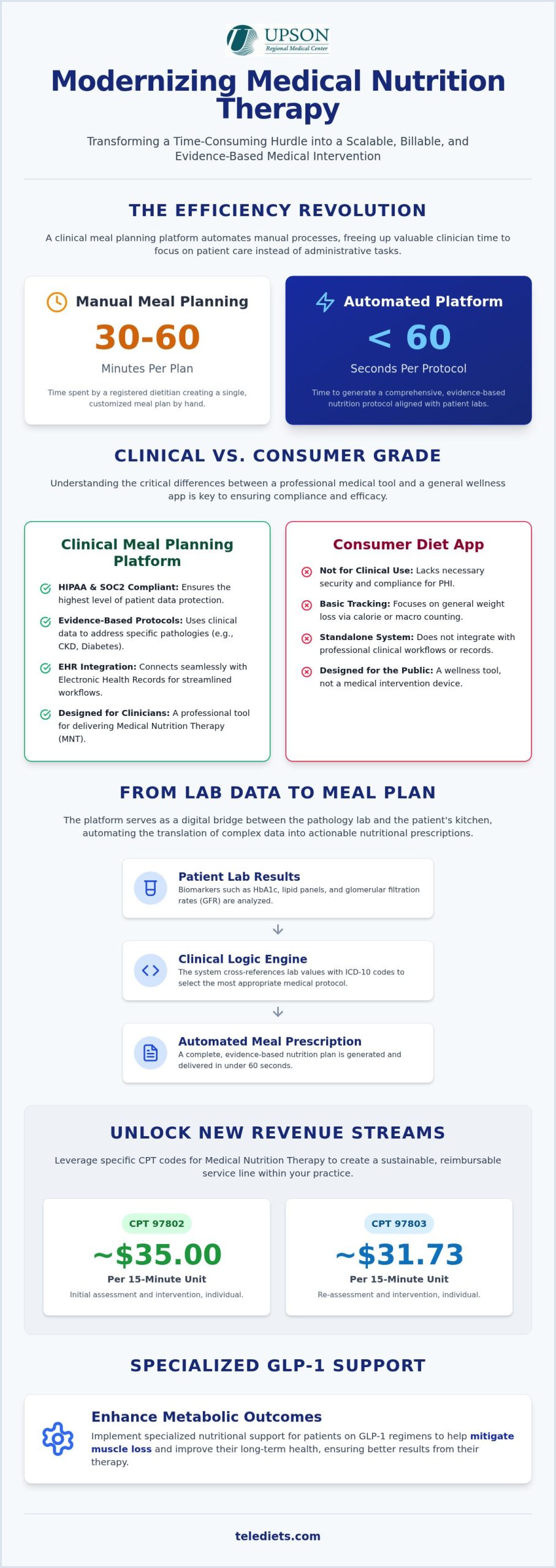
Registered dietitians typically spend 30 to 90 minutes creating a single meal plan by hand, yet a modern clinical meal planning platform can now generate evidence-based protocols in under 60 seconds. You likely recognize that medical nutrition therapy is essential for patient success, especially for those on GLP-1 regimens or managing chronic disease. However, between the manual effort required and the complexities of insurance reimbursement, implementing it at scale often feels like an administrative burden rather than a clinical win. Adopting a clinical-grade system changes that dynamic by placing high-performance tools directly into your workflow.
This guide demonstrates how a clinical meal planning platform transforms nutrition from a time-consuming hurdle into a scalable, billable, and evidence-based medical intervention. You’ll discover how to automate prescriptions in seconds while ensuring they align perfectly with patient lab results. We’ll also provide clarity on capturing new revenue streams through CPT codes 97802 and 97803, which currently offer reimbursements of approximately $35.00 and $31.73 per 15-minute unit. By the end of this article, you’ll have a clear roadmap for modernizing your practice’s nutritional infrastructure for 2026.
Key Takeaways
- Differentiate between consumer-facing diet apps and a professional clinical meal planning platform to ensure your practice remains HIPAA-compliant and evidence-based.
- Learn how to automate nutritional protocols by translating patient lab results, such as A1c and lipid profiles, into precise medical prescriptions.
- Implement specialized nutritional support for GLP-1 patients to help mitigate muscle loss and improve their long-term metabolic outcomes.
- Streamline your clinical workflow using telemedicine plugins that automate meal plan delivery; this allows for more efficient remote patient monitoring.
- Maximize your practice’s ROI by mastering the specific CPT codes and billing strategies required for sustainable, reimbursable nutrition services.
What is a Clinical Meal Planning Platform?
A clinical meal planning platform isn’t just a digital recipe book or a simple calorie tracker. It’s a sophisticated, HIPAA-compliant SaaS infrastructure built specifically for the medical community. By 2026, the definition has evolved from a simple planning tool into a robust medical nutrition therapy engine. It automates the translation of complex patient data into actionable, evidence-based dietary prescriptions. This technology allows providers to bridge the gap between clinical lab values and the actual food their patients consume at home.
To understand the scale of this technology, one must look at the broader field of What is Clinical Nutrition? and its focus on managing metabolic changes associated with chronic disease. These platforms allow you to move beyond generic advice. Instead, they offer a way to deliver high-precision nutrition that functions as a legitimate medical intervention. The shift toward AI-driven automation in 2026 means that high-volume clinics can finally offer personalized, lab-based nutrition to every patient, regardless of their caseload size.
Clinical Precision vs. Consumer Wellness
Consumer-facing diet apps are designed for the general public. They focus on weight loss through basic calorie counting or macro-tracking, but they lack the clinical depth required for a medical environment. In contrast, a clinical meal planning platform uses evidence-based protocols to address specific pathologies. For example, a patient with stage 3 chronic kidney disease requires strict potassium and phosphorus limits that a standard app simply can’t manage safely. You need a system that offers an advanced medical series of plans tailored to complex diagnoses. Clinician oversight remains central here. While the system generates a plan in under 60 seconds, you maintain the authority to review and adjust protocols based on your patient’s unique history. This ensures that automation serves your professional judgment rather than replacing it.
The Core Components of Clinical-Grade Software
To function effectively in a modern clinic, several core components are required for a clinical meal planning platform to be successful. These include:
- Automated Prescription: The system should generate nutrition plans based on specific ICD-10 codes. This ensures the protocol matches the medical diagnosis exactly.
- EHR Integration: Seamless data flow between the platform and Electronic Health Records reduces duplicate entry and improves accuracy across the care continuum.
- Security Standards: SOC2 and HIPAA compliance are non-negotiable. Your patient’s sensitive health information must be protected by the highest industry standards.
- Lab-Based Logic: The engine should analyze biomarkers like A1c or lipids to select the most appropriate dietary protocol automatically.
Integrating these features allows your practice to scale its nutrition services without increasing provider burnout. It transforms a formerly manual task into a streamlined, professional process that supports better patient outcomes.
Translating Lab Results into Nutritional Protocols
Manual meal planning has historically been a significant bottleneck in clinical practice. It’s a process that often requires hours of tedious calculation to ensure a diet doesn’t conflict with a patient’s medical status. A modern clinical meal planning platform removes this administrative weight by acting as a digital bridge between the pathology lab and the patient’s kitchen. The core mechanism involves a direct analysis of specific biomarkers, such as HbA1c for glycemic control, lipid panels for cardiovascular health, and glomerular filtration rates (GFR) for renal management. By interpreting these values, the platform selects the most appropriate medical protocol with mathematical precision.
Efficiency is the primary driver of this transition. While a registered dietitian might spend nearly an hour constructing a single week of meals, an automated engine can generate a comprehensive 30-day plan in under 60 seconds. This speed doesn’t just save time; it fundamentally reduces provider burnout by allowing you to focus on patient interaction rather than data entry. Understanding the clinical necessity of these protocols is vital, especially considering the federal standards for Medicare reimbursement for MNT , which require documented medical necessity and a physician’s referral for coverage.
Biomarker Integration for Personalized Care
The platform doesn’t just look at a snapshot of a patient’s health; it facilitates a dynamic care model. As blood chemistry improves or shifts, the system adjusts macro and micronutrient requirements in real time. For instance, if a patient’s renal markers show improvement, the plan can automatically increase protein allowances without manual intervention. This level of personalization is central to managing complex comorbidities. Clinicians looking to scale these interventions often find the Advanced Medical Series provides the necessary depth for highly specialized patient profiles.
Evidence-Based Protocols for Chronic Disease
Maintaining clinical validity at scale requires strict adherence to established standards. Every protocol within a clinical meal planning platform is designed to meet or exceed the Academy of Nutrition and Dietetics guidelines. Whether you’re treating hypertension with DASH-aligned plans or managing Type 2 Diabetes, the AI engine ensures that every recipe and daily total remains within safe, therapeutic ranges. This standardization provides a layer of safety and reliability that manual planning can’t consistently match, ensuring that every patient receives a gold-standard intervention regardless of the clinic’s daily volume.
Managing the GLP-1 Patient Journey with Specialized Tools
GLP-1 receptor agonists have revolutionized obesity medicine, yet they present unique nutritional hurdles that standard dietary advice simply cannot solve. When patients experience rapid weight loss, they are at a significant risk of losing lean muscle mass alongside adipose tissue. A clinical meal planning platform provides the necessary precision to counter these risks. By integrating dedicated GLP-1 Meal Plan Protocols, you ensure your patients receive the high-protein, nutrient-dense intake required to maintain metabolic health throughout their treatment journey.
Managing side effects like nausea and gastroparesis is another area where specialized tools are essential. Clinical meal timing and specific food textures can significantly improve patient tolerance and medication adherence. Without a dedicated protocol within the platform, providers often struggle to give actionable advice that keeps patients comfortable. Using a clinical meal planning platform allows you to automate these complex adjustments, ensuring that every patient’s diet supports their pharmacological therapy rather than conflicting with it.
Nutritional Support for Pharmacological Interventions
Targeted medical nutrition therapy serves as the primary defense against sarcopenia and the aesthetic concerns often referred to as "Ozempic face," which result from rapid facial fat and muscle depletion. Ensuring adequate protein intake is vital; the platform automates these calculations to prioritize muscle preservation. Additionally, managing hydration and fiber intake is crucial for patients on GLP-1s to prevent common gastrointestinal complications. Medical nutrition therapy provides the essential metabolic foundation that allows GLP-1 medications to achieve their full therapeutic potential while preserving lean muscle mass.
Long-term Maintenance and Titration Support
Success in an obesity clinic isn’t just about the initial weight loss; it’s about long-term maintenance. As patients titrate their dosage, their nutritional needs and appetite levels shift. A clinical meal planning platform allows you to track adherence and adjust protocols seamlessly during these transitions. Transitioning from active weight loss to a maintenance protocol requires a deliberate shift in caloric and macronutrient targets. By using specialized series to support these phases, you improve patient retention and ensure that the metabolic gains achieved during pharmacological treatment are sustained over time. This structured approach transforms a temporary medication cycle into a permanent lifestyle shift.
Workflow Integration and Telemedicine Efficiency
Integrating nutrition into a busy practice shouldn’t require a total overhaul of your daily operations. A clinical meal planning platform acts as the connective tissue between your consultation and the patient’s daily habits. By utilizing a "prescribe and forget" model, you can deliver comprehensive nutrition protocols without adding hours of manual follow-up to your schedule. This automation allows you to scale your MNT services effectively, providing high-level care to a larger patient base without the immediate need to hire additional full-time staff. You maintain control over the clinical direction while the software handles the administrative heavy lifting.
Patient engagement is often the deciding factor in clinical success. When patients access their protocols through a dedicated, provider-branded interface, it reinforces the connection to your practice and increases the perceived value of the intervention. This professional presentation builds trust and encourages long-term adherence, which is vital for managing chronic conditions. To see how these tools can fit into your specific practice model, you can explore our telemedicine plugin features to streamline your remote care delivery.
The Telemedicine Plugin Advantage
The shift toward virtual care requires tools that are as agile as the providers using them. A dietitian telemedicine plugin allows you to embed nutrition planning directly into your virtual visit window, making it a seamless part of the patient encounter. You don’t have to toggle between multiple windows or log into separate systems. You can make real-time adjustments based on the conversation, and the platform automatically syncs this data back to your central clinical dashboard. This ensures that the patient leaves the call with a clear, actionable plan already waiting in their inbox, ready for immediate implementation.
Standardizing Care Across Multi-Provider Clinics
In multi-provider clinics, maintaining a consistent standard of care is a constant challenge. By leveraging a clinical meal planning platform, you eliminate the variability that often comes with individual provider preferences. Every practitioner in your group can access the same evidence-based series, ensuring that every patient receives the same quality of nutritional support regardless of who they see. Reporting and analytics tools then allow you to track clinic-wide outcomes. This data is essential for proving the efficacy of your interventions and identifying areas where patient populations might need additional support. It transforms nutrition from a fragmented suggestion into a standardized clinical protocol.
Maximizing ROI: Insurance Billing and Reimbursement
Integrating a clinical meal planning platform isn’t just a strategy for improving patient outcomes; it’s a calculated move to enhance your practice’s financial health. Historically, many clinics viewed nutrition services as a "loss leader" due to the high labor costs of manual planning. In 2026, that narrative has shifted. By automating the creation of medical nutrition therapy (MNT) protocols, you turn a time-intensive process into a high-efficiency revenue stream. This allows your staff to focus on billable patient contact rather than administrative paperwork, ensuring that every nutritional intervention contributes to the bottom line.
The financial viability of these services relies on accurate coding and robust documentation. TeleDIETS serves as the essential bridge between clinical care and practice revenue, providing the specialized Insurance Billing & CPT Coding Tools necessary to navigate the complexities of payer requirements. When your clinical meal planning platform generates a protocol, it simultaneously creates the data trail needed to justify medical necessity. This integration significantly reduces the likelihood of claim denials and streamlines the path to reimbursement.
Navigating CPT Codes for Medical Nutrition Therapy
Understanding the nuances of CPT codes 97802 and 97803 is vital for capturing the full value of your services. CPT code 97802 covers the initial assessment and intervention, which is currently reimbursed at approximately $35.00 per 15-minute unit for Medicare patients in 2026. To bill this successfully, you must provide detailed documentation of the patient’s medical history, dietary intake, and the specific goals of the MNT. The platform automates this by generating billable patient records that reflect the exact protocols prescribed. Documentation for CPT 97803 requires a recorded reassessment of the patient’s nutritional status and a subsequent modification of the treatment plan based on updated clinical data. By using the system to track these changes, you ensure every follow-up visit meets the stringent requirements for reassessment billing.
Scaling Revenue Through Automated Follow-ups
Ongoing patient care offers a significant opportunity for recurring revenue, particularly through reassessment protocols. Medicare Part B typically covers three hours of MNT in the first year and two hours in subsequent years for patients with diabetes or renal disease. A clinical meal planning platform helps you maximize these allowances by alerting you when a patient is due for a reassessment. This proactive approach supports "incident to" billing where applicable and ensures you don’t leave unclaimed revenue on the table. By closing the loop between the initial lab result, the automated prescription, and the final reimbursed service, you create a sustainable model for chronic disease management. This structured financial framework allows your practice to grow its nutrition department without increasing its overhead, turning MNT into a predictable and scalable asset.
Modernizing Your Practice with Precision Nutrition
The evolution of medical nutrition therapy is no longer a distant prospect; it’s a present reality for high-performance clinics. By moving away from manual, time-consuming meal planning, you can focus on what matters most: the patient. You now have the ability to translate complex lab results into precise protocols in seconds. This ensures that every patient, especially those on GLP-1 medications, receives the metabolic support they need to succeed.
Adopting a robust clinical meal planning platform is the final step in modernizing your chronic disease management workflow. With the right infrastructure, you can provide the Advanced Medical Series protocols your patients require while utilizing integrated insurance billing tools to secure your practice’s ROI. The addition of a seamless telemedicine plugin integration means you can deliver this high-standard care from anywhere.
It’s time to transform your nutritional services from a hurdle into a scalable medical intervention. We invite you to schedule a demo of the TeleDIETS clinical nutrition engine today. You have the expertise to lead your patients toward better health; now you have the tools to make it effortless.
Frequently Asked Questions
What is the difference between CPT 97802 and 97803 for nutrition billing?
CPT 97802 is designated for the initial face-to-face assessment and intervention, typically allowed once per benefit year. For 2026, the Medicare reimbursement rate for this code is approximately $35.00 per 15-minute unit. In contrast, CPT 97803 is used for follow-up reassessments and subsequent interventions, reimbursed at $31.73 per 15-minute unit. Both codes require a physician’s referral and documented medical necessity to qualify for payment.
Can a clinical meal planning platform integrate with my existing EHR?
Yes, most clinical-grade systems are designed to integrate seamlessly with Electronic Health Records (EHR) through secure API or HL7 connections. This interoperability ensures that patient demographic data and lab results flow directly into the nutrition engine, reducing duplicate data entry. It also allows the generated meal plans and progress notes to be saved directly back to the patient’s medical chart for comprehensive record-keeping.
How do GLP-1 meal plan protocols differ from standard weight loss plans?
GLP-1 protocols prioritize lean muscle preservation and gastrointestinal comfort over simple caloric restriction. Unlike standard plans, these specialized protocols feature higher protein density to combat sarcopenia and specific fiber targets to manage common side effects like constipation. They also utilize smaller, more frequent meal timings to help patients manage gastroparesis and nausea often associated with GLP-1 receptor agonists.
Is medical nutrition therapy software HIPAA compliant?
Professional clinical meal planning platform software must adhere to strict HIPAA and SOC2 security standards to protect sensitive patient health information. This includes end-to-end data encryption, secure provider and patient portals, and the execution of a Business Associate Agreement (BAA). Without these connections, any clinical software would be non-compliant. The safeguards that TeleDIETS offers ensures that all nutritional prescriptions and biomarker data remain confidential and compliant with federal regulations.
Do I need a registered dietitian on staff to use a clinical meal planning platform?
You don’t necessarily need a registered dietitian on staff to utilize the platform. TeleDIETS pulls from a massive library of evidence-based meal plans created by a team of registered and licensed dietitians for nearly 30 years. However, having an RD can be beneficial for maximizing certain billing opportunities, as some insurance payers require their involvement for specific MNT reimbursements. The platform acts as a force multiplier, allowing your existing team to deliver high-level nutritional care regardless of their specific dietary background. TeleDIETS also enables colaboration between dietitians to share work and specific nutrition protocols.
How much time does it take to generate a patient meal plan using AI?
Modern AI-driven engines can generate a fully personalized, 30-day nutrition plan in under 30 seconds. This is a drastic reduction from the 30 to 60 minutes typically required for manual meal plan creation consisting of one, two or three days. This speed allows providers to finalize and deliver a medical nutrition prescription during the actual patient consultation, improving both clinic efficiency and patient satisfaction.
What biomarkers are most commonly used to trigger clinical dietary protocols?
The most common biomarkers used to automate protocols include HbA1c for glycemic control, lipid panels for cardiovascular health, and glomerular filtration rate (GFR) for renal management. The system analyzes these specific values to select the appropriate Advanced Medical Series plan. By basing the diet on blood chemistry rather than self-reported data, the platform ensures the intervention is truly evidence-based.
Can I customize the clinical protocols within the platform for my specific practice?
Yes, you can adjust the underlying parameters of any protocol to align with your practice’s specific clinical philosophy. While the platform provides a foundation of evidence-based Standard and Advanced Medical Series plans, you have the authority to modify macronutrient ranges, exclude specific allergens, or set custom caloric targets. This flexibility ensures the automation supports your professional judgment rather than replacing it.
Leave a Reply