
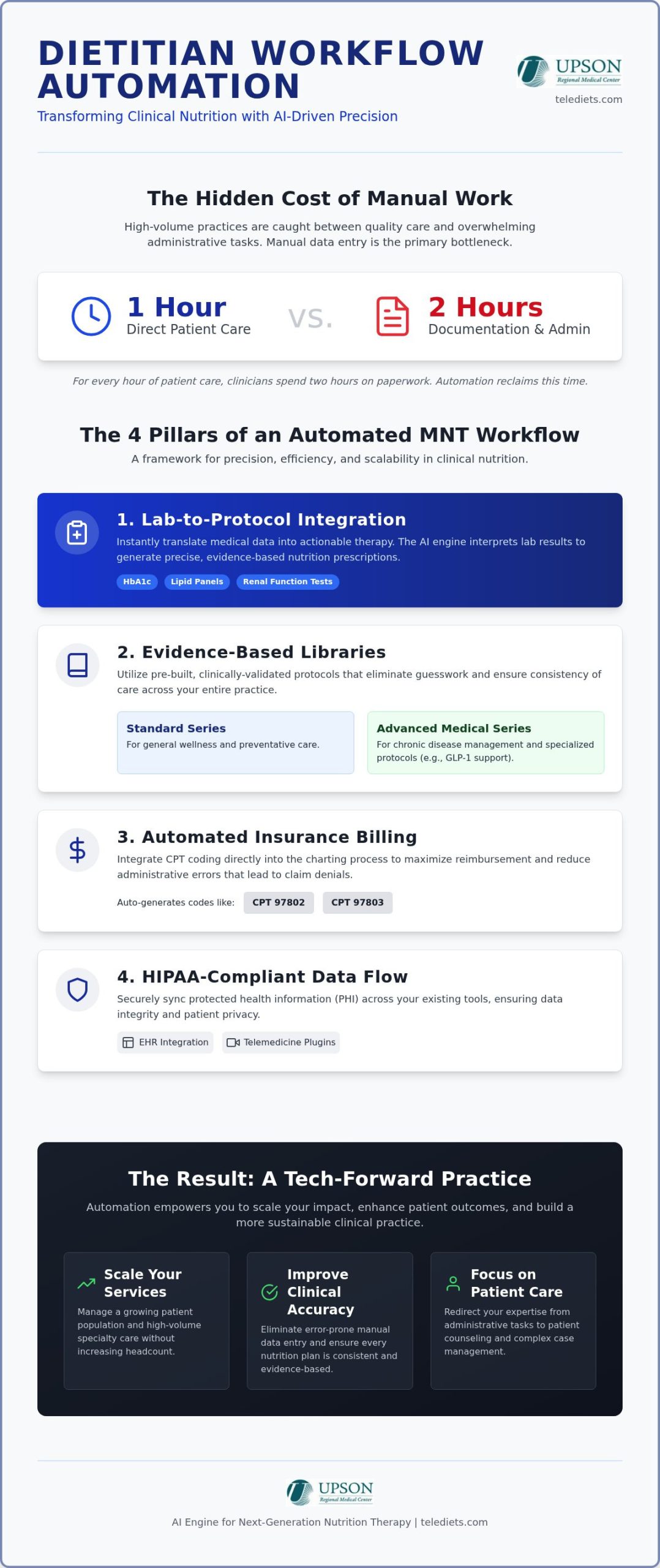
Did you know that for every hour spent with a patient, the average clinician spends two full hours on documentation and manual data entry? It’s a staggering reality that often leaves high-volume practices feeling stuck between providing quality care and maintaining a sustainable business. You likely entered the field of clinical nutrition to transform patient health, not to spend your afternoons manually mapping lab results to meal plans or untangling complex insurance requirements. This is where dietitian workflow automation becomes your most vital asset.
We understand the pressure to scale while maintaining clinical precision, especially with the rise of specialized needs like GLP-1 protocols. In this article, you’ll discover how to eliminate error-prone manual entry and streamline your clinical billing using advanced AI-driven nutrition therapy workflows. We’ll explore the latest 2026 standards for integrating lab-to-prescription engines and show you how to maximize reimbursement for CPT codes 97802 and 97803 without adding to your administrative burden. By the end of this guide, you’ll have a clear roadmap for building a tech-forward practice that prioritizes both provider well-being and patient outcomes.
Key Takeaways
- Learn how dietitian workflow automation transforms manual data entry into a high-speed clinical engine, allowing you to scale your practice without increasing administrative hours.
- Understand the process of lab-to-protocol integration to automatically generate evidence-based dietary plans based on specific blood markers and diagnoses.
- Discover strategies to optimize insurance reimbursement by integrating CPT coding tools directly into your nutrition therapy workflow.
- Explore the impact of specialized protocols, such as the Advanced Medical Series, in managing chronic metabolic conditions and modern weight management treatments.
- Gain a step-by-step framework for mapping your patient journey and integrating an AI nutrition engine with your existing EHR and telemedicine platforms.
The Shift to Clinical-Grade Dietitian Workflow Automation
Modern healthcare requires more than just static meal templates. In the specialized field of clinical nutrition, practitioners are moving away from general wellness trackers toward sophisticated clinical prescription engines. True dietitian workflow automation isn’t just about creating a PDF; it’s about an integrated system that translates medical data into actionable therapy. This shift allows providers to move beyond the limitations of manual meal planning, which remains the primary bottleneck for scaling Medical Nutrition Therapy (MNT). By automating the heavy lifting of data synthesis, you can ensure that every protocol is consistent, accurate, and tailored to the patient’s specific metabolic needs.
The Cost of Manual Nutrition Management
Manual data entry is more than a nuisance; it’s a significant clinical risk. When you’re transcribing lab results from an EHR into a meal plan, the margin for human error increases with every patient. Research shows that physicians spend an average of two hours on documentation for every one hour of direct patient care. This administrative burden limits the number of patients you can serve and delays the delivery of critical nutritional interventions. Automation removes these friction points, allowing for the rapid generation of protocols that are grounded in clinical validity rather than manual guesswork.
Meeting the Demand for High-Volume Specialty Care
High-volume practices face a unique challenge in 2026. The surge in patients requiring specialized metabolic support, particularly those on GLP-1 protocols, has created a demand that manual workflows simply can’t meet. Dietitian workflow automation empowers clinics to scale their services without the immediate need to increase full-time equivalent (FTE) headcount. By utilizing an AI-driven engine to handle the logistics of protocol generation, you can focus your expertise on patient counseling and complex case management. This efficiency is essential for maintaining high standards of care while managing a growing patient population. It’s about working smarter, ensuring that your clinical expertise is applied where it matters most while the system handles the repetitive technical tasks.
Core Pillars of an Automated MNT Workflow
A robust medical nutrition therapy (MNT) framework relies on four foundational pillars. These pillars ensure that dietitian workflow automation functions as a clinical asset rather than just a productivity tool. It’s about precision. By moving away from manual data entry, you create a system where clinical data dictates the therapeutic path. This approach transforms the patient experience from a generic consultation into a targeted medical intervention.
- Lab-to-Protocol Integration: Ingesting blood markers to trigger specific dietary interventions.
- Evidence-Based Libraries: Utilizing a Standard Series for general wellness and an Advanced Medical Series for chronic disease management.
- Automated Insurance Billing: Generating CPT codes like 97802 and 97803 within the charting workflow.
- HIPAA-Compliant Data Flow: Securing protected health information across EHR and telemedicine plugins.
Automating Lab-Based Prescriptions
AI engines now interpret markers such as HbA1c, lipid panels, and renal function tests to suggest the most appropriate Medical Series plan. This transition toward AI-powered precision nutrition ensures that every patient receives a prescription-grade plan that adheres to strict clinical guidelines. It eliminates the “creative” guesswork often found in general nutrition apps, replacing it with evidence-based logic that matches metabolic needs to dietary protocols in seconds.
Maximizing Reimbursement via Automated Coding
Financial sustainability is as vital as clinical outcomes. Automated systems integrate CPT coding tools directly into the charting process. When you document an initial assessment or a follow-up, the software automatically tags the session with the correct unit-based codes. This precision significantly reduces the administrative errors that lead to claim denials. For practices looking to scale, utilizing an integrated MNT engine ensures that billing is as streamlined as the nutrition therapy itself. It allows you to focus on the patient while the system handles the complexities of medical necessity documentation.
Implementing Automation in High-Volume Clinical Settings
Scaling a nutrition service within a busy medical practice requires a transition from manual oversight to a structured digital ecosystem. Success begins with mapping the patient journey from the moment of diagnosis to the delivery of nutritional therapy. By identifying administrative friction points, you can deploy dietitian workflow automation that bridges the gap between the EHR and the patient’s daily habits. This approach ensures that your clinical expertise is supported by a system capable of handling hundreds of patients simultaneously without sacrificing individual care quality.
Integrating Telemedicine Plugins for Remote Care
Remote MNT delivery is no longer an optional feature; it’s a requirement for high-volume clinics. Utilizing a telemedicine plugin allows you to conduct virtual consultations that are directly linked to your AI protocol engine. This integration means you can adjust a patient’s Advanced Medical Series plan in real-time during a call. It expands the reach of a single dietitian, allowing for consistent care delivery across different geographic locations while maintaining a unified HIPAA-compliant data flow. You’ll find that virtual care, when powered by Nutrition Informatics, leads to higher engagement rates and better long-term adherence.
Managing GLP-1 Patient Workflows
The rapid growth of obesity management programs has placed immense pressure on clinical staff. Managing GLP-1 patient workflows requires specific attention to side effect mitigation and muscle preservation. Automation allows you to deploy standardized GLP-1 meal plan protocols the moment a medication is prescribed. These protocols ensure patients receive the necessary protein and micronutrient guidance to protect lean body mass while they lose weight. For clinics managing these complex cases, you can integrate our specialized GLP-1 protocols to automate the follow-up process and monitor patient progress through digital check-ins. This systematic approach ensures that every patient receives the high-touch support they need to succeed on their weight loss journey.
TeleDIETS: The AI Engine for Next-Generation Nutrition Therapy
TeleDIETS serves as the foundational architecture for modern medical nutrition therapy. It transforms nutrition from a peripheral recommendation into a core clinical service by providing an AI engine that generates personalized protocols in seconds. Unlike consumer-grade apps, this system utilizes the Advanced Medical Series to address chronic metabolic conditions with clinical precision. By integrating this technology, your practice moves beyond the limitations of manual planning, ensuring that every patient receives a prescription-grade dietary intervention. This level of dietitian workflow automation creates a scalable model where high-quality care is never sacrificed for volume.
Customizable AI Licensing for Enterprise Platforms
Many high-volume practices and hospital systems struggle with standalone SaaS products that don’t fit their existing infrastructure. TeleDIETS addresses this by offering customizable AI licensing for enterprise platforms. This allows clinical directors to integrate our clinical nutrition engine directly into proprietary telemedicine apps and hospital EHRs. You can build a unique, branded experience for your patients while relying on our proven, evidence-based protocols. It’s a sophisticated solution that bridges the gap between physicians and dietitians, ensuring a unified and authoritative approach to patient care.
Getting Started with Clinical Automation
Transitioning from legacy software to an AI-powered MNT platform is a strategic move for any forward-thinking clinic. The process begins with auditing your current data flow and identifying exactly where manual entry slows down your clinical team. By adopting a modern system, you future-proof your practice against the increasing complexity of medical nutrition standards and reimbursement requirements. Clinical directors ready to streamline their operations can secure your clinical software access here to begin the implementation process. This step is the first toward achieving a truly efficient, tech-forward dietitian workflow automation strategy that scales seamlessly with your patient volume.
To ensure a successful transition, consider these immediate priorities:
- Identify the most common chronic conditions in your patient population to select the right Medical Series protocols.
- Train your staff on utilizing the telemedicine plugin for remote consultations.
- Audit your billing process to ensure CPT codes 97802 and 97803 are being captured automatically.
The Future of Scalable Clinical Nutrition
Embracing a digital-first approach to medical nutrition therapy is no longer just an option for growing practices; it’s a clinical necessity. By integrating dietitian workflow automation, you move beyond the administrative bottlenecks that limit your reach and impact. You’ve seen how lab-to-protocol engines generate precise, evidence-based plans in seconds while ensuring your billing for CPT codes 97802 and 97803 remains accurate and optimized. This shift allows your team to focus on high-level clinical decision-making rather than repetitive manual data entry.
Whether you’re managing complex metabolic cases or scaling a high-volume GLP-1 program, the right tools ensure consistency and clinical validity across every patient interaction. TeleDIETS provides the HIPAA-compliant infrastructure and specialized Advanced Medical Series protocols needed to thrive in a modern healthcare environment. It’s time to empower your clinicians and provide the sophisticated, data-driven care your patients deserve. Upgrade your clinical workflow with TeleDIETS today and take the first step toward a more efficient, sustainable future for your practice.
Frequently Asked Questions
What is dietitian workflow automation and how does it differ from simple meal planning?
Dietitian workflow automation is a clinical system that integrates data entry, protocol generation, and billing into a single, cohesive engine. Unlike simple meal planning, which often relies on static templates or manual input, this automation uses clinical data to trigger specific medical protocols. It removes the administrative burden by syncing lab results directly with evidence-based dietary interventions, allowing a high-volume practice to scale without losing clinical precision.
Can automated nutrition software integrate with my current EHR system?
Yes, modern clinical nutrition engines are designed to function as plugins or via API to integrate with existing EHR and telemedicine platforms. This ensures a seamless data flow where patient diagnoses and lab markers are pulled directly into the nutrition software. By bridging the gap between your primary medical record and nutritional therapy, dietitian workflow automation maintains a single source of truth while automating the creation of specialized meal plans and billing documentation.
How does automation help with MNT insurance billing and CPT codes?
Automation streamlines the billing process by automatically generating the necessary documentation and CPT codes, such as 97802 and 97803, during the patient encounter. The software tracks the medical necessity of the intervention, reducing the likelihood of manual coding errors. This precision helps maximize reimbursement rates and significantly lowers the rate of claim denials, ensuring the financial sustainability of your clinical nutrition services without adding to your administrative workload.
Is the nutrition protocol generated by AI clinically safe for patients with chronic diseases?
AI-generated protocols are clinically safe when they are built upon established, evidence-based medical series. These systems don’t invent new diets; instead, they act as a logic engine that matches a patient’s specific metabolic markers to a validated clinical protocol. This ensures that every recommendation aligns with current medical nutrition therapy standards for chronic diseases, providing a level of accuracy and consistency that manual planning often struggles to maintain over time.
What are the specific benefits of GLP-1 meal plan protocols for my clinic?
GLP-1 meal plan protocols provide standardized nutritional support that focuses on mitigating common medication side effects and preserving lean muscle mass. By automating these specialized plans, your clinic can handle a higher volume of weight management patients without increasing staff workload. These protocols ensure that every patient on a GLP-1 receptor agonist receives the specific protein and micronutrient guidance required for successful, healthy weight loss outcomes.
Leave a Reply