
Manual meal planning is no longer just an administrative headache; it’s a significant barrier to scaling your clinical impact and capturing lost revenue. You likely recognize that medical nutrition therapy is essential for managing chronic conditions, yet the hours spent translating complex lab results into actionable plates often don’t align with a busy provider’s schedule. When your team is stretched thin, nutrition recommendations often become an afterthought rather than a primary clinical intervention.
Implementing the right automated patient meal planning software bridges the gap between your clinical expertise and your patient’s daily habits. This guide demonstrates how to transform medical nutrition therapy from a manual burden into a scalable, evidence-based service that integrates directly into your professional workflow. You’ll discover how AI-powered engines generate precise protocols in seconds, the specific CPT codes like 97802 and 97803 that unlock insurance-reimbursable revenue, and the ways clinical-grade automation improves outcomes for patients managing obesity and diabetes.
Key Takeaways
- Learn how clinical-grade AI transitions your practice from offering generic meal plans to delivering sophisticated, diagnostic-driven Medical Nutrition Therapy.
- Understand the process of translating biomarkers like blood glucose and renal markers into precise nutrient targets through lab-based automation.
- Identify the core technical requirements for automated patient meal planning software, focusing on HIPAA compliance and evidence-based protocol libraries.
- Discover how to utilize integrated billing tools and CPT codes to turn nutritional counseling into a scalable, insurance-reimbursable revenue stream.
- Gain a practical framework for integrating an AI nutrition engine into your existing clinic workflow to enhance patient outcomes without increasing administrative time.
What is Automated Patient Meal Planning Software for Clinicians?
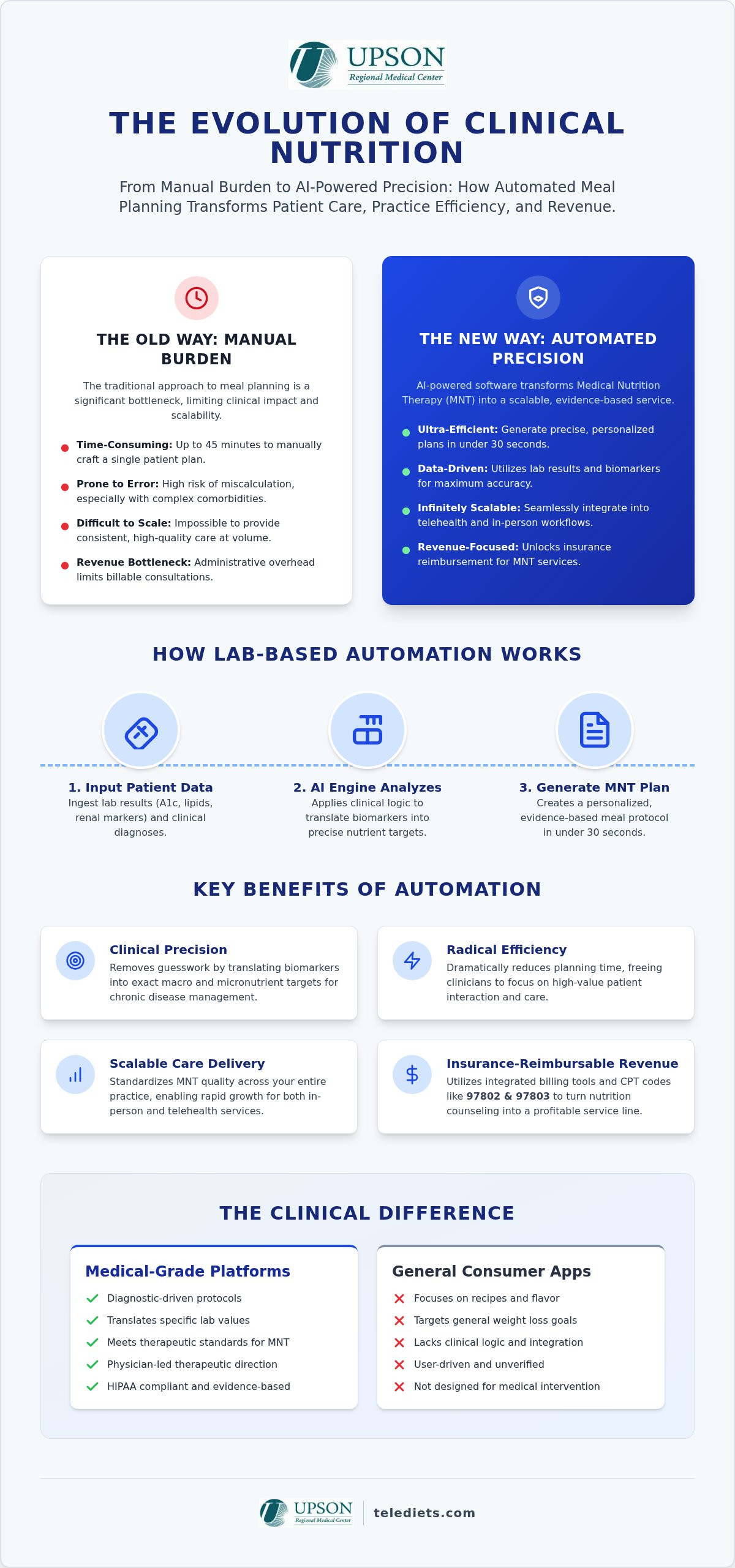
At its core, automated patient meal planning software is a clinical-grade SaaS platform designed to bridge the gap between diagnostic data and daily nutrition. Unlike consumer-facing apps, these systems utilize AI engines to ingest complex medical data, such as lab results and specific clinical diagnoses, to generate precise dietary protocols. It’s about precision, not just recipes. This technology represents a fundamental shift from providing generic meal plans to delivering scalable, evidence-based Medical Nutrition Therapy (MNT).
Manual nutrition counseling often creates a significant bottleneck in high-volume medical practices. When a clinician spends 45 minutes manually calculating macronutrient ratios for a single patient, the service becomes impossible to scale. Automation removes this friction by applying the rigorous standards of Clinical Nutrition to patient profiles in seconds. This ensures that every recommendation remains accurate and consistent across diverse patient populations, regardless of your practice’s volume.
The Clinical Difference: MNT vs. General Recipe Software
The distinction between medical-grade platforms and general recipe software lies in the integration of clinical logic. Clinical systems are built to recognize diagnostic codes and specific lab values, such as A1c levels or lipid profiles, to adjust nutrient targets automatically. While a consumer app might focus on flavor or general weight loss, automated patient meal planning software ensures that every protocol meets therapeutic standards for chronic disease management. This physician-led oversight is vital; it allows you to maintain control over the therapeutic direction while the AI handles the complex calculations. By using structured systems like an Advanced Medical Series, you can provide specialized care that is both clinically sound and professionally efficient.
How Lab-Based Automation Enhances Therapeutic Precision
Effective medical nutrition therapy requires more than just a list of healthy foods. It demands a precise translation of a patient’s unique biomarkers into specific nutrient targets. When you utilize automated patient meal planning software, the system doesn’t just suggest a diet; it calculates exact macronutrient and micronutrient ratios based on blood glucose, lipid profiles, and renal markers. This objective approach removes the guesswork often found in manual planning, ensuring that dietary interventions are as rigorous as pharmaceutical ones.
The complexity of managing patients with multiple comorbidities often increases the risk of human error in dietary prescription. For instance, balancing the protein requirements for a patient with both stage 3 chronic kidney disease and type 2 diabetes is a delicate task. Modern AI applications in clinical nutrition excel here, instantly adjusting protocols to respect conflicting restrictions. The TeleDIETS AI engine leverages this technology to ingest lab data and generate personalized, medical-grade dietary protocols in under 30 seconds. If you’re looking to streamline this process, you can implement these automated protocols within your practice today.
Bridging the Gap Between Diagnosis and Diet
Clinicians can now automate the Advanced Medical Series to address chronic conditions like metabolic syndrome and hypertension with surgical precision. As a patient’s lab results evolve over time, the software dynamically adjusts the plan, ensuring the nutrition therapy remains relevant to their current physiological state. This ensures that the care plan isn’t a static document but a living, therapeutic tool that responds to the patient’s biological progress.
Standardizing Care Across Telemedicine Platforms
Integrating these nutrition engines into your existing telehealth workflow is seamless via dedicated plugins. This allows your practice to scale nutrition services rapidly without the overhead of hiring additional full-time staff. By standardizing the quality of care across your entire patient base, you ensure that every individual receives evidence-based support, whether they are seen in-person or remotely. It’s a reliable way to maintain clinical excellence while increasing your practice’s reach.
Essential Features of Medical-Grade Planning Platforms
Selecting the right automated patient meal planning software requires looking beyond basic recipe databases to the clinical infrastructure supporting your practice. A medical-grade platform must prioritize HIPAA-compliant data handling to ensure all patient communications and lab uploads remain secure. Within this environment, you should have access to comprehensive, evidence-based protocol libraries, such as a Standard Series for general wellness or an Advanced Medical Series for complex chronic disease management. These tools provide the structural foundation needed to maintain high standards of care as your patient volume grows.
User adherence is the final pillar of a successful platform. If a patient finds the interface cumbersome, even the most precise plan will fail. High-quality systems provide intuitive patient portals that drive long-term engagement, making it easier for individuals to track their progress. This educational aspect mirrors recent shifts in academic training, where AI in dietetics education is being used to better prepare professionals for digital-first patient interactions.
Monetizing MNT: Billing and Reimbursement Tools
One of the most significant advantages of professional automated patient meal planning software is the ability to turn nutritional counseling into a profitable service line. Many practices miss revenue opportunities because they lack the documentation needed for insurance claims. Automated systems simplify this by integrating CPT coding tools for codes 97802 and 97803. By maximizing practice ROI through automated tracking, you can ensure your services are both clinically effective and financially sustainable. You can learn more about integrated billing tools for medical nutrition therapy to streamline your reimbursement process.
Specialized Protocols for Modern Obesity Medicine
As the use of GLP-1 receptor agonists increases, specialized protocols have become a necessity in obesity medicine. Patients on these medications require specific “muscle-sparing” and nutrient-dense dietary patterns to mitigate side effects and maintain lean body mass. Automating these requirements ensures that every patient receives the correct protein and micronutrient ratios without requiring manual intervention from your staff. To see how these tools can support your weight management clinic, explore our GLP-1 meal plan protocols to enhance your clinical workflow.
Implementing Automation to Scale Your Practice
Adopting new technology requires a methodical approach to ensure it enhances rather than disrupts your current operations. Integrating an AI nutrition engine into your clinic workflow doesn’t require a total overhaul of your existing systems. It begins with identifying the specific touchpoints where nutrition therapy is most effective, typically during initial assessments or follow-up lab reviews. By training your staff to utilize automated patient meal planning software during these moments, you’re transforming a time-consuming administrative task into a high-value clinical intervention. This shift allows your team to focus on patient counseling rather than data entry.
Measuring the impact of this transition is essential for long-term success. You’ll likely see a measurable improvement in patient adherence as the barriers to starting a new diet are removed. When patients receive immediate, lab-based protocols, their confidence in the treatment plan increases. Future-proofing your practice with AI-driven nutritional intelligence ensures that you remain at the forefront of evidence-based care, capable of handling complex cases with speed and clinical accuracy.
Workflow Integration Strategies
Setting up a telemedicine plugin enables your practice to maintain consistent remote monitoring, which is essential for chronic disease management. You can generate a clinical-grade nutrition prescription in the middle of a consultation, providing immediate value to the patient while their motivation is highest. This real-time delivery reinforces the therapeutic bond and ensures the patient leaves the visit with a clear, actionable plan. It’s about providing the right support at the exact moment it’s needed most.
The Path to Practice Growth
When you analyze the cost-benefit of a SaaS subscription against the hours lost to manual planning, the financial advantage is clear. Professional automated patient meal planning software allows you to scale your MNT services across a larger patient base without increasing your headcount or overhead. This efficiency is the bedrock of sustainable growth in a modern medical environment. Ready to modernize your MNT delivery? Explore TeleDIETS clinical solutions today to enhance your practice’s reach and clinical impact.
Empowering Your Practice Through Clinical Automation
Transitioning to a digital-first approach in nutrition therapy isn’t just about efficiency; it’s about elevating the standard of care you provide to every patient. By integrating automated patient meal planning software, you move beyond generic advice and into the practice of precision medicine. You’ve seen how lab-driven protocols and specialized series for GLP-1 patients can transform outcomes while significantly reducing your team’s administrative load.
The ability to generate evidence-based plans in seconds while securing reimbursement through integrated CPT coding tools ensures your practice remains both clinically effective and financially robust. This technology empowers you to scale your services and reach more patients without compromising the quality of your medical nutrition therapy. It’s time to bridge the gap between diagnosis and dietary intervention with a system built for the modern clinician.
Scale your practice with TeleDIETS medical nutrition therapy software and experience how clinical-grade automation supports your long-term success. Your patients deserve the highest level of nutritional precision, and you deserve a partner that makes delivering it seamless.
Frequently Asked Questions
Is automated patient meal planning software HIPAA compliant?
Yes, medical-grade automated patient meal planning software is built with HIPAA compliance as a core requirement. These platforms use high-level encryption and secure data handling to protect sensitive health information during both storage and transmission. By using a secure SaaS environment, your clinic can safely manage dietary protocols and lab results without risking federal privacy violations or compromising patient trust.
Can I bill insurance for meal plans generated by software?
You can bill insurance for medical nutrition therapy services by utilizing integrated CPT coding tools. Most providers successfully use codes 97802 for the initial assessment and 97803 for subsequent re-assessments. The software simplifies the documentation required for these claims, ensuring you have the evidence needed to support reimbursement while turning nutritional counseling into a sustainable revenue stream for your practice.
How does the software handle complex comorbidities like diabetes and renal disease?
The system handles complex comorbidities by using its AI engine to adjust nutrient ratios based on specific lab data. If a patient has both diabetes and renal disease, the software automatically balances glucose control with precise limits on potassium, phosphorus, and protein. This clinical logic prevents the errors common in manual planning and ensures that dietary prescriptions remain safe for patients with conflicting medical needs.
Does the platform integrate with my existing EHR or telemedicine software?
The platform integrates into your current professional environment via specialized telemedicine plugins. This allows you to generate and deliver nutritional prescriptions without disrupting your existing clinical workflow. By bridging the gap between your diagnostic tools and the nutrition engine, the software ensures that dietary interventions are documented as a formal part of the patient’s medical record and long-term care plan.
How long does it take for a physician to generate a meal plan using AI?
A clinician can generate a complete, medical-grade protocol in under 30 seconds using the AI-powered engine. This efficiency allows you to provide a personalized nutrition prescription during the patient’s visit rather than spending hours on manual calculations afterward. Using automated patient meal planning software enables your team to manage higher patient volumes while maintaining the highest standards of evidence-based care.
Leave a Reply