
In 2026, the success of a clinical nutrition practice no longer rests solely on the quality of patient care; it depends on the precision of the billing engine behind it. You likely feel the weight of administrative burnout every time you manually track 15-minute units or struggle with automating CPT codes for preventative nutrition counseling. It’s disheartening when a missing diagnosis-code link leads to a claim denial after you’ve provided life-changing care.
This guide will show you how to reclaim your time and maximize your practice revenue. By streamlining the complex link between nutritional diagnosis and billing, you can secure a seamless “diagnosis-to-reimbursement” workflow. We’ll examine the 2026 Medicare reimbursement rates for codes like 97802 and 97803 while providing a blueprint for clinical-grade nutrition plans that are pre-mapped to the correct billing codes. You’ll learn how to transform your administrative burden into a reliable, automated engine for growth and clinical excellence.
Key Takeaways
- Identify the critical distinctions between MNT codes and Preventive Medicine Counseling to ensure your 2026 billing aligns with the latest CMS standards.
- Learn how an AI-driven engine bridges the gap between patient lab results and billing-ready prescriptions to eliminate manual entry errors.
- Secure your revenue stream by automating CPT codes for preventative nutrition counseling, ensuring that essential modifiers and diagnosis links are applied before claim submission.
- Scale your practice revenue by integrating specialized GLP-1 meal plan protocols and clinical-grade medical series into your existing telemedicine workflow.
The 2026 Landscape of Preventative Nutrition and MNT Billing
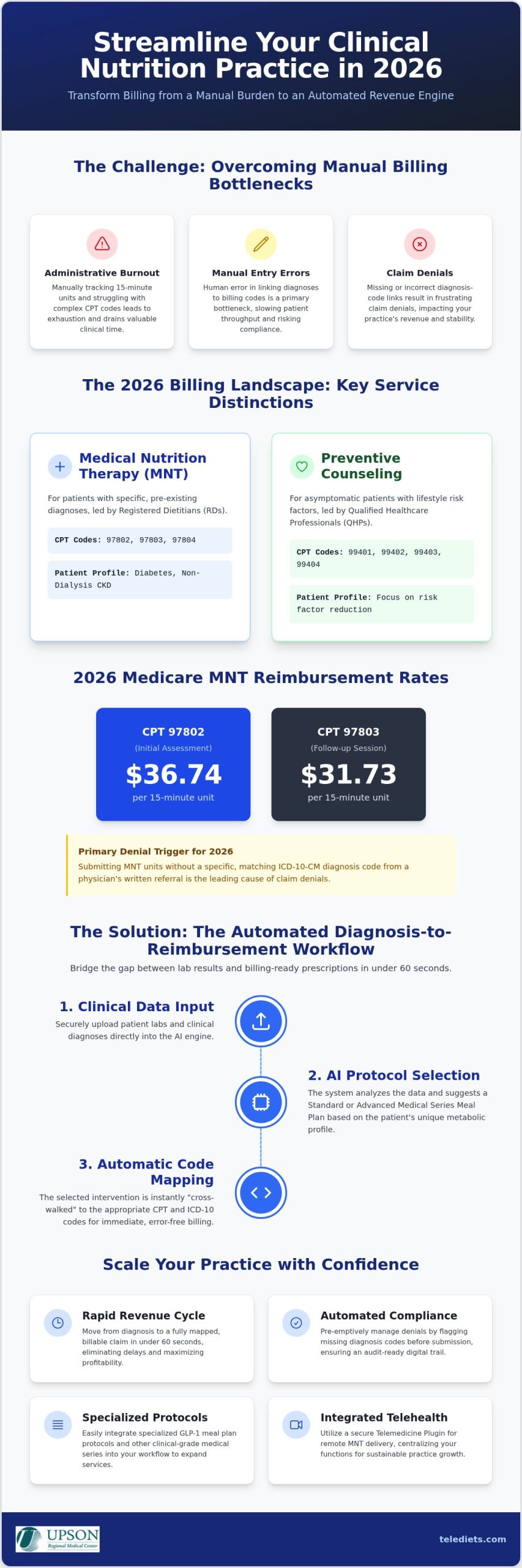
The 2026 clinical environment demands a clear distinction between Medical Nutrition Therapy (MNT) and Preventive Medicine Counseling. While both aim to improve patient health, they utilize different branches of the Current Procedural Terminology (CPT) system. MNT codes (97802-97804) are strictly for patients with specific diagnoses like non-dialysis chronic kidney disease or diabetes. Conversely, Preventive Medicine Counseling (99401-99404) focuses on asymptomatic patients with lifestyle risk factors. High-volume clinics are increasingly turning to software solutions for automating CPT codes for preventative nutrition counseling to protect their bottom line and ensure compliance.
Manual entry remains the primary bottleneck for scaling these services. Registered Dietitians (RDs) typically lead MNT, but Qualified Healthcare Professionals (QHPs) often oversee broader preventative efforts. Without automating CPT codes for preventative nutrition counseling, practices face a “manual coding trap” that slows down patient throughput and invites human error. The financial sustainability of modern practices relies on the “Essential MNT Coding Trio,” which ensures initial assessments, follow-ups, and group sessions are billed with surgical precision to maximize practice revenue.
Understanding CPT 99401-99404 for Physicians
Codes 99401 through 99404 are time-based units used for individual preventative counseling. These codes are appropriate when the primary focus is risk factor reduction rather than treating an acute illness. Physicians should use these instead of standard Evaluation and Management (E/M) visits when the encounter is dedicated solely to behavioral changes like diet or exercise. Each code represents a specific time increment, ranging from 15 to 60 minutes, and requires robust documentation of the patient’s risk profile.
The 2026 MNT Reimbursement Standards
Current CMS guidelines for 2026 set the national Medicare reimbursement rate for 97802 at $36.74 per 15-minute unit and $31.73 for 97803 follow-ups. These rates provide a stable revenue stream if units are tracked accurately. In 2026, the primary trigger for claim denials is the submission of MNT units without a specific ICD-10-CM diagnosis code that matches the physician’s written referral.
How Automation Bridges the Gap Between Labs and CPT Codes
Modern clinical workflows require more than just a diagnosis; they require a direct link between lab data and financial output. The TeleDIETS AI Engine acts as this bridge. It interprets complex blood chemistry and clinical diagnoses to generate billing-ready prescriptions instantly. By automating CPT codes for preventative nutrition counseling, your practice eliminates the “upcoding” risks and administrative errors that often trigger audits. This shift moves your team away from manual data entry and toward high-value patient interaction.
The speed of this integration is a game-changer for high-volume clinics. Consider the logic of a typical patient encounter: moving from a GLP-1 diagnosis to a fully mapped 97802 claim now takes under 60 seconds. This real-time revenue cycle management ensures that your nutrition-integrated practice remains profitable. It’s a professional solution that provides the stability needed to scale without increasing your staff’s administrative burden.
The Automated Prescription Workflow
- Step 1: Clinical Data Input: You upload patient labs and specific clinical diagnoses directly into the AI engine.
- Step 2: Protocol Selection: The system suggests either the Standard Series or Advanced Medical Series Meal Plans based on the patient’s unique metabolic profile.
- Step 3: Automatic Cross-Walking: The software automatically maps the selected intervention to the appropriate CPT and ICD-10 codes for immediate billing.
Integrating MNT Software with Telemedicine Plugins
Our Telemedicine Plugin facilitates remote MNT delivery by providing a secure, integrated interface for virtual consultations. It maintains a rigorous digital audit trail for every automated CPT code generated, ensuring your practice is always prepared for payer reviews. This level of precision is essential for providers automating nutrition billing to support sustainable practice growth. By centralizing these functions, you create a reliable environment where clinical excellence and financial health coexist.
Maximizing Reimbursement Through Automated Compliance
In 2026, compliance isn’t just a regulatory hurdle; it’s the foundation of your practice’s financial health. Pre-emptive denial management is now essential, as software flags missing diagnosis codes before you ever hit submit. This is particularly vital since missing ICD-10-CM links remain a primary CMS denial trigger. By automating CPT codes for preventative nutrition counseling, you ensure the correct application of “Modifier 33,” which is necessary to waive patient cost-sharing for preventative services. This automation protects your revenue cycle from the friction of manual errors.
Scaling specialized protocols, such as GLP-1 support and chronic disease management, requires rigorous evidence-based documentation to defend every claim. By automating CPT codes for preventative nutrition counseling within these complex workflows, you link your clinical interventions directly to the required billing data. When you utilize the Advanced Medical Series Meal Plans, you provide the clinical depth needed to justify medical necessity for high-acuity cases. This structured approach ensures that your practice’s growth is both rapid and legally sound.
Common Billing Pitfalls Automation Solves
Unit-count discrepancies in 97803 follow-up sessions often result in underpayment or rejected claims. Automation resolves these issues by tracking time-based units with precision, ensuring that every 15-minute increment is accounted for. It also maintains parity between MNT billing and standard office visits on the same day. By automatically applying the correct modifiers for distinct services, you avoid the “double-billing” flags that frequently disrupt manual revenue cycles.
Audit-Proofing Your Nutrition Revenue Stream
TeleDIETS ensures every automated code is backed by clinical protocol documentation to withstand payer scrutiny. You can confidently leverage the Advanced Medical Series Meal Plans to provide the granular data required by insurance carriers during a review. This level of clinical-grade precision is why sophisticated providers are automating nutrition billing compliance to secure their long-term practice sustainability. Every claim becomes a verifiable record of professional care and administrative accuracy.
Scaling Your Practice with TeleDIETS Clinical Nutrition SaaS
Leveraging high-level clinical tools allows you to focus on patient outcomes rather than administrative friction. The Standard Series and Advanced Medical Series Meal Plans offer a professional framework for various patient needs, ensuring every prescription is scientifically valid. In 2026, our GLP-1 Meal Plan Protocols have emerged as the fastest-growing revenue driver, providing specialized support for patients on receptor agonist therapies. By automating CPT codes for preventative nutrition counseling, you transform these clinical interventions into a scalable, high-efficiency business model. The transition from lab data to billing-ready claims becomes an invisible, background process that supports your medical team.
Choosing the Right Integration Level
We offer flexible solutions tailored to your specific practice size and technological needs. Large-scale telemedicine platforms typically benefit from AI Engine Licensing, which embeds our sophisticated mapping logic directly into their existing architecture. For independent clinics and group practices, our SaaS Subscription provides a turnkey solution for immediate deployment without the need for custom development. Our SaaS model includes all necessary updates for 2026 billing standards, ensuring you stay compliant with shifting per-unit rates. You can explore TeleDIETS SaaS subscription options to determine which model best supports your current patient volume.
The Future of Physician-Led Nutrition
The “Food as Medicine” movement requires precision at scale to be truly effective within the US healthcare system. Automating CPT codes for preventative nutrition counseling ensures that nutritional prescriptions are treated with the same clinical and financial rigor as traditional pharmaceuticals. This shift empowers you to lead the charge in chronic disease management while maintaining a healthy bottom line. As your partner in clinical nutrition, we provide the stability needed to navigate the complexities of modern insurance billing. Take the next step in clinical growth by equipping your clinic with our Insurance Billing & CPT Coding Tools. It’s time to replace administrative hurdles with a streamlined workflow that prioritizes quality care.
Securing Your Practice’s Clinical and Financial Future
The 2026 healthcare landscape rewards precision and efficiency. By successfully automating CPT codes for preventative nutrition counseling, you move beyond the administrative bottlenecks that hinder practice scaling. You’ve seen how integrating lab data directly with billing tools protects your revenue from common CMS denial triggers. This transition ensures that your clinical expertise remains the primary focus of your daily operations rather than manual data entry.
Our platform empowers you through AI-driven diagnosis-to-code mapping and evidence-based GLP-1 Meal Plan Protocols. Whether you’re utilizing the Advanced Medical Series Meal Plans or our Telemedicine Plugin, you gain a stable partner dedicated to your success. It’s time to replace manual tracking with a sophisticated, automated engine that captures every billable unit accurately. Streamline your clinic with TeleDIETS CPT Coding Tools today. You have the tools to build a thriving, compliant practice that delivers exceptional patient care while maximizing your reimbursement potential.
Clinical Nutrition Billing FAQs
What is the most commonly used CPT code for preventative nutrition counseling in 2026?
CPT codes 99401 through 99404 are the primary codes used for preventative nutrition counseling by physicians and other qualified healthcare professionals. These codes are time-based and focus on risk factor reduction for asymptomatic patients. For registered dietitians, 97802 remains the standard for initial assessments. Automating CPT codes for preventative nutrition counseling ensures your practice selects the correct code based on the provider’s credentials and the specific session duration.
Can physicians bill for CPT 97802 and 97803, or are these restricted to dietitians?
CPT codes 97802 and 97803 are specifically designated for Medical Nutrition Therapy (MNT) and are primarily billed by Registered Dietitians. While some commercial payers may have specific exceptions, Medicare generally requires these codes to be reported by an RD or nutrition professional. Physicians typically report preventative counseling using the 99401 through 99404 series or standard Evaluation and Management (E/M) codes to ensure proper reimbursement and compliance with 2026 national standards.
How does automated MNT billing software handle different insurance payer requirements?
Automated MNT software uses sophisticated rulesets to map clinical interventions to specific payer requirements in real time. The TeleDIETS AI engine automatically applies necessary modifiers, such as Modifier 33 for preventative services, based on the patient’s insurance profile. This technology reduces the risk of denials by verifying that the diagnosis code matches the payer’s specific MNT coverage criteria before the claim is even submitted to the clearinghouse for processing.
Is it possible to bill for a standard office visit and MNT on the same day?
You can bill for both a standard office visit and MNT on the same day if the services are distinct and medically necessary. This requires the use of Modifier 25 on the E/M code to indicate it was a significant, separately identifiable service. Automating CPT codes for preventative nutrition counseling helps manage these complexities by ensuring the correct modifiers are applied, preventing the “double-billing” flags that often lead to manual claim audits and payment delays.
What documentation is required to support automated CPT codes for GLP-1 nutrition protocols?
Supporting automated CPT codes for GLP-1 nutrition protocols requires a written physician referral, documented face-to-face time, and a clear nutrition diagnosis. You must also include the specific ICD-10 code and evidence of the clinical intervention, such as the GLP-1 Meal Plan Protocols used. TeleDIETS automates this process by linking your clinical notes directly to the billing code, creating a robust audit trail that justifies medical necessity for every unit billed.
Leave a Reply