
By 2026, a simple video link is no longer enough to sustain a competitive clinical practice. The most successful providers have realized that the right software for virtual nutrition practice is actually a clinical AI engine that bridges the gap between lab data and billable therapy. You likely find that manual meal planning and the complexities of CPT coding for Medical Nutrition Therapy (MNT) consume far too much of your professional day. It’s exhausting to manage specialized protocols for GLP-1 patients while trying to maintain a high standard of care. You deserve a workflow that supports your expertise instead of hindering it.
This guide shows you how a clinical-grade platform streamlines these workflows, automates billing, and scales patient outcomes effortlessly. We’ll examine how to implement automated lab-based nutrition prescriptions and seamless insurance integration to maximize your revenue. You’ll discover the tools needed to manage chronic disease at scale while reclaiming your time for what matters most: your patients’ health. We’ve built this roadmap to help you lead the next era of digital MNT.
Key Takeaways
- Learn how modern software for virtual nutrition practice transforms from a simple communication tool into a clinical AI engine that automates Medical Nutrition Therapy (MNT).
- Discover how to generate sophisticated, lab-based nutrition prescriptions and specialized protocols for chronic disease management in a matter of seconds.
- Simplify the insurance reimbursement process by utilizing automated tools that accurately identify and apply CPT codes 97802 and 97803 for your sessions.
- Scale your practice outcomes by integrating nutrition workflows directly into your existing EHR through specialized telemedicine plugins and proactive patient identification.
Defining the Virtual Nutrition Counseling Platform in 2026
By 2026, the infrastructure required for a virtual nutrition counseling platform has transitioned from a basic communication tool to a sophisticated clinical engine. While early iterations focused on simple video connectivity, modern software for virtual nutrition practice now functions as a B2B provider-enablement SaaS. This distinction is critical. Unlike consumer-facing marketplaces that prioritize volume over clinical depth, these professional systems empower clinicians to deliver remote Medical Nutrition Therapy (MNT) with surgical precision. Defining Telehealth in this context requires looking beyond the screen to the automated data processing happening in the background.
The Shift from General Wellness to Medical Nutrition Therapy (MNT)
Clinicians are moving away from generic wellness apps that offer basic calorie tracking. The modern standard requires clinical rigor. Evidence-based protocols are now the baseline for diagnosis-based meal planning, ensuring that every recommendation aligns with a patient’s specific medical history. This shift toward MNT allows providers to manage complex conditions with the same validity found in a traditional clinic, but with the efficiency of a digital workflow. It’s about moving from “suggestions” to “prescriptions.”
Core Components of a Clinical-Grade System
A robust system must include more than just HIPAA-compliant video. It requires a secure data architecture that protects sensitive patient information while facilitating seamless interactions. The true heart of the 2026 platform is the AI Engine. This technology translates complex patient data into actionable, lab-integrated protocols in seconds. By automating the transition from diagnosis to prescription, you can scale your practice without sacrificing the quality of care. If you’re ready to upgrade your clinical capabilities, you can explore professional membership options to access these advanced tools.
Beyond Video: The 4 Pillars of a Clinical-Grade Platform
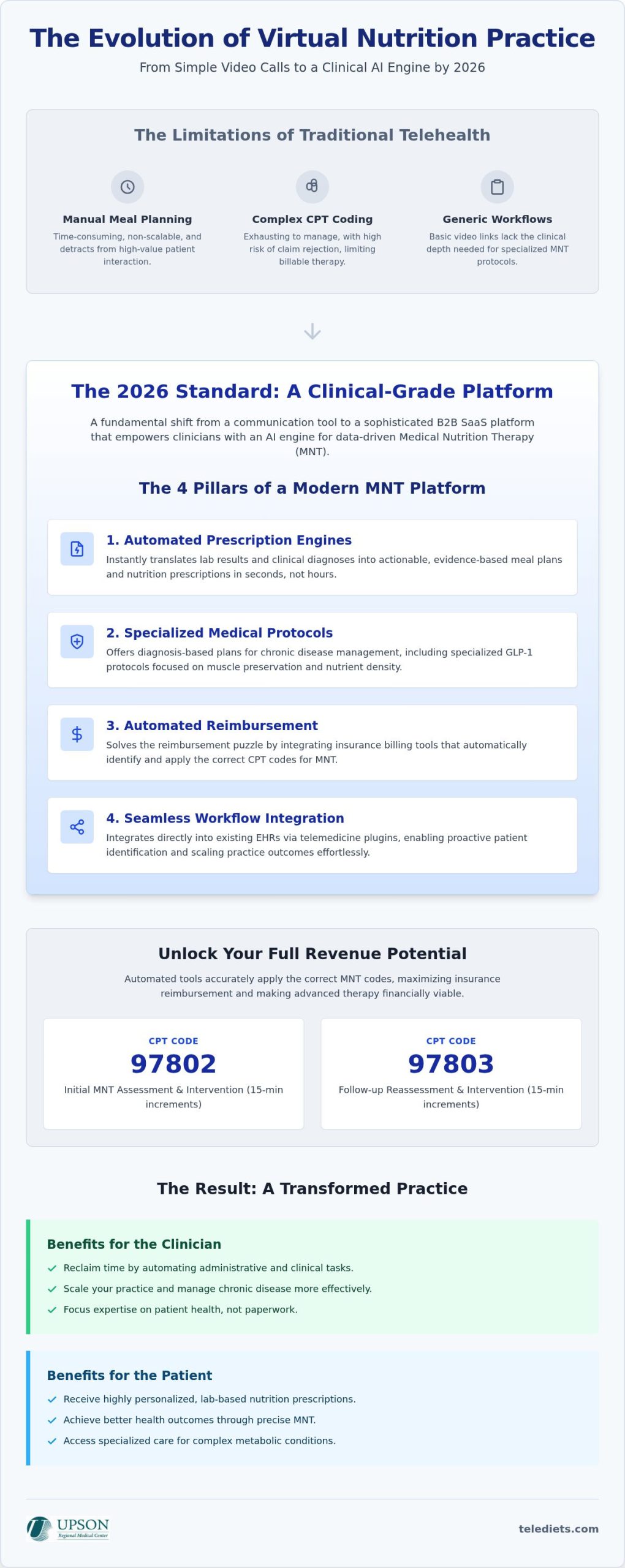
A sophisticated software for virtual nutrition practice must provide more than a stable video connection. To truly support Medical Nutrition Therapy (MNT), the system requires four foundational pillars: automated prescription engines, specialized medical protocols, GLP-1 support, and seamless workflow integration. These components ensure that you spend less time on administrative tasks and more time on patient care. When Scaling Your Practice, these pillars become the difference between a manual, labor-intensive process and a thriving, automated clinical operation.
Integrating Lab Results and Clinical Diagnoses
The ability to convert clinical diagnoses into actionable meal plans in seconds is revolutionary. Our Advanced Medical Series protocols ingest lab data to address specific metabolic needs, ensuring that your advice is always evidence-based. For clinics managing a high volume of patients with less complex needs, Standard Series Meal Plans provide the foundational efficiency needed to maintain quality without practitioner burnout. It’s about having the right clinical tool for every level of patient complexity.
Specialized Protocols for Modern Patient Needs
The recent surge in GLP-1 receptor agonist prescriptions has created a unique clinical challenge. Standard meal plans don’t account for the rapid appetite suppression and potential muscle loss associated with these medications. Our specialized GLP-1 Meal Plan Protocols focus specifically on muscle preservation and nutrient density, filling a critical gap in chronic disease management. You can streamline your clinical workflow by deploying these targeted interventions through a unified telemedicine plugin. By integrating these specialized tools, you ensure your practice remains relevant in an evolving medical environment where generic wellness advice is no longer sufficient for complex metabolic health.
Solving the Reimbursement Puzzle: CPT Coding & Insurance
Financial viability often dictates clinical scope. Many practitioners avoid deep-tier Medical Nutrition Therapy (MNT) because billing for it feels like a second full-time job. Between managing complex ICD-10 codes and tracking 15-minute increments for multiple patients, the risk of claim rejection is high. Sophisticated software for virtual nutrition practice solves this by integrating insurance billing and CPT coding tools directly into the clinical workflow. It’s about empowering you to focus on patient outcomes while the system handles the financial logistics.
Understanding MNT Billing Codes
In 2026, reimbursement rates for Medical Nutrition Therapy remain a vital revenue stream for modern clinics. The initial individual MNT assessment is typically billed under CPT 97802, which currently averages approximately $36.74 per 15-minute unit. Subsequent follow-up sessions utilize CPT 97803, with an average reimbursement of $31.73 per unit. Automated coding tools within your platform identify these opportunities based on real-time session data. This ensures your documentation supports maximum reimbursement without the need for manual calculations or guesswork.
The Role of Telemedicine Plugins in Billing
Telemedicine plugins provide the technical bridge between a clinical visit and a clean insurance claim within your software for virtual nutrition practice. By capturing time-based data automatically, these tools create an audit-proof record of every encounter. This automation streamlines the handoff between the nutrition plan generation and your billing department. It transforms nutrition counseling from a time-consuming task into a profitable, scalable service line for your practice. You can join our professional network to access these advanced billing features. To see how these tools integrate with your current EHR, explore our automated insurance billing solutions.
Scaling Your Practice with Automated Nutrition Workflows
Scaling a clinical practice in 2026 requires a departure from labor-intensive manual processes. By implementing the right software for virtual nutrition practice, you can transition to a model where technology proactively identifies patients who require intervention. For instance, integrated systems now use lab triggers to flag specific biomarkers, allowing your team to offer MNT before chronic conditions escalate. This proactive approach ensures a steady pipeline of billable services while significantly improving patient health outcomes across your entire population.
Deploying a Telemedicine Plugin allows you to integrate nutrition services directly into your existing EHR visits. This integration eliminates the need for clinicians to toggle between disparate systems, which often leads to data silos. By leveraging a clinical AI Engine, you can rapidly generate Advanced Medical Series plans tailored to complex diagnoses without requiring dozens of manual RD hours. These automated workflows provide the necessary data to monitor both patient progress and billing success, providing the clear metrics needed to justify scaling your nutrition service line.
Reducing Provider Burnout through Automation
AI-driven protocols allow your clinical team to focus on high-level care rather than tedious data entry. When the software handles the heavy lifting of meal plan generation and coding, practitioners can spend more time on patient education and behavioral coaching. The TeleDIETS SaaS platform empowers physicians to act as Trusted Expert Guides, providing the framework needed to lead a high-performing clinical team without the burden of administrative exhaustion.
The Future of Virtual Nutrition: Predictive Care
The data collected by your virtual platform will drive future chronic disease prevention strategies through predictive modeling. As your software for virtual nutrition practice accumulates longitudinal data, it identifies trends that help you intervene earlier and more effectively. Positioning your clinic as a technology-forward leader today ensures you stay ahead of the curve in holistic, medical-grade health. This shift toward data-driven, predictive care cements your role as an essential partner in your patients’ long-term wellness journey.
Leading the Next Era of Clinical Nutrition
Transitioning to a clinical-grade software for virtual nutrition practice is the most effective way to modernize your care delivery. By integrating AI-driven lab-to-protocol engines, you eliminate the manual burden of meal plan creation while maintaining scientific validity. This shift allows you to focus on the human element of counseling while the system handles the technical complexities of Medical Nutrition Therapy. It’s about empowering your team to work at the top of their license.
As we’ve explored, automated CPT coding tools for 97802 and 97803 ensure your practice remains profitable and compliant without the administrative headache. When you leverage the evidence-based Advanced Medical Series, you provide specialized care that generic wellness apps simply can’t match. The future of MNT is automated, data-driven, and highly scalable. You now have the roadmap to transform your workflow and improve patient outcomes starting today.
Upgrade your clinical practice with TeleDIETS MNT software and experience the power of integrated clinical tools. Your expertise, paired with our technology, creates a standard of care that patients trust and rely on for long-term health.
Frequently Asked Questions
What is the difference between a virtual nutrition platform and a diet app?
A virtual nutrition platform is a clinical-grade tool designed for provider-led Medical Nutrition Therapy. Unlike consumer diet apps that focus on general calorie counting, this software for virtual nutrition practice ingests lab data to generate automated medical prescriptions. It’s built for clinicians to manage chronic diseases, whereas diet apps are typically direct-to-consumer tools for basic wellness tracking without professional oversight or clinical validity.
Can I bill insurance for virtual nutrition counseling using this platform?
Yes, you can bill insurance using the platform’s integrated CPT coding tools. The system automatically suggests codes like 97802 for initial assessments and 97803 for follow-up sessions based on real-time encounter data. These tools are designed to streamline the reimbursement process, helping clinics maximize revenue while reducing the administrative burden often associated with manual billing for Medical Nutrition Therapy services across the country.
How do GLP-1 meal plan protocols differ from standard weight loss plans?
GLP-1 meal plan protocols are specifically engineered to address the unique metabolic needs of patients on weight-loss medications. Unlike standard plans, these protocols focus heavily on muscle preservation and nutrient density to counter rapid appetite suppression. The software for virtual nutrition practice uses specialized algorithms to ensure patients meet protein and micronutrient targets, which is essential for managing the side effects of GLP-1 receptor agonists safely.
Does the platform integrate with my existing Electronic Health Record (EHR) system?
The platform integrates with existing EHR systems through a dedicated telemedicine plugin. This allows clinicians to generate Advanced Medical Series meal plans and manage billing without leaving their primary clinical environment. By bridging the gap between nutrition data and patient records, the system prevents data silos and reduces the need for manual data entry. It’s designed to fit seamlessly into your current professional clinical workflow.
Is a virtual nutrition counseling platform HIPAA compliant?
Yes, clinical-grade platforms are built with HIPAA-compliant architecture to ensure the security of patient health information. This includes encrypted video conferencing, secure data storage, and protected messaging features. Unlike non-clinical tools, these systems provide the necessary safeguards to protect sensitive lab data and diagnoses. This level of security is fundamental for any professional practice delivering Medical Nutrition Therapy in a remote or hybrid clinical environment.
Leave a Reply