
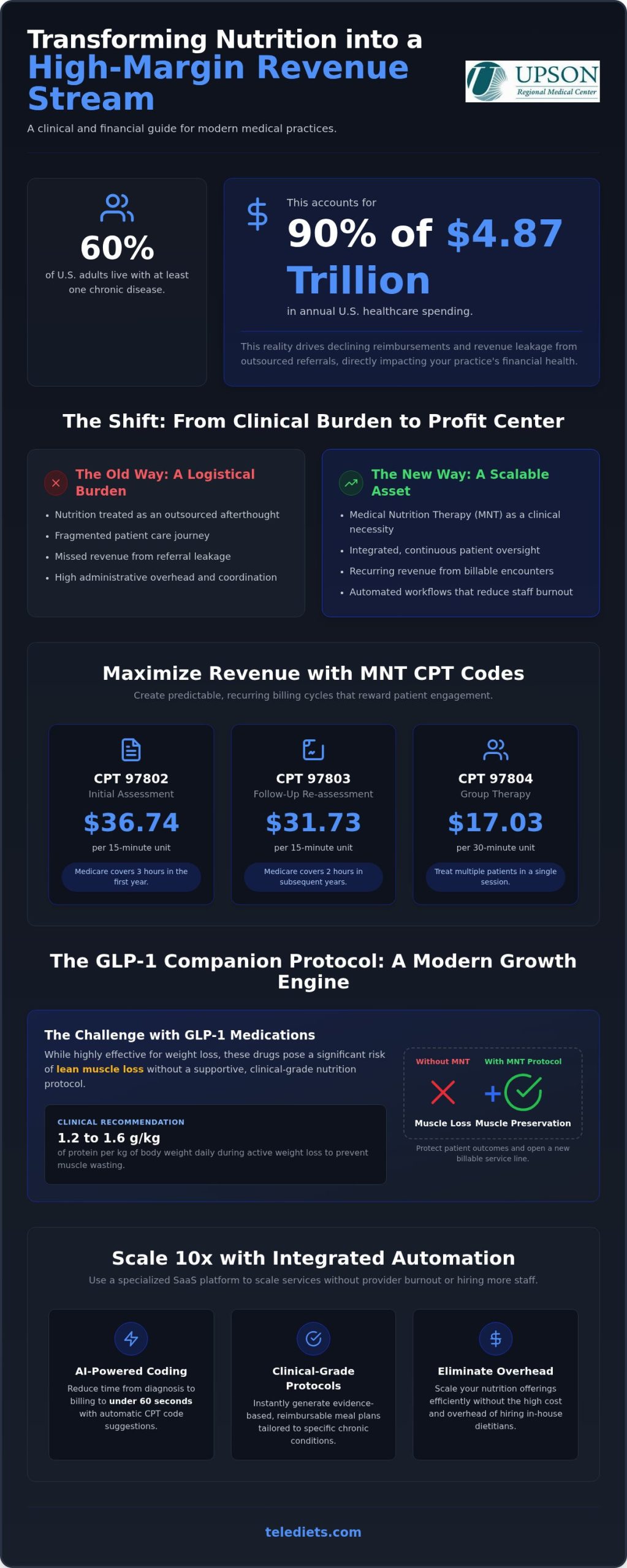
Approximately 60% of U.S. adults now live with at least one chronic disease, a reality that accounts for roughly 90% of the nation’s $4.87 trillion in annual healthcare spending. You likely feel the weight of these statistics through declining reimbursements for standard office visits. While you know nutrition is foundational to outcomes, many providers struggle with increasing practice revenue with nutrition services because they view it as a logistical burden rather than a clinical asset. Referring patients out often leads to fragmented care and missed chances to strengthen your practice’s financial health.
The key to success lies in shifting your perspective. Instead of seeing Medical Nutrition Therapy (MNT) as a burden, you can treat it as a clinical necessity that, when automated, becomes your most scalable profit center. This guide explores how to transform MNT into a high-margin revenue stream using integrated CPT coding tools and specialized protocols. We’ll show you how to build recurring revenue and improve patient retention without the high overhead of hiring in-house dietitians or adding to your administrative workload.
Key Takeaways
- Learn how to redefine Medical Nutrition Therapy as a billable clinical necessity rather than an outsourced wellness service.
- Master the strategic use of CPT codes 97802 and 97803 to create recurring billing cycles, effectively increasing practice revenue with nutrition services.
- Identify how to leverage the growing demand for GLP-1 medications by providing clinical-grade protocols that prevent muscle wasting and improve patient outcomes.
- Discover how to scale your nutrition offerings 10x using automated clinical workflows that eliminate the high overhead of hiring additional full-time staff.
The Economic Case for Medical Nutrition Therapy (MNT) in 2026
For many independent practices, nutrition has long been treated as an outsourced afterthought. However, shifting to an internal model is a primary strategy for increasing practice revenue with nutrition services. Medical Nutrition Therapy (MNT) is an evidence-based, physician-prescribed treatment for specific chronic conditions. Unlike general dietary advice, it’s a formal clinical intervention. When you refer patients to outside providers, your practice suffers from referral leakage. You’re handing off billable encounters while losing oversight of the patient’s clinical journey.
The transition toward value-based care makes these services a financial necessity. With 60% of U.S. adults living with chronic diseases, managing these conditions effectively is the only way to protect your margins. Integrating MNT allows you to capture revenue that would otherwise leave your office.
Bridging the Gap Between Clinical Outcomes and Profitability
Clinical success and financial health are deeply linked. Patients who receive structured nutrition support show higher engagement, which naturally reduces no-show rates for chronic care management visits. This integration plays a critical role in optimizing your MIPS scores. By documenting nutritional interventions, you qualify for higher value-based incentive payments. For a foundational perspective, this Clinical Nutrition Overview explains how these evidence-based protocols function as a core component of modern medicine.
Identifying the High-Revenue Patient Profile
Profitability starts with identifying the right candidates. Patients with Diabetes, Chronic Kidney Disease, and Metabolic Syndrome represent the primary drivers for initial MNT billing. You don’t need to guess who qualifies. By leveraging existing lab data and clinical diagnoses, you can justify the medical necessity of nutrition intervention with precision. This data-driven approach ensures that every plan you provide is both clinically valid and fully reimbursable.
Maximizing Practice Revenue via MNT Billing and CPT Coding
Mastering specific CPT codes is the foundation for increasing practice revenue with nutrition services. For 2026, the national Medicare reimbursement rate for CPT 97802, the initial MNT assessment, is $36.74 per 15-minute unit. Once you establish the initial plan, CPT 97803 allows for follow-up re-assessments at a rate of $31.73 per unit. These codes create a predictable, recurring revenue cycle that rewards consistent patient engagement. For practices looking to scale, CPT 97804 covers group nutrition therapy at $17.03 per 30-minute unit, allowing you to treat multiple patients in a single session without diminishing the quality of care.
MNT Reimbursement: Medicare vs. Private Payers
Medicare provides specific coverage for Diabetes and Chronic Kidney Disease, typically allowing three hours of MNT in the first year and two hours in subsequent years. Adhering to the Medicare MNT Billing Guidelines ensures your documentation meets medical necessity requirements for these claims. While private payers often offer broader coverage for conditions like obesity or hypertension, they require clear documentation of clinical diagnoses to approve the Superbill process. Accurate records are your best defense against claim denials.
Automating the Billing Workflow
Manual coding often leads to administrative burnout and costly errors. AI-powered platforms like TeleDIETS solve this by automatically suggesting the correct CPT codes based on the clinical-grade meal plans generated for each patient. This technology reduces the time from diagnosis to billing to under 60 seconds, which streamlines your entire revenue cycle. By using integrated insurance billing tools, you can ensure every clinical encounter is captured and reimbursed without increasing your staff’s administrative workload.
GLP-1 Companion Protocols: The Modern Practice Growth Engine
The surge in GLP-1 receptor agonist prescriptions represents a transformative shift for clinical practices. While these medications are highly effective, they create a specific clinical need that many providers overlook. Without a clinical-grade nutrition protocol, patients risk significant lean muscle loss. Integrating MNT into your weight management program is a primary driver for increasing practice revenue with nutrition services while ensuring patient safety.
A 2025 joint advisory recommends a protein intake of 1.2 to 1.6 g/kg of body weight per day during active weight loss on GLP-1s. Failing to meet these targets leads to muscle wasting and the aesthetic concerns often termed “Ozempic face.” By providing MNT, you transition these patients from a simple prescription model to a comprehensive care cycle. This positions your practice as a Comprehensive Obesity Center, attracting high-value patients who prioritize evidence-based outcomes.
The Clinical Value of Specialized GLP-1 Meal Plans
Standardized protocols ensure every GLP-1 patient receives the correct protein-to-calorie ratio without requiring hours of repetitive counseling. These GLP-1 Meal Plan Protocols automate the delivery of nutrient-dense plans, allowing you to focus on titration and clinical monitoring. This structured approach ensures fat loss while preserving lean mass, which is critical for long-term metabolic health and patient satisfaction.
Scaling Obesity Management Without Adding Staff
You don’t need to hire a dedicated dietitian to capture this market. Using TeleDIETS allows you to act as a nutrition expert in seconds. By integrating telemedicine plugins, you can offer remote nutrition check-ins, creating recurring billable encounters through CPT 97803. This strategy is essential for increasing practice revenue with nutrition services without incurring high overhead costs. Start scaling your obesity management program today by exploring TeleDIETS clinical tools.
Integrating Nutrition SaaS: Scaling Without Provider Burnout
Traditional methods for increasing practice revenue with nutrition services often rely on hiring full-time staff, but this model creates significant financial risk. The mean wage for Registered Dietitians reached $77,130 in 2025, a high overhead that many independent practices can’t justify. An AI-powered engine acts as a digital specialist, allowing you to handle 10 times the patient volume at a fraction of the cost of a traditional hire. This technology ensures that nutrition remains a scalable profit center rather than an administrative burden that causes provider burnout.
Implementation follows a streamlined three-step process designed for the busy clinical environment. First, you connect your patient’s lab data and clinical diagnoses to the platform. Second, the system generates evidence-based, personalized meal plans in seconds during the actual encounter. Finally, you deploy these plans through a telemedicine plugin or patient portal, giving your patients immediate, professional guidance without extending the visit time. This workflow keeps your focus on the patient while the software handles the complex nutritional calculations.
The ROI of Automated Nutrition Prescriptions
When comparing a $77,000 annual salary to an AI-driven SaaS model, the break-even point is reached almost immediately. You only need a few MNT visits per month to cover the subscription cost, which makes every subsequent encounter pure profit for the practice. This automation eliminates the “no-show” risk associated with in-house specialists while providing higher clinical precision than generic dietary handouts. It’s a low-risk, high-reward strategy for modernizing your clinical offerings.
Next Steps: Launching Your Nutrition Profit Center
Start by auditing your current patient base for MNT-eligible diagnoses like Diabetes or CKD. We recommend launching a 30-day pilot program for your top 20 diabetic patients to observe the immediate impact on both outcomes and billing efficiency. To begin this transition, Start scaling your practice revenue with TeleDIETS today.
Modernizing Your Practice for Sustainable Growth
The clinical landscape of 2026 demands a shift from traditional volume-based models to comprehensive, value-driven care. By integrating Medical Nutrition Therapy, you’re not just improving patient outcomes; you’re actively increasing practice revenue with nutrition services. You’ve seen how automated workflows and precise CPT coding for 97802 and 97803 can turn a standard visit into a high-margin clinical encounter. Outcomes drive revenue. Specialized protocols, particularly for the growing GLP-1 patient population, ensure your practice remains at the forefront of modern metabolic health.
TeleDIETS provides the Advanced Medical Series protocols and billing tools trusted by healthcare providers nationwide. This AI-powered approach allows you to act as a nutrition expert in seconds, ensuring clinical precision without the overhead of additional staff. It’s time to reclaim your role as the central coordinator of your patients’ nutritional health while building a more resilient practice. Scale your practice revenue with TeleDIETS AI Nutrition Software and start your journey toward a more profitable, outcome-focused clinical environment today.
Frequently Asked Questions
Can a primary care physician bill for nutrition services without a dietitian on staff?
Yes, physicians can bill for nutrition services by integrating automated clinical platforms into their existing workflow. While traditional models required hiring a full-time dietitian, modern AI engines allow you to generate evidence-based protocols in seconds. This approach is a primary driver for increasing practice revenue with nutrition services. By using clinical-grade software, you maintain oversight of the patient’s nutritional care while qualifying for reimbursement through standard clinical codes.
What are the most common CPT codes used for medical nutrition therapy reimbursement?
The three primary codes for Medical Nutrition Therapy are CPT 97802, 97803, and 97804. For 2026, the national Medicare reimbursement rate for an initial assessment (97802) is $36.74 per 15-minute unit. Follow-up re-assessments (97803) reimburse at $31.73 per unit, while group therapy (97804) pays $17.03 per 30-minute unit. Utilizing these codes correctly ensures your practice captures all billable nutritional encounters without administrative errors or claim denials.
How much additional revenue can nutrition services realistically add to a private practice?
The revenue potential depends on your patient volume and the consistency of follow-up care. By identifying MNT-eligible patients with chronic conditions like diabetes or CKD, you create recurring billing cycles through CPT 97803. Automated systems allow you to scale these services across your entire patient base without the $77,130 annual overhead of a staff dietitian. This shift transforms nutrition from a cost center into a high-margin clinical profit stream.
Does insurance cover nutrition therapy for patients on GLP-1 medications?
Coverage is typically available when nutrition therapy is prescribed for an underlying diagnosis like obesity, diabetes, or metabolic syndrome. While GLP-1 medications are the catalyst, the nutrition protocol is billed as a clinical necessity to prevent muscle loss and ensure drug efficacy. Many private payers follow Medicare’s lead; and the 2026 legislative landscape is expanding coverage to include a wider range of chronic conditions for MNT referral.
How do automated nutrition plans compare to those created by a registered dietitian?
Automated plans use the same evidence-based protocols and clinical guidelines employed by registered dietitians but deliver them in seconds. Platforms like TeleDIETS generate clinical-grade meal plans by analyzing patient lab data and diagnoses directly. This ensures scientific validity while eliminating the wait times and high costs associated with manual plan creation. It’s a modern solution for increasing practice revenue with nutrition services while maintaining the highest standards of clinical precision.
Leave a Reply