
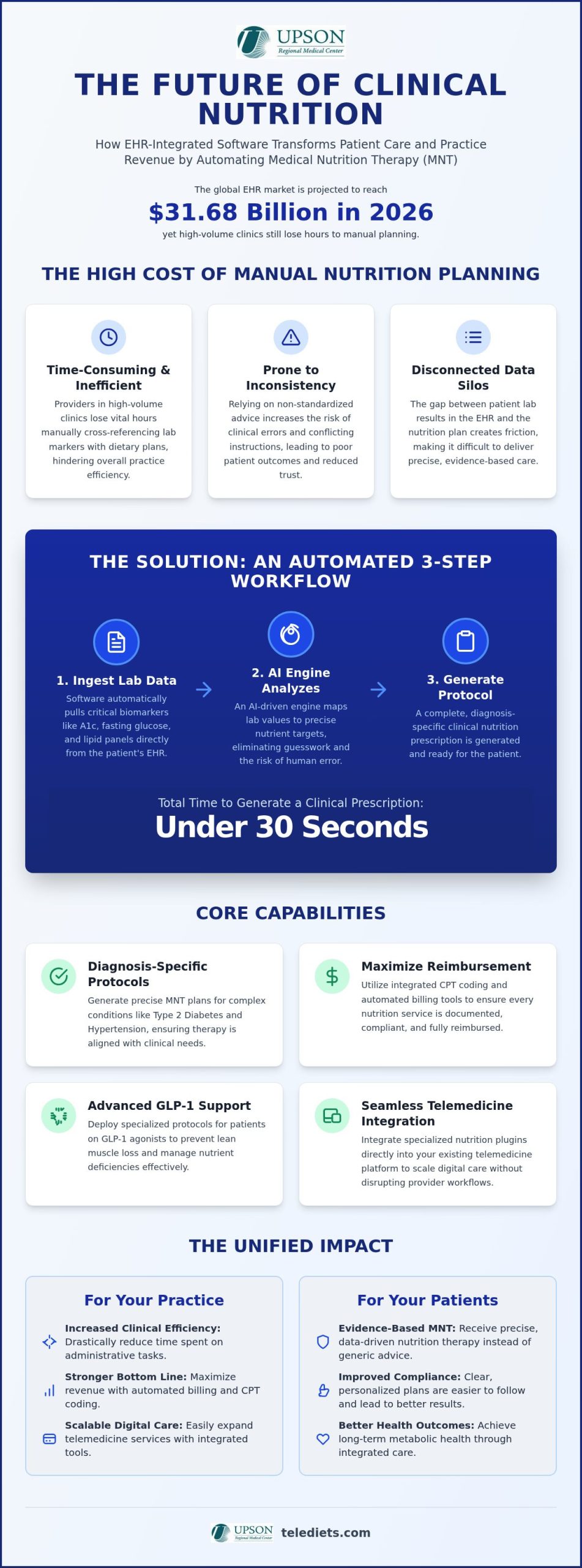
The global EHR market is projected to reach $31.68 billion in 2026, yet many high-volume clinics still lose vital hours to manual meal planning. You understand that medical nutrition therapy is essential for managing chronic conditions, but the difficulty of aligning nutrition plans with specific lab results and diagnoses can be overwhelming. This friction often leads to uncertainty regarding insurance reimbursement and a reduction in clinical efficiency.
Integrating EHR integrated nutrition software into your existing workflow allows you to automate clinical prescriptions while maximizing practice reimbursement. In this guide, we’ll demonstrate how to generate automated nutrition protocols from lab data in seconds and use integrated CPT coding to increase revenue. We’ll also look at how specialized GLP-1 protocols and telemedicine plugins are helping providers scale digital care effectively. By the end, you’ll see why a unified system is the most reliable path toward improved patient compliance and a stronger bottom line.
Key Takeaways
- Learn how modern EHR integrated nutrition software functions as a clinical decision support tool to transition your practice from generic dietary advice to evidence-based Medical Nutrition Therapy.
- Discover how AI-powered engines interpret lab results to generate diagnosis-specific clinical protocols for conditions like Type 2 Diabetes and Hypertension in seconds.
- Streamline your practice revenue by utilizing integrated insurance billing and CPT coding tools that ensure compliance while maximizing reimbursement for nutrition services.
- Master the step-by-step process of integrating specialized nutrition plugins into your telemedicine platform to scale digital care without disrupting existing provider workflows.
The Evolution of EHR Integrated Nutrition Software in 2026
By 2026, the role of an Electronic Health Record (EHR) has shifted from a static repository to a dynamic hub for clinical decision support. EHR integrated nutrition software is no longer a simple administrative portal; it’s a specialized engine that bridges the gap between diagnosis and intervention. This evolution reflects a move away from generic health advice toward evidence-based Medical Nutrition Therapy (MNT). Clinicians now require tools that eliminate the data silo between patient lab results and dietary prescriptions, ensuring that nutritional protocols are as precise as pharmaceutical ones. Real-time synchronization between a diagnosis and its corresponding dietary protocol is the new standard for any modern practice focused on outcomes.
Why Manual Nutrition Planning Fails Modern Clinics
In high-volume settings, manual meal planning is often the first casualty of a packed schedule. It’s too time-consuming for providers to cross-reference every lab marker with a specific dietary plan manually. Relying on non-standardized advice increases the risk of clinical inconsistency. When dietary guidance isn’t synchronized with real-time health data, patients may receive conflicting instructions. This fragmentation leads to poor outcomes and reduced trust, making automated systems essential for maintaining high standards of care.
The Rise of Specialized Clinical Protocols
Modern care requires targeted support like the Advanced Medical Series for complex metabolic needs. With the surge in GLP-1 receptor agonist prescriptions, clinics now face a massive demand for specialized GLP-1 support protocols. These tools help patients manage nutritional needs while on medication, ensuring long-term success. EHR integrated nutrition software provides these protocols instantly. This allows you to deliver specialized care without the administrative burden of manual research or protocol development, empowering your practice to meet current market demands efficiently.
Automating MNT: From Lab Results to Clinical Protocols
The core of modern EHR integrated nutrition software is its ability to transform raw data into actionable therapy. By utilizing an AI-driven engine that ingests lab results directly from the patient record, clinicians can bypass the labor-intensive process of manual calculation. This technology ensures that patients with complex diagnoses, such as Type 2 Diabetes or Hypertension, receive meal plans meticulously aligned with their specific clinical needs. The AI engine effectively reduces the time required to generate a clinical nutrition prescription to under 30 seconds.
Lab-Based Nutrition Prescription Technology
This technology maps critical biomarkers like A1c, fasting glucose, and lipid panels to precise nutrient targets. By adhering to the ENCPRS Functional Profile, the software ensures that the Nutrition Care Process is fully integrated and interoperable. Automated algorithms eliminate the risk of human error in clinical dietary prescriptions, providing a level of accuracy that manual planning cannot match. Utilizing EHR integrated nutrition software allows you to offer tiered care, applying the Standard Series for basic wellness or the Advanced Medical Series for intensive metabolic management.
GLP-1 Nutrition Software for Modern Weight Management
As GLP-1 receptor agonists become standard in weight management, specialized nutritional support is no longer optional. Patients on these medications require specific protocols to prevent lean muscle loss and address potential nutrient deficiencies caused by reduced caloric intake. Integrating GLP-1 Meal Plan Protocols directly into your treatment workflow ensures that pharmacological and nutritional therapies work in tandem. This comprehensive strategy supports long-term metabolic health and improves patient outcomes. If you’re looking to enhance your clinic’s efficiency, consider how integrating an AI-driven MNT engine can transform your practice.
Maximizing Reimbursement with Integrated Billing and CPT Tools
Capturing revenue for nutrition services shouldn’t be a secondary concern for high-volume clinics. EHR integrated nutrition software bridges the gap between clinical care and financial sustainability by automating the billing process. When you integrate Medical Nutrition Therapy (MNT) into your existing workflow, the system naturally generates the documentation required for successful insurance claims. This automation ensures that every minute spent on patient nutrition is accounted for and reimbursed at the correct rates, allowing your practice to thrive while providing essential care.
Essential CPT Codes for Medical Nutrition Therapy
Accurate coding is the foundation of a profitable nutrition program. For initial assessments, you’ll utilize CPT code 97802, which has a 2026 CMS national reimbursement rate of $36.74 per 15-minute unit. Subsequent follow-up care is billed under code 97803 at $31.73 per unit. EHR integrated nutrition software automates the tracking of these units, ensuring your documentation meets the rigorous standards required for Medicare and commercial plans. Medicare Part B covers MNT at 100% for patients with diabetes or chronic renal disease, and having these codes pre-populated in your record prevents missed opportunities.
Reducing Administrative Burden in MNT Billing
Manual billing often leads to high claim denial rates and increased overhead. Automated billing plugins reduce these errors by verifying that the diagnosis codes align perfectly with the MNT protocols provided. This allows you to scale your services without hiring additional administrative staff. To begin implementing these revenue-generating workflows, you can explore the TeleDIETS membership options designed for modern providers. By streamlining the financial side of care, you can focus on patient outcomes while knowing your practice is capturing its full value. Start optimizing your revenue today by choosing an integrated billing solution that supports your clinical goals.
Implementation: Integrating Nutrition Plugins into Telemedicine
Adopting EHR integrated nutrition software doesn’t have to be a complex undertaking. As your trusted expert guide, we prioritize a transition that’s both smooth and authoritative. Integrating a nutrition plugin into your existing telemedicine platform allows you to deliver clinical-grade care without leaving your primary interface. This process maintains rigorous HIPAA compliance and data security, ensuring that sensitive lab data remains protected during remote MNT delivery. By leveraging an AI-powered engine, you can maintain clinical precision even as you scale your virtual practice to meet growing patient demands.
Seamless Workflow Integration for Providers
A streamlined patient journey is essential for clinical efficiency. The transition from an initial telehealth visit to a nutrition prescription should feel like a single, continuous event rather than a series of disconnected tasks. By utilizing Single-Sign-On (SSO) and robust API integrations, you can access Advanced Medical Series protocols without the friction of multiple logins. This prevents platform fatigue for clinicians and keeps the focus on patient care. When your EHR integrated nutrition software communicates directly with your telemedicine tool, the documentation process becomes a natural extension of the consultation.
Scaling Digital Health with AI-Driven MNT
Scaling a national telemedicine network requires a system that can handle thousands of patients simultaneously. AI-driven MNT engines provide the necessary throughput to generate personalized dietary plans based on real-time data. Looking toward the future, these systems will increasingly link with wearable devices and remote monitoring tools. This allows for immediate dietary adjustments based on fluctuating biomarkers, ensuring that chronic disease management remains proactive. By adopting these modern tools, your practice stays at the forefront of digital health innovation while providing reliable, evidence-based support.
Future-Proofing Your Practice with Clinical Nutrition
The healthcare landscape of 2026 requires a transition from simple administrative charting to proactive clinical decision support. By adopting EHR integrated nutrition software, you empower your practice to deliver evidence-based Medical Nutrition Therapy with unprecedented speed and precision. You’ve seen how automated workflows transform lab results into clinical protocols in seconds, while integrated CPT coding ensures you’re fully reimbursed for every unit of care.
Whether you’re utilizing the Advanced Medical Series for chronic disease management or scaling a high-volume clinic with our telemedicine plugin, the result is a more efficient and patient-centered environment. Transitioning to these modern standards doesn’t just improve your daily operations; it solidifies your role as a leader in metabolic health. Take the next step in clinical excellence by empowering your team with tools designed for the future of medicine. Get started with TeleDIETS clinical nutrition tools today and see the difference that seamless integration makes for your bottom line.
Frequently Asked Questions
What is EHR integrated nutrition software and how does it work?
EHR integrated nutrition software is a clinical decision support tool that connects directly to your patient records. It works by pulling real-time lab data and diagnoses to generate evidence-based Medical Nutrition Therapy protocols in seconds. This technology bridges the gap between administrative charting and actual clinical intervention. It allows your practice to move away from generic dietary advice toward precise, data-driven nutritional care that improves patient outcomes.
Can I bill insurance for medical nutrition therapy using this software?
You can bill insurance for medical nutrition therapy, and our platform streamlines this through integrated billing and CPT coding tools. The software automates the documentation required for successful reimbursement, significantly reducing administrative burden and claim denials. Medicare Part B covers MNT at 100% for patients with diabetes or chronic renal disease. This ensures your practice captures the full financial value of the specialized nutritional services you provide.
Which CPT codes are most commonly used for clinical nutrition services?
The most common codes are 97802 for initial individual assessments and 97803 for follow-up care. For 2026, CMS national reimbursement rates are $36.74 for 97802 and $31.73 for 97803 per 15-minute unit. Using EHR integrated nutrition software ensures these codes are tracked accurately. This automation helps you maximize revenue while maintaining compliance with Medicare and commercial insurance standards for clinical nutrition services across the country.
How does the software generate meal plans from patient lab results?
The platform uses an AI-powered engine to map biomarkers like A1c, fasting glucose, and lipid panels to specific nutrient targets. It reads the lab data within the patient record and automatically selects a protocol from the Standard or Advanced Medical Series. This process eliminates manual calculation and human error. It ensures that every meal plan is meticulously aligned with the patient’s current metabolic needs and clinical diagnosis.
Is the nutrition platform HIPAA compliant for telehealth use?
The platform is fully HIPAA compliant and built for secure remote care delivery. It features a dedicated telemedicine plugin that integrates into your existing platform, ensuring all patient data and nutrition prescriptions are encrypted. This allows you to scale digital health services across a national network with confidence. You’ll maintain the highest standards of data security while providing patients with accessible, high-quality medical nutrition therapy from anywhere.
Does the software support specialized protocols like GLP-1 meal plans?
The software provides specialized GLP-1 Meal Plan Protocols designed to support patients on receptor agonist medications. These protocols focus on preventing lean muscle loss and addressing nutrient deficiencies that often occur during rapid weight loss. By integrating these specialized plans into your clinical workflow, you ensure your patients receive the comprehensive support needed for long-term success. It’s a vital tool for modern practices managing chronic weight-related conditions.
Leave a Reply