
What if the hours you spend wrestling with manual CPT codes and claim denials could be reclaimed for direct patient care? You entered this field to transform lives through medical nutrition therapy, not to become a full-time billing specialist. Yet, the reality of running a sustainable practice often means managing a complex web of administrative hurdles. Finding the right nutrition software with insurance billing is no longer just a convenience. It’s a clinical necessity for providers who want to scale their impact without sacrificing their clinical focus.
We understand that your priority is delivering evidence-based interventions for chronic diseases, but manual workflows often create a bottleneck. This guide will show you how to bridge the gap between high-quality clinical care and consistent practice revenue. You’ll learn how modern platforms automate CPT coding for 2026 Medicare rates, such as the $36.74 reimbursement for initial assessments. We’ll also explore how generating medical-grade meal plans in seconds can drive both patient adherence and your bottom line through a seamless, technology-forward workflow.
Key Takeaways
- Discover how to reduce administrative friction and bridge the gap between high-quality clinical care and sustainable practice revenue.
- Master the specific requirements for CPT codes 97802 and 97803 to ensure your initial assessments and follow-up sessions are fully reimbursed.
- Understand why nutrition software with insurance billing is essential for translating patient lab data into automated, evidence-based dietary prescriptions.
- Learn to integrate specialized protocols, such as GLP-1 meal plans, to drive patient adherence and clinical efficiency through a modern telemedicine workflow.
Why Integrated Insurance Billing is Essential for Modern Nutrition Therapy
Sustainable private practice requires a bridge between clinical excellence and financial health. While Clinical nutrition interventions are proven to improve patient outcomes, many providers struggle with the administrative friction of reimbursement. Traditional workflows often separate the science of nutrition from the mechanics of billing, leading to lost revenue and clinician burnout.
Generic EHRs frequently fall short because they aren’t built for the nuances of Medical Nutrition Therapy (MNT) claims. These systems may lack the specific fields required to document nutritional assessments or fail to flag missing data that leads to immediate denials. As the industry shifts toward value-based care, documenting specific nutritional outcomes becomes vital for securing reimbursement and proving the measurable value of your interventions.
The Revenue Potential of Medical Nutrition Therapy (MNT)
Physician-led nutrition interventions are seeing a surge in demand as chronic disease rates rise. With the global nutrition analysis software market projected to reach $1.39 billion by the end of 2026, the opportunity for practice growth is substantial. By utilizing specialized nutrition software with insurance billing, such as the TeleDIETS platform, providers can transition from offering general wellness advice to performing billable clinical procedures. This shift validates the medical necessity of nutrition therapy, allowing for scalable practice growth while maintaining a high standard of patient care.
Common Billing Barriers for Dietitians and Physicians
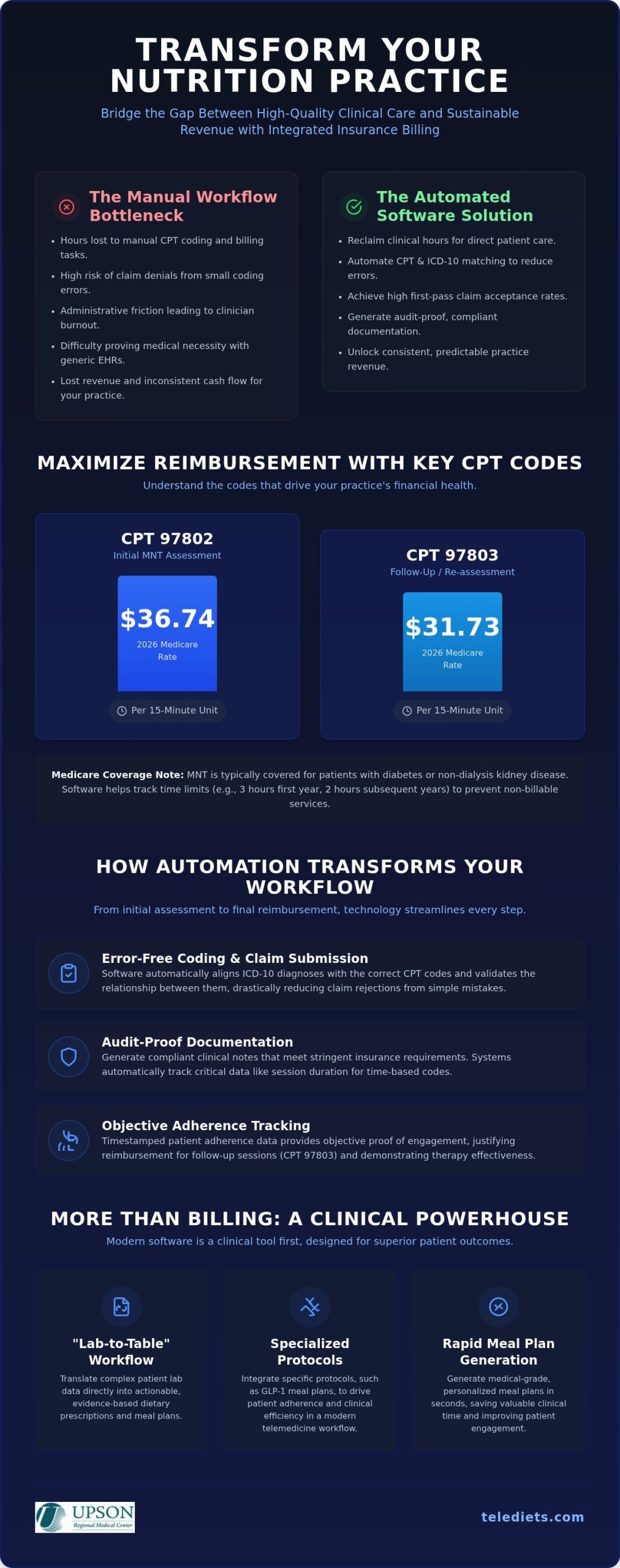
The primary hurdle often lies in the manual matching of complex ICD-10 diagnoses with specific CPT codes. Small errors in this process lead to immediate claim rejections and delayed payments. TeleDIETS eliminates these risks by automatically aligning codes with the specific service provided. Automated software prevents common coding errors by validating the relationship between diagnoses and procedures, ensuring high first-pass claim acceptance rates.
Maximizing Reimbursement: Essential CPT Codes for Nutrition Software
Understanding the specific codes that drive revenue is the first step toward practice sustainability. Professional nutrition software with insurance billing simplifies this by pre-populating claim fields based on your clinical activity. This automation ensures your billing is as precise as your nutritional prescriptions, reducing the risk of administrative errors that delay payment.
CPT 97802 vs. 97803: A Comparison for Providers
| CPT Code | Clinical Purpose | 2026 Medicare Rate | Time Requirement |
|---|---|---|---|
| 97802 | Initial MNT Assessment | $36.74 | Per 15-minute unit |
| 97803 | Follow-up/Re-assessment | $31.73 | Per 15-minute unit |
Documenting medical necessity within your software interface requires a clear link between the patient’s diagnosis and the intervention. For example, Medicare coverage for MNT specifically targets patients with diabetes or non-dialysis kidney disease. Your software should guide you to capture these eligibility details during the initial intake to prevent downstream denials. Medicare guidelines typically allow for three hours of MNT in the first year and two hours in subsequent years; software that tracks these limits in real-time ensures you don’t provide non-billable services.
Automating the Documentation Trail
Modern platforms generate clinical notes that satisfy the stringent requirements of insurance audits. These systems track the exact duration of each session, which is critical for time-based CPT codes and G-codes like G0270 for reassessments. Timestamped patient adherence data is the ultimate proof for follow-up reimbursement because it provides an objective record of the patient’s engagement with the prescribed therapy. To see how these tools integrate into your professional workflow, explore the TeleDIETS coding tools designed for high-volume clinical settings.
Evaluating Nutrition Software: Beyond Simple Meal Planning
Selecting the right platform requires looking beyond aesthetic interfaces and basic calorie counters. For a practice focused on Medical Nutrition Therapy (MNT), the “Lab-to-Table” capability is essential. This workflow allows you to translate complex patient lab data directly into actionable dietary prescriptions. Without this clinical bridge, you’re merely providing a wellness service rather than a billable medical intervention. HIPAA-compliant patient portals are also non-negotiable. They ensure that electronic protected health information (ePHI) remains secure, particularly as 2026 regulatory updates move toward mandatory encryption for all data at rest.
Integration is another pillar of a modern practice. Professional nutrition software with insurance billing should feature telemedicine plugins that connect nutrition care to your existing clinical environment. A diverse clinical library, including Advanced Medical Series protocols, ensures you’re prepared for any patient profile, from renal care to cardiovascular health.
Clinical Validity and Evidence-Based Protocols
Using “wellness-grade” apps for patients with chronic conditions like metabolic syndrome or PCOS is professionally risky. These consumer tools lack the scientific rigor required for therapeutic interventions and often fail to account for complex contraindications. TeleDIETS ensures every plan meets rigorous clinical standards for specific diagnoses like Type 2 Diabetes or Hypertension. By utilizing these evidence-based protocols, you provide care that is both medically sound and audit-proof.
Scaling with AI-Driven Nutrition Engines
Efficiency is the cornerstone of a profitable practice. Scaling with AI-driven engines within your nutrition software with insurance billing allows you to generate personalized, medical-grade plans in seconds rather than hours. This speed doesn’t compromise quality. It enhances your ability to serve a larger patient base without increasing your administrative burden. Check out our professional membership options to start automating your MNT workflow today. To see these protocols in action, view our GLP-1 and Advanced Medical protocols.
Streamlining Workflow with TeleDIETS Integrated Solutions
Implementing a high-volume Medical Nutrition Therapy (MNT) program requires a systematic approach that eliminates manual labor. TeleDIETS provides a structured 4-step workflow designed to transform clinical data into practice revenue without the need for a patchwork of disconnected tools. First, you assess patient needs by integrating lab results and clinical diagnoses directly into the platform. This ensures every plan is rooted in objective medical data from the start. Second, you select from a library of evidence-based options, such as the specialized GLP-1 Meal Plan Series, to match the patient’s specific metabolic profile.
Third, you deliver these plans through a secure, patient-friendly telemedicine plugin that maintains high engagement through digital delivery. Finally, the system generates automated billing by matching the encounter to the correct CPT and ICD-10 tools. This integrated nutrition software with insurance billing ensures that your documentation is audit-proof and your claims reach a high first-pass acceptance rate.
Specialized Protocols for Modern Challenges
The clinical landscape is changing rapidly. With the rise of GLP-1 receptor agonists for obesity management, providers need specialized protocols that address specific nutritional requirements and muscle preservation. TeleDIETS supports these needs through the Advanced Medical Series, providing protocols for complex profiles like renal disease or cardiovascular risk. This clinical precision ensures your interventions are medically sound and highly professional.
The Future of Reimbursable Nutrition Care
Scaling your services improves patient outcomes by providing structured, easy-to-follow digital delivery that keeps patients on track between visits. As you reduce administrative overhead, your practice ROI increases, allowing you to focus on the clinical work that matters most. Optimize your clinical nutrition billing today with TeleDIETS and build a practice that is both financially sustainable and clinically superior.
Empowering Your Practice Through Clinical Precision
The transition from a wellness-focused service to a robust, reimbursable medical intervention is the key to long-term practice sustainability. By mastering the nuances of CPT codes and integrating lab-based diagnostics, you don’t just improve patient outcomes; you build a foundation for professional growth. Advanced medical protocols and automated documentation ensure your practice remains audit-proof while delivering the high-quality care your patients deserve.
Adopting the right nutrition software with insurance billing allows you to reclaim your time and focus on the science of healing. TeleDIETS provides the specialized GLP-1 Meal Plan Protocols and Advanced Medical Series needed to manage complex cases with confidence. With integrated insurance billing and CPT coding tools, you can streamline your workflow and maximize your revenue without the administrative burden. It’s time to elevate your professional standards and secure the future of your nutrition therapy practice. Get Started with TeleDIETS Clinical Nutrition Software today to transform your clinical workflow into a sustainable revenue engine. You have the expertise to change lives, and now you have the tools to support that mission effectively.
Frequently Asked Questions
Does insurance typically cover Medical Nutrition Therapy (MNT)?
Medicare Part B provides coverage for MNT when a patient has a diagnosis of diabetes or non-dialysis kidney disease. Many private insurance plans follow these established guidelines, though specific coverage levels vary by provider. It’s essential to verify patient benefits before the initial assessment. Successful reimbursement depends on documenting medical necessity and using appropriate nutrition software with insurance billing to track time-based units accurately.
What are the most common CPT codes used for nutrition billing?
The most frequent codes are 97802 for the initial assessment and 97803 for follow-up sessions. For 2026, the Medicare reimbursement rate for 97802 is $36.74 per 15-minute unit, while 97803 is $31.73 per unit. Group sessions utilize code 97804. Specialized platforms automate the application of these codes, ensuring that every 15-minute unit is captured and billed according to current federal and private payer standards.
Can I bill for nutrition therapy if I am a physician and not a dietitian?
Physicians can bill for nutrition services, though the specific coding strategy may shift based on the payer and the provider’s role. While Registered Dietitians typically utilize MNT-specific codes, physicians often use Evaluation and Management (E/M) codes or Medicare-specific G-codes. TeleDIETS supports this by providing the documentation tools needed to justify these encounters and select the correct ICD-10 and CPT combinations for various clinical settings.
How does nutrition software help with insurance claim denials?
Software significantly reduces denials by automating the validation of ICD-10 diagnosis codes against specific CPT procedure requirements. It identifies missing data, such as required time stamps or physician referral details, before the claim is transmitted. By ensuring that every submission adheres to the “first-pass” rules of the payer, providers can lower administrative friction and maintain a more predictable revenue cycle for their practice.
Is TeleDIETS software HIPAA compliant for patient data?
TeleDIETS is engineered to meet all requirements of the HIPAA Security Rule, ensuring the protection of sensitive patient information. The platform employs sophisticated encryption for electronic protected health information (ePHI) during transit and while at rest. As 2026 regulatory updates move toward stricter encryption mandates, our infrastructure provides the stability and security necessary for clinical environments to manage patient data safely without risking compliance violations.
What is required to bill for GLP-1 nutritional support services?
Billing for GLP-1 support requires a clear clinical diagnosis, such as obesity or Type 2 Diabetes, to establish medical necessity. Providers must document the specific time spent on counseling and the use of evidence-based interventions like the GLP-1 Meal Plan Protocols. Clinical notes must show how the nutritional plan supports the patient’s medication regimen, providing the documented proof required by insurance payers to approve follow-up reimbursement claims.
Leave a Reply