
What if you could prescribe a clinical-grade nutrition protocol with the same precision and speed as a pharmaceutical script? For many practitioners, the reality is far different. You likely find that manual meal planning is an exhausting, time-prohibitive process that pulls your staff away from direct patient care. As the demand for specialized metabolic support grows, finding the right nutrition software for weight loss clinics has become the bridge between standard care and scalable medical nutrition therapy. You already know that personalized nutrition is essential for long-term success, yet the administrative burden of managing unique dietary needs often outweighs the clinical benefits.
This guide shows you how to transform that burden into a streamlined revenue stream. We’ll explore how to automate lab-based nutrition prescriptions and navigate the complexities of insurance reimbursement using billable CPT codes like 97802 and 97803. You’ll discover how to manage the distinct nutritional requirements of patients on GLP-1 medications while improving overall clinic ROI. From integrating telemedicine plugins to utilizing AI-powered MNT engines, we’re outlining the essential tools to help your practice lead the industry in 2026.
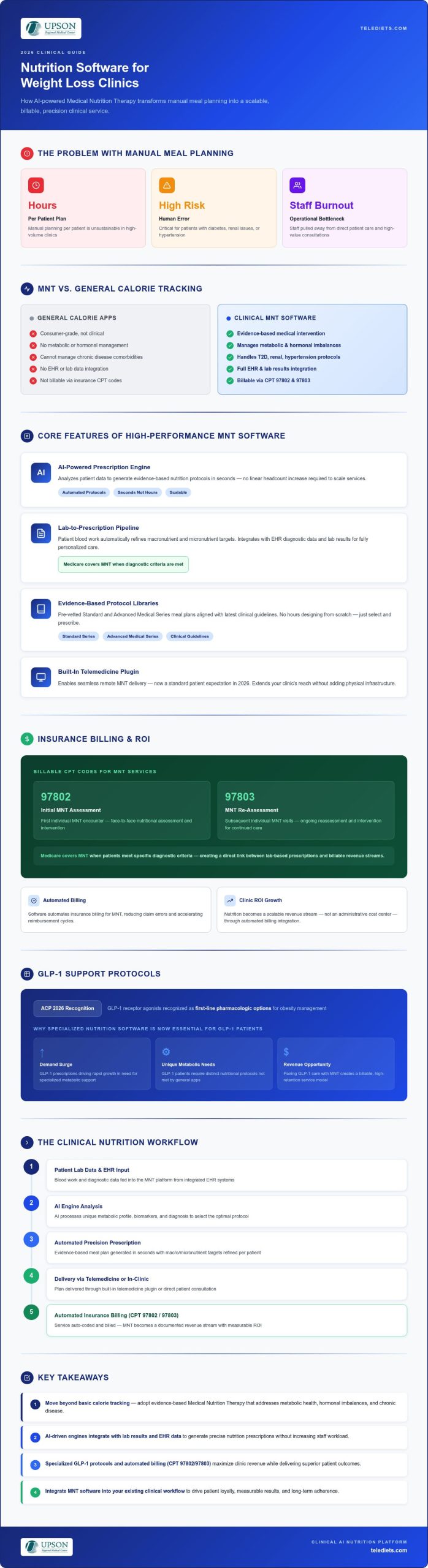
Key Takeaways
- Recognize the clinical necessity of moving beyond basic calorie tracking toward sophisticated, evidence-based Medical Nutrition Therapy.
- Learn how AI-driven engines integrate with lab results and EHR data to generate precise nutrition prescriptions without increasing your staff’s workload.
- Master the specialized protocols required to support patients on GLP-1 medications while maximizing revenue through automated insurance billing tools.
- Identify the most effective ways to integrate nutrition software for weight loss clinics into your existing workflow to drive patient loyalty and measurable results.
The Shift to Medical Nutrition Therapy (MNT) in Weight Loss Clinics
Effective weight management in 2026 requires moving beyond simple calorie counting. Instead, clinicians are adopting Medical Nutrition Therapy (MNT), which is an evidence-based medical intervention used to treat specific conditions through tailored nutritional plans. While general calorie-tracking apps are popular with consumers, they often fail in a clinical environment. They lack the scientific depth to manage metabolic health, hormonal imbalances, or chronic diseases. High-performance nutrition software for weight loss clinics provides the necessary framework to address these complexities effectively. MNT software serves as the essential bridge between complex clinical data and meaningful patient action.
The Limitations of Manual Meal Planning
Creating personalized plans by hand is a significant operational bottleneck. In a high-volume clinic, spending hours on manual adjustments for every patient isn’t sustainable and often leads to staff burnout. It also introduces a high risk of human error. This is especially dangerous when you’re tailoring diets for patients with complex comorbid diagnoses like Type 2 diabetes, renal issues, or hypertension. Automation ensures that your practice maintains clinical accuracy without sacrificing the time needed for direct, high-value patient consultation.
Transitioning from General Wellness to Clinical Precision
Modern practices are moving away from the outdated “eat less, move more” mantra. The focus has shifted toward diagnosis-based nutrition that considers a patient’s unique metabolic profile and lab results. Using nutrition software for weight loss clinics that supports evidence-based Advanced Medical Series protocols ensures your recommendations are grounded in rigorous clinical research. It’s what separates a professional medical weight loss program from a standard commercial diet. This approach empowers you to deliver results that are both measurable and medically sound, fostering trust and long-term adherence.
Core Features of High-Performance Clinical Nutrition Software
The core of high-performance nutrition software for weight loss clinics is an AI-powered prescription engine that analyzes patient data to generate evidence-based protocols in seconds. This level of automation is essential for clinics looking to scale their services without a linear increase in headcount. Integration with EHR diagnostic data and lab results ensures that every recommendation is grounded in the patient’s current health status. Additionally, a built-in telemedicine plugin allows for seamless remote MNT delivery, which has become a standard expectation for patient care in 2026.
Lab-Based Personalization: The New Clinical Standard
Precision medicine relies on nutrition plans that respond to a patient’s unique biomarkers. By automating the “Lab-to-Prescription” pipeline, modern software uses patient blood work to refine macronutrient and micronutrient targets automatically. This immediate engagement helps patients feel that their care is truly individualized, which significantly boosts adherence. Practitioners should keep in mind that these data-driven interventions are often supported by Medicare coverage of MNT services, provided they meet specific diagnostic criteria. This direct link between lab data and billable services creates a sustainable model for clinical growth.
Evidence-Based Protocol Libraries
Clinicians don’t need to spend hours designing every meal plan from the ground up. High-quality platforms provide extensive libraries of pre-vetted Standard and Advanced Medical Series meal plans. These protocols align with the latest clinical guidelines for managing obesity and metabolic health. Using these libraries ensures your advice is scientifically sound while protecting your staff’s time. You can view these Advanced Medical Series options to understand how these protocols function in a live environment. Integrating an AI-powered MNT engine into your nutrition software for weight loss clinics allows you to deliver these sophisticated plans with unprecedented speed and accuracy.
Optimizing GLP-1 Support and Insurance Billing ROI
In 2026, the American College of Physicians recognizes GLP-1 receptor agonists as first-line pharmacologic options for obesity management. This shift has created a surge in demand for specialized nutrition software for weight loss clinics that can handle the unique metabolic needs of these patients. With the April 2026 FDA approval of Foundayo, the first oral GLP-1, the volume of patients requiring medical nutrition therapy has reached an all-time high. Automated billing tools turn a cost center into a profit center by capturing every billable minute of professional consultation.
Specialized Protocols for GLP-1 Receptor Agonists
Patients on these medications face specific risks like sarcopenia and significant appetite suppression. Your software must offer dedicated GLP-1 Meal Plan Protocols that prioritize protein sparing and muscle mass preservation. These systems use automated alerts to help clinicians manage common gastrointestinal side effects through strategic dietary adjustments. By ensuring high nutrient density during periods of low caloric intake, you protect patient health while they achieve rapid weight loss results. This level of support is essential for maintaining patient adherence throughout the titration process.
Streamlining CPT 97802 and 97803 Billing
Navigating insurance reimbursement shouldn’t be a manual task. High-performance nutrition software for weight loss clinics integrates CPT coding for 97802 and 97803 directly into the clinical workflow. As of August 3, 2026, all MNT claims must include a required diagnosis to avoid automatic denial. Integrated tools automatically align nutrition plans with these documented diagnoses, reducing administrative errors and maximizing clinic revenue. With the 2026 Medicare conversion factor set at $33.568 for qualifying APM participants, even small improvements in billing accuracy lead to significant annual gains. You can explore how our AI-powered billing tools streamline this process to ensure your practice captures the full value of every consultation.
Integrating Nutrition Software into Your Clinical Workflow
Successful integration of nutrition software for weight loss clinics requires a strategic approach across your entire multi-provider team. You need to ensure that every clinician is aligned on the same evidence-based protocols. White-label patient portals help maintain this consistency while reinforcing your clinic’s brand. These portals don’t just look professional; they drive adherence by giving patients a central hub for their plans. You’ll find that scaling your practice efficiently with clinical-grade software significantly reduces the time spent on administrative hand-offs.
Telemedicine and Remote Patient Monitoring
Modern care is no longer confined to the four walls of your clinic. By leveraging specialized telemedicine plugins, you can deliver high-quality MNT in a hybrid or fully remote model. These tools allow for real-time tracking of patient adherence through integrated food journals. This data gives you the insight needed to intervene before a patient stalls, ensuring better clinical outcomes. This proactive approach is something traditional, manual methods simply can’t match.
Choosing the Right Partner for Clinical Growth
Selecting the right nutrition software for weight loss clinics involves more than just looking at features. You must ask vendors about their data security protocols and total HIPAA compliance. A reliable partner offers flexibility through both SaaS platforms and AI engine licensing for larger telemedicine infrastructures. When you evaluate the ROI, compare the cost of automated nutrition prescriptions against the hours of manual labor required in traditional methods. The efficiency gains often allow clinics to increase patient volume significantly without hiring additional staff. This transition ensures your practice remains both competitive and clinically superior.
Leading the Future of Metabolic Health
Transitioning to automated Medical Nutrition Therapy (MNT) isn’t just an operational upgrade; it’s a clinical necessity for the modern weight management practice. By integrating an AI-driven lab-to-prescription engine, you can deliver precise, evidence-based care that scales alongside your patient volume without increasing administrative overhead. Finding the right nutrition software for weight loss clinics ensures your practice stays ahead of 2026’s significant regulatory and pharmaceutical shifts. You can now manage complex GLP-1 and Advanced Medical Series protocols with confidence, while using automated CPT 97802 and 97803 coding tools to secure your clinic’s long-term ROI.
This shift allows your team to focus on meaningful patient interactions rather than manual data entry. Empower your clinic with TeleDIETS medical nutrition software to transform your clinical workflow today. Your commitment to evidence-based care is the foundation of every patient’s success; we’re here to provide the sophisticated tools that make that vision a reality.
Frequently Asked Questions
What is the difference between general diet software and medical nutrition therapy software?
General diet software primarily focuses on tracking calories and macronutrients for basic wellness goals. In contrast, high-performance nutrition software for weight loss clinics provides Medical Nutrition Therapy (MNT). This is an evidence-based medical intervention used to treat specific chronic conditions. These systems use AI engines to generate protocols based on clinical diagnoses and lab data, ensuring every meal plan is medically sound rather than just a lifestyle suggestion.
How does nutrition software help with GLP-1 patient management?
Specialized software addresses the unique physiological changes caused by GLP-1 receptor agonists. It utilizes dedicated GLP-1 Meal Plan Protocols designed to prioritize protein sparing and muscle mass preservation during rapid weight loss. The system also helps clinicians manage common gastrointestinal side effects through automated alerts and strategic dietary adjustments. This ensures patients maintain high nutrient density even when experiencing significant appetite suppression, leading to safer and more sustainable outcomes.
Can I bill insurance for nutrition services using this software?
Yes, the platform includes integrated insurance billing and CPT coding tools specifically for codes 97802 and 97803. These tools simplify the documentation required for reimbursement and help align nutrition plans with documented diagnoses to reduce claim denials. Automated systems help your practice meet current regulatory requirements. This effectively turns nutritional counseling into a billable and profitable service while ensuring compliance with the latest 2026 billing standards.
Does the software integrate with existing Electronic Health Records (EHR)?
The platform is designed for high-level clinical integration. It can be deployed as a standalone SaaS application or integrated directly into existing telemedicine infrastructures via AI engine licensing. This allows the software to pull diagnostic data and lab results from your EHR to inform nutrition prescriptions. Such integration creates a seamless workflow, allowing providers to move from diagnosis to a clinical-grade nutrition protocol without leaving their primary digital environment.
How long does it take to generate a personalized meal plan for a new patient?
Generating a personalized, lab-based meal plan takes only a few seconds. The AI-powered engine processes patient biomarkers and clinical diagnoses to create an evidence-based protocol immediately. This speed eliminates the hours previously spent on manual meal planning. Using advanced nutrition software for weight loss clinics allows your staff to focus on high-value patient consultations rather than administrative tasks. This efficiency is critical for scaling a high-volume practice without increasing headcount.
Leave a Reply